Arabian Post Staff -Dubai
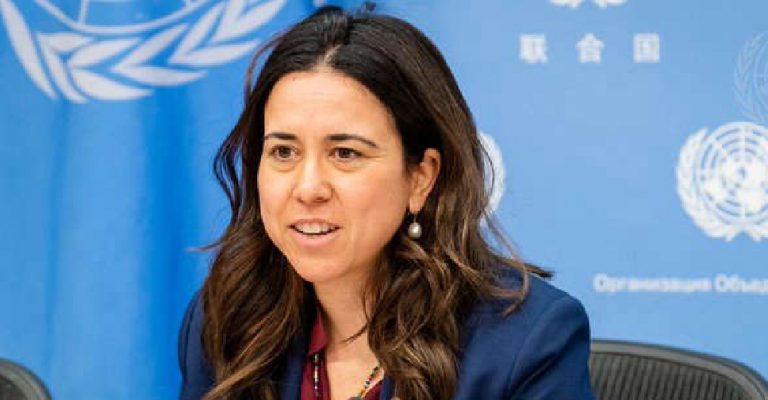
President Sheikh Mohamed bin Zayed Al Nahyan submitted her nomination on Wednesday in a letter to the presidents of the General Assembly and Security Council. Nusseibeh, the UAE’s Minister of State and former permanent representative to the UN, announced her candidacy as negotiations continued over a successor to António Guterres.
Nusseibeh said her priority would be restoring the organisation’s effectiveness in resolving international disputes, strengthening preventive diplomacy and ensuring that multilateral institutions deliver practical results rather than merely responding to crises.
“I am standing to be Secretary-General because I believe this is a moment to act with greater urgency,” she said, calling for earlier intervention, dialogue across political divisions and sustained efforts to secure agreements.
Her entry follows the Security Council’s latest informal ballot on October 16, which failed to produce a candidate acceptable to all five permanent members. The selection process has become increasingly complicated by competing geopolitical priorities and disagreements over the qualifications required for the position.
Costa Rica’s Rebeca Grynspan, who heads the UN Conference on Trade and Development, has emerged as a leading contender in informal voting. Rafael Grossi, director-general of the International Atomic Energy Agency, is another prominent candidate. Neither has secured the necessary consensus among the Council’s most influential members.
The United States, Britain, France, Russia and China each possess veto powers over the Council’s recommendation. Their agreement is effectively indispensable before the General Assembly can appoint a successor.
Nusseibeh’s candidacy also challenges the informal expectation that the next secretary-general should come from Latin America. Although regional rotation is not a binding requirement, geographical representation remains an important consideration in negotiations over the appointment.
If successful, Nusseibeh would become the first woman to lead the United Nations and the second secretary-general from the Arab world, following Egypt’s Boutros Boutros-Ghali, who served between 1992 and 1996.
The UAE president’s nomination letter emphasised her diplomatic experience, judgement in addressing international challenges and record of constructive engagement with the organisation.
Nusseibeh has taken leave from her government position to concentrate on the campaign. She has pledged to maintain independence in carrying out the secretary-general’s responsibilities, including engagement with governments holding sharply opposing positions.
Her proposed programme places conflict prevention at the centre of UN operations. It advocates quiet diplomacy, humanitarian access agreements, prisoner exchanges and local ceasefires as practical measures capable of creating conditions for broader political settlements.
She also wants the organisation to work more closely with regional mediators and governments directly involved in disputes, rather than insisting that UN institutions lead every negotiation.
Administrative reform forms another significant element of her platform. Nusseibeh proposes clearer institutional priorities, stronger accountability, reduced duplication and greater authority for personnel working directly in conflict-affected countries.
Her programme calls for major UN Secretariat activities to demonstrate measurable achievements against expenditure, reflecting growing pressure on international institutions to justify their effectiveness amid financial constraints.
Development priorities include employment creation, sustainable financing, fairer debt arrangements and stronger partnerships with private investors and philanthropic organisations. She also advocates international cooperation on artificial intelligence, biotechnology and climate-related security challenges.
Her candidacy could nevertheless encounter opposition connected to the UAE’s regional policies, particularly allegations concerning Sudan’s civil war. The UAE has repeatedly denied accusations that it supports the Rapid Support Forces, a paramilitary organisation accused of serious violations during the conflict.
Nusseibeh has indicated that Sudan’s humanitarian emergency would remain an important concern, while maintaining that diplomatic engagement must continue across political divisions.
She represented the UAE at the United Nations from 2013 until 2024 and led its delegation during the country’s elected Security Council membership in 2022 and 2023.
During that period, she twice presided over the Security Council and participated in negotiations covering humanitarian assistance, international security and institutional reform.
She also served as a vice-president of the General Assembly and president of UN Women’s executive board, alongside involvement in initiatives concerning women, peace and security.
Guterres completes his second five-year term on December 31. Under the UN Charter, the General Assembly appoints the secretary-general following a Security Council recommendation, with the next term beginning on January 1, 2027.
Also published on Medium.
Follow Arabian Post
Select Arabian Post as your preferred source on Google and MSN News for trusted business news and Arab politics and updates.