News related to
World Liberty Financial

AI Financial has warned that it may not remain viable over the next year after a steep fall in the value of its World Liberty Financial token holdings exposed the fragility of a balance sheet built around a volatile crypto treasury. The Nasdaq-listed company, formerly known as ALT5 Sigma, disclosed that it held 7,283,585,650 WLFI tokens at the end of its first quarter, carrying them at a [...]
Crypto exchange MEXC has closed its first USD1 event series with more than 161,000 participants and $2.4 billion in futures trading volume from new users, underscoring how fee promotions and stablecoin-linked incentives are reshaping competition among digital asset platforms. The campaign, which ended on May 13, centred on USD1, the dollar-pegged stablecoin associated with World Liberty Financial. MEXC positioned the initiative as part of its wider 0-fee [...]
World Liberty Financial’s leadership has moved to contain a wave of online speculation over the Trump-linked crypto venture, with Donald Trump Jr. and chief executive Zach Witkoff insisting the project remains intact even as its legal dispute with Tron founder Justin Sun deepens. Trump Jr., speaking at the Consensus crypto conference in Miami on Thursday, rejected claims that he and other members of the Trump family had [...]
HONG KONG SAR – Media OutReach Newswire – 17 April 2026 – Today, IX Asia Indexes announced the 2026 1st quarter review of the ixCrypto Index Series. The constituent changes will be implemented on the effective date of 24th April 2026 (Friday). The results of the constituent review and exchange review are as follows:

1. Constituent Review – ixCrypto Index Series

1. 1. ixCrypto Index (“IXCI”)
The number of constituents will remain at 19 with no additions and deletions.

Additions:
No addition

Deletions:
No deletion

The free float adjusted market capitalization coverage is 84.26%* (excluding stablecoins, which represents 10.90% of the total crypto universe), while the 90-day-average volume is 77.36%*. The recapping at 40% will take effect on the effective date.

Since the last review, there has been a decrease in the crypto total market capitalization from USD3.38T to USD2.62T (-22.53%)#, and a decrease in the daily volume from USD157.69B to USD108.17B (-31.40%)#. Bitcoin remains the largest crypto in the constituent list, with its price decreased by 24.58% since the last review.

1.2. ixCrypto Portfolio Indexes

1.2.1 ixCrypto 5 Equal Weight Index (“IXEW5”) and ixCrypto 5 Square Root Index (“IXSR5”)

Additions:
No addition

Deletions:
No deletion

1.2.2 ixCrypto 10 Equal Weight Index (“IXEW10”) and ixCrypto 10 Square Root Index (“IXSR10”).

Additions:
No addition

Deletions:
No deletion

1.2.3 ixCrypto Altcoin 10 EW Index (“IXAEW10”) and ixCrypto Altcoin 10 Square Root Index (“IXASR10”).

Additions: Monero

Deletions: Chainlink

1.3. ixCrypto BTC/ETH Indexes
As of the cut-off date on 31st March 2026, the ixCrypto BTC/ETH 50/50 Index (“IX5050”) maintains a 50%/50% weighting for the ixBitcoin Index “IXBI” and ixEthereum Index “IXEI”. The ixCrypto BTC/ETH Proportional Index (“IXPI”) has a weighting of 83.12% and 16.88% for IXBI and IXEI, respectively.

At the upcoming effective date, IX5050 weightings will remain unchanged at 50%/50%. IXPI weightings will be adjusted to 84.53% and 15.47% for IXBI and IXEI, respectively, reflecting the market capitalization proportions of Bitcoin and Ethereum at the cut-off date.

1.4. ixCrypto Stablecoin Index
The number of constituents will remain at 6 (Appendix 5). Stablecoin comprises 10.90% of the total crypto universe, and ixCrypto Stablecoin Index covers 98.26% of the 90-day average market capitalization in the stablecoin universe.

Additions
No addition

Deletions
No deletion

2. Exchange Review
To ensure the fairest price objective, all indexes are calculated based on average of multiple exchanges. As a result of exchange review, 10 exchanges passed the review process, which are as follows:

  1. Binance
  2. Pionex (ADDITION)
  3. BitMart (ADDITION)
  4. MEXC
  5. LBank
  6. Bybit
  7. Gate.io2
  8. Kucoin
  9. Crypto.com Exchange
  10. Coinbase Exchange

Deletion

  1. Huobi Global
  2. OKEx

The selected 10 exchanges will be used to generate each of the fair average prices for the IX indexes’ constituents. The exchange review covers volume rankings, exchange background checks, founders’ background checks, USD/USDT/USDC/BTC pair coverage, overconcentration rules, exchange API coverage checks, and stability, among other aspects, for an exchange.

For more details about our exchange selection criteria, please email [email protected]. More information on the ixCrypto Indexes, including their constituents and constituents’ weights, is provided in the Appendices, or refer to the website https://ix-index.com/.

*Exclude stable coins and coins that trigger conflict of interest (based on conflict-of-interest rule methodology 3.9, effective on Oct 2, 2020)
#As of 31th March 2026, based on the past 90 days average
XXXX (ADDITION)Newly introduced exchanges as of 2026 Q1

Appendix 1

ixCrypto Index (“IXCI”)

Universe All crypto coins traded in at least two different exchanges around the world
Selection Criteria Cryptocurrencies ranking in the top 80% of cumulative full market capitalization (“MC”) coverage and within an acceptable range in accordance with the Volume Buffer Rule in terms of 90-day average trading volume
Number of Constituents 19 in Q1 2026
Launch Date 12th December 2018
Base Date 3rd December 2018
Base Value 1,000
Reconstitution Rule If the coverage is below 75% or any of constituents is not within an acceptable range in accordance with the Volume Buffer Rule in terms of 90-day average trading volume, IXCI will be reconstituted to bring MC coverage back and do liquidity screening.
Reconstitution and Rebalancing Frequency Quarterly and with a fast entry rule
Weighting Methodology Free float adjusted market capitalization weighted with a cap of 40%
Currency US Dollar / HK Dollar [EOD in 14 currencies]
Dissemination Every 5 seconds for 24×7

(On Bloomberg, Reuters and major information vendors)

Website https://ix-index.com/
Bloomberg Page IXCI <GO>

Appendix 2

Weightings of the Constituents of ixCrypto Index

Crypto 90-day-average- Market Cap 90-day-average-Volume Cut-off
Price
Cumulative Market Coverage Weighting (%) After 40% Cap#
1 Bitcoin $1,533,407,044,481 $43,779,443,111 $66,691.44 58.59% 40.00%
2 Ethereum $291,140,668,312 $23,907,396,435 $2,023.51 69.71% 25.84%
3 BNB $99,700,601,834 $2,038,341,597 $608.55 73.52% 8.78%
4 XRP $98,820,126,064 $3,218,693,555 $1.32 77.30% 8.59%
5 Solana $58,322,802,634 $4,336,158,111 $82.44 79.53% 5.00%
6 TRON $27,802,977,066 $657,701,996 $0.32 80.59% 3.20%
7 Dogecoin $18,028,347,533 $1,341,528,833 $0.09 81.28% 1.47%
8 Cardano $11,055,216,118 $608,106,281 $0.24 81.70% 0.93%
9 Bitcoin Cash $10,617,756,282 $424,111,900 $459.70 82.10% 0.97%
10 Hyperliquid $8,515,529,227 $338,272,606 $36.79 82.43% 1.00%
11 Monero $7,415,161,010 $124,095,526 $321.29 82.71% 0.63%
12 Chainlink $7,273,963,510 $623,444,392 $8.61 82.99% 0.65%
13 Stellar $5,965,923,096 $147,863,725 $0.17 83.22% 0.59%
14 Zcash $4,956,891,601 $450,471,925 $225.56 83.41% 0.40%
15 Litecoin $4,745,674,586 $397,678,356 $53.20 83.59% 0.43%
16 Avalanche $4,565,289,028 $327,621,719 $8.79 83.76% 0.40%
17 Sui $4,558,926,661 $688,122,173 $0.86 83.94% 0.36%
18 Hedera $4,371,988,560 $136,144,137 $0.09 84.11% 0.40%
19 Shiba Inu $3,987,578,330 $135,856,575 $0.00 84.26% 0.36%

As of 31 March 2026

# Weighting (%) after 40% Cap is adjusted according to the cut-off price, the arrangement of order may not the same as 90-day-average-Market Cap

Selection of index constituents is based on the past 90-day-average market capitalization and volume.
For the calculation methodology of the index, please refer to the “ixCrypto Index Methodology Paper” on our website

Appendix 3

Weightings of the Constituents of ixCrypto Portfolio Indexes

Index Constituent ixCrypto 5 EW Index ixCrypto 5 SR Index ixCrypto 10 EW Index ixCrypto 10 SR Index ixCrypto Altcoin 10 EW Index ixCrypto
Altcoin 10
SR Index
1 Bitcoin 20.00% 47.35% 10.00% 38.28%
2 Ethereum 20.00% 20.26% 10.00% 16.37% 10.00% 25.472%
3 BNB 20.00% 11.81% 10.00% 9.54% 10.00% 14.848%
4 XRP 20.00% 11.67% 10.00% 9.44% 10.00% 14.682%
5 Solana 20.00% 8.91% 10.00% 7.20% 10.00% 11.199%
6 TRON 10.00% 5.76% 10.00% 8.968%
7 Dogecoin 10.00% 3.91% 10.00% 6.085%
8 Cardano 10.00% 3.10% 10.00% 4.829%
9 Bitcoin Cash 10.00% 3.18% 10.00% 4.944%
10 Hyperliquid 10.00% 3.22% 10.00% 5.005%
11 Monero 10.00% 3.968%

As of 31 March 2026

Appendix 4

Weightings of the Constituents of ixCrypto BTC/ETH 50/50 Index and ixCrypto BTC/ETH Proportional Index

Crypto 90-day-average Crypto Market Cap 90-day-average Crypto Volume Index Level Weight in BTC/ETH 50/50 Weight in BTC/ETH Proportional
Bitcoin $1,533,407,044,481 $43,779,443,111 16119.86 50.00% 84.53%
Ethereum $291,140,668,312 $23,907,396,435 17402.12 50.00% 15.47%

As of 31 March 2026

Appendix 5

Weightings of the Constituents of ixCrypto Stablecoin Indexes

Crypto 90-day-average- Market Cap 90-day-average-
volume
Cut-off Price Cumulative
Market Coverage
Weighting (%) After 40% Cap
1 USDt $185,014,602,798 $90,009,449,564 $0.9991 7.07% 40.00%
2 USDC $75,247,269,332 $12,399,472,322 $0.9997 9.94% 40.00%
3 Ethena USDe $6,227,533,422 $125,083,188 $0.9991 10.18% 6.02%
4 Dai $5,364,237,297 $153,912,985 $0.9997 10.39% 5.50%
5 World Liberty Financial USD $4,432,479,244 $1,826,951,498 $0.9995 10.56% 4.48%
6 PayPal USD $3,897,616,348 $150,988,466 $0.9996 10.71% 4.00%

As of 31 March 2026

Appendix 6

ixCrypto Indexes Dissemination

Real time indexes are disseminated every 5-second interval for 24×7 since 23 June 2022. The real-time indexes are available for viewing on the IX Crypto Index official webpage and Bloomberg Page IXCI <GO>. For IXCI, IXBI and IXEI, the indexes are also available through Nasdaq Global Index Data Service (GIDS) with the tickers “IXCI”, “IXBI” and “IXEI”, with dissemination interval kept at 15-second unchanged.

The vendor tickers are shown below:

Index Name Bloomberg Ticker TradingView Ticker Reuters Ticker
Real-time Delayed
ixCrypto Index IXCI IXCI2 IXCI .IXCI
ixBitcoin Index IXCBI IXCBI2 IXBI .IXBI1
ixEthereum Index IXCEI IXCEI2 IXEI .IXEI1

For further information about ixCrypto Index and other available indexes including IX Crypto spot price index series and EOD indexes, please visit company official webpage https://ix-index.com or subscribe to LinkedIn: IX Asia Indexes

For data licensing and product, please contact us at [email protected].

For free API use on academic research or trial, please contact [email protected]


Hashtag: #ixCryptoIndex

The issuer is solely responsible for the content of this announcement.

About IX Asia Indexes and IX Asia Index Advisory Committee

IX Capital International Limited is an award-winning index and investment advisory company. The index business arm- IX Asia Indexes, providing real-time digital asset and innovative indexes, disseminated 24×7 globally and built on robust infrastructure. Since the launch of the first crypto benchmark index (“IXCI”) launched in Hong Kong in December 2018, the ixCrypto index series expand into over 40 indexes designed for exchange futures products, mark-to-market, and fund managers’ portfolio construction purposes. To ensure the professionality and impartiality of the index methodologies and operations, IX Asia Indexes has established its index advisory committee with representation from different industries, including fund management, exchanges, brokerage, financial blockchain experts, crypto service providers, etc. The committee will meet quarterly a year to discuss matters relating to the IX Asia Indexes, including to review and to comment the data sources, methodologies, and operations of IX Asia Indexes, to provide guidance to the future development of new IX Asia Indexes and to handle other issues and decisions on an as-needed basis.

IX Asia Indexes was awarded the Fintech Award (wealth investment and management) 2019 and 2021 organised by ETNet. It as well won an award for Startup of the Year and Basic Technology (Big Data) from Hong Kong Fintech Impetus Awards 2022 by Metro Broadcast and KPMG. It also won Asia Pacific Enterprise Achievement Award 2024 by Echolade. IX Asia Indexes completed its IOSCO compliance statement and obtained ISO/IEC 27001:2022 UKAS certification.

Website:

Advisory Committee:

About IX Crypto Indexes

The ixCrypto index (“IXCI”) is the first crypto index launched in Hong Kong. It was launched on 12 December 2018. It is denominated in USD with a base value of 1000 and a base date on 3 December 2018. Designed to be easy to understand while providing a good representation of the crypto market, ixCrypto index aims to cover the top 80% of the cumulative free-float adjusted market capitalization in the crypto universe and, at the same time, the crypto currencies should fall within the top liquid cryptos ranked by trading volume in the 90 days preceding the review date. The index is to be reviewed quarterly and with a fast entry rule. Real time indexes are disseminated every 5-second for 24×7 since 23 June 2022. Real time index data together with ixBitcoin Index and ixEthereum Index can be obtained from IX Asia Indexes Data Services and Bloomberg terminal on IXCI <GO>. For IXCI, IXBI and IXEI, the indexes are also available through Nasdaq Global Index Data Service (GIDS) with the tickers “IXCI”, “IXBI”, “IXEI”, with dissemination interval kept at 15-second unchanged. Wechat: 信昇亞洲指數.


ADVERTISEMENT
Washington has doubled to $40 billion a US-backed maritime reinsurance facility aimed at coaxing commercial vessels back through the Strait of Hormuz, as the five-week war with Iran continues to unsettle one of the world’s most important trade arteries. The expanded programme, announced on Friday by the US International Development Finance Corporation and Chubb, adds AIG, Berkshire Hathaway, Travelers, Liberty Mutual, Starr and CNA to the scheme, [...]
World Liberty Financial, the cryptocurrency venture closely associated with President Donald Trump, unveiled plans to issue blockchain-based tokens backed by loan revenue interests tied to the Trump International Hotel & Resort in the Maldives, a luxury development slated for completion in 2030 and being built in partnership with the Trump Organization and Dubai-listed developer DarGlobal. The move forms part of WLFI’s broader real-world asset strategy aimed at [...]
A UAE-based investment firm has acquired a 49% holding in World Liberty Financial, the cryptocurrency platform linked to Donald Trump, in a transaction that values the venture at about $500 million and places foreign capital at the heart of a politically sensitive digital-asset business. The investment, disclosed through corporate filings and confirmed by people familiar with the transaction, gives the Gulf investor a near-equal stake in a [...]
Advertisements
ADVERTISEMENT
HONG KONG SAR – Media OutReach Newswire – 18 December 2025 – IX Asia Indexes today announced the 2nd Half 2025 Review of the IX Digital Asset Industry Classification System (“DAICS®“), aiming to provide professionals worldwide with a transparent and standardized classification scheme to determine sector and exposure of particular digital assets. DAICS® classifies digital assets into 2 main categories: a) Cryptocurrencies and b) Asset Backed Tokens (ABTs) in a 3-tier system for each category. For Cryptocurrencies: Tier 1-Industry/ Tier 2-Sector/ Tier 3-Sub-sector; and for ABTs: Tier 1-Asset Type/ Tier 2-Branch/ Tier 3-Sub-branch. The results are as follows:

  • DAICS® coin coverage: As of 3rd December, the top 50 coins by average market capitalization across the past 90 days
  • DAICS® market capitalization coverage: 96.98%*
  • The % coverage of market capitalization of the 50th ranked coin: 0.048%**
  • Member changes within the Top 50 Coins in DAICS®: eight coins added and nine coins deleted
  • Additions: Zcash (ZEC), World Liberty Financial USD (WUSD), PayPalUSD (PYUSD), Memecore (M), Worldcoin (WLD), Story (IP), Arbitrum (ARB), KuCoin (KCS)
  • Deletions: Mantra (OM), GateToken (GT), Official Trump (TRUMP), VeChain (VET), Render (RENDER), First Digital USD (FDUSD), Filecoin (FIL), Cosmos (ATOM), Algorand (ALGO)
  • 9 Green Coins labelled: Cronos (CRO), Pi (PI), Internet Computer (ICP), Hedera, Sui (SUI), Toncoin (TON), Arbitrum (ARB), Mantle (MNT), Tron (TRX)

Note:
*Special currency treatment of DAICS® applies, where any wrapped or second-level cryptocurrency is not considered in the calculation for the market capitalization of DAICS®

**Based on 3rd December 2025
G: Green Coin

The rankings of additions and deletions for the DAICS® top 50 cryptocurrencies are listed in Appendix 1. All classification changes, including the ixCrypto Infrastructure Index and ixCrypto Stablecoin index, will take effect on 23rd January 2026, with market capitalization, rankings, and weightings available at www.ix-index.com.

1. Cryptocurrencies

1.1. Structure and Definitions

Tier 1: Industry Changes
The industry groups remain unchanged, with 5 industries and the respective weightings as follows:

Industry Weighting (%)
Payment (110) 73.87%
Infrastructure (120) 19.89%
Financial Services (130) 4.82%
Tech & Data (140) 0.22%
Media & Entertainment (150) 1.20%

Tier 2: Sector Changes
The number of sectors has increased from 17 to 18. There is one new sector added under the industry group “Tech & Data (140)”:

Identification (14040)
Definition: Cryptocurrencies that facilitate decentralized identity authentication and/or blockchain-based validation of digital intellectual property rights. The classification emphasizes trust, data consent, and privacy as core architectural features while the crypto by itself is not an identity token.

1.2. Reclassification Changes
This review doesn’t have any reclassification of the existing coins. The DAICS® 2H 2025 cryptocurrencies classification is available in Appendix 2.

1.3. Green Coin Label
This review identifies 9 Green Coins, classified based on their energy-per-unit-transaction, which is defined as the amount of energy consumed for a successful single unit transaction of the coin in the blockchain network. The coins selected rank in the top 20 percentile of the least energy-consuming cryptocurrencies out of the 50 DAICS® constituents. The top 20 percentile’s threshold in this review is ≤ 0.150 Wh. The table below lists these low-energy coins.

Industry Low Energy-per-transaction (≤ 0.150 Wh)
Payment (110) CROG
PIG
Infrastructure (120) ICPG
SUIG
ARBG
TRXG
HBARG
TONG
MNTG
Financial Services (130) NIL
Tech & Data (140) NIL
Media & Entertainment (150) NIL


Note: G as ‘Green Coin‘ labelling for cryptocurrencies that adhere to the principles of sustainability

2. Asset Backed Tokens (ABT)

2.1. Structure and Definitions

Tier 1: Asset Type Changes
The asset types remain unchanged at 6 as follows:
1) Culture (205),
2) Real Estate (215),
3) Financials (235),
4) Entertainment (255),
5) Natural Resources (265), and
6) Green Economy (275)

Tier 2: Branch Changes
The number of branches has increased from 31 to 32, with a new branch added under Financials (235): Tokenized funds (23540).

2.2. Classification Changes
This review doesn’t have any reclassification of the existing assets.

2.3. Coverage of DAICS®
A classification summary and definition table of both cryptocurrencies and ABTs are available in Appendices 3 and 4. For further information regarding the methodology of the DAICS®, please refer to the “IX Digital Asset Industry Classification System”- principle and guiding methodology on the company website https://ix-index.com/daics.html.

For more details on DAICS® qualification criteria, please email [email protected].

Appendix 1

Additions and Deletions in DAICS® Top 50 Cryptocurrencies

Additions
Current Rank Cryptocurrencies
28 Zcash (ZEC)
31 World Liberty Financial USD (WUSD)
41 PayPal USD (PYUSD)
45 MemeCore (M)
46 Worldcoin (WLD)
49 Story (IP)
50 Arbitrum (ARBG)
51 KuCoin (KCS)

Deletions

Prev. Rank Cryptocurrencies Current Rank
34 Mantra (OM) 300+
41 GateToken (GT) 67
43 OFFICIAL TRUMP 56
45 VeChain (VET) 55
46 Render (RNDR) 58
47 First Digital USD (FDUSDG) 71
48 Filecoin (FIL) 61
50 Cosmos (ATOM) 54
51 Algorand (ALGO) 52

G: Green Coin

Appendix 2

Classification of the Top 50 Coins by Industry and Sector
Category

Industry Sector Cryptocurrencies
Cryptocurrencies (1) Payment:

Blockchain based money, designed for transactional purposes. This includes daily transactions usage and stablecoins.

Transaction & Payment BTC
XRP
BCH
XLM
LTC
XMR
CROG
ZEC
PIG
KAS
Stablecoin USDT
USDC
USDe
DAI
WUSD
PYUSD
Infrastructure:

Bedrock blockchain that facilitates the operation of other decentralised applications. This includes the creation and running of dedicated blockchain platforms, achieving interoperability between networks, increasing the amount or speed of transactions etc

Application Development Protocol & Smart Contract ETH
SOL
TRXG
ADA
HYPE
SUIG
AVAX
HBARG
TONG
NEAR
ETC
APT
ICPG
Interoperability LINK
DOT
ATOM
Scaling & Sharding MNTG
ARBG
POL
Supporting System NIL
Financial services:

Tokens that provide on-chain asset management services, crypto-exchange services, funding, lending and other capital markets related services

Exchange Tokens BNB
LEO
BGB
UNI
OKB
KCS
Lending & Borrowing AAVE
Staking ENA
Financial Asset Tokenization ONDO
Tech & Data:

Provision of data management and storage, and development of innovative crypto technology

Storage & Sharing NIL
Data Management NIL
Artificial Intelligence TAO
Identification
(NEW)
WLD IP
Media & Entertainment:

Recreational and media services. Including content creation and distribution, advertising through crypto-asset incentive mechanisms, gaming and collectibles

Social Media & Community DOGE
SHIB
PEPE
M
Streaming NIL
Gaming NIL
Metaverse NIL

Note:
G as ‘Green Coin‘ for cryptocurrencies that adhere to the principles of sustainability

NEW for newly added sector

Appendix 3

DAICS® Industry and Sector Definition

Category Industry Sector Sector definition
Cryptocurrencies (1) Payment: (110)

Definition
Blockchain based money, designed for transactional purposes. This includes daily transactions usage and stablecoins.

Transaction & Payment
(11010)
Cryptocurrencies that are used for store of value, unit of account, medium of exchange
Stablecoin
(11020)
Cryptocurrencies where price is pegged to a / a basket of, reference asset
Infrastructure: (120)

Definition
Bedrock blockchain that facilitates the operation of other decentralised applications. This includes the creation and running of dedicated blockchain platforms, achieving interoperability between networks, increasing the amount or speed of transactions etc.

Application Development Protocol & Smart Contract
(12010)
layer-1 blockchain network that facilitates DApp creation and smart contract execution and smart contract
Interoperability
(12020)
Network that increases inter-connectivity and integration of the fragmented cryptocurrency ecosystem
Scaling & Sharding
(12030)
Networks that increase the ability to cope with the influx of many transactions at a time and blockchain network that can be split into smaller partitions, to improve scalability and process transactions quicker
Supporting System
(12040)
Networks/sidechains that improve functionality of layer-1 network
Financial services: (130)

Definition
Tokens that provide on-chain asset management services, crypto-exchange services, funding, lending, and other capital markets related services

Exchange Tokens
(13010)
Cryptocurrencies that represent the stable coin in the exchange ecosystem and allow users to covert from digital asset on decentralised or centralised system int fiat currencies
Lending & Borrowing
(13020)
Borrowing and lending crypto assets with interest in return and other secondary financial tools derived from primary underlying asset, such as crypto futures and options
Staking
(13030)
Holding and “staking” of certain amount of cryptocurrency in a wallet to facilitate network operations
Financial Asset Tokenization (13040)

Cryptocurrencies/protocols that focus on the tokenized issuance and management of financial assets
Tech & Data: (140)

Definition
Provision of data management and storage, and development of innovative crypto technology

Storage & Sharing
(14010)
Crypto protocols that provide decentralized storage and/or sharing of data filing and resources.
Data Management
(14020)
Networks/Protocols that facilitate the indexing and querying of data from blockchain(s), enabling efficient data retrieval and management for decentralized applications
Artificial Intelligence
(14030)
Cryptos/Protocols that facilitate the use of AI powered apps or projects directly using blockchain platform.
Identification
(14040) (NEW)
Cryptocurrencies that facilitate decentralized identity authentication and/or blockchain-based validation of digital intellectual property rights. The classification emphasizes trust, data consent, and privacy as core architectural features while the crypto by itself is not an identity token.
Media & Entertainment: (150)

Definition
Recreational and media services. Including content creation and distribution, advertising through crypto-asset incentive mechanisms, gaming and collectibles

Social Media & Community
(15010)
Cryptos that provides mast social community and followers without a close secondary industry sector
Streaming
(15020)
Cryptos that provides rights to access decentralised video-streaming sites
Gaming
(15030)
Cryptos which mainly used in gaming or gaming supporting industry
Metaverse
(15040)
Cryptos that is commonly used in collective virtual open space, created by the convergence of virtually enhanced physical and digital reality. This includes the use of VR and/or AR and/or 3D.

Note: NEW for newly added sector

Appendix 4

DAICS® Asset Type and Branch Definition
Category

Asset Type Branch Sub -branch
Asset-Backed Tokens (2) Culture: (205)

Definition
Real asset relating to sports, art, cultural drama, festive collectibles and design IPs etc.

Art
(20510)

This shall be further developed in the future with more digital assets available in the market

Sports
(20520)
Festive Collectibles
(20530)
Design IPs
(20540)
Drama and Play IPs
(20550)
Real Estate:(215)

Definition
Assets that mainly derived its valuation from property, real estate, and land

Commercial Property
(21510)
Residential Property
(21520)
Governmental Property
(21530)
Residential and Commercial Land
(21540)
Financials: (235)

Definition
Real financial asset including listed company shareholdings on regulated centralised exchanges and private company shareholdings; debt instruments; property trusts and derivatives that settled on regulated exchange (CeFi and DeFi).

Tokenised Securities (Company Securities, ETF)
(23510)
Tokenised Debts
(23520)
Tokenised REITs
(23530)
Tokenised Funds(NEW)
(23540)
Entertainment: (255)

Definition
Ownership of the IPs assets in the area of entertainment in real world such as concert, play, shows, circus, musicals, songs, movies, games, events and programs, and souvenir collectibles that is derived from the above areas.

Movies
(25510)

This shall be further developed in the future with more digital assets available in the market

Songs
(25520)
Concerts
(25530)
Gaming
(25540)
All Other Entertainment Events and Collectibles
(25550)
Natural Resources: (265)

Definition
Natural resources asset that derived directly from sea, sky, atmosphere and underground and can be classified as a commodity with standardisation such as precious metals, agricultural, energy and metals.

Precious Metals
(26510)
Agricultural
(26520)
Energy
(26530)
Metals
(26540)
Green Economy (275)

Definition
Ownership of Projects Asset that falls under the definition of the UN 17SDG²s, with over 80% of the income or jobs provided on these 17 initiatives.

No Poverty & Zero Hunger
(27510)

Following definition of the United Nations
17 sustainable development goals²

Good Health and Well-Being
(27520)
Quality Education
(27530)
Gender Equality
(27540)
Clean Water and Sanitation/Affordable and Clean Energy
(27550)
Decent Work and Economic Growth/ Industry, Innovation, and Infrastructure/ Partnerships for the Goals
(27560)
Reduced inequalities/ Peace, Justice and Strong Institutions
(27570)
Sustainable Cities and Communities/Responsible Consumption and Production
(27580)
Climate Action
(27590)
Life Below Water & Life on Land
(27500)

Note: NEW for newly added branch

² United Nations 17 sustainable development goals covering 1) No Poverty 2) Zero Hunger 3) Good Health and Well-Being 4) Quality Education 5) Gender Equality 6) Clean Water and Sanitation 7) Affordable And Clean Energy 8) Decent Work and Economic Growth 9) Industry, Innovation and Infrastructure 10) Reduced inequalities 11) Sustainable Cities and Communities 12) Responsible Consumption and Production 13) Climate Action 14) Life Below Water 15) Life on Land 16) Peace, Justice and Strong Institutions and 17) Partnerships for the Goals https://sdgs.un.org/goals

The issuer is solely responsible for the content of this announcement.

About DAICS®

DAICS® covers both cryptocurrencies and asset-backed tokens (“ABTs”), to be reviewed semi-annually at the end of June and December. On the cryptocurrency side, it is a three-tier system that groups cryptocurrencies into 5 main industries: 1) Payment, 2) Infrastructure, 3) Financial services, 4) Technology & Data, and 5) Media & Entertainment. These industries are further divided into sectors and sub-sectors to be introduced in the future. Under asset-backed tokens, there are 6 asset types: 1) Culture, 2) Real Estate, 3) Financials, 4) Entertainment, 5) Natural Resources, 6) Green Economy. These asset types are further divided into branches and sub-branches to be introduced in the future.

About the IX Asia Tokenization Advisory Committee and Working Group

The establishment of the IX Asia Tokenization Advisory Committee (“Advisory Committee”) is to pursue the goal and vision of formulating a standard for a global tokenization framework in a compliant and transparent way. The key role of the Advisory Committee is to formulate the guidelines and references for tokenization in terms of infrastructure, business, financial stability, sustainability, internal control, and classification. The Advisory Committee is comprised of industry-recognised leaders from blockchain consultancy, sustainable projects, and the field of the Art industry.

The establishment of the Working Group is to identify, evaluate and recommend key directions and founding principles according to their specific industry knowledge and expertise in relating to the creation of the specified token. It will examine and propose improvements to the guidelines and references for tokenization. The working group is formed of a diverse group of market experts representing relevant sectors and markets, to provide input and discuss case studies for creation of tokenization framework, best practices and development of real-world projects.

For more information about IX Asia Tokenization Advisory Committee & Working Group, please visit .

Market attention turned sharply towards World Liberty Financial as its WLFI token climbed more than 7% on the daily chart, supported by renewed momentum in a buyback programme that has drawn heightened interest from traders. The jump in value, which pushed volumes higher across multiple exchanges, underscored a shift in sentiment around the project after a period of steady consolidation in its price trajectory.

Traders noted that the upswing aligned with the recommencement of the token buyback scheme, which had been announced earlier in the year as part of the platform’s strategy to stabilise circulating supply and incentivise long-term holding. The renewed activity around the programme appeared to signal confidence within the project’s core team, with market participants interpreting the move as an effort to strengthen liquidity and reinforce the token’s market position during a phase of broader volatility in digital assets.

The project, positioned as a decentralised finance ecosystem offering yield products and cross-border payment tools, has been attempting to carve out a more distinct space in the congested DeFi landscape. Its token performance has shown periods of sharp movement in line with broader market swings, but the latest rise stood out due to the targeted intervention through the buyback initiative. Analysts tracking on-chain data confirmed a noticeable reduction in WLFI circulating supply over the past 48 hours, indicating execution of the buyback in measurable volumes.

A senior market analyst at a Dubai-based digital asset fund said the token’s rebound reflected “a coordinated liquidity strategy combined with renewed user engagement,” adding that sustained price support would depend on whether the buybacks continue at a stable pace. The analyst also pointed to the rising interest in tokens backed by structured DeFi models, noting that these projects have gained traction as traders search for instruments offering more predictable mechanics compared with purely speculative assets.

WLFI’s latest surge coincided with a broad improvement in sentiment across mid-cap digital tokens, though its gain exceeded the general market trend. Data aggregators showed that while major assets such as Bitcoin and Ether recorded modest upward moves, WLFI’s performance outpaced most alternative tokens in its category. The increase was accompanied by a measurable uptick in wallet activity, with new holders entering the market as trading forums circulated speculation about further buyback rounds.

Company representatives had earlier disclosed that the buyback programme was designed to respond dynamically to market conditions, enabling the project to reinforce token value during periods of instability. Blockchain analysts have noted that such mechanisms, if implemented with transparency and predictable parameters, can help sustain community confidence and mitigate sharp sell-offs. The WLFI team’s renewed engagement, including technical updates and communication around upcoming ecosystem features, also contributed to the current sentiment shift.

Industry observers said market participants were also watching regulatory signals closely, as global jurisdictions continue to refine frameworks for digital assets. A clearer regulatory environment, particularly in markets influential to token liquidity, has historically contributed to greater investor participation. WLFI’s activity in markets such as the UAE and Southeast Asia has expanded over the past year, aided by partnerships with payment service providers and liquidity networks aiming to widen adoption.

Developments in DeFi have shown that buyback-driven appreciation, while effective in the short term, typically requires sustained platform growth to maintain momentum. This has put attention on WLFI’s roadmap, which outlines the rollout of additional financial tools and integrations aimed at strengthening ecosystem utility. Market analysts said user adoption metrics over the next quarter would be critical in determining whether the token can retain the gains recorded following the buyback revival.

The broader digital asset market has been characterised by alternating periods of risk appetite and caution, shaped by shifting macroeconomic indicators and geopolitical developments. WLFI’s rise occurred during a phase where traders were displaying a stronger preference for tokens linked to structured platforms with defined use cases. This positioned WLFI favourably as its developers highlighted enhancements to yield mechanisms and expansion into multi-chain support, which could increase platform accessibility.

Trading desks reported that the token’s order books reflected thicker buy-side interest as the session progressed, suggesting that momentum-driven traders were reinforcing the upward movement. Price analysts, however, cautioned that tokens experiencing sudden appreciation following buybacks may face corrections if broader market sentiment turns or if programme intensity decreases. Despite this, WLFI’s advocates argue that the project’s tokenomics structure is engineered to provide periodic support without distorting long-term market behaviour.

Eight Democratic senators, led by Adam Schiff of California, have formally asked Steve Witkoff—the U. S. Special Envoy to the Middle East—for detailed explanations regarding his continued involvement with crypto assets tied to World Liberty Financial, a venture he co-founded with the family of Donald Trump. The lawmakers’ letter highlights potential conflicts of interest stemming from Witkoff’s dual role as a diplomat and investor.

Their concerns centre on Witkoff’s asset disclosures, which indicate he still holds stakes in entities tied to World Liberty and other crypto businesses as of his 13 August 2025 financial report. The senators press him to clarify whether he has divested these holdings, whether he has obtained ethics waivers, and whether his official capacities have overlapped with personal financial interests.

World Liberty Financial launched the stable-coin USD1, and in May 2025 a firm linked to the Abu Dhabi sovereign investment arm reportedly committed around US$2 billion to the venture. The same Gulf-state entity is connected to high-level U. S. export approvals of advanced semiconductor chips, a situation that lawmakers see as raising grave ethical questions.

Witkoff, a New York real-estate magnate and longtime Trump associate, was appointed envoy in early 2025 despite limited experience in diplomacy. While his defenders say he has taken steps to divest and comply with regulation, critics say he remains financially tied to ventures that stand to benefit from his government role. The administration has signalled it is reviewing his disclosures and ethics compliance.

In their letter, the senators request responses to seven key questions by 31 October 2025. They ask how Witkoff could sell off a real-estate holding of about US$120 million while retaining crypto interests; whether he or his family hold additional digital assets beyond those disclosed; when he divested, if at all; whether he holds any interests in Trump-family business ventures; whether he has obtained ethics guidance from the U. S. Office of Government Ethics; and whether any waiver was granted allowing him to participate in matters in which he had a financial interest.

Separately, lawmakers highlight the chronology of events: after World Liberty received the Gulf-state investment commitment, the White House approved export of advanced U. S. chips to the United Arab Emirates—raising the appearance of intertwined public and private interests. Ethics experts say this conflation of diplomacy and private profit may run afoul of federal rules under 18 U. S. C. § 208 and the constitutional emoluments clause, which bars public officials from participating in matters in which they have a financial interest.

ADVERTISEMENT

Fight Fight Fight LLC, the company behind the TRUMP memecoin, has launched a capital-raising campaign of at least $200 million with ambitions that could scale up to $1 billion to establish a dedicated digital asset treasury that would accumulate holdings of the token, according to people with knowledge of the matter.

The undertaking is led by Bill Zanker, a long-time promoter and Trump ally, and signifies one of the most aggressive attempts yet to stabilise a creator-driven token through internal backing. The funds would be deployed primarily to purchase TRUMP tokens from the open market, an effort to shore up price and signal confidence in what has become a volatile asset.

TRUMP, launched just before Donald Trump’s second inauguration, operates on the Solana blockchain under two joint issuers—Fight Fight Fight LLC and CIC Digital—together controlling 80 percent of its total supply. The public tranche was released in January 2025, and the token rapidly gained speculative traction before encountering steep declines.

Insiders caution that the fundraising process is ongoing and not guaranteed to succeed in full. They also note that structuring such a treasury around a politically branded memecoin carries substantial market, regulatory and reputational risks.

Cryptocurrency analysts observe that the move is consistent with broader trends in 2025: increasingly, token issuers are creating “treasury models” to backstop flagging price action. Yet few of those are tethered so explicitly to a political figure or narrative, making the TRUMP case unique.

The token’s price trajectory has been volatile. After peaking earlier in the year, it has fallen sharply—losing more than 80 percent of its value from highs—attracting scrutiny about its speculative nature and sustainability. Meanwhile, TRUMP maintains strong social media backing and occasional high-visibility events, such as a dinner hosted by Trump in May for top token holders, which had triggered a notable price bump.

In June, plans were floated by the issuer to launch an “Official Trump Wallet” to facilitate trading and custody, but disputes emerged with World Liberty Financial. Those tensions underscored internal complexity and fragmented control within the broader Trump crypto ecosystem.

Analysts underline that for the treasury plan to have long-term impact, it must go beyond buybacks. Critics argue that stockpiling tokens may serve only short-term price support, lacking sustainable utility or integration into broader infrastructure. There is a risk that concentrated control over token issuance and vesting schedules could invite regulatory scrutiny or undermine confidence among external investors.

Institutional curiosity is emerging: Canary Capital Group has reportedly filed paperwork with U. S. regulators to launch a spot ETF tied to TRUMP. Yet the Securities and Exchange Commission’s cautious posture toward meme coins, and obstacles in listing a futures-based derivative market, could impede progress.

The broader Trump-adjacent crypto strategy has already stretched into multiple verticals. Trump Media & Technology Group announced a $2.5 billion initiative to build a bitcoin treasury, and World Liberty Financial has launched a $1.5 billion self-buy programme in its own token, WLFI. In that case, about half the funding is to be in WLFI itself, with the rest directed to debt settlement and resale.

World Liberty Financial, the crypto venture tied to Donald Trump’s family, has announced it will issue a debit card enabling users to spend digital assets as conventional currency, with a pilot slated next quarter and full deployment targeted by late 2025 or early 2026.

At Singapore’s TOKEN2049 conference, CEO Zach Witkoff stated that the underlying aim is to “bridge crypto assets with everyday spending,” forecasting that the card could go live in the fourth quarter or first quarter of 2026. Co-founder Donald Trump Jr. joined the presentation, underscoring the project’s ambition to integrate cryptocurrency more deeply into consumer payments.

Beyond payments, World Liberty is advancing a plan to tokenise real-world commodities, aiming to use blockchain infrastructure to trade assets like oil, gas, timber and cotton. Witkoff described these as “really interesting” domains for on-chain trading, pointing to what the company sees as excess transactional inefficiency in traditional markets. The firm also launched its governance token, WLFI, earlier this month, and has introduced USD1, a dollar-pegged stablecoin backed by U. S. Treasuries and other cash equivalents to cut dependency on conventional banking rails.

World Liberty has secured a high-profile institutional backer: the UAE-based Aqua 1 Foundation invested USD 100 million in WLFI tokens, becoming the venture’s largest public investor. The strategic pact aims to fuel World Liberty’s expansion in South America, Europe and Asia, and to jointly incubate blockchain initiatives.

The governance token WLFI currently is non-transferable, granting holders voting rights rather than direct tradeability; World Liberty has said it is “working behind the scenes” to make WLFI transferable in the future. A large portion of WLFI’s supply remains held by the Trump family and affiliated entities.

The stablecoin USD1 gained traction after a major crypto exchange deal: World Liberty was among the early adopters when the funds backed by an Abu Dhabi entity were routed through USD1 to a major crypto platform, helping to elevate USD1’s market position in the stablecoin ecosystem.

Regulatory and ethical concerns already shadow the venture. Critics argue the project blurs lines between private enterprise and public office, noting that much of the Trump family’s wealth could become entangled with policy outcomes. Donald Trump Jr. has dismissed conflict-of-interest allegations as “complete nonsense,” but scrutiny over the convergence of politics and crypto is intensifying.

WLFI has exhibited wide volatility since launch, riding speculative momentum across global exchanges. Meanwhile, competing crypto card offerings already exist, with established fintechs and digital-asset platforms offering crypto-linked cards in partnership with Visa and Mastercard. Witkoff contends World Liberty’s version will differentiate through tighter integration with its stablecoin and tokenisation strategy.

Falcon Finance has reached a new milestone as the circulating supply of its decentralized stablecoin, USDf, climbs to an all-time high of $1.5 billion, signalling sharply increased adoption and confidence in its DeFi infrastructure. The expansion tracks a surge from $1.12 billion over approximately one month, a performance driven by a blend of yield innovation, enhanced transparency, and risk-mitigation frameworks.

The $10 million on-chain insurance fund plays a pivotal role in strengthening institutional trust. Seeded initially with USD1 and replenished via protocol fees, the fund is structured to act as a financial buffer during market stress—supporting yield commitments, offsetting rare instances of negative returns, and serving as a fallback bidder for USDf to uphold its peg. Premium collateral strategies further bolster systemic resilience.

Yield generation remains a cornerstone: the yield-bearing counterpart of USDf, sUSDf, has delivered a standout 30-day APY of 9.30 per cent as of 30 August, outperforming notable competitors such as Ethena’s sUSDe, Maple’s SyrupUSDC, Sky’s sUSDS, Ondo’s OUSG, and BlackRock’s BUIDL.

To deepen engagement and expand utility, Falcon Finance launched the frxUSD–USDf Curve liquidity pool, which offers participants more than 20 per cent APR and rewards denominated as “40× Miles.” The community-oriented Yap2Fly campaign—run in partnership with Kaito—distributed $50,000 in rewards to its top 50 users in August, further stimulating active participation.

Transparency remains central to the protocol’s ethos. Falcon now publishes full reserve breakdowns and supports these with weekly third-party attestations. As per the latest reporting, USDf reserves amount to $1.29 billion—comprising $640.16 million in bitcoin, $375.65 million in stablecoins, with remaining allocation across Dogecoin, Fetch. ai, TRON, TON, and Ethereum. Custody spreads across Fireblocks, Ceffu, and multisignature setups, with 72.2 per cent held under multisig, fostering verifiable security.

These developments are underpinned by earlier strategic investments and roadmap expansions. A $10 million funding from World Liberty Financial in July accelerated technical integration with the fiat-backed USD1 stablecoin, facilitating liquidity sharing and conversion infrastructure. By mid-2025, USDf had already breached the $1 billion supply threshold, demonstrating steady growth ahead of its latest benchmark.

Falcon portrays USDf as more than a synthetic dollar; it is positioned as a global liquidity solution. The protocol’s architecture permits any custody-ready asset—including crypto, stablecoins, and real-world tokenised assets—to be turned into USD-pegged on-chain liquidity. This dual-token model is geared towards unlocking yield while safeguarding against volatility, effectively merging traditional risk frameworks with DeFi innovation.

Market observers note that USDf’s climb to $1.5 billion is emblematic of a broader shift in DeFi: users and institutions are increasingly seeking stable, yield-bearing alternatives to both fiat and traditional stablecoins. Falcon’s layered risk-management systems, institutional-grade safeguards, and developer partnerships appear to answer that demand with growing credibility.

McLaren Racing is set to be valued at in excess of £3 billion as its Middle Eastern backers move to acquire the remaining minority stake in the team. Bahrain’s Mumtalakat sovereign wealth fund and Abu Dhabi’s CYVN Holdings are preparing to buy out the 30 per cent share previously held by investors such as MSP Sports Capital, UBS O’Connor and Ares Management in a deal expected to be confirmed imminently.

This valuation marks a substantial leap from its December 2020 valuation of approximately £560 million, when MSP Sports Capital entered the picture during a fundraising round. The outcome promises significant returns for the minority investors who backed McLaren during its earlier financial challenges.

McLaren’s resurgence under chief executive Zak Brown and team principal Andrea Stella has helped propel the team back to the forefront of Formula One. Following years overshadowed by dominant rivals, McLaren clinched its first constructors’ championship in 2024, and in the current season its drivers—Oscar Piastri and Lando Norris—are locked in a fierce duel at the top of the drivers’ standings.

The sport’s expanding global appeal, driven by Liberty Media’s strategic digital outreach and the cultural phenomenon of the Netflix series Drive to Survive, has magnified team valuations across the grid. McLaren’s rise is emblematic of that broader trend.

Alongside on-track performance, McLaren has diversified into other motorsport arenas. It competes in IndyCar and has confirmed plans to enter the World Endurance Championship, notably the 24 Hours of Le Mans, beginning in 2027. Mastercard has also joined as the team’s title sponsor, in a deal slated to begin in 2026.

The Gulf investors, Mumtalakat and CYVN, currently hold control of McLaren Group Limited, the parent entity of McLaren Racing. With this deal, they will consolidate full ownership of the racing arm.

Beyond this deal, McLaren’s broader corporate structure has undergone notable change. In March 2024, Mumtalakat completed a full takeover of McLaren Group. Later, in December 2024, CYVN acquired McLaren Automotive along with a non‑controlling interest in the racing division. These moves underscore a strategic integration under Gulf ownership, spanning both competition and high-performance automotive manufacturing.

The proposed stake sale is set to be formally announced in the coming days—and might already be public by the time this report is published.

Further context: Aston Martin, another Formula One team, recently sold a minority stake in its racing operation for approximately $147 million, valuing that team at around $3.2 billion.

ADVERTISEMENT

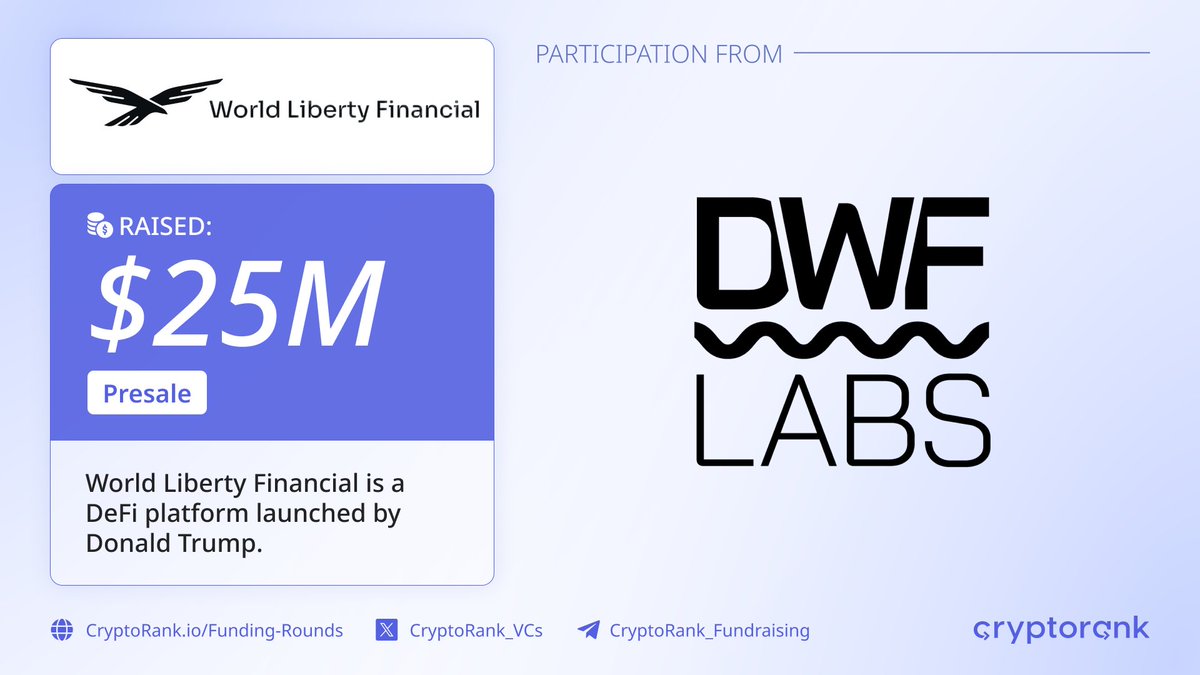
DWF Ventures, the investment arm of Web3 market‑maker DWF Labs, has delivered a detailed evaluation of $WLFI, World Liberty Financial’s newly issued utility token. Published via X, the analysis emphasises $WLFI’s integration into World Liberty’s broader ecosystem and its potential as a key enabler in connecting traditional finance with on‑chain liquidity. Unlike World Liberty’s $TRUMP memecoin, $WLFI is purpose‑built to power the upcoming “WLFI super app”, which will streamline access through web wallets and bank on‑ramps, and underpin planned lending and borrowing services.

The report highlights the success of the USD1 stablecoin—backed by short‑term US Treasuries and cash equivalents—which now commands a market capitalisation approaching $2.5 billion and enjoys listings on major exchanges such as Binance and Coinbase. These developments have significantly boosted investor attention toward the $WLFI token.

World Liberty has raised approximately $500 million across two funding rounds by selling about a quarter of its 100 billion token supply. Among its backers are DWF Labs itself and crypto figure Justin Sun, while ALT5 Sigma has outlined a $1.5 billion treasury strategy centred around $WLFI. DWF Ventures expects that the token could soon be integrated by several DeFi protocols, including Falcon Finance, Ethena and Mantle.

Importantly, DWF Ventures positions $WLFI’s launch as more than a token debut; it sees the initiative as a structural pivot that could catalyse institutional adoption and facilitate compliant capital onboarding—possibly even drawing interest from sovereign investors.

But $WLFI’s entry into the market has triggered concerns. Reports reveal technical difficulties involving the Lockbox contract, intended to unlock 20 percent of token allocations for early investors, which have left many users unable to activate the mechanism. Pre‑market trading responded with a 40 percent drop, raising doubts about launch readiness. Coupling these issues with the political profile of its founders, the token has become entangled in financial and reputational risks.

Indeed, WLFI’s connection to the family of the former president has cast a shadow over its market potential. The token’s political dimensions have already affected diplomatic engagements—such as withdrawals from the Bitcoin Asia 2025 conference—and prompted ethical criticism over conflicts of interest.

Broader scrutiny of World Liberty Financial underscores such tensions. Investigations have revealed that the Trump family commands a substantial share of revenue from token sales and that governance design reflects unusual centralisation for a DeFi project. Further concerns relate to self‑dealing practices: for instance, ALT5 Sigma—a firm acquired by World Liberty—purchased $750 million worth of WLFI tokens. As part of this arrangement, its leadership includes Eric Trump and WLFI co-founder Zach Witkoff, a structure that regulators and critics view as raising red flags.

Ethics experts warn that such close ties between ruling office, private enterprise and foreign investment could undermine democratic safeguards. The New Yorker, for one, described the venture as stretching the norms of political ethics, with World Liberty seen by some as a mechanism for influence through token‑based access channels.

The $WLFI launch is clearly more than a token generation event—it is shaping into a test case for the nexus of politics, finance and regulation in the emerging Web3 era.

World Liberty Financial’s WLFI token is set to begin trading on the Ethereum mainnet on 1 September 2025, with only 20 per cent of the total supply unlocked for early supporters, while the remaining 80 per cent remains under community‑governance lock. Funding rounds have raised up to $2.26 billion, including significant equity backing from ALT5 Sigma, attributing a paper valuation—and potential risk—for retail traders.

Trading commences at 12:00 UTC on 1 September, when presale participants can claim and exchange the portion of tokens unlocked by activating the audited “Lockbox” smart contract. A week‑long activation window began on 25 August to prepare wallets. The initial release affects only a fraction of the total supply; community votes will determine release schedules for the locked remainder.

Pre‑launch futures activity offers a stark view of market sentiment. WLFI perpetual contracts debuted around $0.42, implying a fully diluted valuation of $40 billion. However, futures prices plunged 44 per cent shortly after, collapsing from $0.44 to below $0.25 and slashing the FDV to $24 billion, amid heavy shorting and a sharply negative funding rate of around ‑35 per cent.

Tokenomics reveal a further concentration of risk: insiders—including the Trump family—hold a vast share of true control. Estimates suggest between 75 per cent and over 80 per cent of the supply remains allocated to founders, team members, and affiliated entities, with release terms opaque and subject to governance decisions.

The project has drawn intense scrutiny for its centralised structure and ethical implications. Reuters reported that the Trump family raised approximately $550 million through WLFI token sales and now claims around 75 per cent of net revenue. That level of control starkly contrasts with the decentralised ideals usually associated with DeFi. Commentary in outlets such as The New Yorker emphasises how such arrangements echo a “raffle-ticket” model, whereby early purchasers gain governance power and speculative upside while insiders benefit disproportionately, fuelling concerns about influence‑peddling and conflicts of interest.

Further fuelling caution, benzinga commentary and crypto analysts warn that the small circulatable portion at launch, paired with concentrated insider holdings, could make WLFI’s valuation look inflated on paper—yet leave retail investors exposed if token dumps or sell pressure emerge post‑launch.

Pending regulatory clarity also looms large. With USD1 stablecoin already launched and tied to WLFI’s ecosystem, the project’s compliance with securities laws remains under question, especially given public funds, centralised control, and political ties.

Experts urge prospective investors to proceed with caution. The disparity between locked and unlocked supply, the volatility seen in derivatives markets, and the centralisation of control combine to form a high-risk scenario reminiscent of past politically affiliated crypto launches. While some anticipate short-term rallies driven by hype and governance claims, the sustainability and fairness of WLFI’s structure remain deeply uncertain.

The U. S. House of Representatives has approved the GENIUS Act, the inaugural federal regulatory framework targeting fiat‑backed stablecoins, with a decisive 308–122 bipartisan vote on 17 July 2025. With Senate approval secured in June by a 68–30 margin, the legislation now advances to President Trump’s desk for signature, anticipated as early as tomorrow.

The GENIUS Act mandates that issuers—including banks, credit unions, fintech firms, and select non‑bank entities—maintain one‑to‑one reserves in cash or low‑risk assets such as U. S. Treasury bills, with mandatory monthly public disclosures of reserve composition. It also institutes anti‑money laundering controls, requires issuance organisations to obtain licences from federal or state financial regulators, and prohibits paying interest directly to stablecoin holders.

The legislation forms part of a broader “Crypto Week” effort in the House, which also included passage of the CLARITY Act—allocating oversight of digital asset classification between the SEC and CFTC—and the Anti‑CBDC Surveillance State Act, barring the Federal Reserve from issuing a central bank digital currency. Both now await Senate consideration.

Advocates argue that the GENIUS Act addresses long-standing regulatory uncertainty, providing market stability and consumer safeguards within a $260 billion-plus stablecoin ecosystem. Senior figures from institutions such as JPMorgan Chase, Bank of America, Citi, Walmart, and Amazon have reportedly expressed interest in issuing stablecoins under the new regime. Market sentiment reflects optimism: crypto‑linked equities and assets rose when the House vote was finalised, with Bitcoin nearing record highs above $119,000.

Nonetheless, critics highlight significant concerns. Consumer advocates emphasise that stablecoins remain outside FDIC protection and could pose redemption risks or obscure hidden fees. Others express unease over potential weak guardrails: the SEC’s Paul Atkins cautioned that regulatory innovation must still ensure sufficient market safeguards.

Ethics debates spotlight former President Trump’s extensive ties to the crypto industry, including investments in World Liberty Financial and a meme coin touted as generating over $300 million in related revenues. Opponents claim this raises conflict‑of‑interest questions and risks favouring Trump‑linked enterprises, though the White House has asserted asset segregation via a family trust.

In Congress, both Democratic and Republican proponents defended the legislation for delivering much‑needed structure. Democratic Rep. Josh Gottheimer remarked that introducing “some rules of the road” was preferable to having none. Opposing voices like Rep. Maxine Waters cautioned that the law might “signal tolerance for corruption” without closing presidential exemptions from conflict‑of‑interest prohibitions. Meanwhile, Senate Democrats, including Richard Blumenthal, criticised the bill’s failure to eliminate loopholes or demand stronger consumer protection standards.

Beyond federal oversight, the GENIUS Act introduces a layered supervisory model: federal agencies will regulate larger issuers and interstate entities, while state regulators handle smaller players—those issuing under $10 billion annually. The legislation sets out implementation timelines, including one‑year deadlines for rule‑making and an 18‑month effective date, with a three‑year transition period before enforcement on custody and transaction restrictions.

Industry stakeholders anticipate dramatic market growth. Scott Bessent, Treasury secretary, projected the stablecoin market could swell from around $195 billion to over $2 trillion following the GENIUS Act’s implementation. Christian Catalini of the MIT Cryptoeconomics Lab predicted fierce competition as banks and fintechs join traditional issuers with consumer trust bolstered by regulation.

The crypto sector, stung by past regulatory setbacks under the prior administration’s enforcement actions, now views the GENIUS Act as a turning point. Major players like Circle and Coinbase backed the measure after directing substantial lobbying resources toward lawmakers. Jennifer Nolan, head of the Blockchain Association, described it as a “defining moment in the evolution of U. S. digital asset policy”.

With presidential signature expected imminently, the GENIUS Act is poised to redefine the U. S. approach to stablecoins—ushering in regulated issuance, enhanced transparency, and heightened institutional involvement. Its progress also spotlights ongoing debates about market oversight, political influence, and financial stability in an increasingly digital economy.

ADVERTISEMENT

A UAE-based investment vehicle, Aqua 1 Foundation, has acquired $100 million in governance tokens from World Liberty Financial, the cryptocurrency venture affiliated with the Trump family, making it the most prominent publicly disclosed investor to date. The move, confirmed by both parties, signals a strategic push to accelerate the creation of a blockchain-based financial ecosystem built on stablecoins and tokenised real-world assets.

Aqua 1 described the allocation of governance tokens—known as WLFI—as an opportunity to contribute to decisions on the platform’s development. Although WLFI is currently non-transferable, World Liberty has confirmed it is “working behind the scenes” to enable trading functionality. At the Permissionless conference in Brooklyn, WLF co‑founder Zak Folkman stated that WLFI could soon be tradable, with the stablecoin set for an independent audit “within days”.

Dave Lee, founding partner at Aqua 1, emphasised the synergy expected from the partnership, citing plans to jointly identify and foster high‑potential blockchain initiatives. The intention is to integrate WLF’s USD1 stablecoin infrastructure into global commercial payments and treasury systems. The move marks Aqua 1 as a key bridge between traditional finance and decentralised finance, aligning with its ambition to extend influence into South America, Europe, Asia and Middle Eastern markets.

Despite its substantial investment, Aqua 1 has maintained a low profile. Reports indicate its web presence is minimal—with just a handful of social media posts and evidence of a website only registered on 28 May.

WLF, launched in late 2024 by Donald Trump, three of his sons and associate Steve Witkoff, has raised well over half a billion dollars through token sales. The Trump family controls a significant stake—around 60% ownership and 75% of net token sales revenue—raising concerns over conflicts of interest. Democratic lawmakers and ethics watchdogs have repeatedly voiced apprehension that these financial interests may influence policy, amid reports that WLF proceeds reached hundreds of millions of dollars.

WLF’s stablecoin, USD1, is 100% backed and supported by U.S. dollar reserves, including Treasuries, and has already drawn sizeable institutional backing. In May, an Abu Dhabi firm used USD1 in a $2 billion transaction with Binance, while WLF prepares to publish an attestation of its stablecoin reserves as part of forthcoming audit disclosures.

The institutionalisation of WLFI governance aligns with the platform’s roadmap, which includes plans to launch a consumer‑friendly mobile app to streamline access to its digital ecosystem. The expected transition to transferable governance tokens is likely a precondition to broader distribution and potential listings on third‑party exchanges.

Regulatory scrutiny remains a key challenge. Critics argue that WLF’s entanglement of private financial interests with public office contradicts norms protecting against foreign influence. At least one senator has raised concerns after the Abu Dhabi stablecoin transaction. Additional worries stem from the Trump administration’s shift toward crypto deregulation, a change that coincides with WLF’s rise, prompting concerns from ethics groups about policy bias favoring the platform.

That overlap of influence has fuelled broader debates in Congress. Legislators have begun proposing amendments such as the GENIUS Act, which would regulate stablecoins more robustly, and restrictions on digital asset investments by sitting presidents. Observers note that WLFI’s new status and Aqua 1’s involvement could sharpen the need for regulatory clarity and transparency around token governance.

Meanwhile, WLF’s expansion plans are proceeding apace. The platform is reportedly developing a Middle East‑based Aqua Fund to support digital economy projects leveraging blockchain and artificial intelligence. The collaboration is expected to produce tokenisation platforms such as BlockRock, targeting institutional asset-digitisation markets.

Aqua 1’s governance stake marks a turning point. By becoming the lead institutional backer, the foundation now holds significant influence over decisions shaping WLF’s evolution. With token transferability and app launches on the horizon, WLFI stands poised for a new phase of adoption—though progress will likely be watched closely by regulators and investors alike.

Donald Trump’s family has quietly reduced its stake in World Liberty Financial, the crypto venture closely tied to his business and political interests, trimming its holding from 60 per cent to 40 per cent after June 8. The move marks a significant shift in the family’s involvement in the blockchain sector.

The reduction in equity coincided with a rising valuation for WLF, which earlier sold US$550 million in its native $WLFI tokens and has attracted substantial foreign investments, including a US$2 billion infusion from a UAE-backed entity using its stablecoin USD1 for Binance transactions. Analysts estimate the 20 per cent stake sale could have fetched around US$190 million, with approximately US$135 million potentially going to Donald Trump personally.

World Liberty Financial, launched during the 2024 election cycle, has been a central hub of the Trump family’s crypto strategy. The firm is a decentralised finance protocol that aggressively markets its connection to Trump, listing him as “chief crypto advocate” and involving his sons in senior Web3 roles. Under its structure, Trump-linked entities capture 60 per cent of ownership and 75 per cent of token sale revenues.

The firm’s high-profile stablecoin USD1, launched in March 2025, swiftly became one of the top five global stablecoins, with a circulating supply exceeding US$2 billion by April. In May, the WLF stablecoin was chosen by an Abu Dhabi investment fund to purchase US$2 billion in Binance shares—a deal criticised for merging private enterprise and diplomatic influence.

Critics have raised concerns that the share reduction, lacking any formal announcement, typifies the project’s secretive nature and the family’s opaque handling of crypto profits. DT Marks DEFI LLC—an entity renamed from DT Tower II LLC in 2024 and fully owned by Trump family—holds the WLF stake. Ownership structure has branched out to include Don Jr., Eric, and Barron Trump, each holding minor positions alongside their father within the DEFI entity.

The lack of disclosure prompted scrutiny, and no official response has emerged from the Trump Organisation or WLF regarding the transaction. This latest move mirrors an earlier reduction in January 2025, when the family lowered its control from 75 per cent to 60 per cent.

The pivot comes amid intensifying criticism of World Liberty’s entanglement with state and family interests. Steve Witkoff—Trump’s Middle East envoy—is linked to key dealmaking, with his son Zach co-founding WLF. Their collaborative efforts to court foreign investment from UAE and Pakistan have sparked concern over potential conflicts between diplomatic roles and private profit. Legal experts and ethicists question the blending of public service and personal gain in a venture that funnels income to the Trump and Witkoff families while concurrently lifting Trump administration deregulatory actions on digital assets.

The share reduction enters a broader regulatory moment. The US Senate recently passed stablecoin legislation that may reshape legal frameworks around such assets, while Circle, a peer stablecoin issuer, saw its valuation spike—heightening investor comparisons with WLF. With global crypto markets in flux and the Trump-linked coin ecosystem expanding, the timing of the sale aligns with strategic portfolio recalibration.

World Liberty continues to promote itself as the “official” Trump crypto brand, prompting its legal team to issue cease-and-desist directives against unauthorised token imitations. There is no indication that the stake reduction signals a retreat; rather, it appears to be a calculated liquidity event amid heightened scrutiny and shifting valuations.

U.S. President Donald Trump has appealed directly to the House of Representatives to pass the GENIUS Act—a bipartisan stablecoin regulation bill cleared by the Senate—without any amendments or delays, stressing that it will position the country as the “undisputed leader” in digital assets.

The Senate passed the bill on 17 June with a decisive 68‑30 vote, supported by senators from both parties. It introduces stringent rules for stablecoin issuance, including full backing of coins with liquid reserves and monthly disclosures of reserve compositions, alongside audit and Treasury oversight provisions. Trump openly praised the legislation, calling it “pure genius” and urging House Republicans to advance a “clean” version so it reaches his desk before Congress breaks for its August recess.

Major market players reacted positively. The approval spurred significant gains in related equities: shares of Circle Internet, issuer of the USDC stablecoin, surged between 16% and 27%, reflecting investor optimism for regulatory clarity and mainstream token adoption.

The GENIUS Act’s framework mandates that only permitted issuers—such as banks or federally approved payment companies—may issue stablecoins for U.S. users. It requires a one‑to‑one reserve ratio in U.S. dollars or Treasuries and monthly public disclosures about reserve composition. Additionally, it introduces safeguards for consumer protection and bankruptcy protocols prioritising stablecoin holders. Large issuers will have to undergo annual audits, and the bill prohibits stabilecoin ownership by Congress members, though it excludes the President and Vice President.

While Trump’s endorsement reflects his broader pro-crypto pivot—underscored by investments like Bitcoin, policy appointments, and support from his digital-assets advisory council—critics have flagged potential conflicts of interest. Trump and his family hold substantial stakes in crypto ventures including World Liberty Financial and its USD1 stablecoin, having earned tens of millions in 2024. Critics stress that exemption of the President from the bill’s conflict-of-interest ban leaves a loophole that some fear could be exploited.

Senators on both sides celebrated the bill. Republican sponsor Bill Hagerty described it as a “paradigm-shifting development” that moves the U.S. toward global leadership in crypto. Senate Banking Chair Tim Scott described it as “the most significant digital assets legislation ever to pass the U.S. Senate”. Treasury Secretary Scott Bessent projected that the bill could expand the stablecoin market to $3 trillion‑plus by decade’s end.

Nonetheless, the path ahead is not without hurdles. Some Democrats, including Elizabeth Warren, Jeff Merkley and others, raised objections during Senate negotiations, warning the bill could grant a “super‑highway for corruption” and fails to curtail potential for big tech firms entering the stablecoin market. Senate negotiators incorporated numerous amendments to secure support, but key concerns remain unresolved.

The U.S. Senate has enacted the GENIUS Act, the first-ever federal framework for regulating dollar‑pegged stablecoins, with a decisive 68–30 bipartisan vote on 17 June 2025. Eighteen Democrats joined Republicans in supporting the legislation, which now advances to the House and is expected to reshape Washington’s digital asset rules.

The bill mandates that stablecoin issuers back tokens with liquid assets such as U.S. Treasuries, require regular financial disclosures and adhere to anti‑money‑laundering measures. It grants banks the authority to issue stablecoins, while explicitly restricting executive branch officials and legislators from sharing in their profits—a direct response to concerns over conflicts of interest.

A surge in crypto-sector investment in political campaigns appears to have shifted momentum. Industry spending topped $119 million in support of pro‑crypto congressional candidates during the 2024 cycle. Lobbyists then intensified efforts to engage Democratic lawmakers, viewed as essential for reaching the 60-vote threshold in the evenly divided Senate.

Internal communications among Democratic operatives reveal strategic alignment with crypto backers. In a private group chat described in reporting by the Lever, coalition members acknowledged that, despite ethical concerns, opposing the industry would be “political suicide.” One member reportedly observed that any amendment targeting Trump‑family conflicts would be “DOA,” suggesting token amendments offered for optics rather than impact.

Legislators including Senator Elizabeth Warren have voiced misgivings, arguing that the bill inadequately shields consumers or addresses risks associated with big‑tech or foreign‑issued stablecoins. She contends it grants too much leeway to the likes of former President Donald Trump’s crypto ventures, such as the Trump memecoin and World Liberty Financial.

The crypto lobby’s efforts have extended beyond campaign funding to retention of influential political operatives. Coinbase, for instance, recently appointed veteran Democratic strategist David Plouffe to its advisory board, joining a roster of insiders from both parties. Observers note this reflects crypto’s emerging status as a “politically competitive” constituency.

The political dynamic has shifted decisively. As AP reports, Democrats are balancing distrust of Trump-linked crypto enterprises with newfound recognition of the sector’s electoral influence. Backing the GENIUS Act became for many a strategic necessity, notwithstanding deep ideological resistance to deregulation.

The Senate vote occurred amid broader legislative discussions. The CLARITY Act—aimed at clarifying agency jurisdiction across the SEC and CFTC—is under consideration in the House Financial Services Committee. Some lawmakers propose merging the stablecoin and authority-defining bills, though others caution it could delay the GENIUS Act’s passage.

Crypto industry leaders view the GENIUS Act as a critical precursor to more comprehensive legislation. Ledger’s Head of Global Policy, Seth Hertline, described the Senate’s action as “a political bellwether” for the sector’s broader legislative agenda.

The bill’s passage also intersects with Trump’s personal crypto interests. His family’s stablecoin projects have sparked accusations of profiteering and lobbying for relaxed oversight. Critics warn that current legislative safeguards fall short of preventing conflicts of interest.

The next phase lies in the House, where Republican leadership must reconcile the Senate’s GENIUS Act with its own STABLE Act or integrate it into broader regulatory plans. Some Republicans advocate adding provisions to limit central bank digital currency initiatives, though such measures may complicate Senate approval.

Major stablecoin issuers such as Tether and Circle —together controlling over $200 billion in supply—stand to gain regulatory clarity and legitimacy if the GENIUS Act becomes law. Recent moves by major corporates, including JPMorgan’s planned stablecoin on Coinbase’s Base chain and indications that Amazon and Walmart are exploring token issuance, signal growing private‑sector enthusiasm.

As the House deliberates, questions remain whether the Senate’s bipartisan vote marks the start of a fully fleshed-out U.S. crypto regulatory regime—or the culmination of a high-stakes battle between policy integrity and political pragmatism.

Donald Trump’s financial disclosure for the 2024 calendar year reveals more than $600 million in gross income and at least $1.6 billion in assets, offering a detailed window into the former president’s expansive business empire and the diversification of his revenue streams. The filing, submitted on 13 June 2025, highlights a sharp rise in earnings derived from cryptocurrency ventures, numerous golf and hospitality properties, global licensing agreements, and an [...]
World Liberty Financial , a cryptocurrency initiative associated with U.S. President Donald Trump, has executed an airdrop, distributing 47 units of its USD1 stablecoin to each holder of its WLFI token. The distribution, conducted on the Ethereum blockchain, was automatic and required no action from recipients. The figure of 47 USD1 tokens per wallet is widely interpreted as a symbolic reference to Trump's position as the 47th [...]

World Liberty Financial , a cryptocurrency firm closely linked to President Donald Trump and his family, has sent a cease-and-desist letter to Fight Fight Fight LLC and NFT marketplace Magic Eden. The legal action follows the announcement of a new digital wallet branded as the “Official $TRUMP Wallet by President Trump,” which the Trump family asserts was launched without their approval.

The disputed wallet was unveiled earlier this week through the X account associated with the $TRUMP memecoin, a cryptocurrency project initiated by Fight Fight Fight LLC. The company, reportedly connected to longtime Trump associate Bill Zanker, partnered with Magic Eden to promote the wallet, inviting users to join a waitlist. However, the Trump family has publicly denied any involvement with the project.

Donald Trump Jr., Eric Trump, and Barron Trump have all issued statements distancing themselves from the wallet. Eric Trump cautioned against the unauthorized use of their family name, while Donald Trump Jr. emphasized that the Trump Organization had no connection to the project. He also revealed that the family is developing their own official wallet through World Liberty Financial.

World Liberty Financial, co-founded by the Trump family, has been actively expanding its presence in the cryptocurrency space. The firm has launched its own stablecoin, USD1, and is reportedly working on a crypto wallet focused on token yield generation. The company has attracted significant investment, including a $2 billion infusion from a firm associated with the Abu Dhabi government.

The emergence of the unauthorized $TRUMP Wallet has led to confusion and concern within the crypto community. The wallet’s website has experienced intermittent outages, and its X account has been suspended. Despite these issues, neither Fight Fight Fight LLC nor Magic Eden has commented on the dispute.

The Trump family’s foray into cryptocurrency has been marked by controversy. The $TRUMP memecoin, launched in January 2025, saw an initial surge in value before experiencing a significant decline. While the token generated substantial revenue through trading fees, it also raised ethical questions regarding the president’s dual role as a public official and a private entrepreneur.

Critics argue that the intertwining of the Trump family’s business interests with their political influence poses potential conflicts of interest. The lack of clear boundaries between governance and private enterprise has led to calls for greater transparency and regulatory oversight in the rapidly evolving crypto industry.

VISHNU RAJA
RYO YAMADA
HITORI GOTOH
IKUYO KITA
Social Media Auto Publish Powered By : XYZScripts.com