

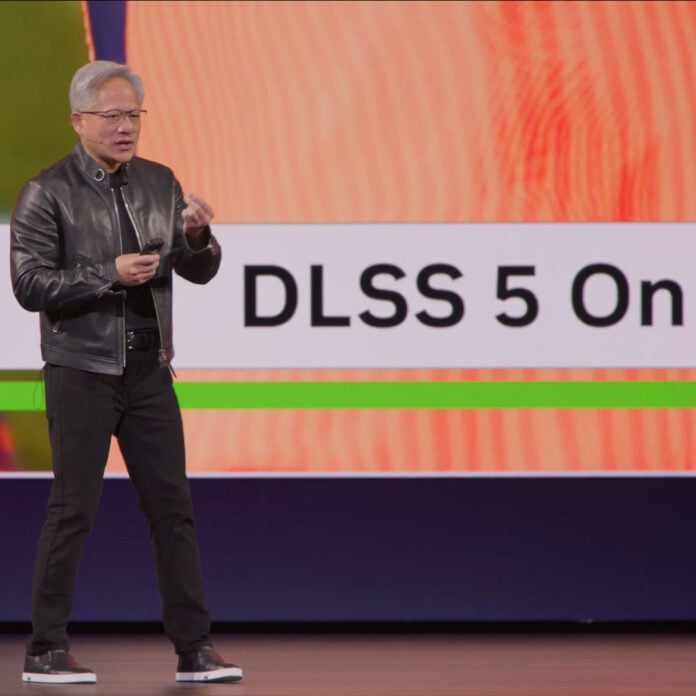
Nvidia chief executive Jensen Huang has pushed back against mounting criticism of the company’s next-generation DLSS 5 upscaling technology, insisting detractors misunderstand its purpose and impact on creative control in game development.
Speaking amid industry debate over the expanding role of artificial intelligence in graphics rendering, Huang said concerns that DLSS 5 overrides artistic intent are misplaced. He argued the technology is designed to enhance performance and visual fidelity without altering the core vision of developers. “The idea that it removes artistic control is completely wrong,” Huang said, adding that developers retain full authority over how the technology is implemented.
DLSS, or Deep Learning Super Sampling, has evolved from a performance-boosting feature into a broader AI-driven rendering framework. Earlier iterations focused on upscaling lower-resolution images to higher resolutions using trained neural networks, improving frame rates while maintaining image quality. DLSS 5, as outlined by Nvidia, introduces more advanced frame generation and reconstruction techniques, relying heavily on AI models trained on large datasets to predict and render frames between traditionally generated ones.
The latest version arrives at a time when gaming hardware is under pressure to deliver increasingly complex visuals. Studios are pushing towards photorealism, real-time ray tracing, and higher frame rates, all of which demand significant computational resources. Nvidia’s approach positions AI as a core component in bridging the gap between hardware limitations and visual ambition.
Critics, however, have questioned whether this shift could lead to an overreliance on algorithmic rendering. Some developers and enthusiasts argue that AI-generated frames may introduce artefacts or inconsistencies, potentially deviating from the intended aesthetic. Others have raised broader concerns about transparency, suggesting that players may be viewing images that are partially “hallucinated” by neural networks rather than fully rendered by the game engine.
Huang addressed these concerns directly, framing DLSS as a tool rather than a replacement for traditional rendering. He emphasised that developers decide when and how to use the technology, including the ability to fine-tune or disable features entirely. According to Nvidia, DLSS 5 integrates into existing pipelines in a way that complements, rather than overrides, artistic workflows.
Industry response has been mixed. Several major game studios have embraced earlier DLSS versions, citing measurable gains in performance and smoother gameplay experiences, particularly in titles that support ray tracing. Developers working on large-scale open-world games have pointed to the technology’s ability to maintain high frame rates without requiring prohibitively expensive hardware.
At the same time, a segment of the gaming community remains sceptical. Technical analysts have noted that frame generation techniques can sometimes introduce latency or visual anomalies, particularly in fast-paced scenes. Competitive gamers, in particular, have expressed reservations about relying on AI-generated frames in environments where responsiveness is critical.
The debate reflects a broader shift in how graphics are produced and perceived. AI-assisted rendering is becoming increasingly central not only in gaming but also in film production, simulation, and virtual reality. Companies across the semiconductor and software sectors are investing heavily in machine learning models designed to accelerate visual computing tasks.
Nvidia has positioned itself at the forefront of this transition, leveraging its expertise in GPUs and AI infrastructure. The company’s RTX series graphics cards, which support DLSS, have been widely adopted in the gaming market, while its data centre business continues to expand through demand for AI training and inference workloads.
Huang’s defence of DLSS 5 also highlights the company’s strategic emphasis on software-driven innovation. As hardware improvements become more incremental, firms are increasingly relying on AI to deliver noticeable gains in performance and user experience. This approach allows manufacturers to extend the lifespan of existing hardware while still offering meaningful upgrades.
Competitors are pursuing similar strategies. AMD’s FidelityFX Super Resolution and Intel’s XeSS represent parallel efforts to integrate AI upscaling into gaming ecosystems. Each platform varies in its implementation and hardware requirements, but all signal a move towards hybrid rendering models that combine traditional techniques with machine learning.
Analysts note that the success of DLSS 5 will depend on developer adoption and real-world performance. While Nvidia’s claims suggest significant improvements in efficiency and image quality, independent testing across a range of titles and hardware configurations will shape industry perception. Early feedback from developers working with preview builds indicates cautious optimism, with some highlighting improved stability and reduced artefacts compared to earlier versions.
Huang maintained that the evolution of DLSS reflects a natural progression in graphics technology, comparing it to earlier transitions such as programmable shaders and real-time lighting. He argued that resistance to change is common but tends to diminish as new tools become standard within development pipelines.
Follow Arabian Post
Select Arabian Post as your preferred source on Google and MSN News for trusted business news and Arab politics and updates.




