

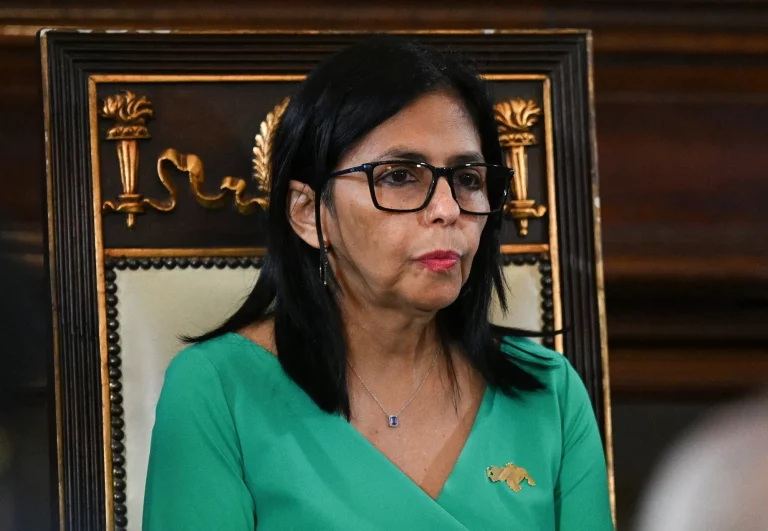
Arabian Post Staff -Dubai
Rodríguez defended the 25-year arrangement in a televised address, insisting Venezuela would retain ownership and sovereignty over its natural resources while using US capital, technology and operating expertise to revive an industry weakened by underinvestment, mismanagement and sanctions.
The agreement covers 17 strategic oilfields and sets an initial production target of more than 1.5 million barrels a day, Rodríguez said. She estimated it could attract more than $100 billion in investment and generate about $209 billion in revenue for the Venezuelan state, assuming an oil price of $65 a barrel.
President Donald Trump announced the agreement on Friday, saying Washington had secured majority control over more than 65 billion barrels through a partnership with private business. US officials have said a newly formed venture will have rights to the fields, with the United States receiving 55 per cent of its effective output through a combination of equity and rights to buy crude at cost.
The full legal and commercial terms have not been published, leaving unresolved questions over financing, the identity and role of private operators and how the arrangement fits Venezuela’s constitutional and hydrocarbons framework. Rodríguez has said the project will run for 25 years, while separate descriptions of field concessions have referred to longer contractual rights.
Opposition leaders have challenged both the transparency of the pact and Rodríguez’s authority to commit resources on such a scale. Juan Pablo Guanipa said foreign investment was necessary to rebuild the oil sector but argued that any durable agreement required free elections, representative government and clear rules governing the use of proceeds.
Henrique Capriles also demanded disclosure of the agreement’s scope, legal basis, benefits for Venezuelans and obligations assumed by Caracas. Ricardo Hausmann, a former planning minister and Harvard University professor, questioned Rodríguez’s constitutional legitimacy to bind the country to the arrangement.
Criticism has also come from figures associated with the movement founded by Hugo Chávez. Rafael Ramírez, a former oil minister and former president of state producer PDVSA, denounced the agreement and questioned the transfer of such extensive influence over national petroleum assets to Washington. Other dissident Chavista voices have similarly portrayed the pact as inconsistent with the movement’s longstanding defence of state control over oil.
The unusual convergence of criticism has sharpened scrutiny of Rodríguez’s political relationship with Washington. Risa Grais-Targow, Latin America director at Eurasia Group, said the deal could reinforce Trump’s commitment to working with Rodríguez and reduce Washington’s incentive to press rapidly for another presidential election, an outcome that would potentially strengthen the acting president’s position.
That possibility has unsettled opposition groups that have been demanding a swift electoral timetable after Nicolás Maduro was captured by US forces in January and taken to New York to face federal drug-trafficking charges. Washington subsequently dealt with Rodríguez as Venezuela’s interim leader while maintaining pressure for a political transition.
No provision publicly disclosed so far states that the oil arrangement is tied to postponing elections, and neither Trump nor Rodríguez has said the agreement alters Venezuela’s electoral timetable. The link between the energy pact and Rodríguez’s hold on power therefore remains a political assessment rather than an established condition.
Rodríguez has instead presented the agreement as an economic recovery programme. She said about $19 from each barrel produced and sold under the bilateral arrangement would flow directly to Venezuela, helping finance public services and reconstruction.
Also published on Medium.
Follow Arabian Post
Select Arabian Post as your preferred source on Google and MSN News for trusted business news and Arab politics and updates.




