
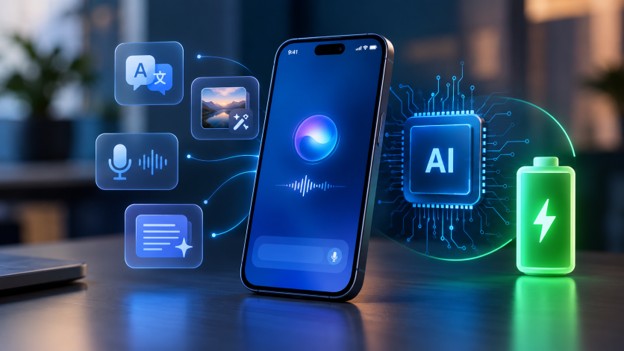
Artificial intelligence is becoming a bigger part of the smartphone experience, powering features such as real-time translation, photo editing, voice assistants, and text summarisation. Similar digital experiences, including those offered through platforms like GameZone casino, also rely on mobile devices that balance functionality with performance. However, delivering AI capabilities without significantly reducing battery life remains a technical challenge.
Manufacturers are exploring specialised processors, smaller AI models, and hybrid processing systems to make AI features more efficient while managing power consumption, heat, and hardware demands.
Why Does On-Device AI Consume Battery Power?
The technology behind on-device AI allows smartphones to execute certain types of work locally, instead of transmitting information to a third-party server. This capability results in reduced dependence on communication networks, faster response time and less data being transferred.
But that does not eliminate resource requirements for computing. Various forms of AI techniques place certain requirements on the runtime computer system of the phone, including CPU load and memory consumption.
Studies demonstrate that the level of energy efficiency of a mobile AI system is rather variable depending on the system that is being analyzed.
How Can Smartphone Makers Improve AI Efficiency?
Manufacturers are exploring various options for better performance and less energy consumption.
Dedicated AI processors: Neural processing units (NPUs) are made to work on machine learning jobs faster. Choosing appropriate tasks for such hardware can optimize the speed and the energy consumption at the same time.
Smaller AI models: Compact models do not require as much energy and resources as larger ones. Methods like quantisation use lower numerical precision for the model, which may lead to less memory and computational requirements. However, the outcome would depend on the model used.
Improved management of workload: AI technology in mobile phones system might allow understanding the complexity of tasks that have to be done. For instance, one can run simple tasks locally while leaving the more complicated tasks for the cloud solution whenever the connection is available.
This all shows the direction in which the industry moves. TSMC Company was reported by Reuters in May 2026 to acknowledge the importance of energy efficiency in the process of designing chips, as the need in AI computation increases among chip manufacturers.
Is On-Device AI Better Than Cloud Processing?
At no time is one method superior to the other. Local processing enables functions to be enabled without an Internet connection, decreases network delay, and minimizes the transmission of personal data. However, executing larger models directly on the phone can strain its computing capabilities.
Cloud processing offloads a lot of work to remote machines, making complicated AI functions available without the need for the mobile phone to perform all the computations itself. But some costs come with this approach, including the need for a live Internet connection, response time, as well as the data processing and energy consumption of the servers and networks involved.
The hybrid method can help to meet all these requirements. For example, a phone may perform simple tasks locally while resorting to complex calculations from the cloud for more difficult requests.
What Does This Mean for Future Smartphones?
The significance of AI performance in developing hardware and software for smartphones is gaining importance. Companies have to measure the efficiency of CPUs, RAM, batteries, cooling systems, and background workloads of their devices.
Customers must consider more than just marketing claims related to AI. A smartphone that features top-notch AI capabilities may still suffer in terms of battery performance based on the applications and usage modes used. Conducting independent tests as well as reading reviews from well-respected sources can yield more valuable insights than simply looking at the specifications of a smartphone.
Battery drain may be attributed to a number of reasons that do not relate to AI, such as brightness of a smartphone’s display, network connectivity, background processes, and battery lifespan.
Can Smartphone Makers Find the Right Balance?
Smartphone manufacturers are capable of achieving a good balance between effective AI and battery life, but no particular solution will work for different gadgets and workloads. Using special chips, streamlined architectures, and mixed processing allows minimizing extra power drain, while proper architecting of software determines the way any combination of these technologies should operate.
At the end of the day, progress should be evaluated not only based on the number of AI features included in the smartphone, but also on whether these features are indeed practical and do not require prohibitive battery drain or lose privacy.
Also published on Medium.
Follow Arabian Post
Select Arabian Post as your preferred source on Google and MSN News for trusted business news and Arab politics and updates.