
DUBAI, UAE — Red Rock Technology FZ-LLC has entered into an exclusive strategic agreement with Innobotics, securing sole rights to deploy and commercialize its robotics and automation technologies across the GCC, Africa and India. The agreement establishes a cross-regional infrastructure layer combining AI governance, automation and physical deployment systems, positioning Red Rock as a primary integrator in markets where food security, supply chain resilience and technological sovereignty are rapidly converging priorities.
The timing of the agreement reflects a broader structural shift underway across emerging and frontier markets, where governments are increasingly prioritizing localized control over food production, logistics and critical infrastructure. In this context, the ability to deploy integrated AI-driven systems at scale is moving from operational advantage to strategic necessity.
The deal grants Red Rock comprehensive territorial exclusivity across three of the world’s fastest-growing technology adoption markets. Combined, the GCC, Africa and India represent a population base exceeding two billion people and account for a significant proportion of global demand in food production, infrastructure development and applied AI integration. For Red Rock, the agreement formalizes a distribution architecture that extends well beyond software licensing and into the physical deployment of intelligent systems at national scale.
Innobotics, led by Chief Executive Officer Emanuela Fossato, develops integrated robotics and automation technologies with direct application in controlled environment agriculture, logistics and critical infrastructure. The company’s systems are designed for high-stress deployment conditions, including arid-zone production environments and low-resource supply chains, two contexts of acute strategic relevance across the Gulf and sub-Saharan Africa.
Under the terms of the agreement, Red Rock will assume full commercial responsibility for Innobotics deployments within its exclusive territory. Integration will be orchestrated through the Seedelligence AI ‘Brain’, the centralized intelligence layer powering Red Rock’s National Food & Seed Sovereignty Institute initiative. The structure is not a reseller arrangement. It is a layered deployment model in which Red Rock acts as the primary technology integrator, combining Innobotics hardware and automation capabilities with its own AI governance layer to produce end-to-end sovereign infrastructure solutions for enterprise and government clients.
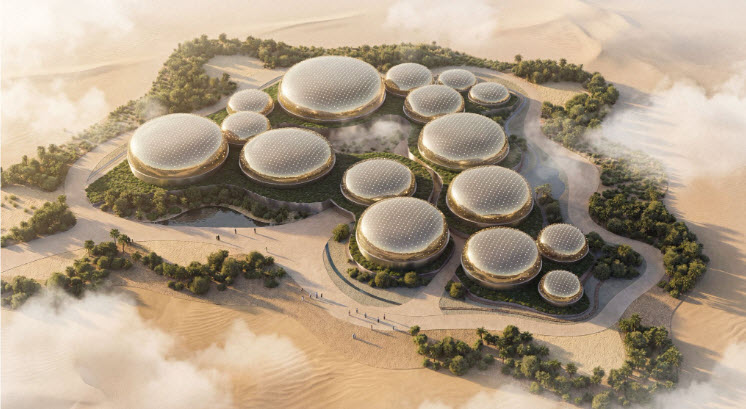
The investment commitment, organized as a multi-phase deployment over a five-year horizon, is structured to support the development of up to ten large-scale controlled-environment agricultural and infrastructure facilities across the GCC, Africa and India. Each deployment is estimated within a range of $180 million to $280 million, bringing the total potential program value to between $4.8 billion and $5.5 billion. Capital allocation will be directed toward three principal areas: physical infrastructure buildout, AI integration at the operational layer, and long-term ecosystem development, including training, institutional partnerships and localization across each target market. The phased structure enables sovereign entities, development funds and large enterprises to engage progressively, from pilot implementations to full-scale national deployments.
“This is not a distribution agreement. It is the establishment of a permanent operational layer,” said Riccardo Ammendola, Chairman of Red Rock Technology. “We are enabling a transition from dependency on imported systems to infrastructure that can be governed, adapted and scaled locally. That transition is already underway.”
Michele Fiscalini, Chief Executive Officer and co-founder of Red Rock Technology, framed the development in terms of the longer transition underway in how nations conceptualize resource security. “Infrastructure has always followed power. Today, power follows data, and data follows the architecture you control. We are building that architecture.”
The agreement carries particular relevance for the GCC’s food security agenda. Regional governments have accelerated investment in domestic production capacity in response to sustained supply chain disruptions and growing awareness of import dependency risk. Innobotics’ controlled-environment and automation technologies, deployed through Red Rock’s integration framework and coordinated through the Seedelligence AI ‘Brain’, are directly applicable to the sovereign food production models that Gulf states are now prioritizing at the policy level.
In India and Africa, the opportunity structure is distinct but equally significant. India’s agricultural sector remains one of the largest by workforce globally, yet faces mounting pressure from climate variability and post-harvest loss. Across Africa, infrastructure deficits in cold chain, processing and distribution represent a compounding constraint on food system efficiency. In both contexts, the Innobotics and Red Rock integration model is intended to address systemic gaps rather than incremental improvements.
Red Rock has established institutional credibility within the region through recognized engagements with public sector entities and leading academic institutions, and is actively developing enterprise and government relationships across the UAE. The Innobotics agreement extends that institutional standing into an operational deployment mandate across a territory that, by any commercial measure, constitutes a significant share of global frontier-market infrastructure demand.
Initial deployments are expected to begin within the GCC during the current financial year, with parallel expansion pathways already under development for India and key African markets. As implementation moves from pilot to scaled deployment, the agreement is positioned to become a reference model for how integrated AI and automation systems are deployed across regions where infrastructure, food systems and data governance are increasingly interconnected.
Also published on Medium.
Follow Arabian Post
Select Arabian Post as your preferred source on Google and MSN News for trusted business news and Arab politics and updates.