Arabian Post Staff -Dubai
Gas engine maker Innio is seeking a valuation of up to $20.25 billion in a New York listing, placing the Munich-based company at the centre of investor demand for businesses tied to artificial intelligence infrastructure and data centre power.
AI Alpine, Innio’s principal shareholder and an entity co-owned by funds managed by Advent International and the Abu Dhabi Investment Authority, plans to sell 75 million shares at $24 to $27 each. At the top of the range, the offering would raise about $2.03 billion, with a further 11.25 million shares available to underwriters through a 30-day option. Innio has applied to list on the Nasdaq Global Select Market under the ticker INIO.
The proposed transaction comes as power supply has become one of the biggest constraints facing the expansion of AI computing. Data centre developers are seeking faster access to reliable electricity as grid connections, substation capacity and transmission upgrades struggle to keep pace with demand from cloud platforms, chip-intensive computing and enterprise AI workloads. That shift has lifted market interest in companies offering modular, decentralised and quick-start power systems.
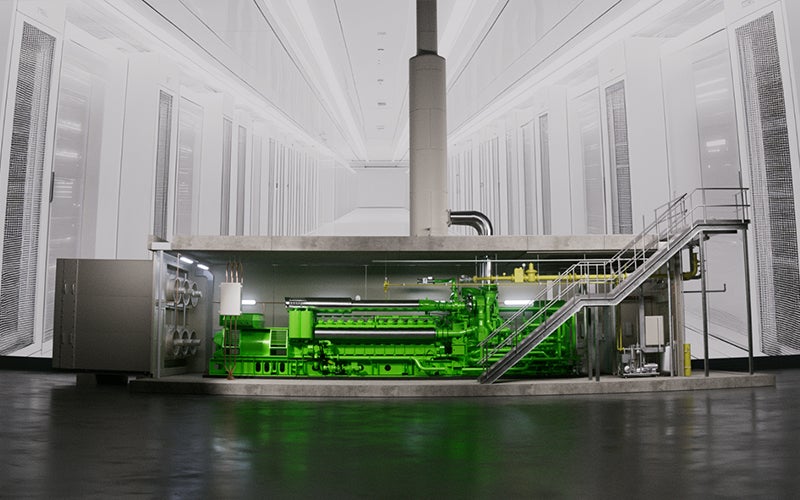
Innio manufactures gas engines and related systems under the Jenbacher and Waukesha brands. Its products are used in data centres, microgrids, grid stabilisation, industrial energy systems and gas compression. The company also operates a services business built around maintenance, spare parts, upgrades and digital monitoring across an installed base of about 44 gigawatts in roughly 100 countries.
The IPO is being positioned less as a conventional industrial listing and more as an infrastructure play linked to the AI buildout. Innio’s annual data centre equipment orders expanded about 16-fold between 2020 and 2025, while overall equipment order intake reached $3.88 billion in 2025, up nearly 188 per cent from the previous year. Data centre order intake rose to about $2.28 billion in 2025 and stood at about $1.01 billion in the first quarter of 2026, underscoring how sharply customer demand has shifted towards behind-the-meter power.
Financial disclosures show revenue of $2.64 billion in 2025, up 22.1 per cent from 2024. Gross profit stood at $911.8 million, operating income at $346.5 million and net income at $141.8 million. For the 12 months ended March 31, 2026, revenue was about $2.81 billion and net income about $97.8 million, reflecting both the scale of the order cycle and the costs tied to capacity expansion.
The offer is structured as a sale by the shareholder rather than a primary capital raise for the company, meaning Innio will not receive proceeds from the sale of shares by the selling shareholder. That feature may draw scrutiny from investors weighing the strength of the company’s operating momentum against the extent to which the IPO functions as a partial exit for its private equity and sovereign wealth fund backers.
Advent created Innio as a standalone company in 2018 after carving out General Electric’s distributed power business in a $3.25 billion transaction. ADIA later took a minority stake in 2023, adding Gulf sovereign capital to a business positioned around flexible gas generation, hydrogen-ready systems and distributed energy services. Under Advent’s ownership, Innio has expanded its North American manufacturing and assembly footprint, a key issue as data centre developers look for shorter delivery timelines.
Goldman Sachs, J. P. Morgan and Morgan Stanley are leading the offering, with market reception likely to be watched closely across the energy technology and infrastructure sectors. The deal also follows a period in which investors have rewarded companies tied to electrification, grid reliability and AI-related capital spending, while applying sharper scrutiny to valuations where growth depends on sustained hyperscale data centre expansion.
The central investment case rests on Innio’s ability to supply flexible power at a time when electricity bottlenecks are reshaping the economics of data centre development. Reciprocating gas engines can be deployed in modular configurations, start quickly and support customers seeking on-site generation where grid access is delayed or insufficient. The company has also promoted hydrogen-ready technology and fuel flexibility as part of a longer-term energy transition strategy.
Also published on Medium.
Follow Arabian Post
Select Arabian Post as your preferred source on Google and MSN News for trusted business news and Arab politics and updates.