Strategy’s vast bitcoin treasury swung back into paper profit after the cryptocurrency climbed above $78,000, restoring gains on one of the market’s most closely watched corporate bets and reviving confidence in Michael Saylor’s high-risk, high-conviction strategy. Market data on Friday showed bitcoin trading as high as about $78,242, while Strategy’s latest disclosed average purchase price stood at roughly $75,577 per coin, leaving the company’s position above cost […]
Arabian Post Staff -Dubai Abu Dhabi has moved to expand lower-cost rental housing through a new partnership between the Department of Municipalities and Transport and Aldar, with the two sides planning about 9,000 value housing units across Mohamed Bin Zayed City and Baniyas in a scheme aimed at easing pressure on tenants and broadening access to professionally managed homes. The projects, announced on 17 April, sit within […]
Singapore Gulf Bank has launched a USDC mint-and-redeem service on the Solana blockchain, opening a round-the-clock channel for corporate and high-net-worth clients to move between fiat currency and digital dollars directly from their bank accounts as it pushes deeper into cross-border payments and treasury services. The bank said the product is designed to bypass delays tied to correspondent banking and standard settlement windows, offering near-instant conversion and […]
Dogecoin climbed on Friday, extending a 24-hour advance that outpaced some larger digital assets and lifted sentiment across the meme-coin corner of the market, as traders responded to a burst in turnover and a broader recovery in risk appetite. Market trackers showed DOGE trading near 9.8 US cents on 17 April, with daily volumes above $2.5 billion and sharply higher than the previous day, pointing to […]
Arabian Post Staff -Dubai EDGE Group and Indra Group have agreed to explore the development and production of next-generation radar systems in Brazil, extending a defence partnership that has widened from the Gulf into Europe and now Latin America. The memorandum of understanding was signed at LAAD Security 2026 in São Paulo, where both companies said the plan is intended to help build a domestic radar production […]
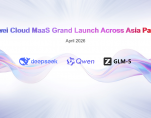
JAKARTA, INDONESIA – Media OutReach Newswire – 15 April 2026 – Huawei Cloud AI Boost Day, themed “Agentic AI Practice”, was successfully held in Jakarta. At the event, Huawei Cloud announced the official launch of its MaaS service in Asia Pacific.
Huawei Cloud MaaS grand launch across Asia Pacific
Following the rollout of AI Compute Service in Hong Kong (China), Thailand, Indonesia, and Singapore in 2025, Huawei Cloud MaaS (Model-as-a-Service) is now available, leveraging Huawei’s in-house acceleration engine to support mainstream models and provide customers with stable and high-quality token services.
Huawei Cloud continues to strengthen its collaboration with high-quality open-source models in the industry. Six models from three categories—GLM, DeepSeek, and Qwen—are the first to be supported by MaaS. These models are designed for two major application scenarios: intelligent Q&A and AI coding. They offer one-click access and out-of-the-box model hosting services, covering the entire lifecycle of model management from deployment to inference, fine-tuning, and evaluation. With elastic compute and pay-per-use billing, enterprises and developers can quickly integrate AI capabilities into their service systems without having to worry about the underlying infrastructure. This makes AI accessible to everyone.
Notably, this release includes support for the latest GLM-5 model. GLM-5 has attained state-of-the-art (SOTA) performance in coding and agent capabilities, making it an ideal general-purpose agent foundation for complex system engineering and long-text agent tasks in enterprise environments.
Huawei Cloud’s long-term strategic investment in AI has resulted in a comprehensive suite of AI solutions, including CloudMatrix AI Infra, MaaS, ModelArts (a model training and inference platform), CodeArts (a coding agent), AgentArts (an agent platform), and DataArts (a data agent).
CodeArts and AgentArts will be launched outside the Chinese mainland in the second half of 2026.
Huawei Cloud has established an optimized cloud infrastructure network in the Asia Pacific region. This network comprises five Regions and 18 availability zones (AZs) located in Singapore, Thailand, Hong Kong (China), Indonesia, and the Philippines, ensuring a 50 ms access latency. Additionally, in Malaysia, Huawei Cloud and partners have jointly built a local cloud.
Huawei Cloud AI Compute Service have helped many Asia Pacific customers elevate their cloud journey from simply migrating to the cloud to using AI well. They have benefited from improved productivity and better adaptation to changing environments.
iFLYTEK, a leading intelligent voice and AI company, selected Singapore as the first destination for its global expansion strategy in 2023, naturally extending its collaboration with Huawei Cloud from China to a global scale. Huawei Cloud AI Compute Service helped iFLYTEK quickly deploy their large language model training resources within two weeks. The training remained stable for 60 days without interruption, ensuring zero faults during the release of major versions.
In Vietnam, Green and Smart Mobility (GSM), an emerging green mobility platform, migrated its core operations platform to Huawei Cloud to reduce costs, enhance efficiency, and achieve multi-cloud flexibility. GSM has developed a comprehensive fleet management platform using AI and IoT. By utilizing Huawei Cloud IoTDA and ModelArts AI technologies, GSM analyzes violations and generates risk alerts to ensure driver and passenger safety, thereby fulfilling its mission of promoting green and safe transportation.
Huawei Cloud will continue to invest in AI innovation and provide a secure, stable, and intelligent cloud foundation to help enterprises in Asia Pacific achieve sustainable business growth in the AI era.
The issuer is solely responsible for the content of this announcement.
About Huawei
Founded in 1987, Huawei is a leading global provider of information and communications technology (ICT) infrastructure and smart devices. We have 207,000 employees and we operate in more than 170 countries and regions, serving more than three billion people around the world.
Our vision and mission is to bring digital to every person, home and organisation for a fully connected, intelligent world. To this end, we will work towards ubiquitous connectivity and inclusive network access, laying the foundation for an intelligent world; providing diversified computing power where you need it, when you need it, to bring cloud and intelligence to all four corners of the earth; build digital platforms to help all industries and organisations become more agile, efficient, and dynamic; and redefine user experience with AI, making it smarter and more personalised for people in all aspects of their life, whether they’re at home, on the go, in the office, having fun, or working out. For more information, please visit Huawei online at www.huawei.com
Asian equities pushed higher on Thursday as hopes of a diplomatic opening in the US-Iran conflict combined with solid corporate earnings to lift sentiment across the region, extending a rebound that has carried global benchmarks back towards, and in some cases beyond, their pre-war highs. MSCI’s broadest index of Asia-Pacific shares outside Japan rose about 0.9 per cent, while Japan’s Nikkei jumped 2.2 per cent to a fresh record, tracking Wall Street gains after the S&P 500 and Nasdaq ended at all-time closing highs on 15 April.
The rally reflected a market view that the worst-case economic fallout from the conflict may yet be avoided if negotiations regain momentum. Investors were encouraged by signs that talks between Washington and Tehran could resume after earlier efforts faltered, easing some fears over energy supply disruptions and allowing attention to swing back to earnings, economic data and the resilience of household demand in the United States and Asia. That shift in mood helped lift US stock futures and underpinned broader gains from Tokyo to Mumbai.
Japan led the advance, with exporters and technology names benefiting from stronger risk appetite and the market’s belief that any easing in Middle East tensions could reduce pressure on fuel costs and shipping. The Nikkei’s record level also reflected investor confidence that large Japanese companies remain well placed to benefit from global demand for semiconductors, automation and artificial intelligence infrastructure. Elsewhere, South Korean and Hong Kong shares also moved higher, while mainland Chinese markets were supported by data showing the economy expanded by 5.0 per cent in the first quarter, beating expectations and offering some reassurance that domestic activity has retained momentum despite the geopolitical shock.
Wall Street’s lead mattered. The S&P 500 closed at 7,022.95 on Wednesday, a record that marked a full recovery from losses triggered after the conflict began in late February, while the Nasdaq posted another record finish and extended a powerful winning streak. Strong results from major banks, including Bank of America and Morgan Stanley, reinforced the idea that corporate America is entering the earnings season on firmer footing than many investors had feared when oil prices spiked and risk assets sold off. Reuters reported that 84 per cent of companies that had reported by then had beaten expectations, helping to steady nerves about margins and consumer activity.
The earnings story is now sharing the stage with geopolitics. Markets are effectively pricing a narrower range of negative outcomes than they were only weeks ago, but that optimism remains conditional. Oil prices, while off their most alarming levels, are still elevated by historical standards, and every diplomatic headline continues to carry outsized weight because the Strait of Hormuz remains central to global crude flows. Reports that Iran may allow shipping through the waterway helped calm traders, though supply risks have not disappeared, especially with refinery disruptions in Australia and the threat of fresh sanctions or military miscalculation still present.
That tension between relief and caution is visible across asset classes. The dollar was broadly steady, the euro stayed firm, gold edged up and cryptocurrencies drifted lower, all signs that investors have not fully abandoned hedges even as they add exposure to equities. In India, shares opened higher as lower oil prices and hopes of renewed dialogue supported all major sectors, with the Nifty 50 and Sensex building on gains from the previous session. For economies that import large volumes of energy, any sustained cooling in crude would ease inflation pressure, support currencies and give central banks more room to focus on domestic growth rather than external shocks.
Technology remains a central pillar of the market’s confidence. Taiwan Semiconductor Manufacturing Co. was in focus ahead of results that investors expected to show a sharp profit jump, driven by demand tied to artificial intelligence chips. That anticipation has fed into a broader belief that the AI investment cycle can continue to offset weakness elsewhere in the global economy. Yet the strength of that narrative also creates a vulnerability: richly valued technology shares leave little room for disappointment, and any sign of slowing orders or tighter capital spending could quickly change the market tone.
Amazon has struck an $11.57 billion deal to buy Globalstar, a move that would give the technology group a sharper edge in satellite communications, deepen its rivalry with SpaceX’s Starlink and place it at the centre of the next phase of smartphone connectivity, including services tied to future iPhone and Apple Watch models. The proposed acquisition, announced on April 14, would fold Globalstar’s satellites, spectrum assets and […]
SoftBank Group’s push to raise broader backing for a $40 billion loan tied to its investment in OpenAI is drawing fresh attention to how far global lenders are willing to support Masayoshi Son’s debt-heavy bet on artificial intelligence. More banks are being approached to join the financing, extending a syndication effort that began after SoftBank secured the bridge facility in March, in what has become a major […]
Arabian Post Staff -Dubai Saudi Arabia’s Public Investment Fund has stepped up its backing of Lucid Group with a fresh $550 million investment through affiliate Ayar Third Investment Company, extending the sovereign wealth fund’s role as the electric vehicle maker’s financial anchor at a time when Lucid is trying to stabilise cash burn, repair operational strains and broaden its commercial reach. The commitment forms part of a […]
Hongkong Land and Gammon Construction introduce CarbonCure’s CO₂ mineralisation technology in Tomorrow’s CENTRAL project, a first for Hong Kong.
Injecting captured CO₂ into concrete reduces cement use by up to 7%.
Supporting Hongkong Land’s goal of cutting Scope 3 carbon intensity 22% by 2030, positioning Tomorrow’s CENTRAL as a sustainability leader.
Buildings Department approval of the CarbonCure concrete mix sets the stage for wider industry adoption.
HONG KONG SAR – Media OutReach Newswire – 14 April 2026 – Hongkong Land and Gammon Construction have partnered to introduce CarbonCure to Hong Kong. Through this strategic collaboration, the companies are deploying the patented CO₂ mineralisation technology in Tomorrow’s CENTRAL project, marking its first use in Hong Kong. This alliance pioneers low-carbon building materials in the city and accelerates the wider industry’s transition.
(From left to right) Mr. Eddie Tse, Group Sustainability Manager, Gammon Construction; Ms. Ka Yan Chu, Assistant Technical Manager, Concrete Technology Services, Gammon Construction; Ms. Grace Lam, Senior Sustainability Manager, Hongko
Reducing cement‑related emissions without compromising performance
Embodied carbon accounted for 70% of Hongkong Land’s total carbon emissions in 2025, with industry research indicating that more than 80% of the embodied carbon in a typical new commercial building is associated with concrete, brick and steel. Cement production generates about 7% of global CO₂ emissions, more than three times that of civil aviation, making it a critical decarbonisation priority.
CarbonCure offers one of the most effective solutions, reducing cement content by 4–7% without compromising concrete quality or performance. The new technology injects captured CO₂ into fresh concrete during mixing, where it undergoes a chemical reaction to form a mineral, permanently trapping carbon within the material. When combined with a low-carbon concrete mix containing approximately 40% Ground Granulated Blast-Furnace Slag (GGBS), a 34% carbon emissions reduction is achieved compared to traditional non-green concrete.
Implementing this innovative technology supports Hongkong Land’s target of achieving a 22% reduction in Scope 3 carbon intensity by 2030. It also aligns with Tomorrow’s CENTRAL project’s sustainability objectives, including using 100% low carbon concrete, 100% green rebar, and 100% sustainable timber during construction, and to divert 75% of construction waste.
Tomorrow’s CENTRAL: a project with sustainability at its core
Tomorrow’s CENTRAL is Hongkong Land’s bold three-year plan to transform the LANDMARK retail portfolio. Announced in June 2024, the project is ambitious in its scope, encompassing extensive façade enhancements, retail renovations and office lift-lobby relocations From inception, sustainability has been the project’s guiding principle.
The CarbonCure concrete mix technology was deployed by Hongkong Land and Gammon in November 2025 after it was approved by the Buildings Department in September 2025 following a rigorous 18-month testing and preparation period.
Michael T. Smith, Group Chief Executive of Hongkong Land, said: “Sustainability is a key business priority for Hongkong Land. Using lower carbon concrete on Tomorrow’s CENTRAL helps to advance the goals of our Sustainability Framework 2030. As the first developer to apply this technology in Hong Kong’s premium commercial sector, we continue to demonstrate our commitment to innovation and encourage wider industry uptake.”
Eddie Tse, Group Sustainability Manager, Gammon Construction, said: “We are delighted to partner with Hongkong Land on Hong Kong’s first application of CarbonCure concrete. Their strong commitment to sustainability and openness to pioneering solutions have been instrumental in making this milestone possible. By permanently mineralising carbon within building materials and reducing cement use, lower carbon concrete represents a meaningful step forward in embodied‑carbon reduction. With this successful deployment, we look forward to extending similar innovations across the industry and collaborating with more clients to drive low‑carbon construction in Hong Kong.”
Hashtag: #HongkongLand
The issuer is solely responsible for the content of this announcement.
Hongkong Land
Hongkong Land is a major listed property development, investment and management group. It focuses on developing, owning and managing premium and ultra-premium mixed-use real estate in Asian gateway cities, featuring Grade A office, luxury retail, residential and hospitality products. With over US$50 billion in assets under management, Hongkong Land’s ultra-premium mixed-use real estate footprint spans over 1.97 million sq. m. lettable area in operation and 1.43 million sq. m. lettable area under development, with flagship mixed-use projects in Hong Kong, Singapore and Shanghai. Its properties hold industry leading green building certifications and attract the world’s foremost companies and luxury brands. Established in 1889, Hongkong Land takes a long-term view, investing significantly alongside its capital partners and concentrating its portfolio where it can create the most value for tenants, customers and investors. Hongkong Land Holdings Limited has a primary listing on the London Stock Exchange, with secondary listings in Singapore and Bermuda. Hongkong Land is a member of the Jardine Matheson Group.
UAE authorities have rolled out a nationwide school nutrition guide that bans sugary drinks, fried foods, sweets, chocolate products, processed meats, tea and coffee across educational institutions, widening a health drive that officials say is aimed at improving children’s diets, sharpening concentration in class and cutting obesity. The framework applies across public, private, independent and vocational schools, as well as centres for People of Determination, and sets […]
Rockstar Games has confirmed that a data breach affected company information, saying a “limited amount of non-material company information” was accessed through a third-party incident and that the episode has had no impact on its operations or players. The disclosure lands at a sensitive moment for one of the world’s most closely watched game developers, with Grand Theft Auto VI still one of the industry’s biggest commercial […]
South Korea’s exports rose 36.7 per cent from a year earlier in the first 10 days of April, extending a powerful trade run driven by semiconductor demand and offering fresh evidence that the country’s technology cycle remains firmly supported by global spending on artificial intelligence infrastructure. Outbound shipments reached $25.2 billion in the April 1-10 period, the highest ever recorded for the opening 10 days of a month, according to Korea Customs Service data carried by Yonhap on Monday.
The early-April figures reinforce a broader pattern already visible through the first quarter. South Korea, one of the world’s most closely watched export economies because of its central role in memory chips, displays and consumer electronics, has been benefiting from a steep recovery in semiconductor sales after a prolonged industry downturn. Reuters reported at the end of February that the country’s chip exports had jumped 160.9 per cent in that month alone, passing $20 billion for a third straight month as AI investment and stronger memory prices lifted demand.
Semiconductors were again the main engine in the latest 10-day release. Chip exports surged 152 per cent from a year earlier, underscoring how heavily South Korea’s trade performance is now tied to data-centre investment, high-bandwidth memory demand and the wider AI build-out led by large technology firms. That strength has helped offset a less even backdrop in other parts of the economy, where investment, household demand and external policy risks remain more mixed.
The export rebound matters well beyond monthly trade headlines. South Korea’s central bank raised its 2026 growth forecast to 2.0 per cent in February and signalled that a chip-led upswing was giving policymakers more room to hold interest rates steady while watching inflation and financial stability risks. Reuters also reported this month that central bank officials see strong semiconductor exports and an extra budget as factors easing downward pressure on growth, even as won weakness and higher energy costs complicate the inflation outlook.
Factory data has pointed in the same direction. A Reuters report on S&P Global survey findings showed South Korea’s manufacturing activity expanded in January at the fastest pace in nearly a year and a half, helped by stronger export orders from China, North America and Europe. Manufacturers reported improving optimism as orders strengthened in sectors such as autos and semiconductors, indicating that the recovery is not only statistical but also visible in production and order books.
Still, the trade picture is not free of risk. South Korea remains highly exposed to swings in global demand, to US trade policy and to supply disruptions linked to tensions in the Middle East. Reuters polling before the March trade data showed imports rising sharply as higher oil prices pushed up the energy bill, even while exports surged on semiconductor strength. That combination can support headline trade values, but it also leaves the economy vulnerable to a renewed squeeze from commodity inflation and currency volatility.
Another uncertainty lies in concentration. The same chip boom that is lifting exports also raises dependence on a narrow cluster of products and companies. South Korea’s trade resilience is being powered largely by memory and advanced semiconductor demand, especially products linked to AI servers. Investment plans such as SK Hynix’s announcement in February of 21.6 trillion won in new facilities show confidence in long-term demand, but they also underline how central the semiconductor cycle has become to the country’s broader growth model.
For now, the momentum remains hard to ignore. Reuters polling ahead of the March data had already pointed to the fastest export growth in nearly five years, with shipments to the United States and China both showing strong gains alongside the semiconductor surge. Monday’s early-April figures suggest that pace has carried into the second quarter, strengthening the case that South Korea’s exporters are entering another period of outsized performance after a weak stretch in 2025.
Arabian Post Staff -Dubai AD Ports Group is accelerating its effort to turn itself from a Gulf port operator into a broader trade and logistics network, using expansion in Egypt, Africa, Pakistan and the Mediterranean to win a larger role in global supply chains as companies seek more resilient routes and integrated cargo services. For the Abu Dhabi-based group, 2025 marked another year of record financial growth. […]
Cyclone Maila has killed at least 11 people in Papua New Guinea, with flooding and landslides tearing through Bougainville and cutting off communities already struggling with damaged roads, broken bridges and disrupted food supplies. Local authorities and relief officials said the toll could still rise as reports continue to come in from remote areas where communications remain patchy after the storm crossed the region late last week. […]
Scientists have identified 37 active subglacial lakes beneath glaciers in the Canadian Arctic, with 35 of them not previously documented, adding a significant new layer to understanding how one of the planet’s fastest-changing cryospheric regions behaves as temperatures climb. The findings, published on 23 March 2026 in The Cryosphere, are based on satellite-derived elevation data collected between 2011 and 2021 and point to a far more dynamic […]
Arabian Post Staff -Dubai Central Bank of the UAE has appointed financial software group VERMEG to develop a central securities depository solution, a move that places the monetary authority more directly inside the country’s post-trade market infrastructure and signals a broader push to tighten the links between payments, settlement and capital markets. The announcement was made on 13 April, with CBUAE saying the project is intended to […]
Earth is becoming brighter after dark overall, but the shift is proving far less uniform than older global averages suggested, with fast-growing parts of Asia and Africa lighting up while sections of Europe and some older urban zones are dimming through efficiency drives, new lamp technologies and policies aimed at cutting waste and light pollution. The clearest picture yet, drawn from daily satellite observations between 2014 and […]
Enhanced Labs has raised $1 million in a strategic pre-seed round as the decentralised finance startup seeks to widen access to structured yield products built on options and derivatives, moving beyond large crypto tokens towards a broader set of on-chain assets that includes tokenised real-world assets. The round was led by Maximum Frequency Ventures, with GSR, Selini, Flowdesk and angel investors also taking part, according to company […]
Bank of Korea left its benchmark interest rate unchanged at 2.50 per cent on Friday, extending its policy pause to a seventh straight meeting as policymakers confronted a harder mix of rising price pressures, a weak won and a growth outlook darkened by higher energy costs and disruption linked to conflict in the Middle East.
The seven-member Monetary Policy Board said uncertainty had intensified and judged it appropriate to hold the base rate while assessing how the conflict, financial-market volatility and foreign-exchange swings feed through to the domestic economy. The central bank’s statement made clear that the policy dilemma has sharpened: inflation risks are moving up even as growth is expected to slow more than earlier forecast.
Governor Rhee Chang-yong, speaking after what Reuters reported was his final press conference before his term ends on April 20, said supply-side shocks from the Middle East were especially damaging for Asian economies reliant on imported energy. That matters acutely for South Korea, where policymakers are trying to prevent a renewed inflation cycle without choking activity at a time when sentiment has softened and some industries are already facing production constraints.
The rate hold had been widely anticipated. Reuters said all 31 economists in its poll expected no move at this meeting, reflecting a market consensus that the central bank had little room to ease and few grounds to tighten immediately. Instead, the decision underscored how monetary authorities in export-driven Asian economies are being forced to navigate a narrow path between external shocks and domestic fragilities.
At the centre of the debate is inflation. Official data showed consumer prices in March rose 2.2 per cent from a year earlier, up from 2.0 per cent in February, while core inflation, which excludes food and energy, also stood at 2.2 per cent. The Bank of Korea said petroleum prices had risen sharply and noted that short-term inflation expectations among the public edged up to 2.7 per cent. It now expects consumer inflation this year to exceed its February projection of 2.2 per cent by a meaningful margin, with core inflation also likely to come in above the earlier 2.1 per cent forecast.
That shift is important because the central bank had been able for months to argue that price growth was gradually stabilising near target. The worsening external backdrop has disrupted that narrative. The board said inflation is likely to move into the mid- to upper-2 per cent range as global oil prices and supply constraints lift import costs, though government price-stabilisation measures may soften part of the blow. Reuters reported that Seoul’s fuel-price caps, introduced last month for the first time in decades, helped restrain March inflation but are unlikely to provide a lasting shield if energy costs stay elevated.
Growth, meanwhile, is losing momentum. The central bank said the economy had been supported by strong exports, firmer consumption and continued job gains, but warned that downside pressure had increased since the outbreak of the Middle East conflict. It expects expansion this year to come in below the 2.0 per cent forecast issued in February, as higher energy prices and supply bottlenecks offset support from semiconductor exports and a supplementary budget. That combination leaves the Bank of Korea confronting an uncomfortable form of policy tension: weaker activity alongside stronger inflation.
The won has added to the pressure. The central bank said the currency weakened into the 1,500-won range against the US dollar as investors moved into safer assets and foreign investors sold domestic equities, before recovering some ground after a temporary ceasefire between the United States and Iran. A softer currency raises the local-currency cost of imported fuel and raw materials, complicating the inflation picture and limiting the case for any near-term rate cuts.
Financial markets reflected that cautious tone. Reuters reported that South Korea’s policy-sensitive three-year treasury bond futures erased early gains during the governor’s press conference, suggesting investors interpreted the message as more alert to inflation risks than to immediate growth support. Analysts cited by Reuters said the rebound in energy prices and the won’s weakness have narrowed the central bank’s room for manoeuvre, even if domestic demand still needs close watching.
Circle Internet Group shares slid nearly 10 per cent on Thursday, closing at $85.10, after a fresh Wall Street “sell” call added to investor unease over the stablecoin issuer’s margins and over criticism of its handling of funds tied to the Drift Protocol exploit. Market data showed the stock ended the session down 9.89 per cent, extending a volatile stretch for one of crypto’s most closely watched […]
Arabian Post Staff -Dubai Louvre Abu Dhabi has launched a digital teaching platform that links museum objects directly to school subjects, widening the role of art in classrooms beyond history and humanities and giving teachers a new route to use cultural material in everyday lessons. The Museum Curriculum Portal has been rolled out as part of a broader Abu Dhabi effort to connect cultural institutions more closely […]
CoreWeave has expanded its artificial intelligence infrastructure relationship with Meta to $21 billion, extending a partnership that underlines how the biggest technology groups are leaning on specialist cloud providers to secure the computing power needed for the next phase of AI development. The enlarged agreement, announced on April 9, runs through December 2032 and builds on a prior deal valued at about $14 billion struck in September. […]



 https://www.huaweicloud.com
 https://www.linkedin.com/company/huaweicloudapac
 https://x.com/huaweicloudapac
 https://www.facebook.com/HuaweiCloudAPAC