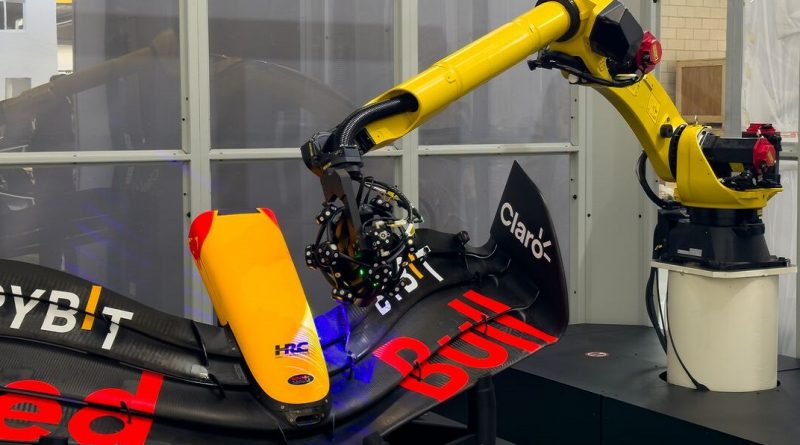
Hexagon has agreed to buy Waygate Technologies from Baker Hughes for about $1.45 billion in cash, giving the Swedish measurement technology group a bigger presence in industrial inspection and opening a new front in its push beyond traditional metrology.
The deal, announced on Monday, hands Hexagon control of a business that supplies non-destructive testing equipment used to inspect critical components and assets without taking them apart or shutting them down. Waygate’s technologies span radiography, computed tomography, ultrasound, imaging and remote visual inspection, tools used across aerospace, automotive, energy and heavy industry. Baker Hughes said the transaction is expected to close in the second half of 2026, subject to regulatory approvals and other customary conditions.
For Hexagon, the acquisition adds another layer to a business already known for sensors, positioning systems, software and manufacturing intelligence. The company framed the purchase as a way to extend precision measurement from the outside of a component to its internal structure, a move that could deepen its relationships with manufacturers looking to tighten quality control and reduce costly faults.
Waygate generated about $630 million in revenue in fiscal 2025, according to Hexagon, with an earnings margin of roughly 10 per cent before interest and tax. Hexagon drew particular attention to Waygate’s radiography and remote visual inspection operations, which it said produced around $330 million in revenue at a margin of about 16 per cent. That split is important because it shows Hexagon is not simply buying scale. It is targeting product lines where it sees stronger profitability and room for operational improvement.
Baker Hughes, meanwhile, is continuing a broader reshaping of its portfolio as it tries to sharpen its focus on energy technology businesses with stronger long-term growth potential. Chairman and chief executive Lorenzo Simonelli said the sale fits a strategy centred on rotating equipment, flow control, digital, production optimisation and decarbonisation. The company has been repositioning itself for several years as demand patterns shift across the global energy system, and it has sought to build a business less dependent on its older oilfield service identity.
That helps explain why Waygate, despite its industrial pedigree and recognised market position, was no longer a natural fit inside Baker Hughes. The business sits within the group’s Industrial & Energy Technology segment, but it is more closely tied to inspection markets than to the gas, LNG and industrial process opportunities Baker Hughes has been emphasising. The sale also strengthens Baker Hughes’ balance sheet at a time when the company is pursuing larger strategic moves, including its pending acquisition of Chart Industries.
Hexagon said it plans to finance the purchase with cash on hand and existing debt capacity, suggesting it sees the transaction as manageable within its present capital structure. Investors will now be looking for evidence that the buyer can lift margins and integrate Waygate’s hardware into Hexagon’s wider ecosystem of software, analytics and industrial data tools. That is where the strategic logic will be tested.
The industrial inspection market has become more important as manufacturers and infrastructure operators face tighter safety demands, rising maintenance costs and greater pressure to avoid unplanned downtime. Non-destructive testing plays a central role in checking welds, castings, turbine blades, pipelines and aircraft parts for hidden defects. Growth in the sector has also been supported by the increasing complexity of modern components, especially in aerospace engines, battery systems and advanced manufacturing.
Hexagon believes that trend works in its favour. By pairing Waygate’s inspection devices with its own production software and measurement systems, it is betting that customers will want integrated platforms rather than stand-alone tools. That could prove attractive for factories trying to digitalise quality assurance from design through production and on to maintenance.
Still, the transaction is not without risk. Waygate’s profitability trails the levels Hexagon is used to in parts of its Manufacturing Intelligence business, and the buyer has already signalled that some operations may face strategic review. Hexagon said Waygate’s ultrasonic testing and imaging solutions would be treated as stability assets while it works on performance improvements. That wording indicates management sees stronger near-term promise in some product lines than in others.
Follow Arabian Post
Select Arabian Post as your preferred source on Google and MSN News for trusted business news and Arab politics and updates.