

Arabian Post Staff -Dubai
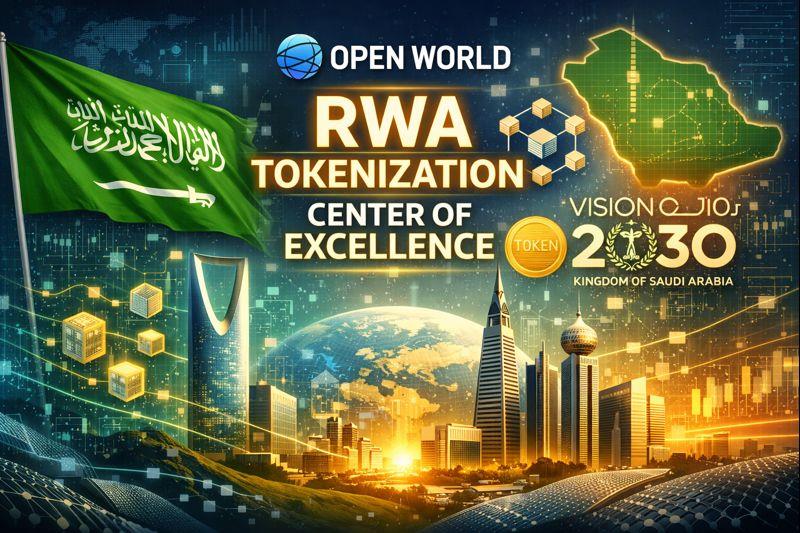
Saudi Arabia has moved to formalise real-world asset tokenisation with the launch of the Kingdom’s first dedicated Centre of Excellence, as Open World announced an in-Kingdom operating entity designed to support compliant digital-asset innovation aligned with Vision 2030 goals.
The initiative positions Saudi Arabia to accelerate the tokenisation of physical and financial assets such as real estate, commodities, infrastructure receivables and private credit under domestic regulatory frameworks. Open World said the centre will work with sovereign bodies and large enterprises to develop production-grade use cases, governance standards and technical infrastructure that meet Saudi compliance requirements rather than pilot-only experiments.
The centre is intended to operate as a coordination hub bringing together policymakers, regulators, financial institutions, technology providers and academia to build common standards for asset digitisation. Its mandate includes advisory work on regulatory design, sandbox participation where applicable, technical architecture for custody and settlement, and workforce development to build local capability in distributed-ledger systems.
Real-world asset tokenisation has gathered momentum globally as governments and large institutions seek efficiency gains in issuance, settlement and lifecycle management. Proponents argue that tokenisation can lower transaction costs, improve transparency and unlock liquidity in traditionally illiquid assets by enabling fractional ownership and programmable compliance. Saudi authorities have highlighted digital infrastructure, fintech and capital-markets development as priorities within Vision 2030, making RWA tokenisation a natural extension of existing reforms.
Open World said the Saudi entity will operate onshore to ensure alignment with domestic laws governing securities, payments, data residency and anti-money laundering controls. The centre’s early work is expected to focus on establishing reference architectures that can integrate with existing banking and capital-markets systems, rather than creating parallel rails. Industry participants say this approach reflects lessons from other jurisdictions where tokenisation projects stalled after failing to connect with incumbent infrastructure.
Market participants note that Saudi Arabia’s scale and state-backed investment programmes make it a compelling test bed for enterprise-grade tokenisation. Large infrastructure pipelines, property development and commodity flows create a wide pool of assets that could benefit from digital issuance and lifecycle automation if legal certainty is achieved. Analysts also point to the Kingdom’s push to deepen capital markets and attract foreign investment as a driver for adopting globally interoperable standards.
The Centre of Excellence is expected to engage with regulators to shape guidance on asset classification, investor protections and disclosure standards for tokenised instruments. While Saudi frameworks for digital assets continue to evolve, officials have consistently signalled a preference for tightly supervised innovation that prioritises financial stability and consumer protection. Industry executives say this stance increases the likelihood that projects emerging from the centre will progress beyond proofs of concept.
Education and skills development form another pillar of the initiative. Open World plans training programmes and research collaborations aimed at building a local talent pool capable of designing, auditing and operating tokenisation platforms. Observers say this is critical, as a shortage of specialised skills has slowed adoption elsewhere despite strong institutional interest.
The announcement comes as regional competition intensifies to attract fintech and digital-asset investment. Gulf markets have adopted differing regulatory approaches, with some prioritising speed to market and others emphasising conservative supervision. Saudi Arabia’s strategy appears to favour scale and integration with national development objectives, betting that regulatory clarity and sovereign-grade projects will draw long-term capital.
Follow Arabian Post
Select Arabian Post as your preferred source on Google and MSN News for trusted business news and Arab politics and updates.



