

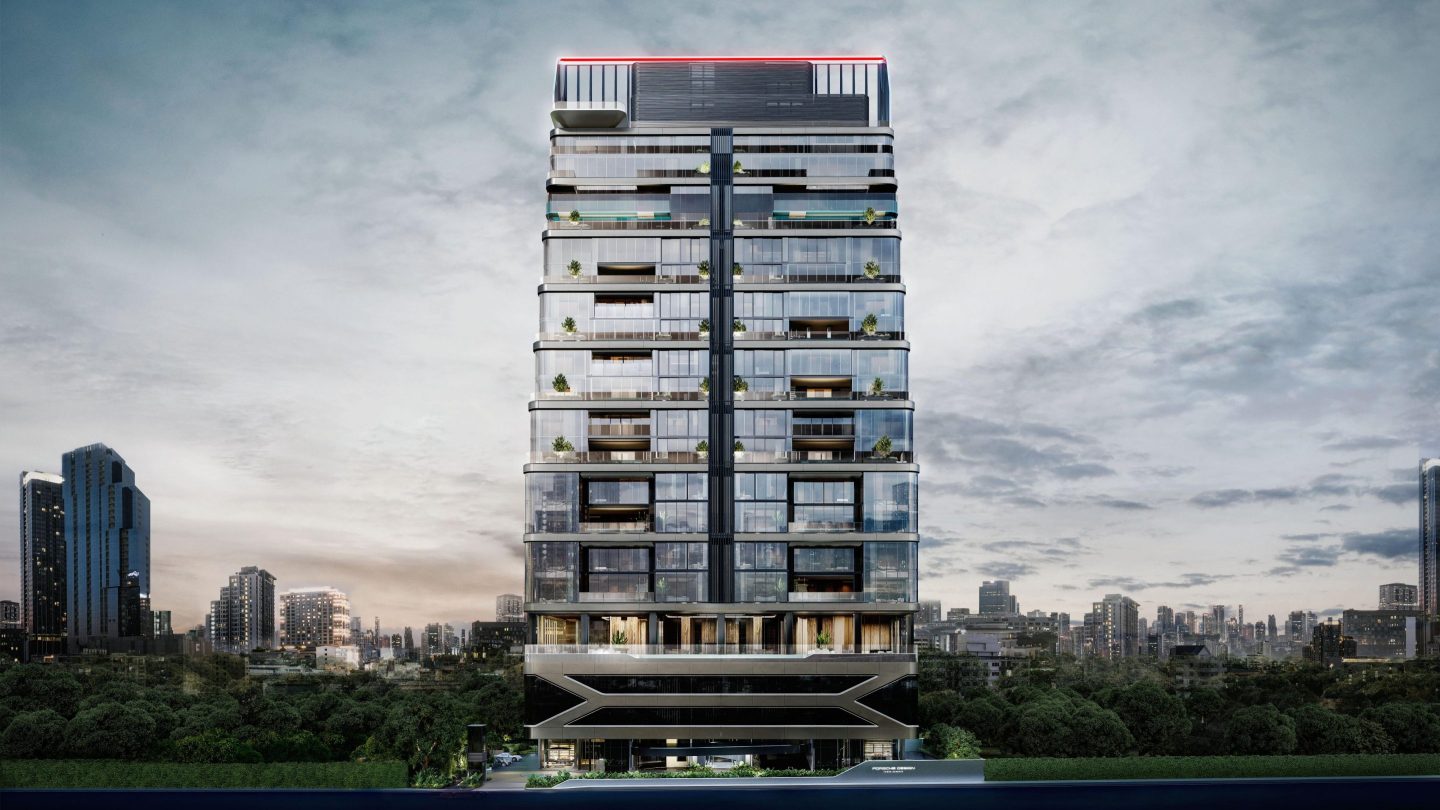
Porsche Design Tower Bangkok has intensified competition in Southeast Asia’s branded residence market after being presented to global yacht collectors at the Singapore Yachting Festival 2026 as a limited-edition property aimed at ultra-high-net-worth buyers seeking design pedigree, privacy and collectible real estate.
The 21-storey tower, rising 95 metres on Sukhumvit 38 in Bangkok’s Thonglor district, is being developed through a collaboration between Porsche Design and Ananda Development. It is the first Porsche Design Tower in Asia and the third worldwide after projects linked to Miami and Stuttgart, placing Bangkok within a small group of cities being used by luxury lifestyle brands to extend their reach beyond products and into residential property.
The project will comprise only 22 duplex and quadplex Sky Villas, with residences ranging from about 525 to 1,135 square metres. Prices have been positioned from about $15 million to $40 million, making the development one of the most expensive residential offerings in Thailand’s capital. Construction is scheduled to begin before completion targeted for the end of 2028, while the show suite in Bangkok is available by private appointment.
The presentation in Singapore marked a sharper effort to reach buyers whose interests overlap with luxury mobility, yachting, design and private collections. Rather than selling the tower as a conventional condominium, the marketing places it in the category of a scarce lifestyle asset. That approach reflects a wider shift in luxury property, where affluent buyers are increasingly drawn to homes that combine brand identity, service standards, security and membership-like exclusivity.
A defining feature of the Bangkok tower is the “Passion Space” concept, a private garage and display area attached to each residence. These spaces are designed for car collections, private gatherings or personal pursuits, and are accessed through a central spiral car ramp known as “The Loop”. The arrangement gives the building its most distinctive automotive link, turning the owner’s vehicle collection into part of the residential experience rather than a separate amenity.
The tower’s design also draws on Porsche cues. Its automated terrace system is inspired by the movement of the Porsche 911 Targa roof, while the exposed “X-Frame” structure takes references from the Mission R concept car. A lit crown at the top of the building is intended to create a night-time signature on Bangkok’s skyline. The interior proposition includes private lifts, large entertainment areas, wellness zones, pools and high-end kitchen and bathroom fittings.
Chanond Ruangkritya, president and chief executive of Ananda Development, has positioned the tower as a project that embeds Porsche’s design language into the structure rather than merely attaching a name to a luxury address. The developer is betting that a small pool of regional and international buyers will pay a premium for scarcity, brand association and the ability to personalise large-scale residences in a prime district.
Bangkok provides a strong setting for that strategy. Thonglor remains one of the capital’s most established luxury neighbourhoods, with restaurants, retail, wellness services and transport links that appeal to wealthy local residents, expatriates and regional buyers. The city has also become an important hub for branded residences, helped by tourism, medical services, international schools and its role as a base for high-net-worth families across Asia.
The project arrives as Thailand’s luxury property market shows a split trend. Mass-market condominium developers have faced weaker purchasing power, tighter lending and slower absorption, while the highest end of the market has remained more resilient because buyers are less dependent on mortgages. Limited freehold land in central Bangkok, rising construction costs and demand for larger, service-rich homes have supported pricing in prime locations.
The ultra-luxury segment, however, is not without risk. A 22-unit tower reduces supply pressure but also narrows the buyer base sharply. Sales depend on a small number of wealthy purchasers who must accept not only high upfront prices but also long-term maintenance costs associated with specialised amenities, private garages and brand-level service expectations. Foreign ownership limits for condominiums in Thailand also restrict the share available to non-Thai buyers.
Follow Arabian Post
Select Arabian Post as your preferred source on Google and MSN News for trusted business news and Arab politics and updates.




