

Arabian Post Staff -Dubai
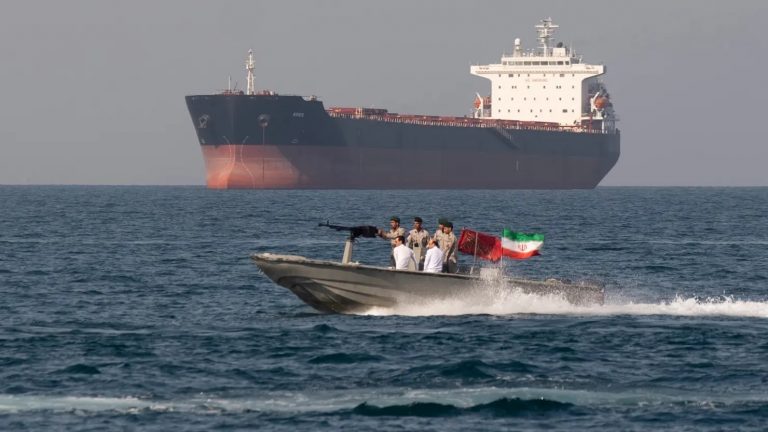
Iran is advancing plans to bar American, Israeli and other designated hostile vessels from the Strait of Hormuz while demanding compensation from countries blamed for attacks on its territory.
A draft law under review by the Iranian parliament’s National Security and Foreign Policy Committee would prohibit vessels linked to the United States and Israel from using the strategic waterway. Ships from other states classified as hostile could also be denied passage unless their governments compensate Iran for military and economic damage.
The proposed legislation would authorise penalties of up to 20 per cent of a ship’s cargo value for violations. It could also block vessels carrying goods connected to military or financial support for Israel, extending Tehran’s restrictions beyond ships flying American or Israeli flags.
The measure is being examined as Iran and Oman negotiate a broader arrangement to restore commercial traffic through the strait. Shipping and energy markets are watching the talks closely because several operational and political issues remain unresolved.
One proposal would direct inbound vessels through waters closer to Iran while outbound traffic would use lanes nearer Oman. The system would give both coastal states a formal role in managing movements through the narrow passage between the Persian Gulf and the Gulf of Oman.
Tehran has sought recognition of its authority over traffic using its territorial waters. Iranian officials have also discussed charging vessels for maritime services, including navigation support, security and emergency assistance. Reports that the agreement would impose a fixed toll based on cargo value have been disputed, leaving the structure of any payments unclear.
Oman has acted as a central intermediary between Iran, the United States and Gulf governments. Muscat’s longstanding relations with Tehran and Washington have made it an important channel for negotiations aimed at preventing further disruption to energy exports.
The talks gained urgency after the United States and Israel attacked Iran in February, triggering months of military confrontation and a severe decline in shipping through Hormuz. Iran responded with strikes across the region and restrictions on vessels connected to its adversaries.
Commercial traffic has increased from the lowest levels recorded during the conflict but remains below normal capacity. Shipowners continue to face elevated insurance costs, security risks and uncertainty over whether any reopening agreement would guarantee equal access.
Before the conflict, about 20.9 million barrels of oil and petroleum products passed through Hormuz each day. The waterway also handled more than one-fifth of global liquefied natural gas trade, most of it exported from Qatar.
Asian economies have the greatest exposure to prolonged disruption. China, India, Japan and South Korea receive a large share of the crude oil and condensate transported through the strait. Limited pipeline alternatives mean that Gulf producers cannot redirect all their exports if maritime traffic is interrupted.
Saudi Arabia and the United Arab Emirates operate pipelines capable of carrying some crude to terminals outside the Persian Gulf. Their combined spare capacity, however, is far below the volume normally shipped through Hormuz. Qatar has no comparable export route for most of its liquefied natural gas.
Iran’s proposed restrictions would face strong legal and diplomatic opposition. International maritime rules provide ships of all states with a right of transit passage through straits used for international navigation. That right is designed to prevent coastal countries from selectively blocking commercial or military vessels.
Iran has signed but not ratified the United Nations Convention on the Law of the Sea. Tehran maintains that foreign warships should seek permission before entering its territorial waters, a position rejected by the United States and several other maritime powers.
Oman has ratified the convention and has generally supported uninterrupted navigation. Any joint management agreement would therefore need to reconcile Iran’s security demands with Oman’s legal commitments and the commercial requirement for predictable access.
The parliamentary initiative could give Tehran additional leverage in the negotiations. It may also complicate efforts to reopen the strait by turning wartime restrictions into a permanent legal framework.
Hardline lawmakers argue that states involved in attacks on Iran should not enjoy unrestricted access to waters under Iranian jurisdiction. More pragmatic officials favour an agreement that restores exports, reduces regional tensions and relieves pressure on Iran’s economy.
Shipping companies will require more than a political announcement before resuming normal operations. Insurers are expected to demand clear guarantees covering mines, drone attacks, vessel seizures, naval confrontations and the treatment of ships carrying cargo for countries opposed by Tehran.
Also published on Medium.
Follow Arabian Post
Select Arabian Post as your preferred source on Google and MSN News for trusted business news and Arab politics and updates.




