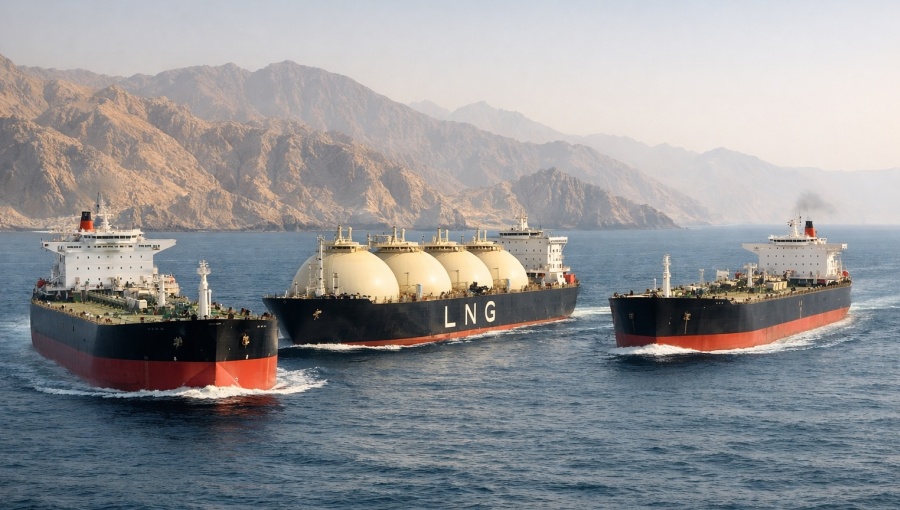
A tanker under U. S. sanctions has passed through the Strait of Hormuz despite Washington’s new maritime restrictions around Iranian ports, raising fresh questions over how tightly the measures can be enforced and how much disruption they will inflict on a waterway central to global energy trade. Shipping data cited by Reuters showed the vessel, Rich Starry, moving through the chokepoint on Tuesday after loading methanol at Hamriyah in the UAE and setting course for China.
The passage matters because Rich Starry is not an ordinary cargo ship. U. S. sanctions records identify the vessel by its former name, Full Star, under the Iran-related sanctions programme, linked to Shanghai Xuanrun Shipping Company Limited. The ship’s IMO number, 9773301, matches the sanctions listing, confirming the identity of the vessel now sailing as Rich Starry.
Washington’s blockade, announced after ceasefire talks with Tehran broke down, was presented as a way to shut maritime access to and from Iranian ports while still permitting neutral vessels travelling to non-Iranian destinations. U. S. and maritime advisories have said the restrictions apply to ships engaged with Iranian ports, oil terminals or coastal facilities, rather than amounting to a blanket closure of all commercial navigation through Hormuz. That distinction is important: Rich Starry’s transit suggests that sanctioned status alone does not automatically prevent movement through the strait when the cargo and voyage do not involve an Iranian port.
Even so, the tanker’s movement is politically sensitive. It comes a day after Reuters reported that vessel-tracking data showed Rich Starry and another tanker, Ostria, turning away as the new U. S. measures took effect. The later successful transit indicates that ship operators, insurers and traders are still testing the operational boundaries of the blockade in real time, recalculating risk as military warnings, sanctions rules and commercial necessity collide in one of the world’s most heavily watched sea lanes.
Another ship adds to that picture. Reuters reported that Murlikishan, also sanctioned by the United States, was heading into the strait and was expected to load fuel oil in Iraq on April 16. That suggests sanctioned tonnage is still attempting to operate around the Gulf, whether because charterers believe the legal risk is manageable, because enforcement remains selective, or because traders are willing to exploit any ambiguity in the rules while the military situation remains fluid.
The broader stakes are far larger than the fate of one methanol cargo. The Strait of Hormuz carries about a fifth of the world’s oil and gas trade, making even limited disruption enough to shake prices, supply chains and political nerves across Asia, Europe and the Gulf. Reuters reported that oil prices moved above $100 a barrel after the blockade announcement, while the International Maritime Organization warned that constrained traffic had already left around 1,600 vessels and 20,000 seafarers stranded in the Gulf.
European leaders have also signalled alarm. European Commission President Ursula von der Leyen said restoring freedom of navigation in the strait was of paramount importance, underlining how quickly the issue has moved beyond a U. S.-Iran confrontation into a wider question of energy security and maritime order. For import-dependent Asian buyers, especially China, every successful passage by a sanctioned vessel is likely to be scrutinised as a clue to whether the blockade will become a hard barrier or a costly but permeable obstacle.
Follow Arabian Post
Select Arabian Post as your preferred source on Google and MSN News for trusted business news and Arab politics and updates.