NANJING, CHINA – Media OutReach Newswire – 26 October 2026 – Nanjing Iron & Steel Co., Ltd. (NISCO) has worked with Huawei and ecosystem partners to commercially deploy the world’s first steel model powered by swarm intelligence—the YuanYe Steel Large Model (YuanYe)—across multiple scenarios at scale. This helps NISCO transition its core operations from relying on experience to being powered by data and intelligence collaboration.

As a traditional manufacturer navigating the challenges of transformation and cost efficiency, NISCO has built a robust digital and intelligent foundation by adopting industry-leading products including Ascend, Kunpeng, Huawei Cloud Stack, and Pangu models. By embedding AI into every core stage of production—ironmaking, steelmaking, rolling, and quality inspection—NISCO is forging green and high-end AI-powered super steel plants.
Unlike general-purpose monolithic models, YuanYe innovatively fuses multiple AI models with the steel industry’s metallurgical mechanism models to create a dual-drive, multi-model cluster architecture. This architecture features a “right brain” for probabilistic computing and a “left brain” for precise and scientific decision-making. Powered by massive amounts of sensing data aggregated from millions of operational technology (OT) data points across 26 business domains, NISCO has achieved real-time digital twin mapping within its intelligent operations center, laying solid data and scenario foundations for YuanYe. This enables the entire steelmaking process to become not only visible, but also capable of precise control and intelligent assessment. Now 100% of NISCO’s key equipment is connected and digitally controlled and its new product R&D cycles have been shortened by 50%, reducing annual costs by over CNY100 million (approx. US$15 million).
As the model continues to iterate, NISCO had launched 25 business agents by October 2026. These agents cover a wide range of scenarios, from visual quality inspection and process optimization to production scheduling and operations management, setting a new benchmark for digital and intelligent steel transformation.

Breakthroughs in four core scenarios: YuanYe redefines traditional operations for significant safety, efficiency, and quality gains
From automating labor to empowering people: Defining a new paradigm of inclusive AI
Li Jinyan, General Manager of the Digital and Intelligent Integrated Development Department and Director of the AI Research Institute at NISCO, said: “Digital and intelligent transformation is inherently human-centric. Its purpose is not to replace people, but to unleash human potential. Our goal is to lift employees out of the endless sea of data, empowering them to direct their creative energy toward work of higher value.” To date, NISCO has deployed over 300 AI models across its plants, alongside more than 1,000 low-code agents and lightweight applications built independently by frontline employees.
As Cheng Yongfu, Senior Industrial Solution Expert at Huawei’s Steel & Non-ferrous BU, noted: “The real value of industrial AI can only be realized when it expands from single-point applications to comprehensive integration with production, operations, and management, which can unlock sustained, scalable empowerment.”
Looking ahead, as model deployment expands and computing demands continue to grow, NISCO will team up with Huawei and other partners to explore the construction of dedicated data centers for smart steel plants. Centered on the AI-native three-tier architecture (AI-native OS, AI-native factory, and AI-native enterprise) and powered by the YuanYe model, NISCO is accelerating high-quality steel development, aiming to provide a replicable and scalable benchmark for the digital and intelligent transformation of the global steel and manufacturing industries.
Hashtag: #Huawei #NISCO
The issuer is solely responsible for the content of this announcement.
SINGAPORE – Media OutReach Newswire – 21 October 2026 – Asia is projected to add 702 million middle-class adults between 2026 and 2036, three-quarters of all middle-class growth in emerging markets, according to a new study from World Data Lab (WDL) and EBANX, a global technology company specializing in payment services for emerging markets.

But this new consumer class will not shop the same way developed-market consumers do: by 2036, only 20% of adults in emerging markets will hold a credit card, against 66% in developed markets.
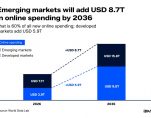
Global online spending is projected to grow from USD 11 trillion in 2026 to USD 25.6 trillion in 2036. Emerging markets add USD 8.7 trillion of that increase (60% of all new online spending), with China (USD +4.7 trillion) and India (USD +1.3 trillion) leading this growth. Indonesia (USD +243 billion), Brazil (USD +249 billion) and Mexico (USD +191 billion) form the next tier.
The categories matter as much as the markets. Online gaming spending in emerging markets grows 14% a year over the decade, the fastest of any category, and SaaS nearly 10%. Emerging markets will generate 76% of global growth in social media spending and 64% in SaaS.
The demographic picture challenges a common assumption. Consumers aged 45 and over account for 51% of emerging markets’ online spending growth through 2036, and spending by those aged 65 and over grows 12% a year, faster than any other age group.
The outlook was discussed during “Navigating Payments: How innovation and fragmentation are changing the game for e-commerce,” a webinar co-hosted by World Data Lab (WDL) and EBANX.
“Over the next ten years, people aged 45 and over will add USD 4.4 trillion in online spending in emerging markets, half of all the growth. Some of them already shop on their phones and will keep doing so as they get older. Others will buy online for the first time in their fifties or sixties. Merchants who build their checkout only for a 25-year-old will miss both groups,” explained Wolfgang Fengler, CEO of WDL.
The study models consumer spending, demographics, and financial access across 184 countries to 2036, drawing on the World Bank’s Global Findex and WDL’s consumer models, combined with EBANX’s experience processing payments for global merchants in emerging markets since 2012.
“If your checkout only takes credit cards, you are competing for one in five adults in emerging markets and conceding the other four”, said Marie-Elise Droga, Chief Revenue Officer of EBANX. “The merchants growing fastest with us didn’t wait for cards to arrive: they added the payment rails their customers already use, and they’re taking new buyers, bigger baskets and recurring revenue that card-only competitors can’t even see.”
834 million new online buyers, 281 million new credit cards
Between 2026 and 2036, the global economy will add 834 million online buyers but only 281 million credit card holders—a ratio of nearly three to one. In emerging markets, two in three new online buyers (67%) will arrive without a credit card. Adults without it already account for 55% of online spending in emerging markets, a share that rises to 90% in India and 93% in Sub-Saharan Africa. Credit cardless adults also represent 52% to 59% of spending in every digital category, from gaming and SaaS to streaming and travel.
Digital payment use is also running ahead of online shopping. Of the 2.6 billion emerging-market adults spending between USD 6 and USD 25 a day, 70% already pay merchants digitally while only 33% buy online, leaving at least 957 million digitally active consumers who are not yet online buyers. Many hold a bank account or mobile wallet but no card that works at an international checkout.
“This is closely tied to the innovation that came out of the financial industry in emerging markets, which developed solutions for an increasingly mobile economy and for the habits of local consumers. Today, we call them local payment methods, or LPMs, and they allowed e-commerce growth to decouple from the credit card, which still has very low penetration in these countries,” said Estelita Hass, head of Market Intelligence at EBANX.
Subscriptions are the next frontier — and India shows why
Recurring categories such as streaming, SaaS and online education will reach USD 2.1 trillion a year in emerging markets by 2036, with USD 1.1 trillion coming from adults without a credit card. In India, 82% of recurring online spending will be cardless. Account-based recurring rails are beginning to close that gap: a global SaaS company saw a 20% uplift in new subscribers after adding UPI at checkout in India, and cybersecurity company Nord Security now generates 28% of its revenue in Brazil through Pix Automático, Brazil’s recurring instant payment, six months after launching it with EBANX.
The webinar presentation is available at [LINK].
Hashtag: #EBANX #WorldDataLab #Fintech #Payments #EmergingMarkets #Consumers
The issuer is solely responsible for the content of this announcement.
EBANX is the leading technology platform connecting global businesses to the world’s fastest-growing digital markets. Founded in 2012 in Brazil, EBANX was built with a mission to expand access to international digital commerce. Leveraging proprietary technology, deep market expertise, and robust infrastructure, the platform enables global businesses to offer hundreds of local payment methods and streamline cross-border payments across Latin America, Africa, and Asia. With a global footprint, it established a technology and regulatory headquarters in Singapore in 2026. More than just payments, EBANX drives growth, enhances sales, and delivers seamless purchase experiences for businesses and end users alike.
For further information, please visit:
Website:
https://ebanx.com/en/
LinkedIn:
https://www.linkedin.com/company/ebanx/
Microsoft, Alphabet and McDonald’s are among 22 publicly traded companies objecting to plans to offer blockchain-based versions of their shares on a proposed US trading platform, complicating a venture backed by cryptocurrency exchange OKX and New York Stock Exchange owner Intercontinental Exchange. The opposition widened on Friday when six more companies, including Wells Fargo, Arm Holdings and Intuit, joined the list of issuers resisting the proposed OKXICE […]
Brazilian President Luiz Inácio Lula da Silva has secured an unprecedented fourth term after defeating right-wing challenger Flávio Bolsonaro in a closely contested presidential runoff, although his opponent has refused to accept the result. Brazil’s Superior Electoral Court confirmed that Lula, representing the Workers’ Party, received 51.79 per cent of valid votes against 48.21 per cent for Bolsonaro, a senator from the Liberal Party. The final tally […]
Electrum has patched a security flaw that allowed malicious servers to divert bitcoin payments when wallet users attempted to increase transaction fees, after developers confirmed at least one theft. The developers released version 4.8.3 on 24 October and urged users of earlier versions to upgrade. Their security advisory classified the vulnerability as high severity and said some servers had exploited it against customers. Two users reported suspicious […]
These awards celebrate the most inspirational initiatives and developments in land, real estate, construction and infrastructure, recognising outstanding achievement, teamwork and corporate excellence. This year’s entrants have contributed to some of Hong Kong’s largest projects, including driving investment into the commercial sector, delivering essential infrastructure and leading sustainable practices.
Guest of Honour, Mr. TAI Sheung Shing, Victor, JP, Under Secretary for Housing, Housing Bureau, The Government of the Hong Kong Special Administrative Region, kicked off the ceremony with a speech recognising chartered surveyors for their significant contributions to the built environment. Additionally, the event welcomed Mr. David Lam, JP, Under Secretary for Development, Development Bureau, The Government of the Hong Kong Special Administrative Region, as a Presentation Guest at the Gala Dinner, to jointly witness this important occasion.
“These awards are about excellence. Excellence in our profession is about much more than a successful transaction, a well-delivered project or an impressive building. It is about the judgement behind a difficult decision. The integrity to give the right advice, even when it is not the easiest advice to give. And the commitment to leave a place, a business or a community better than we found it. ” said Ms. Ada Fung FRICS, Judging Chair of RICS Hong Kong Awards 2026. “For those of us working in Hong Kong, these qualities matter enormously. Our city never stands still, and neither can our profession. We must help clients navigate uncertainty, make better use of our built environment, and turn long-term ambitions into practical results.”
The RICS Annual Lifetime Achievement Award was presented to Mr. Philip Lo FRICS, a Steward of the Hong Kong Jockey Club. Mr. Lo is a former Chairman of Rider Levett Bucknall China and Hong Kong. He is a fellow of RICS and served on the RICS UK Management Board from 2011 to 2016, alongside his extensive leadership roles within RICS Hong Kong. He remains deeply committed to public service, currently holding key roles with the Hong Kong Housing Authority and the Hong Kong Housing Society, as well serving as an Adjunct Professor at The University of Hong Kong.
“Our profession is unique. We may not always have our names on the buildings, but we know every building carries our fingerprints. More importantly, through the built environment, we have the opportunity not only to create buildings and infrastructure, but also to shape communities, improve lives and contribute to the long-term development of society. That sense of purpose has always been one of the most rewarding aspects of my career.” said Mr. Philip Lo FRICS.
Results of RICS Hong Kong Awards 2026:
Project award categories
1. Commercial Property Project of the Year
2. Corporate Social Responsibility Project of the Year
Team award categories
3. Agency Team of the Year
4. Construction Project Management Team of the Year
5. Facilities Management Team of the Year
6. Property Management Team of the Year
7. Quantity Surveying Team of the Year
8. Refurbishment / Revitalisation Team of the Year
9. Research Team of the Year
10. Valuation Team of the Year
Special category awards
11. Best Deal of the Year
12. Environmental Impact Award
13. Proptech Innovation of the Year
Individual awards
14. Emerging Achiever of the Year
15. Lee Ming Kiu, Owen MRICS, Resident Engineer, AECOM
The full RICS Hong Kong Awards Winners list is available at: https://www.rics.org/training-events/rics-awards/hong-kong-awards
High resolution photos are available at: https://drive.google.com/drive/folders/1c2FnfB9S-IXgcfj8SGXAFe6RP16oQFlA?usp=sharing
Notes for editors:
RICS Hong Kong Awards 2026 is sponsored by:
Hashtag: #RICS
The issuer is solely responsible for the content of this announcement.
The RICS Awards Hong Kong showcases outstanding achievements and developments in Hong Kong’s land, property and construction industries and across the built environment. The awards are open to everyone working within the property profession. The jury panel of the RICS Awards 2026 Hong Kong is formed by fourteen outstanding local industry leaders. Nominated projects have all displayed outstanding performance in professionalism, outcome & achievement, teamwork & collaboration and thought innovation.
About RICS
We are RICS. As a member-led chartered professional body working in the public interest, we uphold the highest technical and ethical standards.
We inspire professionalism, advance knowledge and support our members across global markets to make an effective contribution for the benefit of society. We independently regulate our members in the management of land, real estate, construction and infrastructure. Our work with others supports their professional practice and pioneers a natural and built environment that is sustainable, resilient and inclusive for all.