

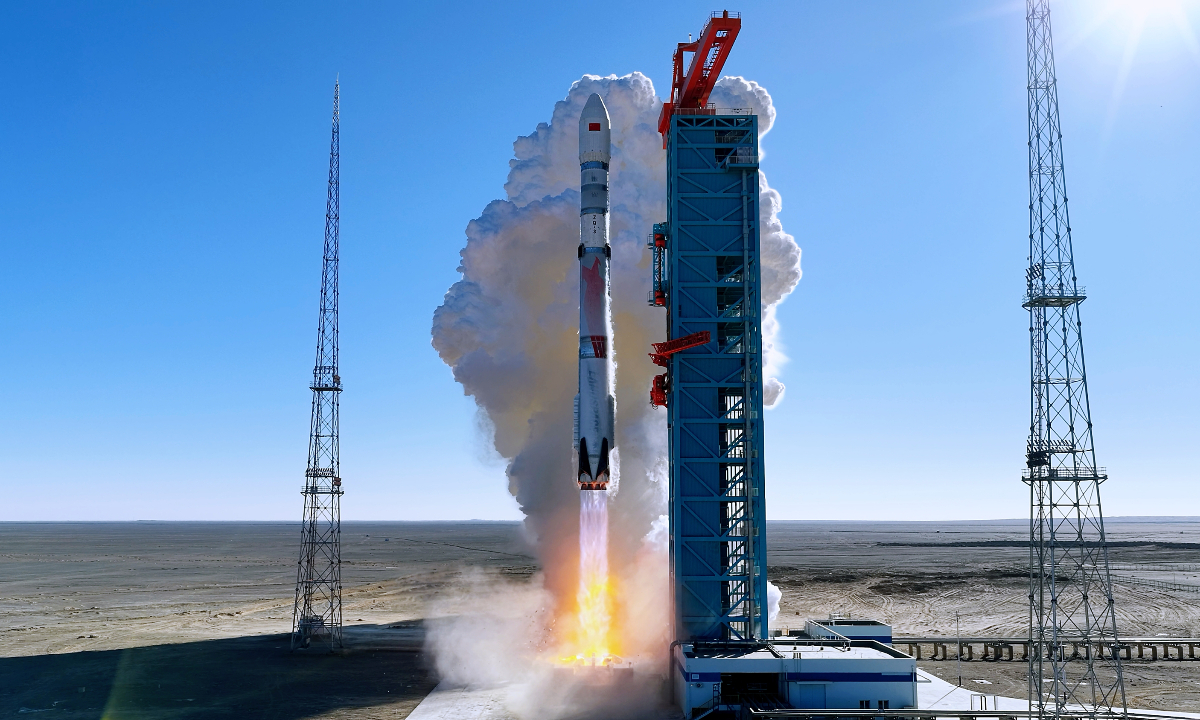
Beijing has pushed its reusable space programme a step further with the launch of an experimental spacecraft that state media described as a technology-verification mission, underlining how the country is trying to cut launch costs, raise flight tempo and broaden the range of missions it can carry out in orbit. The spacecraft was launched on 7 February aboard a Long March-2F rocket from the Jiuquan Satellite Launch Center in northwest China, in what was the fourth publicly disclosed mission of this type since 2020.
Chinese authorities released only a brief account of the flight, saying the spacecraft would verify reusable-spacecraft technologies and support the peaceful use of space. No official duration was given, and no details were provided on the systems being tested, the orbit reached or the vehicle’s configuration. That secrecy has become a hallmark of the programme and makes it difficult to judge exactly how far the technology has advanced, but the pattern of repeated flights suggests a sustained effort rather than a one-off demonstration.
Chronology matters here. China’s first disclosed flight in September 2020 lasted about two days. A second spacecraft launched in August 2022 stayed in orbit for 276 days before landing in May 2023. A third mission, launched in late 2023, returned in September 2024 after 268 days in orbit. Those longer flights point to growing confidence in long-duration autonomous operations, recovery procedures and mission endurance. Outside observers have often compared the craft with the United States’ X-37B-style approach to reusable uncrewed orbital vehicles, though Beijing has not publicly confirmed such comparisons.
This mission also fits into a much wider acceleration in Chinese space activity. On 7 April, China used a Long March-8 rocket from the Hainan commercial launch site to place 18 internet satellites into orbit for the Qianfan constellation. On 11 April, it carried out a sea launch using a Smart Dragon-3 rocket from waters off Guangdong, sending up a test satellite aimed at supporting satellite internet technology. Taken together, those launches show a programme expanding on several fronts at once: reusable vehicles, commercial launch infrastructure and large low-Earth-orbit communications networks.
Beyond low-Earth orbit, China is tying these advances to a broader national space agenda. Beijing is aiming for a crewed lunar landing by 2030 and is developing the Long March-10 rocket, the Mengzhou spacecraft and the Lanyue lunar lander for that effort. At the same time, the Chang’e-7 lunar probe is scheduled for launch in the second half of 2026. That means the reusable-spacecraft programme should be viewed less as an isolated experiment than as one part of an expanding architecture that spans launch systems, spacecraft design, lunar exploration and space-based connectivity.
Money and industrial policy are also shaping the picture. Reuters has reported that Beijing is funnelling more support towards private launch companies as it tries to build capacity for large satellite constellations and reduce reliance on state-owned providers alone. CAS Space has targeted fresh capital for reusable rocket research, while LandSpace and other firms are also turning to capital markets. Separate policy changes have given reusable-rocket developers a faster route to listing, provided they meet technical milestones, showing how closely commercial launch activity is now aligned with national strategic goals.
Yet the programme’s momentum should not be mistaken for mastery. China is advancing, but it is still chasing a lead established by SpaceX in frequent booster recovery and reflight. On 3 April, Space Pioneer said the maiden flight of its Tianlong-3 reusable rocket had failed, and Reuters reported that no Chinese firm had yet demonstrated the ability to recover and reuse a rocket’s main stage. LandSpace plans another recovery test for its Zhuque-3 rocket this year, while the Long March-12B reusable rocket completed a static firing test in January ahead of later flight missions. Progress is visible, but so are the engineering gaps.
Follow Arabian Post
Select Arabian Post as your preferred source on Google and MSN News for trusted business news and Arab politics and updates.




