

Arabian Post Staff -Dubai
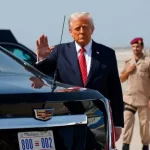
Speaking in Garden City, New York, on Friday, Trump acknowledged the pressure that rising fuel costs were placing on households but argued that preventing Tehran from developing nuclear weapons justified the additional expense. Americans who had to “pay a tiny little bit more for your gasoline” should remember that the price was connected to confronting what he described as “a very evil country”.
The remarks mark a politically sensitive shift for a president who campaigned on promises to lower energy and household costs. Gasoline prices have climbed sharply since the conflict with Iran disrupted oil flows from the Gulf, complicating the White House’s effort to persuade voters that its economic policies are improving living standards.
Trump also intensified his rhetoric over the Strait of Hormuz, saying the United States would declare the strategically vital waterway American territory “pretty soon”. He offered no legal mechanism for such a declaration and did not explain how Washington could establish sovereignty over a strait bordered by Iran and Oman.
Iran rejected the suggestion, insisting that US statements could not alter the legal status of the waterway. Iranian officials have maintained that Tehran retains authority over its territorial waters and have warned Washington against attempting to impose unilateral arrangements governing shipping through the strait.
International maritime rules treat Hormuz as a strait used for international navigation. Its waters fall within the jurisdiction of Iran and Oman, while vessels enjoy navigation rights under the framework governing international straits. Any attempt by Washington to claim the passage as US territory would therefore face formidable diplomatic and legal obstacles as well as opposition from regional governments.
The confrontation matters far beyond the dispute over sovereignty. Before the war, more than 20 million barrels of crude oil and petroleum products moved through Hormuz each day, equivalent to about one-fifth of worldwide petroleum consumption. Traffic has fallen dramatically during the conflict, with oil flows through the strait averaging about 4.9 million barrels a day during the second quarter of 2026.
Reduced Gulf shipments have forced producers and traders to redirect cargoes through pipelines and alternative maritime routes. Energy markets remain vulnerable to renewed attacks on commercial vessels and any further tightening of passage through Hormuz. Oil inventories have also fallen as producers have been unable to move significant volumes to overseas customers.
The disruption has fed directly into US fuel costs. National gasoline prices returned to around $4 a gallon during July as hostilities intensified, after Trump had repeatedly promised voters that expanding domestic energy production and changing federal policies would bring prices down. Gasoline prices were about 29 per cent higher than a year earlier when Trump delivered his Garden City remarks.
Energy costs are also feeding into the broader political debate over inflation. Consumer prices rose 3.4 per cent over the year to July, slower than the previous month but still above the Federal Reserve’s target. Energy prices remained substantially higher than a year earlier despite some easing during July.
The combination of fuel costs, tariffs and persistent food-price pressures has given Democrats an opening ahead of the November midterm elections. Democratic candidates are increasingly linking household expenses to Trump’s decision to wage war against Iran, arguing that voters are paying for a conflict whose duration and financial consequences have exceeded early expectations.
Public opinion has become another concern for Republicans. Surveys have indicated weakening confidence in Trump’s handling of the cost of living, while support for the Iran campaign has remained limited. Economic issues continue to rank among voters’ leading concerns as control of Congress hangs in the balance.
Republicans have countered that eliminating Iran’s nuclear threat and restoring secure navigation through Hormuz would ultimately stabilise energy markets. The administration argues that sustained military and economic pressure can force Tehran into concessions and reopen Gulf export routes on terms that protect international shipping.
Trump has meanwhile signalled further economic action against Iran. His administration is preparing additional sanctions intended to deepen pressure on Tehran alongside military operations and restrictions affecting maritime trade.
Also published on Medium.
Follow Arabian Post
Select Arabian Post as your preferred source on Google and MSN News for trusted business news and Arab politics and updates.




