Arabian Post Staff -Dubai
Adhraa Al Mansoori, Executive Director of Commercial at Etihad Rail, said the station’s location was chosen for its proximity to major landmarks and transport links. It is about 12 minutes from Fujairah International Airport, six minutes from Umbrella Beach Corniche and five minutes from Sakamkam Fort, positioning it to serve commuters, visitors and domestic tourism traffic.
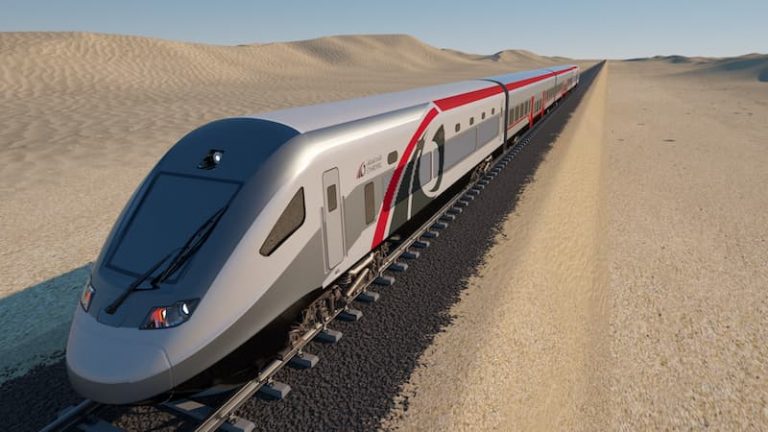
The first phase of passenger services will launch simultaneously on three routes connecting Abu Dhabi, Dubai and Fujairah, with timetables to be announced through official channels closer to the start of operations. The Fujairah-Abu Dhabi journey is expected to take about 105 minutes, with trains capable of speeds of up to 200km/h and capacity for up to 400 passengers.
The station includes retail areas, a VIP lounge, high-speed Wi-Fi, onboard dining support, automated payment machines, waiting areas, directional signage and a passenger service office. Its design reflects the company’s attempt to build rail travel around airport-style convenience while integrating with local road and public transport links.
Etihad Rail’s passenger network is planned to connect 11 cities and regions across the UAE through stations in Abu Dhabi, Dubai, Sharjah, Fujairah, Al Sila, Al Dhannah, Al Mirfa, Madinat Zayed, Mezaira’a, Al Faya and Al Dhaid. The first four station locations announced earlier were Mohammed Bin Zayed City in Abu Dhabi, Jumeirah Golf Estates in Dubai, University City in Sharjah and the Al Hilal area in Fujairah.
Officials have framed the rollout as a shift in inter-emirate mobility, offering a scheduled alternative to road travel at a time when population growth, tourism expansion and logistics activity are placing pressure on highways. Once the network is fully operational, passenger ridership is projected to reach more than 36.5 million annually by 2030.
The project is also being presented as an economic platform for Fujairah. Improved access to the emirate is expected to support investment in hospitality, retail, real estate and services, while strengthening its links with business centres in Abu Dhabi and Dubai. Al Mansoori said 70 per cent of materials used in the national railway network were sourced locally through 97 domestic suppliers, underlining the project’s role in supporting supply chains within the country.
Etihad Rail has moved from freight operations to passenger readiness over several years. The national freight network has been operating commercially and has already linked industrial zones, ports and logistics hubs. Passenger services are intended to use the same broader 900km national rail backbone, shifting the system from a freight-focused asset into a public transport network.
The company has said its trains will include ergonomic seating, Wi-Fi coverage, power outlets and modern interiors. Ten of the 13 passenger trains have arrived in the UAE and have undergone testing and certification, while services are expected to operate on fixed schedules designed to reduce journey uncertainty between cities.
The passenger operation will also depend on integration with local transport systems. Stations are being designed to connect with buses, taxis, car parks and urban transit corridors, including Dubai’s Jumeirah Golf Estates area, where future interchange with metro services is expected to strengthen last-mile access.
Keolis, the international public transport operator, has been brought in to support passenger operations, including service management, staffing and multimodal connections. The partnership reflects the technical complexity of moving from infrastructure completion to reliable daily service, where punctuality, ticketing, safety, station management and passenger assistance will determine public confidence.
Also published on Medium.
Follow Arabian Post
Select Arabian Post as your preferred source on Google and MSN News for trusted business news and Arab politics and updates.