

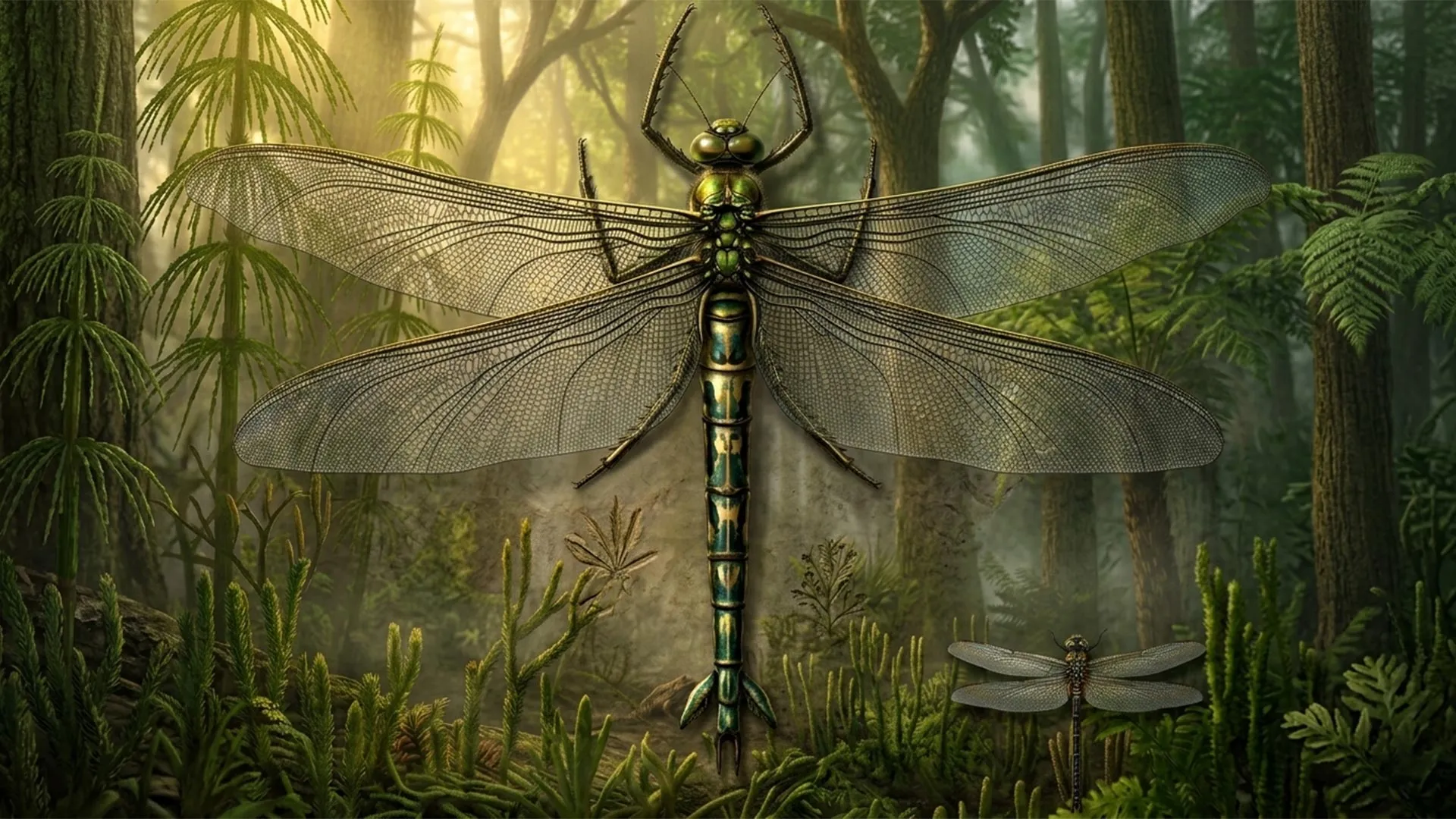
Giant prehistoric insects may not have owed their extraordinary size to oxygen-rich air after all, after new research challenged one of palaeobiology’s most familiar explanations for why dragonfly-like creatures with wingspans approaching 70cm once flew over Earth’s coal-swamp forests.
A peer-reviewed study published in March 2026 found that the flight muscles of large insects were not constrained by the oxygen-delivery system long assumed to limit their size. The findings weaken the argument that high atmospheric oxygen alone allowed insects of the late Palaeozoic era to reach dimensions far beyond those of living species, forcing researchers to look again at predators, exoskeleton mechanics and other evolutionary pressures.
For decades, the prevailing theory rested on a strong geological coincidence. Around 300 million years ago, when vast tropical coal forests covered equatorial Pangaea, atmospheric oxygen was far higher than today’s 21 per cent. Fossils from that world include mayfly-like insects with wingspans of about 45cm and griffinflies, extinct relatives of dragonflies, with wingspans of about 70cm. The apparent overlap between oxygen-rich air and insect gigantism made the hypothesis persuasive.
Unlike mammals and birds, insects do not use lungs to move oxygen through blood. They rely on a branching network of air tubes known as tracheae, ending in fine tracheoles that deliver oxygen directly to muscle cells. Since flight is energetically demanding, scientists had reasoned that very large insects would need unusually high oxygen levels to fuel their flight muscles.
The new work tested that assumption at the level where the oxygen demand is greatest. Researchers used high-resolution electron microscopy to examine how tracheoles supply oxygen to insect flight muscle across species of different sizes. They found that these tiny airways usually occupy only 1 per cent or less of the flight muscle. Even when the relationship was extended to the scale of 300-million-year-old griffinflies, the space requirement remained modest.
That result matters because a true oxygen bottleneck should leave clear anatomical evidence. Larger insects would be expected to devote substantially more muscle space to oxygen-delivery structures if flight muscles were close to their physiological limit. Instead, the study indicates that insects had considerable room to increase tracheole investment without compromising muscle function.
Edward Snelling, who led the research, said the findings require a reassessment of textbook explanations for what limits insect body size. His argument is that if oxygen set the upper limit, the evidence should be visible within the tracheolar network. The study found some size-related compensation, but not enough to support oxygen as the decisive constraint.
Roger Seymour, part of the research team, drew a comparison with birds and mammals, where capillaries in cardiac muscle occupy roughly ten times the relative space taken up by insect tracheoles in flight muscle. That comparison strengthens the case that insects could have expanded their oxygen-supply network if muscle oxygen delivery had truly been the main barrier.
The findings do not mean oxygen played no role in insect evolution. Some researchers still argue that limits may occur upstream of the tracheoles, in larger airways or across other parts of the body. Oxygen may also have shaped development, metabolism, fire ecology and the broader environment in which giant insects evolved. What the study rules out more directly is the idea that oxygen diffusion inside flight-muscle tracheoles was the key factor preventing today’s insects from becoming similarly huge.
That distinction leaves the disappearance of giant insects open to competing explanations. One possibility is predation. As flying vertebrates diversified, especially early reptiles, pterosaurs and later birds, large slow-manoeuvring insects may have faced greater survival pressure. Smaller body size could have offered better agility, faster life cycles and lower vulnerability.
Another possibility lies in structure. Insects wear their skeletons externally, and scaling up an exoskeleton creates mechanical problems different from those faced by animals with internal skeletons. Weight, moulting difficulty, wing loading and the stress placed on joints may all impose hard limits as insects grow. A body plan that works efficiently at small scale does not necessarily remain viable at much larger dimensions.
The study also carries implications beyond fossil curiosity. Insects are the most diverse animal group on Earth, and understanding the limits of their body size helps researchers interpret how they respond to climate change, habitat disruption and shifts in oxygen, temperature and ecological pressure. Their physiology is tightly linked to the environment, but the new evidence suggests the relationship is more complex than a single oxygen dial.
Follow Arabian Post
Select Arabian Post as your preferred source on Google and MSN News for trusted business news and Arab politics and updates.




