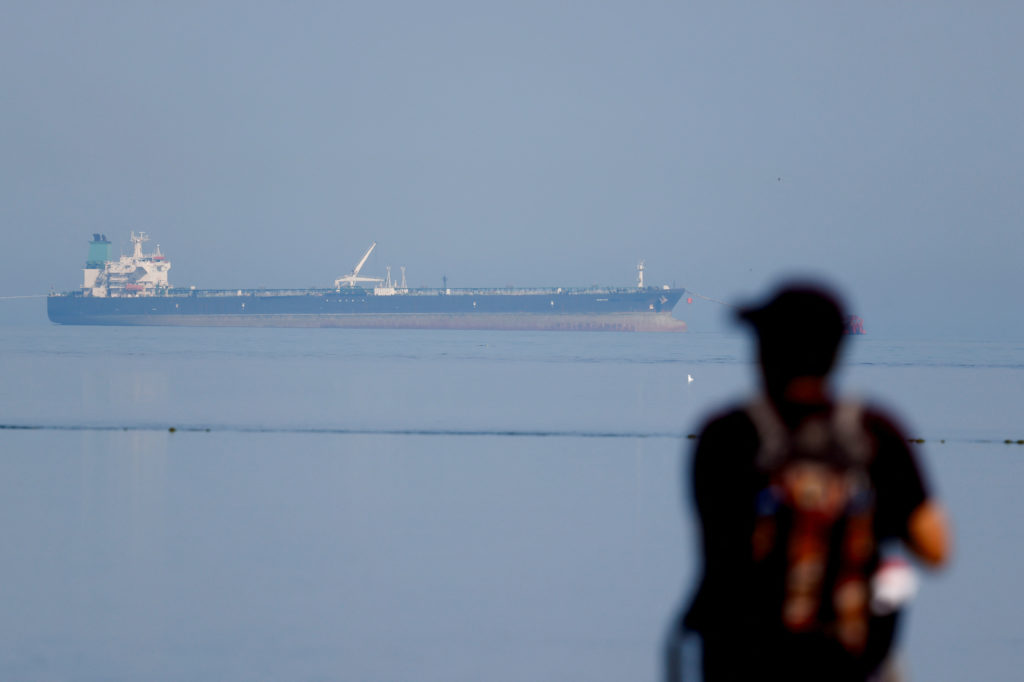
Two empty supertankers heading towards the Persian Gulf reversed course near the Strait of Hormuz on Sunday, underscoring how quickly shipping sentiment can turn when diplomacy falters in one of the world’s most sensitive energy corridors. The movements came as talks between Washington and Tehran in Islamabad ended without agreement, leaving a fragile ceasefire under strain and traders, shipowners and refiners facing renewed uncertainty over access to Gulf crude.
The failed negotiations followed 21 hours of discussion between delegations led by US Vice President JD Vance and Iran’s parliament speaker Mohammad Bagher Qalibaf. The central disputes included Tehran’s refusal to meet American demands over nuclear weapons and wider arguments over navigation, control and conditions in the Strait of Hormuz. Both sides departed Pakistan without announcing a framework for further talks, a setback for mediation efforts that had briefly raised hopes of a more stable passage for commercial traffic.
That diplomatic breakdown is being watched far beyond the Gulf because Hormuz remains a critical artery for global oil and liquefied natural gas flows. Reuters reported a day earlier that the waterway handles roughly a fifth of global oil and LNG shipments, making even temporary disruption capable of lifting freight costs, raising insurance premiums and unsettling benchmark crude prices. The reversal of empty tankers is especially telling because ballast voyages into the Gulf are normally a sign that loading programmes are resuming. When those ships turn away at the last moment, it suggests owners or charterers judge the risk to have shifted abruptly.
Shipping data over the weekend had offered a more encouraging picture. Three fully laden oil supertankers managed to transit the strait on Saturday, the first such movements since the conflict began in late February, while several empty tankers also started moving in to load cargoes. Hundreds of vessels, however, were still reported to be stranded or waiting for greater clarity, showing that trade has not returned to normal even during the ceasefire window. Sunday’s U-turns therefore appear less an isolated navigation choice than a fresh warning that confidence in the route remains highly conditional.
The wider military picture adds to the unease. Reuters reported that the US military has begun setting conditions to clear mines from the strait, with American warships moving through the passage as part of an effort to establish safer navigation. President Donald Trump said US forces had attacked Iran’s mine-laying capability and started clearing the channel. Even if commercial shipping can resume in limited fashion, such operations point to a waterway still being treated as an active security theatre rather than an ordinary trade route.
Iran’s position has also complicated the outlook. In earlier reporting, Tehran signalled that vessel passage during the truce would be subject to military coordination and tighter regulation, while separate accounts described arguments over tolls and conditions for reopening the route. Those proposals have alarmed maritime and energy markets because they raise the possibility that access to Hormuz could become entangled in prolonged bargaining rather than restored under predictable international norms. For tanker operators, uncertainty over rules can be almost as disruptive as outright closure, since chartering decisions depend on knowing whether a voyage can be completed on schedule and at insurable risk.
Commercial caution is already visible among large operators. Maersk said earlier this week that the ceasefire might create transit opportunities but did not provide the maritime certainty needed for a return to routine regional services. The group has kept a close watch on official guidance and risk conditions, reflecting a wider industry approach in which owners will move selectively, often only after additional naval protection, war-risk cover and charter-party adjustments are in place. Such caution can ripple through the supply chain, affecting everything from Gulf crude exports to refined product deliveries and containerised cargo routed via regional ports.
For oil markets, the significance of Sunday’s tanker reversals lies not only in the ships themselves but in what they signal about sentiment. Traders can absorb conflict headlines for a time, but physical shipping behaviour is harder to dismiss. When laden tankers move through, markets see proof that barrels are still flowing. When empty vessels hesitate before entering, it suggests future loading cycles could be interrupted, which in turn sharpens concern over availability, freight and timing. That matters for Asian buyers in particular, as Gulf producers remain central to supply balances across the region.
Follow Arabian Post
Select Arabian Post as your preferred source on Google and MSN News for trusted business news and Arab politics and updates.