

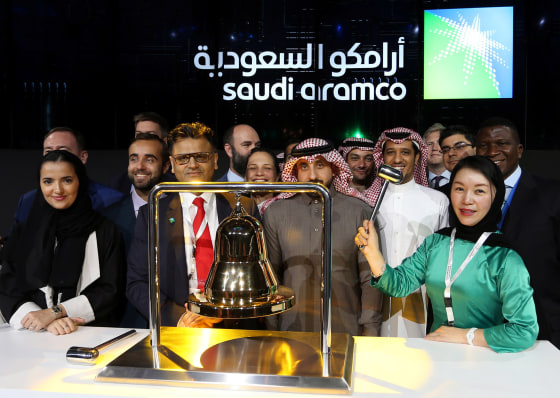
Saudi Aramco’s initial public offering has become one of the most talked-about events in global finance, with its ambitious approach to market entry setting a precedent for the world’s largest oil company. The IPO, which was launched in 2019, sought to achieve a staggering $2 trillion valuation, a figure that stirred controversy and scepticism within financial circles. But despite its high-profile marketing campaign and the sweeping promises made to investors, the IPO has struggled to deliver on the expectations set by the Saudi royal family.
The IPO was heralded by some of the most lavish promotional efforts in history. Bankers, financial advisors, and government officials worked tirelessly to drum up interest among institutional and retail investors. At the heart of the campaign was the claim that those who did not buy into the Aramco listing would regret it, with one senior member of the Saudi royal family stating that those who missed out would be “chewing their thumb” with regret.
However, the IPO failed to achieve the anticipated $2 trillion valuation at the time of listing. Instead, Aramco’s valuation was set at $1.7 trillion, a figure still incredibly high but notably lower than what had been initially projected. This discrepancy raised questions about the pricing strategy and whether the market was truly prepared to pay such a premium for Aramco’s stock.
Despite this, the IPO went ahead, and the company was listed on the Tadawul stock exchange in Riyadh in December 2019, with shares priced at 32 riyals each. On its first day of trading, Aramco’s stock saw a notable surge, briefly touching a valuation of $1.9 trillion. While this initial rise gave the impression of a successful listing, the stock’s performance since then has been less spectacular.
After the IPO, Aramco’s share price stabilised but failed to maintain the excitement generated in the run-up to the listing. The company’s stock has been volatile, reflecting broader trends in the oil market, where prices have been influenced by a mix of geopolitical factors, supply-demand imbalances, and the transition to renewable energy. As a result, Aramco has not been able to reach the $2 trillion mark, and the promise of immense returns to investors has remained elusive.
A significant part of the issue lies in the broader global trend of declining oil prices and the changing dynamics of the energy sector. With global demand for fossil fuels facing long-term pressures due to environmental concerns and the growing influence of green energy alternatives, Aramco’s reliance on oil as its main source of income has put its future growth potential under scrutiny.
The Aramco listing was designed to help diversify Saudi Arabia’s economy, which is heavily dependent on oil revenue. Crown Prince Mohammed bin Salman, the de facto ruler of Saudi Arabia, has spearheaded a Vision 2030 initiative aimed at reducing the kingdom’s reliance on oil by fostering investments in non-oil sectors like technology, tourism, and entertainment. The IPO was viewed as a key component of this strategy, with the sale of Aramco shares expected to raise tens of billions of dollars to fund these diversification efforts.
However, the political and economic uncertainties surrounding the Middle East, including the ongoing tensions in the region, have added an extra layer of complexity to Aramco’s performance. Investors have expressed concerns about the geopolitical risks inherent in doing business in a region that has seen fluctuating oil prices and security threats.
Aramco’s challenges in meeting the lofty valuation expectations have had broader implications for the Kingdom’s broader economic strategy. While the IPO did raise substantial capital for the Saudi government, it also demonstrated the difficulty in realising the $2 trillion target that had been the cornerstone of the offering. This shortfall raised questions about the viability of similar future IPOs for state-owned assets and the pace at which the Saudi government can diversify its economy away from oil.
Despite these setbacks, the Saudi government has maintained confidence in Aramco’s long-term prospects. The company continues to be a dominant player in the global energy market, with its vast reserves and production capacity securing its position as the world’s largest oil company. Moreover, Aramco has maintained a strong dividend payout, attracting income-focused investors. The company’s resilience in weathering the storm of oil market volatility has helped sustain investor interest.
Follow Arabian Post
Select Arabian Post as your preferred source on Google and MSN News for trusted business news and Arab politics and updates.




