Intel, Oracle, IBM and quantum computing company IonQ have objected to plans to trade blockchain-based versions of their shares through a venture backed by cryptocurrency exchange OKX and Intercontinental Exchange, raising the number of opposing companies to 26. The four names appeared in an updated public notice dated 26 October from OKXICE, the proposed trading venue jointly owned by Intercontinental Exchange, which operates the New York Stock […]
China could become the global leader in advanced artificial intelligence models by 2030 while matching or challenging other countries across strategically important technologies, according to a new assessment by Bloomberg Intelligence.
The forecast identifies large language models, which underpin generative AI applications, as an area where China is particularly well positioned to establish leadership. It also anticipates that Chinese companies and research institutions will become at least competitive across other critical technology sectors, potentially reshaping the balance of technological capabilities between Beijing and Washington.
The assessment comes as Chinese AI developers narrow the performance gap with American competitors despite restrictions on access to advanced semiconductors. Improvements in model efficiency, expanding domestic computing infrastructure and competitive pricing have strengthened China’s position in the global market.
Bloomberg Intelligence senior analyst Robert Lea identified a sharp improvement in Chinese model performance earlier this month. Leading Chinese systems trailed their American counterparts by approximately 3% on benchmark scores, compared with around 9% in May and 15% earlier this year.
That narrowing gap followed the September introduction of DeepSeek’s V4.1 Flash model, which demonstrated further advances in reasoning and computational efficiency. The findings suggest that restrictions on sophisticated American chips have not prevented Chinese developers from improving their systems.
The projections nevertheless remain conditional on technological progress, investment and commercial adoption over the next four years. Competitive performance in individual benchmarks does not necessarily establish overall leadership, particularly when computing capacity, profitability and enterprise deployment are considered.
China’s expanding capabilities are already influencing international adoption patterns. Models developed by DeepSeek, Alibaba and Moonshot AI have attracted developers seeking alternatives to comparatively expensive proprietary systems offered by American technology companies.
Data from OpenRouter, a platform providing access to multiple AI models, showed Chinese systems gaining substantial shares of usage during 2026. However, the figures represent activity through that platform rather than the entire global market, where direct subscriptions and enterprise contracts remain significant.
Chinese developers have also benefited from distributing models with openly available weights, allowing businesses and programmers to customise systems without depending entirely on proprietary services. This approach has encouraged international experimentation and strengthened adoption among cost-conscious users.
American companies retain important advantages, particularly in advanced semiconductor access, large-scale computing infrastructure and commercial relationships with enterprise customers. OpenAI, Anthropic and Google continue investing heavily in frontier models and the infrastructure required to train increasingly sophisticated systems.
Financial performance illustrates the distinction between technological competitiveness and commercial success. Anthropic disclosed revenue of $16.3 billion for the first half of 2026, compared with $1.2 billion during the corresponding period a year earlier, reflecting strong demand for its enterprise services.
Chinese developers face greater pressure on pricing, with intense domestic competition limiting opportunities to convert growing usage into sustainable earnings. Lower-cost models can accelerate adoption while simultaneously reducing margins available to finance future development.
Semiconductor manufacturing remains another constraint. Washington’s export controls restrict Chinese access to certain advanced processors and manufacturing equipment, although domestic suppliers including Huawei are developing alternatives intended to support national computing requirements.
China’s response increasingly combines domestic chip development with software optimisation. Researchers have demonstrated that improvements in training methods, architecture and inference efficiency can reduce dependence on the most powerful available hardware.
Beijing is also pursuing greater integration between artificial intelligence and telecommunications infrastructure. A three-year programme issued by the Ministry of Industry and Information Technology in June established targets for autonomous networks, computing access and specialised AI applications through 2028.
The programme envisages significant breakthroughs in core technologies by 2030, alongside improved coordination between communications networks, computing resources and intelligent services. Its objectives complement broader efforts to establish domestic technological capabilities.
Regulatory developments could influence the international availability of Chinese technology. Authorities proposed export restrictions this month covering 23 categories of AI technology, including language models, autonomous agents, chip designs and computing clusters.
The draft measures would potentially subject transfers of certain model weights, source code and advanced technologies to government approval. Their final scope and implementation remain undetermined.
China’s Ministry of Commerce has presented the proposals as part of a wider effort to regulate strategically sensitive technology transfers. The consultation also covers technologies beyond artificial intelligence, reflecting the government’s expanding attention to intellectual property and national security.
For overseas developers using Chinese models, the eventual rules could affect access to advanced systems and associated technical resources, depending on the restrictions adopted and the thresholds applied to particular technologies.
Dubai’s flexible office market has substantial capacity for expansion, but a shortage of suitable buildings is preventing operators from fully meeting growing demand for furnished workplaces and shorter lease commitments. Flexible offices represent only 2.6 per cent of Dubai’s total office stock, according to Cushman & Wakefield Core’s UAE Trends in Flexible Office 2026 study, published on 22 October. The proportion is considerably lower than in several […]
Britain must prepare to fight a war alongside its allies within little more than 1,000 days, Defence Secretary Wes Streeting has warned, citing the expanding military capabilities of hostile states. Streeting said adversaries, including Russia, could acquire military strength and capacity to mount an attack by 2030. He described preparing Britain to fight and win a conflict as his defining priority, while emphasising that stronger defences were […]
President Donald Trump has vowed to proceed with his redevelopment of a public golf course in Washington and appeal a federal judge’s order restricting work at the site. US District Judge Ana Reyes issued a preliminary injunction on Monday barring the administration from cutting or damaging additional trees at East Potomac Golf Links while a lawsuit challenging the project proceeds. The order also requires advance written notice […]
Arabian Post Staff -Dubai Israelis vote on Tuesday in their first general election since the October 2023 Hamas-led attacks, with Prime Minister Benjamin Netanyahu facing a closely fought challenge over his wartime leadership and the country’s political direction. The election follows four years marked by Israel’s worst security failure, the devastating war in Gaza and military campaigns against Hezbollah in Lebanon and Iran. Final opinion polls indicate […]
Joint study shows emerging markets will generate 60% of new online spending over the next decade — most of it from consumers without a credit card
SINGAPORE – Media OutReach Newswire – 21 October 2026 – Asia is projected to add 702 million middle-class adults between 2026 and 2036, three-quarters of all middle-class growth in emerging markets, according to a new study from World Data Lab (WDL) and EBANX, a global technology company specializing in payment services for emerging markets.
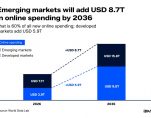
Emerging markets will add USD 8.7T in online spending by 2036
But this new consumer class will not shop the same way developed-market consumers do: by 2036, only 20% of adults in emerging markets will hold a credit card, against 66% in developed markets.
Global online spending is projected to grow from USD 11 trillion in 2026 to USD 25.6 trillion in 2036. Emerging markets add USD 8.7 trillion of that increase (60% of all new online spending), with China (USD +4.7 trillion) and India (USD +1.3 trillion) leading this growth. Indonesia (USD +243 billion), Brazil (USD +249 billion) and Mexico (USD +191 billion) form the next tier.
The categories matter as much as the markets. Online gaming spending in emerging markets grows 14% a year over the decade, the fastest of any category, and SaaS nearly 10%. Emerging markets will generate 76% of global growth in social media spending and 64% in SaaS.
The demographic picture challenges a common assumption. Consumers aged 45 and over account for 51% of emerging markets’ online spending growth through 2036, and spending by those aged 65 and over grows 12% a year, faster than any other age group.
The outlook was discussed during “Navigating Payments: How innovation and fragmentation are changing the game for e-commerce,” a webinar co-hosted by World Data Lab (WDL) and EBANX.
“Over the next ten years, people aged 45 and over will add USD 4.4 trillion in online spending in emerging markets, half of all the growth. Some of them already shop on their phones and will keep doing so as they get older. Others will buy online for the first time in their fifties or sixties. Merchants who build their checkout only for a 25-year-old will miss both groups,” explained Wolfgang Fengler, CEO of WDL.
The study models consumer spending, demographics, and financial access across 184 countries to 2036, drawing on the World Bank’s Global Findex and WDL’s consumer models, combined with EBANX’s experience processing payments for global merchants in emerging markets since 2012.
“If your checkout only takes credit cards, you are competing for one in five adults in emerging markets and conceding the other four”, said Marie-Elise Droga, Chief Revenue Officer of EBANX. “The merchants growing fastest with us didn’t wait for cards to arrive: they added the payment rails their customers already use, and they’re taking new buyers, bigger baskets and recurring revenue that card-only competitors can’t even see.”
834 million new online buyers, 281 million new credit cards
Between 2026 and 2036, the global economy will add 834 million online buyers but only 281 million credit card holders—a ratio of nearly three to one. In emerging markets, two in three new online buyers (67%) will arrive without a credit card. Adults without it already account for 55% of online spending in emerging markets, a share that rises to 90% in India and 93% in Sub-Saharan Africa. Credit cardless adults also represent 52% to 59% of spending in every digital category, from gaming and SaaS to streaming and travel.
Digital payment use is also running ahead of online shopping. Of the 2.6 billion emerging-market adults spending between USD 6 and USD 25 a day, 70% already pay merchants digitally while only 33% buy online, leaving at least 957 million digitally active consumers who are not yet online buyers. Many hold a bank account or mobile wallet but no card that works at an international checkout.
“This is closely tied to the innovation that came out of the financial industry in emerging markets, which developed solutions for an increasingly mobile economy and for the habits of local consumers. Today, we call them local payment methods, or LPMs, and they allowed e-commerce growth to decouple from the credit card, which still has very low penetration in these countries,” said Estelita Hass, head of Market Intelligence at EBANX.
Subscriptions are the next frontier — and India shows why
Recurring categories such as streaming, SaaS and online education will reach USD 2.1 trillion a year in emerging markets by 2036, with USD 1.1 trillion coming from adults without a credit card. In India, 82% of recurring online spending will be cardless. Account-based recurring rails are beginning to close that gap: a global SaaS company saw a 20% uplift in new subscribers after adding UPI at checkout in India, and cybersecurity company Nord Security now generates 28% of its revenue in Brazil through Pix Automático, Brazil’s recurring instant payment, six months after launching it with EBANX.
The issuer is solely responsible for the content of this announcement.
ABOUT EBANX
EBANX is the leading technology platform connecting global businesses to the world’s fastest-growing digital markets. Founded in 2012 in Brazil, EBANX was built with a mission to expand access to international digital commerce. Leveraging proprietary technology, deep market expertise, and robust infrastructure, the platform enables global businesses to offer hundreds of local payment methods and streamline cross-border payments across Latin America, Africa, and Asia. With a global footprint, it established a technology and regulatory headquarters in Singapore in 2026. More than just payments, EBANX drives growth, enhances sales, and delivers seamless purchase experiences for businesses and end users alike.
China’s state-linked equity funds attracted their largest weekly inflows since the April 2025 trade-war sell-off, signalling intensified efforts to support a stock market battered by persistent selling.
Nine exchange-traded funds widely associated with the country’s so-called national team recorded combined net inflows of 128.7 billion yuan ($19 billion) during the week ending 23 October. The total was the highest since nearly 140 billion yuan entered the same closely watched group during the tariff-driven market turmoil 18 months earlier.
The surge followed a punishing decline in mainland shares that pushed the CSI 300 benchmark into bear-market territory, conventionally defined as a fall of at least 20% from a previous peak. Investors have been monitoring large purchases of index-tracking funds for indications that state-backed institutions are seeking to contain further losses.
The figures measure money entering funds favoured by official investors rather than confirmed purchases by government-controlled entities. No public announcement has established how much of last week’s inflows came directly from the state, making the scale of official intervention difficult to determine precisely.
Central Huijin Investment, a unit of sovereign wealth fund China Investment Corporation, is among the principal institutions associated with market stabilisation. Its investment activity has become an important signal for traders attempting to assess Beijing’s willingness to support share prices during periods of intense volatility.
The latest inflows were concentrated in exchange-traded products offering exposure to broad mainland equity benchmarks. Such vehicles enable institutions to acquire diversified holdings quickly, directing demand towards major listed companies without having to purchase individual shares separately.
Thursday’s trading illustrated the pressure facing authorities. The CSI 300 fell into a bear market as persistent selling overwhelmed earlier signs of institutional support. Funds favoured by state investors attracted approximately 46 billion yuan that day, highlighting the contrast between substantial new subscriptions and continuing weakness in underlying shares.
Friday brought a partial reversal. The CSI 300 finished 1.7% higher at 4,105.33 after falling by as much as 2% during the session. The recovery coincided with unusually active trading in several large index funds, although trading patterns alone cannot identify the buyers responsible.
One CSI 300 exchange-traded fund managed by E Fund Management registered turnover of about 19.5 billion yuan on Friday, its busiest session since October 2024. Heavy turnover can reflect purchases and sales by multiple participants and does not, by itself, establish the size of net state investment.
The rebound provided relief after a prolonged retreat that had already tested confidence in official market-support measures. The benchmark had endured a record sequence of weekly declines, leaving investors focused on whether additional institutional demand could interrupt the selling pressure.
Analysts at China Securities, including Yao Ziwei, had previously identified large subscriptions to leading broad-market funds and heavier activity towards the close of trading as characteristics consistent with institutional buying against the prevailing market trend. Their observations did not amount to confirmation of individual investors’ identities.
The scale of potential support has also attracted attention. Analysts including Rebecca Sin estimated that Central Huijin raised approximately $231 billion through exchange-traded fund sales during the first half of 2026 and redeployed about $43 billion after purchases resumed in July. Their calculations suggested considerable remaining capacity, although available resources do not guarantee further buying.
Those estimates underscore the distinction between market intervention and a sustained recovery. Purchases can provide immediate demand for shares, but their effect depends partly on whether other investors become willing to hold equities without continued institutional assistance.
The comparison with April 2025 is significant because that episode followed sweeping American tariff announcements that triggered sharp market losses. Authorities subsequently introduced measures intended to stabilise trading and confidence. Last week’s inflows approached the scale seen during that earlier emergency, despite the different circumstances surrounding the latest decline.
The nine-fund basket represents only part of China’s exchange-traded fund market. Subscription figures can vary depending on the funds selected, the valuation method and the period measured, while changes in units outstanding cannot establish the identity of the ultimate purchaser.
Mainland exchange-traded funds are listed securities whose prices fluctuate throughout the trading day. Their creation and redemption mechanisms allow authorised institutions to adjust the number of units outstanding as investor demand changes. These mechanisms can produce substantial changes in reported fund flows even when trading activity involves different categories of institutional and individual market participants.
CoinDCX has confirmed a cryptocurrency loss of nearly $16 million after an internal transfer system failed, reversing its initial dismissal of suspicious withdrawals from wallets previously compromised in a security breach. The Mumbai-based exchange said on Sunday that it had absorbed the loss of 15.99 million USDT, a dollar-linked cryptocurrency issued by Tether, and that customer balances and active trading systems remained unaffected. Its disclosure followed questions […]
Electrum has patched a security flaw that allowed malicious servers to divert bitcoin payments when wallet users attempted to increase transaction fees, after developers confirmed at least one theft. The developers released version 4.8.3 on 24 October and urged users of earlier versions to upgrade. Their security advisory classified the vulnerability as high severity and said some servers had exploited it against customers. Two users reported suspicious […]
Tourists leaving the UAE can now receive value added tax refunds within one business day under an artificial intelligence platform introduced by the Federal Tax Authority, reducing the previous waiting period of approximately nine days. The system, launched on October 20 in partnership with authorised refund operator Planet, is operating at Dubai International Airport, Zayed International Airport in Abu Dhabi and Sharjah International Airport. It enables eligible […]
Cybercriminals penetrated Microsoft 365 accounts at 79 organisations during a coordinated campaign involving stolen authentication tokens, phishing and attempts to conceal fraudulent email activity, cybersecurity company Huntress has disclosed. The investigation, published on October 22, identified at least 497 successful sign-ins and more than 200,000 failed login attempts between July 14 and September 22. Researchers said attackers reused legitimate sessions captured through deceptive authentication processes, enabling access […]
By Emma McDermott ATT, Founder of Global Tax Consulting Dubai’s lack of personal income tax is one of the main attractions for British professionals considering a move to the UAE. Combined with the employment opportunities, lifestyle and relative proximity to the UK, it is easy to understand why so many people are making the move. However, relocating to Dubai does not automatically mean that you stop […]
Corporate investment in artificial intelligence is accelerating, but most technology leaders still cannot demonstrate substantial financial benefits, according to new research exposing a widening gap between adoption and measurable business performance. A Gartner survey released on October 19 found that only 13 per cent of chief information officers said their organisations had achieved significant or transformational value from AI. The findings, presented at the Gartner IT Symposium […]
Technology companies were responsible for the largest share of people affected by third-party data breaches, according to new findings from risk advisory firm Kroll. Kroll’s 2026 Data Breach Outlook, published on Thursday, found that 69% of individuals affected in incidents it handled between June 2025 and June 2026 had been exposed through breaches involving third parties. Of that group, 79% were linked to compromises in the technology […]
Chinese President Xi Jinping has ordered an all-out search for survivors and urgent treatment for the injured after a powerful earthquake struck Tibet, killing at least 16 people and leaving dozens injured. The magnitude 7.0 earthquake hit Baqen County in Nagqu, in the Xizang Autonomous Region, at 10.33pm on Thursday. Local authorities said on Friday that the number of injured had risen to 65, while the confirmed […]
North Korea-linked hackers have incorporated post-quantum cryptography into a cyberespionage campaign against South Korean organisations, encrypting malware deliveries while exploiting widely used financial security software, cybersecurity researchers disclosed. Kaspersky identified the campaign, named Operation FlashHole, at its Security Analyst Summit in Bali on Wednesday. Its investigation established that at least three organisations in software development, construction and wired communications equipment manufacturing had been affected. The earliest evidence […]
Production-grade in-app messaging with no credit card required to start, plus an optional Cloud Bonus offering your choice of either 15% off AWS or 30% off Alibaba Cloud
SINGAPORE – Media OutReach Newswire – 22 October 2026 – Nexconn, a global cloud communications platform, announced the launch of its production-ready Free Chat Plan. Under the new initiative, developers and startups can deploy enterprise-grade chat infrastructure for up to 10,000 monthly active users (MAU) completely free—with full Chat Pro features enabled and no credit card required.
The launch tackles a persistent industry pain point: typical free tiers across the category cap at 100 to 1,000 MAU and restrict apps to sandbox environments—thresholds far too low to validate user retention or viral growth.
“A free tier should empower teams to validate their business model, not just verify that an SDK compiles,” said Will Song, Head of Global Business at Nexconn.
To further extend startup runway, Nexconn also introduced an additional Cloud Bonus: teams that link a payment method can choose between 15% off AWS or 30% off Alibaba Cloud to offset their backend cloud costs.
The offer is open to teams that simply send their first in-app message by December 31, 2026, 11:59 p.m. Singapore Time (SGT, UTC+8), locking in up to 10,000 MAU of Pro chat (valued at $860/month). Developers can claim the plan and view full details at https://www.nexconn.ai/free-chat-api?utm_source=pr.
What the Free Chat Plan Includes
The plan provides comprehensive capabilities across the entire application lifecycle:
Rich Messaging Architecture: Unlimited messages across direct (1-on-1), group, community, and open channels.
Modern Social Interactions: Read receipts, typing indicators, user mentions, unread badges, and cross-platform multi-device synchronization.
Native Push: Built-in multi-channel mobile push gateway included with no add-on fees.
High-Capacity Resource Quotas: Supports up to 500 peak concurrent connections, 10 GB of cloud storage, and 180 days of searchable message history.
No-charge Migration Support: End-to-end data migration support for teams transitioning from Sendbird, Stream, CometChat, PubNub, Agora, or Twilio.
Developer Acceleration: An open-source AI Integration Skill allows developers to generate client SDK code and backend token endpoints via simple text prompts.
The Cloud Bonus: The 10,000 MAU Chat plan remains free and does not require a credit card. Teams may optionally link a payment method to activate the Cloud Bonus—15% off AWS services or 30% off Alibaba Cloud services.
How to Get Started
Sign Up: Create an account in the Nexconn Console.
Build: Integrate the SDK manually or with the open-source AI Skill.
Activate Your Free Plan: Complete enrollment by simply sending at least one message before December 31, 2026, 11:59 p.m. Singapore Time (SGT, UTC+8).
(Optional) Cloud Discounts: Link a payment method to activate your choice of 15% off AWS services or 30% off Alibaba Cloud services.
The issuer is solely responsible for the content of this announcement.
About Nexconn
Nexconn is a global cloud communications platform engineered for developers, high-growth startups, and enterprises building real-time, mission-critical digital experiences.
The company delivers a unified real-time portfolio tailored to global scale:
AICP (AI Communication Platform): High-performance Chat and Call (voice/video) APIs, combined with production-ready, scenario-specific AI Agents (such as Smart Office and Social Marketing). This unified platform allows businesses to seamlessly embed intelligent, context-aware communications into any web or mobile application.
Enterprise & Public Sector Deployments: Carrier-grade private cloud and on-premises solutions engineered for organizations and government bodies requiring strict data residency, privacy, and compliance.
Paris police have prohibited unauthorised demonstrations across prominent parts of the capital on Thursday, including the presidential palace, parliament and tourist districts, as authorities seek to prevent further violence during nationwide protests. The order issued by the Paris Police Prefecture applies from 8am until 8pm on 22 October. It covers gatherings, marches and processions that have not been declared under French law, rather than imposing a blanket […]
US cybersecurity authorities have warned that SafePay ransomware operators have compromised at least 600 organisations worldwide, including critical infrastructure providers, and urged businesses to strengthen network defences against further attacks. The Cybersecurity and Infrastructure Security Agency (CISA) issued the joint advisory on Tuesday alongside the Federal Bureau of Investigation, US Secret Service and law enforcement partners in Britain and Germany. It describes SafePay as one of the […]
Arabian Post Staff -Dubai BlackRock has launched a robotics-focused exchange-traded fund, widening its artificial intelligence investment range as investors become more selective about exposure to the technology. The iShares Future Robotics and Related Technologies Active ETF began trading on NYSE Arca on Wednesday, 21 October, under the ticker RBTX. The fund seeks investments across businesses developing, supplying and deploying intelligent machines that automate physical tasks, including operations […]
Nearly two-thirds of the world’s largest businesses have assigned leadership responsibility for artificial intelligence security, but formal oversight and executive accountability remain uneven, according to new research released on Tuesday. The 2026 Security Organisational Design Benchmark Report, published by cybersecurity research firm IANS and executive recruitment company Artico Search, found that 65% of organisations generating at least $10 billion in annual revenue have established a head of […]
Iran’s Islamic Revolutionary Guard Corps (IRGC) has claimed that its air defence forces shot down an American MQ-1 unmanned aircraft over the Strait of Hormuz, although independent confirmation of the reported interception remains unavailable. The claim, circulated through social media, follows a series of Iranian announcements concerning American surveillance drones operating around the strategic waterway. The available information does not establish whether the circulating statement describes a […]
Town, a San Francisco-based artificial intelligence startup developing workplace assistants, has raised $108 million in Series B financing, securing a $1 billion valuation just four months after its public launch. The funding round, announced on October 19, was co-led by Forerunner Ventures and Menlo Ventures, with participation from existing investors Andreessen Horowitz and First Round Capital. Other participants included Better Tomorrow Ventures, Precedent. vc, Scribble Ventures, Serena […]





 https://ebanx.com/en/
 https://www.linkedin.com/company/ebanx/