News related to
political

OpenAI chief Sam Altman, Anthropic chief Dario Amodei and xAI owner Elon Musk have publicly backed a slower pace for frontier artificial intelligence development, an unusual alignment among fierce rivals as safety concerns intensify and Altman says OpenAI will not pursue a stock-market listing in 2026. The convergence followed an essay by Amodei calling for the industry to “pace the frontier” rather than continue scaling advanced models […]

Arabian Post Staff -Dubai International visitor spending in the Middle East is forecast to rise by US$116 billion, or 57%, between 2025 and 2030, signalling a sharp expansion in tourism revenues despite near-term geopolitical disruption. The projection comes from the ATM Travel Trends Report 2026, produced by Arabian Travel Market with Tourism Economics, an Oxford Economics company, and presented at Arabian Travel Market in Dubai. The report […]

Saudi warplanes struck Houthi positions across Yemen on Wednesday as the Iran-aligned movement pressed territorial gains along the Red Sea coast and widened attacks on Saudi targets, intensifying a new front in the Middle East war. Houthi military spokesman Yahya Saree said Saudi aircraft had carried out as many as 450 strikes during the week. Officials from Yemen’s internationally recognised government acknowledged that their forces and Saudi […]

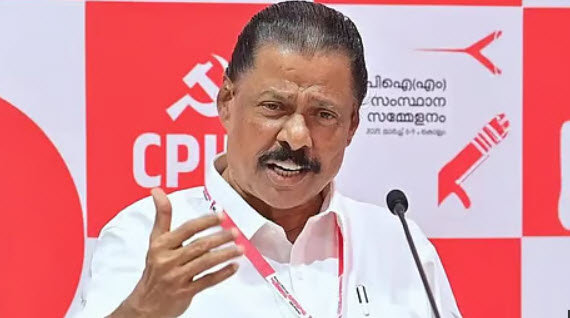
By P. Sreekumaran THIRUVANANTHAPURAM: A big salute to the CPI(M)’s lower-level leaders and the party cadres. For, it was their bold, open and trenchant criticism of the leadership which forced the party to go for a change for the better. The party’s central leadership, ably led by general secretary M. A. Baby, also deserves full […]

The article Kerala CPI-M in self-critical, corrective mode at three-day conclave appeared first on Latest India news, analysis and reports on Newspack by India Press Agency).

Yemen’s Houthi movement said on Wednesday that it had shot down a Royal Saudi Air Force F-15 fighter jet over Marib province, a claim that Saudi authorities had not confirmed and that could not immediately be independently verified. Houthi military spokesman Yahya Saree said the aircraft was brought down with a locally manufactured surface-to-air missile while conducting what he described as hostile operations over Marib. He gave […]

US midterm elections are emerging as a fresh policy risk for artificial intelligence-linked stocks as President Donald Trump defends rapid AI development while candidates from both parties respond to widening voter resistance to data centres and calls for tighter safeguards. The political pressure intensified this week after Trump rejected demands for a slowdown in advanced AI development and argued that existing laws and enforcement powers were sufficient […]

India summoned Pakistan’s top diplomat in New Delhi on Wednesday after naval vessels from the two countries collided in international waters of the northern Arabian Sea, escalating friction more than a year after their last military confrontation.

The Ministry of External Affairs said Pakistan’s Charge d’Affaires was called in and a strong protest lodged over what it described as “unacceptable and unprofessional conduct” by Pakistani naval units. The ministry said the conduct led to a collision with a unit of the Indian Navy and urged Pakistan’s authorities to ensure that military units exercise due care and observe existing bilateral agreements.

The collision occurred on Tuesday while a frontline warship from India was conducting what officials described as a routine surveillance mission. Officials from India said a Pakistan Navy vessel approached at high speed before the vessels collided. No major damage was reported, and there was no immediate public statement from Pakistan’s government or military responding to New Delhi’s account.

India also instructed its top diplomat in Islamabad to lodge a similar protest with Pakistan’s Foreign Ministry. The exchange elevated what could otherwise have remained a maritime safety incident into a formal diplomatic dispute between two nuclear-armed neighbours whose military contacts are governed by a series of confidence-building arrangements.

New Delhi said the episode breached a 1991 bilateral agreement covering military exercises, manoeuvres and troop movements. Under that agreement, naval ships and submarines of the two countries are required to remain at least three nautical miles apart in international waters to reduce the risk of accidents. India’s foreign ministry said the Charge d’Affaires had been asked to convey the need for all military units to respect those provisions and prevent a recurrence.

Pakistan had not, as of Wednesday afternoon, issued its own description of the encounter, leaving key operational details — including the precise movements of the vessels before impact — based on India’s official account. No ship names, casualty reports or detailed damage assessments were released publicly by either side.

The incident is the clearest publicly acknowledged military encounter between the neighbours since four days of hostilities in May 2025. That fighting followed an April 22 attack on tourists in Pahalgam, in Jammu and Kashmir, that killed 26 people. India blamed Pakistan for supporting cross-border terrorism, an allegation Islamabad rejected, and the crisis developed into missile, drone and artillery exchanges before both sides announced an understanding to halt the fighting.

Relations have remained strained since then despite the cessation of large-scale hostilities. Diplomatic ties had already been downgraded in 2019 amid disagreements over Kashmir, and neither country currently posts an ambassador in the other’s capital, with missions headed by Charges d’Affaires.

The latest protest focused narrowly on maritime conduct rather than broader political disputes. India’s statement did not announce retaliatory military measures or new diplomatic restrictions, and it called instead for compliance with the bilateral framework designed to prevent accidents between armed forces operating near one another.

The northern Arabian Sea is routinely used by both navies for patrols, exercises and surveillance. The 1991 agreement was intended to create practical safeguards at times of tension, alongside notification procedures for certain military activities. Its distance requirement gives commanders a defined separation standard when vessels or submarines from the two countries encounter each other beyond territorial waters.

The military relationship remains sensitive because both countries maintain forces across the Line of Control in Kashmir and continue to accuse each other of hostile activity. Their 2025 confrontation demonstrated how quickly a security incident can widen across domains, although neither government indicated on Wednesday that the naval collision had triggered wider force movements or changes in military posture.

Tuesday’s collision did not produce the kind of damage that would normally force a ship out of service, according to India’s account. The absence of reported casualties limited the immediate operational consequences, but the diplomatic summons ensured the episode received attention at the highest working level between the two foreign ministries.

Advertisements

Monaco is poised to leave the Financial Action Task Force’s grey list next month after completing an on-site review of reforms aimed at strengthening controls against money laundering and terrorist financing, with Bulgaria and Côte d’Ivoire also moving towards removal. The Paris-based watchdog is expected to consider the three jurisdictions at its plenary meeting from October 26 to 30, after determining in June that each had substantially […]

Djibouti has joined the Artemis Accords, becoming the 72nd country and eighth African nation to endorse the US-led principles for peaceful, transparent and coordinated civil space exploration. Djibouti’s ambassador to the United States, Mohamed Siad Douale, signed the accords on behalf of his government at NASA Headquarters in Washington on Monday, September 14. NASA Deputy Administrator Matt Anderson hosted the ceremony, which was also attended by US […]

BRICS leaders have placed development priorities of emerging economies at the centre of their New Delhi agenda, endorsing stronger representation for the Global South while advancing cooperation on trade, technology, finance and sustainable growth.

Chinese President Xi Jinping used the 18th BRICS Summit to argue that countries should pursue development paths suited to their own national conditions, a message that overlapped with the summit’s broader emphasis on policy autonomy, inclusive growth and reform of global institutions.

Addressing the first leaders’ session on September 12, Xi marked 20 years of BRICS cooperation and said members had strengthened themselves through unity while preserving independence in choosing their economic and social models. He described BRICS as an increasingly important platform for emerging markets and developing countries.

The summit’s New Delhi Declaration gave that theme wider institutional form. Leaders called for a more representative international order, greater participation by developing countries in global decision-making and reforms to institutions including the United Nations, World Trade Organization and international financial architecture.

The declaration also reflected the diversity within the expanded grouping. Rather than prescribing a single model of development, BRICS leaders stressed national circumstances, differing capacities and the need for policy space, particularly in areas such as energy transition, industrialisation and climate action. That approach broadly matched Xi’s argument that development strategies should reflect domestic conditions rather than external templates.

Xi sought to extend the idea into technology policy. He proposed an initiative on artificial intelligence-enabled industrialisation, deeper cooperation in research and applications, and stronger industrial and supply-chain links. China also promoted open-source AI collaboration and international platforms intended to improve access to emerging technologies for developing economies.

Other leaders framed similar priorities through their own national perspectives. Prime Minister Narendra Modi emphasised resilience, innovation, cooperation and sustainability, the four themes of India’s 2026 BRICS chairship, and called for solutions developed within the grouping to serve a wider range of developing countries. He also urged members to translate summit commitments into practical programmes.

BRICS members agreed on measures spanning digital cooperation, food and energy security, health, trade facilitation and the use of local currencies in cross-border transactions. The declaration supported stronger payment connectivity while stopping short of endorsing a common BRICS currency.

The economic agenda also underlined the practical test facing the grouping. Members backed use of national currencies in trade and investment, stronger cooperation through the New Development Bank and efforts to improve financial resilience. Such measures are intended to widen financing options for developing economies without committing members to a single monetary framework or common currency.

The expanded bloc now brings together countries with sharply different political systems, strategic alignments and economic structures. That breadth gives BRICS a larger claim to represent developing-country concerns, but it also limits how far members can converge on detailed policy prescriptions. Analysts have noted differences over whether the group should remain primarily an economic and development forum or assume a stronger geopolitical role.

Those tensions were visible alongside the development agenda. Leaders opposed protectionism and unilateral economic measures, supported a stronger multilateral trading system and called for reforms that would increase the voice of developing countries. At the same time, members avoided turning the summit into a unified ideological platform, relying instead on consensus language broad enough to accommodate competing interests.

Xi’s second summit intervention on September 13 placed a “people-centred” development philosophy within a wider call for Global South cooperation. He urged progress on the UN Sustainable Development Goals, improvements to global climate governance and a consensus-based framework for governing artificial intelligence.

China’s approach also carries strategic implications. Beijing has increasingly used BRICS and other multilateral forums to promote its views on development, sovereignty and global governance. Some members share its criticism of unequal representation in international institutions, while others remain cautious about allowing BRICS to become identified with any single country’s geopolitical agenda.


Netflix, Amazon and YouTube have created a Washington-based lobbying coalition to press for policies favouring consumer choice and technology-neutral treatment of streaming services as political scrutiny intensifies over the migration of live sport from traditional television. The Streaming Access and Choice Alliance, or SACA, was announced on Monday with the three companies as founding members and TechNet, a technology industry advocacy group, leading the organisation. Mike Ward, […]

The Friedrich Naumann Foundation for Freedom awards its Freedom Prize 2026 to the courageous people of Iran who are fighting for freedom, civil rights and democracy.

POTSDAM, GERMANY – Newsaktuell – 15 September 2026 -The Friedrich Naumann Foundation for Freedom honors the Iranian people with its Freedom Prize 2026 on 7 November 2026 at St. Paul’s Church in Frankfurt. Reza Pahlavi will accept the award in a fiduciary capacity. Bijan Djir-Sarai, foreign policy spokesperson the Free Democratic Party (FDP), will deliver the laudatory address.

Since 2006, the Friedrich Naumann Foundation for Freedom has awarded the Freedom Prize every two years in recognition of outstanding commitment to the development of a liberal civil society, thereby contributing to strengthening values and goals of freedom around the world.

Steffen Saebisch, Chairman of the Board of the Friedrich Naumann Foundation for Freedom, comments: “The Friedrich Naumann Foundation for Freedom is deliberately awarding the Freedom Prize to the Iranian people rather than to an individual. We seek to honor the desire for freedom of the many hundreds of thousands of people who have risked their lives to overthrow the criminal mullah regime. We are pleased that Reza Pahlavi is accepting to receive the award in trust on behalf of the Iranian people until the day the prize can be presented to the freely elected representatives of Iran.”

The Friedrich Naumann Foundation for Freedom has asked Reza Pahlavi to receive the award in trust on behalf of the Iranian people, as he is the best-known personality of the Iranian opposition and is committed to the return to freedom and democracy in Iran. According to his own statements, he does not advocate one form of government over another, as long as it is democratic. He repeatedly emphasizes that the future political order of Iran must be decided by the Iranian people. According to many, he is currently also the most important political figure of identification for many Iranians (probably the majority) in Iran. In addition, Reza Pahlavi is committed to an end to Iranian-fueled conflicts in the Middle East, the normalization of Iran’s relations with its neighboring countries and, in particular, reconciliation with Israel.

The award goes to all those who stand up for their rights, for their own freedom and for a free and democratic society. It is dedicated in particular to those who lost their lives in the fight against a murderous regime and to those who were or are currently persecuted and imprisoned because of their commitment to freedom and democracy.

The award honors the courage of countless people who resist in their everyday lives: women who stand up for their right to self-determination; students who demand freedom of thought and learning; journalists who, despite intimidation and threats, stand up for press freedom; workers who fight for fair conditions and dignity; families who resist paternalism and the denial of individual choices in their conduct of life. Their strength lies not in individual actions, but in the perseverance of a society that refuses to be silenced.

For decades, the theocratic regime has ruled brutally and with great contempt for basic human rights. That is why it is all the more admirable that so many people in Iran are speaking out in various ways against the regime and in support of their freedom and fundamental rights, taking to the streets to make their voices heard. These extraordinarily courageous people deserve the full support of everyone for whom freedom, self-determination and democracy are the highest ideals.

By conferring the Freedom Prize on the Iranian people, the Foundation is deliberately drawing attention to the many unnamed people whose civic courage often remains unseen, but who form the basis of any peaceful change. The Freedom Prize is an expression of respect and solidarity – and at the same time an appeal to the international community to consistently protect the rights of all Iranians and to support their demands for freedom effectively.

The Iranian people stand for the hope that an open society can also emerge where freedom is suppressed. Their commitment reminds us: freedom is indivisible – and it begins with people who have the courage to stand up.

That is why our Foundation is committed to honoring freedom-loving people in Iran. By conferring the Freedom Prize on the Iranian people, the Foundation is sending a clear message to the public: The struggle for freedom and democracy has the full support of all liberals.

The issuer is solely responsible for the content of this announcement.

US Senator Bernie Sanders and former Trump adviser Steve Bannon will appear at a Washington gathering on Tuesday, joining labour, religious and political figures calling for controls over advanced artificial intelligence. The Pro-Human Assembly, organised by the Future of Life Institute, is expected to bring together participants who rarely share a political platform but have converged around concerns that advancing AI could threaten jobs, autonomy, democratic institutions […]

Arabian Post Staff -Dubai Wall Street is preparing for the Federal Reserve to raise interest rates this week for the first time since July 2023, after another surge in oil prices and stubborn inflation pushed market expectations decisively towards tighter policy. Interest-rate futures on Monday assigned roughly a 90% probability to a quarter-point increase at the Federal Open Market Committee’s September 15-16 meeting. A move of 25 […]

By R Suryamurthy The 2026 New Delhi Declaration arrives at a revealing moment for BRICS: two decades after the grouping emerged as a shorthand for the rising economic weight of the Global South, it is no longer merely demanding a larger seat at the table of global governance, but is beginning to construct the institutional […]

The article BRICS is not building a new order, but a hedge against the old one appeared first on Latest India news, analysis and reports on Newspack by India Press Agency).

Arabian Post Staff -Dubai Ras Al Khaimah has retained its A/A-1 sovereign credit rating from S&P Global with a stable outlook for 2026, with the agency citing prudent fiscal management, strong buffers and broad economic stability over the next two to three years. S&P said the emirate’s fiscal position should remain resilient despite geopolitical uncertainty, supported by conservative budgeting, low debt and the government’s ability to adjust […]

Chevron’s Australia president expects liquefied natural gas prices to remain elevated for about six months as war-driven disruption to Middle East supply keeps the global market tight. Balaji Krishnamurthy, who leads Chevron’s Australian operations, said at the Gastech conference in Bangkok on Monday that higher prices were likely to persist while the market adjusts to reduced Qatari exports and constrained shipping through the Strait of Hormuz. He […]

Artificial intelligence leaders are facing mounting resistance from investors and President Donald Trump after calls by Anthropic and OpenAI to slow the advance of frontier models triggered sharp losses in technology shares and exposed a widening dispute over how quickly the industry should proceed. Anthropic chief executive Dario Amodei has urged leading developers to reduce the pace at which they improve model capabilities, arguing that safety systems […]

Egypt and India have agreed to pursue concrete steps towards lifting bilateral trade to $12 billion, with President Abdel Fattah El-Sisi and Prime Minister Narendra Modi also discussing ways to expand investment ties during talks on the sidelines of the 18th BRICS Summit in New Delhi.

The leaders met on Sunday as Egypt pressed for faster progress on a trade goal first set during El-Sisi’s state visit to New Delhi in January 2023. Egypt’s presidency said the discussions covered measures to strengthen the strategic partnership, increase commerce and encourage more investment from India in sectors including manufacturing, technology, clean energy and the automotive industry.

El-Sisi stressed the importance of translating the economic relationship into projects and commercial flows capable of taking trade to the $12 billion target. The two sides also reviewed opportunities for companies from India to expand their presence in Egypt, which Cairo has promoted as a production and export base serving markets in Africa, the Middle East and Europe.

Bilateral merchandise trade stood at about $6.5 billion in the 2025-26 financial year, according to figures cited by India’s embassy in Cairo. That leaves the two countries seeking almost to double the current level if they are to reach the objective discussed by their leaders.

Investment formed a central part of the meeting. Egypt highlighted manufacturing, information technology, renewable and clean energy, and vehicle production as areas where it wants to attract additional capital. Cairo has also sought greater participation by overseas companies in the Suez Canal Economic Zone and other industrial centres as it works to raise exports and secure more foreign currency.

Modi and El-Sisi reviewed the broader strategic partnership and discussed cooperation in economic and commercial fields, along with regional and international developments. Their meeting came as New Delhi hosted the September 12-13 BRICS summit under the theme of resilience, innovation, cooperation and sustainability.

Egypt joined BRICS at the start of 2024 and has since used the grouping to widen economic links with major emerging economies. The New Delhi summit brought together an expanded bloc whose agenda included trade, finance, technology, energy, climate issues and greater use of national currencies in cross-border transactions.

The trade push also builds on institutional contacts between Cairo and New Delhi. Egypt’s Foreign Minister Badr Abdelatty said during BRICS ministerial meetings in May that the two countries wanted to raise bilateral trade to $12 billion over five years and strengthen cooperation in investment, technology and other economic sectors.

El-Sisi and Modi upgraded relations to a strategic partnership in 2023, creating a framework for closer coordination across trade, investment, defence, energy and political consultation. The latest talks focused more narrowly on turning the economic component of that partnership into measurable gains, particularly through private-sector investment and expanded market access.

Egypt has been courting manufacturers as it seeks to increase domestic production and exports, while companies from India already operate in industries including chemicals, textiles, food processing and manufacturing. Cairo’s investment campaign has emphasised projects that can supply the domestic market while using Egypt’s trade agreements and transport links to reach neighbouring regions.

The two leaders also discussed international and regional issues, according to Egypt’s presidency, without announcing a separate bilateral agreement during the meeting. Their talks were among a series of leader-level engagements held around the BRICS gathering as member states sought to advance economic cooperation alongside the summit’s wider diplomatic agenda.

For Egypt, the $12 billion goal provides a benchmark for a relationship that has expanded beyond traditional merchandise trade into investment-led cooperation. For India, stronger commercial ties with Egypt offer access to a major Arab and African market and to production locations close to the Suez Canal, one of the world’s principal shipping routes.

Chinese foreign exchange regulators are stepping up pressure on banks to persuade corporate clients to hedge more of their currency exposure, to reduce companies’ vulnerability to yuan swings.

Some local branches of the State Administration of Foreign Exchange have urged lenders to encourage businesses to increase hedging, extending a campaign that has pushed corporate derivatives use to record levels. The guidance targets companies with sizeable foreign-currency receipts or payments as the yuan trades near three-year highs.

The push reflects Beijing’s preference for companies to manage exchange-rate risk through forwards, swaps and options. SAFE has repeatedly promoted what it calls an exchange-rate risk-neutral approach, arguing that companies should focus on their underlying business and use hedging tools to reduce the effect of currency movements on earnings.

Corporate hedging has risen sharply this year. SAFE said enterprises used foreign-exchange derivatives covering 35.3 per cent of their currency transactions in the first half of 2026, up 5.3 percentage points from the full-year level in 2025. The contracted value of derivatives used for exchange-rate risk management reached nearly $1.4 trillion, an increase of about 40 per cent from a year earlier.

The regulator has also broadened access to hedging services. About 130 major domestic and foreign-funded banks can provide foreign-exchange derivatives to companies, while a SAFE database shared with lenders covers about 290,000 foreign-trade enterprises. Authorities have encouraged banks to expand online dealing channels and improve credit and margin arrangements for smaller businesses.

The effort also seeks more balanced corporate behaviour. The latest local instructions add to earlier informal guidance from the central bank and SAFE asking some lenders to lift corporate hedging ratios. Such measures are part of a wider effort to prevent companies from building large unprotected positions after periods when many exporters assumed the yuan would remain weak or move gradually.

That behaviour became more costly as the currency strengthened. The yuan has appreciated this year against the dollar and was trading near a three-and-a-half-year high last week, while global currency markets have been unsettled by changing interest-rate expectations, higher energy prices and geopolitical tensions. Exporters receiving dollars can suffer valuation losses when the yuan rises unless they hedge future receipts.

Beijing has simultaneously tried to avoid an excessive or disorderly rise in the currency. The People’s Bank of China removed a 20 per cent foreign-exchange risk reserve requirement on forward dollar purchases from March 2, lowering the cost of buying dollars forward after a strong yuan rally. The move gave companies and banks more flexibility while signalling that policymakers wanted to discourage one-sided appreciation expectations.

SAFE data show that China’s foreign-exchange market remains supported by large trade and capital flows. Banks recorded a $271.2 billion surplus in foreign-exchange settlement and sales in the first half. The regulator said the ratio measuring companies’ willingness to convert foreign-currency earnings into yuan stood at 65 per cent, while the ratio reflecting demand to purchase foreign currency was 61 per cent.

Foreign-exchange reserves rose to $3.438 trillion at the end of August from $3.419 trillion a month earlier. The yuan gained 0.49 per cent against the dollar during August, while the dollar weakened against a basket of major currencies, contributing to valuation changes in China’s reserve holdings.

Officials have stressed that greater hedging is intended to strengthen corporate resilience rather than direct the yuan toward a particular level. SAFE has said exchange rates are determined by market supply and demand and are difficult to predict, making risk management more important as two-way fluctuations become more common.

The regulator has reduced some transaction costs for smaller companies and encouraged financial institutions to simplify documentation for derivatives. Banks have been asked to use enterprise data to identify firms with foreign-currency exposure and offer products suited to their cash flows rather than promote speculative positions.

China’s state security minister Chen Yixin has warned that artificial intelligence poses six major risks to national security, ranging from political manipulation and cyberattacks to data leakage, social disruption and military transformation. Chen, who heads the Ministry of State Security, set out the risks in an article published on Sunday by China Cyberspace magazine, arguing that Beijing must build a stronger system for monitoring, regulating and responding […]

Sweden’s centre-left opposition held a narrow lead early Monday after a national election that could determine whether the far-right Sweden Democrats enter government for the first time, leaving the final result dependent on remaining ballots. Preliminary figures from the Swedish Election Authority put the opposition bloc led by Social Democrat Magdalena Andersson ahead of Prime Minister Ulf Kristersson’s governing alliance, with the margin narrow enough to keep […]

Dmitry Medvedev has accused leading artificial intelligence companies of overstating fears that their technology could destroy humanity, arguing that commercial self-interest rather than existential concern is shaping their public warnings. Russia’s Security Council deputy chairman said the creators of generative AI systems were “not being sincere” when presenting themselves as alarmed by the possibility that advanced models could become an existential threat. He linked that scepticism to […]

Dogecoin co-creator Billy Markus has joked that the US government should spend $1.2 trillion buying Dogecoin and distribute the cryptocurrency to Americans, turning a contentious cash-dividend proposal into a meme-coin thought experiment rather than advancing a formal policy plan. Markus, who uses the name Shibetoshi Nakamoto on X, made the remark on September 12 while responding to President Donald Trump’s promise of a $5,000 payment to every […]

VISHNU RAJA
RYO YAMADA
HITORI GOTOH
IKUYO KITA