

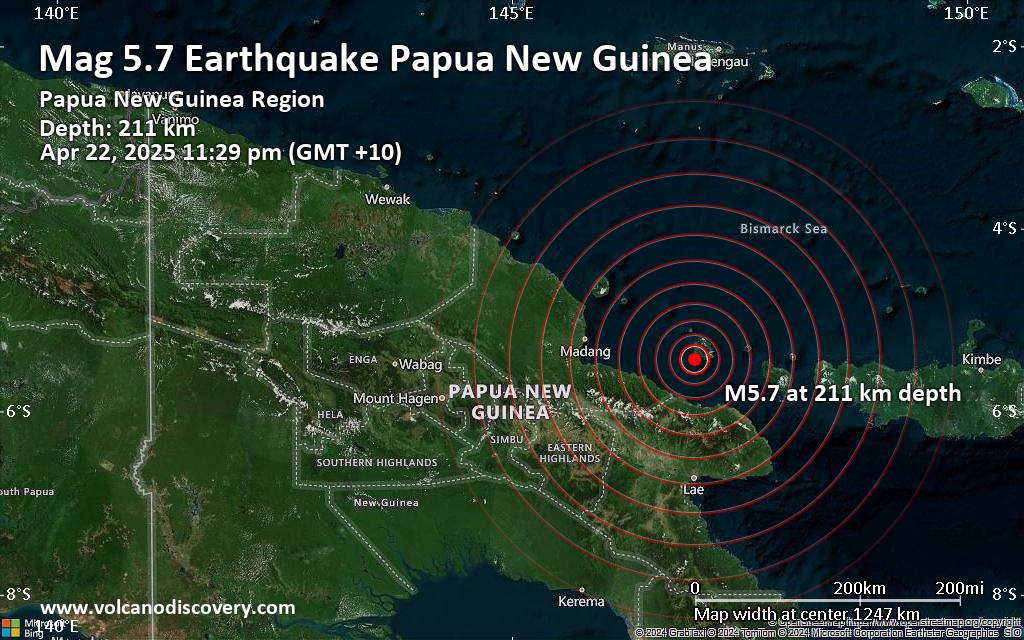
A magnitude 5.7 earthquake struck the New Britain region of Papua New Guinea on Monday, registering at a depth of just 10 km, according to the European Mediterranean Seismological Centre. The tremor occurred at approximately 01:17 pm local time, near New Britain Island, and while shallow, it did not prompt any tsunami alerts.
Seismologists note that shallow quakes—those less than 70 km deep—tend to produce more intense shaking at the surface. However, initial satellite assessments and regional monitoring systems have not reported significant structural damage or casualties from this event. Civil defence authorities in Port Moresby have dispatched teams to assess potential effects in the hardest‑hit communities, based on reports from local residents describing moderate tremors.
Papua New Guinea lies along the Pacific “Ring of Fire,” a seismically active belt known for frequent tectonic activity. The region has a history of powerful quakes and associated hazards. In 2002, a magnitude 7.6 earthquake off the northern coast caused widespread destruction in Sandaun and East Sepik provinces, followed by fatal tsunamis. More recently, in 2018 the country experienced a magnitude 7.5 quake near Mt Sisa that spawned hundreds of aftershocks and claimed multiple lives.
Comparatively, the latest quake is moderate in magnitude and shallow in depth. Its location—near the New Britain region—often experiences seismic events due to complex plate interactions between the Pacific and Indo‑Australian plates. Regional experts explain that stress buildup along active fault lines in this zone leads to episodic releases of energy via moderate to strong quakes. The absence of a tsunami alert reinforces the assessment that this particular jolt, while sharp, did not displace enough seabed to threaten coastal areas.
Emergency response protocols have been activated in provincial capitals including Kimbe and Rabaul. Local officials report that schools and clinics have been advised to conduct safety inspections to ensure structural integrity. Hospitals remain on standby for any potential surge in patients, with triage teams positioned to respond rapidly to injuries or panic‑related incidents.
Communications infrastructure across New Britain showed intermittent disruption as mobile networks experienced overload when residents sought updates from family members. Internet service providers report data traffic surges, but key systems remain functional. No power outages have been confirmed as of the latest updates.
Despite the mild shaking, health authorities have urged calm and adherence to standard earthquake safety measures—dropping to the ground, seeking cover under sturdy furniture, and steering clear of windows. Coastal communities are being reminded to move to higher ground in the unlikely event of delayed sea wave activity.
International monitoring agencies continue to track aftershock activity. Should follow‑up tremors occur, relief agencies are poised to conduct field surveys to evaluate damage across remote villages accessible only by boat or light aircraft. Regionally, geological experts stress the importance of strengthening resilience through earthquake‑proof building codes and public education campaigns on evacuation procedures.
Papua New Guinea’s geographic vulnerability means that even moderate quakes like this serve as critical reminders of the need for ongoing preparedness. Infrastructure investment initiatives aimed at reinforcing schools, clinics and community centres are in progress, supported by both national and international partners. However, progress remains uneven, particularly in rural areas where construction standards vary greatly.
As communities continue assessments, early reports suggest that lifelines remain steady and that there is no immediate indication of serious outcomes. Emergency services remain alert, and communications outreach is ongoing to keep citizens informed via local radio and mobile alerts—efforts deemed essential in preventing panic during seismic episodes.
Follow Arabian Post
Select Arabian Post as your preferred source on Google and MSN News for trusted business news and Arab politics and updates.



