

Arabian Post Staff -Dubai
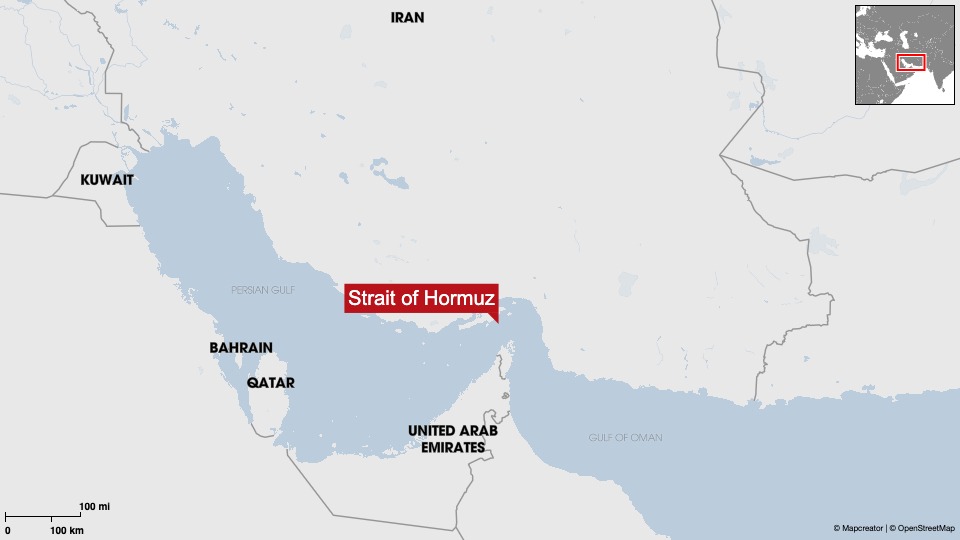
Tehran has reopened the Strait of Hormuz to limited maritime traffic but declared that only Chinese ships may pass through the strategic waterway, warning that any other vessel attempting an unauthorised crossing could face military action as the war between Iran, the United States and Israel entered its fifth day.
Iranian authorities said the decision to permit Chinese vessels was a “gesture of thanks” for Beijing’s diplomatic backing during the escalating conflict, while all other commercial shipping remains barred from the narrow sea corridor linking the Persian Gulf with the Indian Ocean. Iranian military commanders have asserted that forces of the Islamic Revolutionary Guard Corps now exercise full control over the strait and have cautioned that foreign vessels attempting to transit without permission risk missile strikes or drone attacks.
The development marks one of the most dramatic disruptions to global maritime trade in decades. The Strait of Hormuz is widely regarded as the world’s most critical energy chokepoint, carrying roughly one-fifth of global oil and a significant share of liquefied natural gas shipments. Energy exporters including Saudi Arabia, Iraq, Kuwait, the United Arab Emirates and Qatar depend heavily on the passage to reach international markets, while Asian economies rely on its traffic for vital fuel supplies.
Shipping activity through the strait has slowed sharply since the outbreak of hostilities triggered by joint military strikes by the United States and Israel against Iranian targets. Tehran retaliated with missile and drone attacks and began restricting maritime access to the channel, prompting insurers, tanker operators and container lines to halt voyages into the region or divert vessels elsewhere.
Hundreds of ships have been left stranded outside the Persian Gulf or waiting for security clearances as military tensions intensified across the region. Some vessels have suffered damage from projectiles or near-miss incidents during the standoff, adding to fears among shipping companies and commodity traders that the confrontation could disrupt energy supplies on a global scale.
Tehran’s decision to permit only Chinese vessels reflects the complex geopolitical alignment emerging from the conflict. China has maintained close economic relations with Iran for years and remains one of the largest buyers of Iranian crude oil. Chinese officials have called for restraint and emphasised the need to protect energy shipping routes while criticising attacks on Iranian territory by Washington and Tel Aviv.
Iranian officials indicated that allowing Chinese ships to cross the strait would safeguard Beijing’s energy imports while signalling appreciation for what they described as supportive diplomatic positions from the Chinese government. The move also underscores Tehran’s attempt to use maritime leverage as a strategic tool in the broader confrontation.
Analysts say the selective reopening of the waterway illustrates how maritime chokepoints can be weaponised during geopolitical crises. By restricting traffic through Hormuz while allowing passage for a key economic partner, Iran may be seeking to maintain limited export flows and preserve relations with a major customer without fully relinquishing its ability to disrupt global trade.
Energy markets reacted sharply as the conflict expanded. Oil prices surged amid concerns that prolonged restrictions could choke supplies from the Gulf, forcing refiners and traders to search for alternative sources. Economists warn that any sustained disruption in the strait would place upward pressure on fuel costs worldwide and could ripple through shipping, aviation and manufacturing industries.
Asian economies appear particularly vulnerable. China, India, Japan and South Korea collectively import large volumes of crude oil and natural gas that normally pass through the corridor. Although some countries maintain strategic reserves, a prolonged shutdown could trigger competition for alternative supplies from Russia, the United States or West Africa, potentially raising energy costs across the region.
Military activity in the area has further heightened tensions. Washington has indicated that it may deploy naval escorts to protect oil tankers attempting to move through the strait, a step reminiscent of past operations aimed at safeguarding Gulf shipping during periods of confrontation with Tehran. American officials have also discussed providing government-backed insurance for vessels navigating the route to stabilise energy flows.
Regional security concerns have spread beyond maritime trade. Missile interceptions and drone alerts have been reported in several Gulf states as hostilities between Iran and Israel intensified, while international airlines and logistics companies have rerouted flights and cargo shipments to avoid potential conflict zones.
Strategists note that control over the Strait of Hormuz has long been central to Iran’s deterrence doctrine. The narrow channel, only about 33 kilometres wide at its tightest point, provides Tehran with the capacity to influence a substantial share of global energy transport. Even limited disruptions can create shockwaves in international markets.
Also published on Medium.
Follow Arabian Post
Select Arabian Post as your preferred source on Google and MSN News for trusted business news and Arab politics and updates.




