

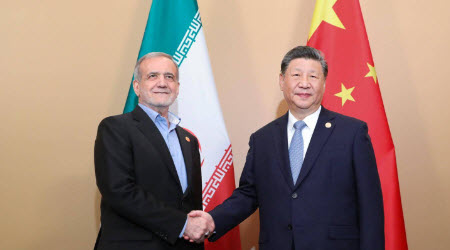
China’s carefully constructed Gulf strategy is facing one of its toughest tests as Iran’s confrontation with the United States disrupts energy flows, threatens Arab partners and exposes the limits of Beijing’s influence over Tehran.
The immediate pressure point is the Strait of Hormuz, where shipping traffic remains sharply below normal levels after months of conflict. Fresh attacks on two vessels operated by Abu Dhabi National Oil Company have intensified concerns over the security of a waterway that carries a large share of Gulf energy exports.
The UAE has blamed Iran for the attacks, which caused limited damage and no reported casualties. Tehran has maintained that it retains significant control over navigation through Hormuz, while Washington has threatened further measures aimed at isolating Iran and constraining its oil exports.
For Beijing, the confrontation cuts across several strategic interests at once. China is Iran’s largest trading partner and overwhelmingly the biggest destination for Iranian crude. At the same time, Saudi Arabia, the UAE and other Gulf states have become far more important to China as sources of energy, investment opportunities and markets for technology and infrastructure.
China imported about 1.4 million barrels a day of Iranian crude in 2025, equivalent to roughly 12 per cent of its total crude imports. Much of the trade has operated outside official customs reporting because of sanctions, with cargoes frequently relabelled or transferred through intermediaries.
Yet the commercial weight of the Arab Gulf is considerably larger. Two-way trade between China and Saudi Arabia reached about $108 billion in 2025, with a similar figure recorded for the UAE. China’s trade with Iran was much smaller even after estimates of undeclared oil shipments were included.
That imbalance explains Beijing’s reluctance to allow its partnership with Tehran to damage relations with Gulf capitals. Saudi Arabia and the UAE have become central to China’s Middle East economic ambitions, spanning petrochemicals, renewable energy, artificial intelligence, logistics, electric vehicles and infrastructure.
Energy exposure is equally important. About half of China’s crude imports originate in the Middle East, while a substantial share of its liquefied natural gas comes from Qatar, the UAE and Oman. Roughly 45 to 50 per cent of China’s imported crude normally moves through Hormuz.
China has buffers against an extended oil disruption. Large state and commercial stockpiles, diversified suppliers and increased domestic production provide Beijing with greater protection than many other Asian importers. Estimates earlier this year suggested China held around 1.4 billion barrels in storage, while additional Iranian crude remained in floating and bonded storage.
Its dependence on Gulf gas is harder to manage. Qatar supplied more than a quarter of China’s LNG imports last year, leaving Beijing with fewer short-term alternatives if shipments are interrupted. Replacing seaborne gas requires either higher-priced cargoes from elsewhere, greater domestic consumption restraint or additional pipeline imports.
The crisis is therefore strengthening China’s long-standing drive to reduce vulnerability to maritime chokepoints. Domestic oil output reached about 4.3 million barrels a day last year, while Beijing has accelerated renewable power, energy storage and pipeline gas projects.
Diplomatically, however, the challenge is more immediate. Gulf governments have been pressing China to use its economic relationship with Iran to encourage restraint and support negotiations. Foreign Minister Wang Yi and China’s regional envoy Zhai Jun have maintained intensive contacts across the region as Beijing promotes a ceasefire.
Expectations were raised by China’s role in brokering the 2023 Saudi-Iran rapprochement, an agreement that appeared to demonstrate Beijing’s ability to translate economic influence into diplomatic leverage.
The continuing Hormuz disruption has complicated that image. China has avoided publicly confronting Iran over threats to shipping and has concentrated instead on calls for de-escalation, sovereignty and negotiation. Beijing has also resisted taking steps that could suggest alignment with Washington.
That approach protects China’s relationship with Tehran but risks disappointing Gulf governments that increasingly view secure shipping as a test of Beijing’s strategic credibility. China can offer investment, technology and diplomatic access, but the conflict has shown that its ability to alter Iran’s calculations remains uncertain.
Beijing also has wider geopolitical considerations. Iran provides discounted energy and represents an important partner in institutions such as BRICS and the Shanghai Cooperation Organisation. China has opposed efforts to isolate Tehran completely while avoiding formal defence commitments that could draw it directly into regional conflict.
Oil prices have added urgency to the dilemma. Brent crude climbed above $88 a barrel on Friday as fears of prolonged supply restrictions returned. Reduced Hormuz traffic, attacks on commercial vessels and uncertainty surrounding ceasefire efforts have kept a substantial geopolitical premium embedded in energy markets.
China’s refiners are particularly sensitive to those movements. Independent processors have relied heavily on discounted Iranian and Russian barrels to protect margins. Any sustained interruption of Iranian supplies would force them towards more expensive alternatives even if Beijing’s national stockpiles remain ample.
The longer the conflict lasts, the more China must reconcile two competing objectives: preserving Iran as a strategic and discounted-energy partner while assuring Saudi Arabia, the UAE and other Gulf states that deeper economic ties with Beijing carry meaningful political value.
The article Iran escalation puts China’s Gulf strategy under serious strain appeared first on Latest India news, analysis and reports on Newspack by India Press Agency).
Follow Arabian Post
Select Arabian Post as your preferred source on Google and MSN News for trusted business news and Arab politics and updates.



