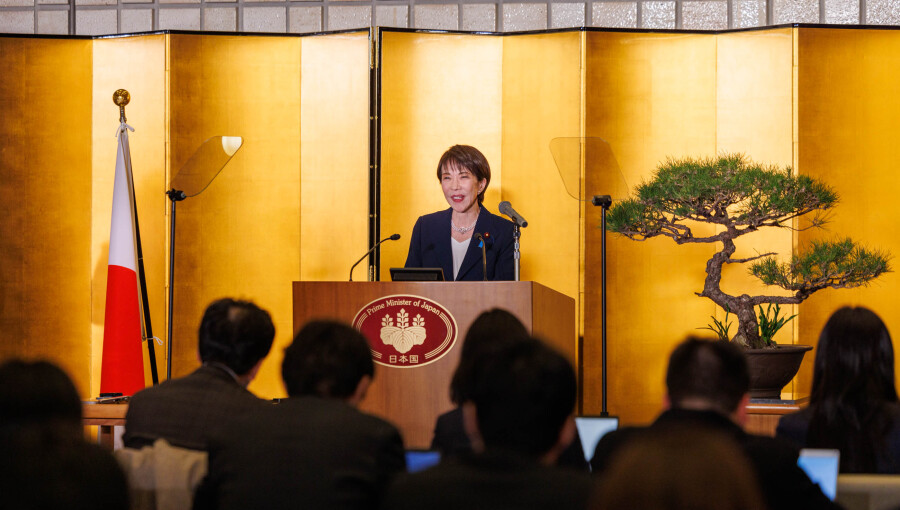
French President Emmanuel Macron is due to meet Japanese Prime Minister Sanae Takaichi in Tokyo on Wednesday, with the war involving Iran and the growing scramble for critical minerals set to dominate talks that reach far beyond bilateral ties.
The meeting comes as Japan and France face the same strategic question from different angles: how to protect economic security in a world where energy supplies, shipping routes and industrial inputs are increasingly exposed to conflict and geopolitical pressure. Officials in Paris and Tokyo have signalled that the Middle East crisis will take priority, while a parallel push on rare earths and other critical minerals is expected to produce a roadmap aimed at cutting reliance on China-dominated supply chains.
Macron arrived in Japan for a visit running from March 31 to April 2, according to Japan’s foreign ministry, and the French presidency indicated before the trip that the Middle East would sit at the centre of his discussions with Takaichi. That focus reflects the scale of the external shock hitting Japan in particular. The country depends on the Middle East for most of its oil imports, leaving it highly vulnerable to any disruption linked to the Strait of Hormuz and the broader military confrontation now rattling global energy markets.
For Tokyo, the stakes are immediate and economic. Fuel costs have surged, policymakers have already been forced to dip into stockpiles, and businesses are watching shipping and insurance costs with growing concern. For Paris, the crisis has become a test of diplomacy, deterrence and alliance management, especially as European governments weigh how to safeguard navigation and energy flows without being pulled into a wider war. Macron has cast France’s posture in the region as defensive while also trying to sustain a diplomatic track, a position that aligns in part with Japan’s preference for stability and de-escalation.
That shared concern is likely to shape the tone of the Tokyo meeting. Both leaders are expected to discuss the consequences of prolonged instability in the Gulf, including higher crude prices, supply disruptions and the pressure such shocks place on manufacturers, consumers and governments already dealing with fragile global growth. The discussions are also likely to examine how middle powers can respond when security crises spill directly into trade, transport and industrial policy.
Alongside the Iran-related agenda, Japan and France are expected to move ahead on a strategic minerals initiative that has acquired sharper urgency as countries seek to reduce exposure to Chinese export controls and concentration risk. A Nikkei report, carried by Reuters, said the two governments plan to agree a roadmap on rare earths and critical minerals, including a public-private refining project for heavy rare earths in southwestern France by the end of this year. Heavy rare earths are essential for products ranging from electric vehicle motors to advanced electronics and defence systems, making them central to industrial policy as well as national security.
That makes the Tokyo talks about more than a simple bilateral commercial arrangement. They are part of a wider realignment among advanced economies seeking alternatives to long-established supply chains that leave critical sectors exposed to political leverage. Japan has spent years trying to diversify procurement after earlier resource shocks, while France and other European countries are under mounting pressure to convert strategic autonomy rhetoric into concrete industrial capacity. A joint roadmap would suggest that both sides now see resource security as a matter requiring state-backed cooperation, not just market adaptation.
The minerals dimension also fits with broader shifts underway in Japan’s foreign and economic policy under Takaichi, who has sought to frame economic resilience, supply-chain diversification and strategic technology as inseparable from security planning. Macron, for his part, has pushed a version of European sovereignty that places greater emphasis on reducing dependence in energy, technology and raw materials. Their meeting therefore offers a useful snapshot of how two US allies are trying to build room for manoeuvre in a world shaped by war, economic coercion and fragmented trade.
Other areas of cooperation are expected to feature in the talks, including space and nuclear power. French officials have indicated that the two sides intend to expand work in the space sector, while Japanese and French channels have also pointed to a nuclear cooperation roadmap. Those items may not attract the same immediate attention as the Middle East crisis, but they reinforce the broader pattern of the visit: a move towards deeper industrial and strategic coordination between two countries that increasingly see resilience as a long-term policy priority.
Follow Arabian Post
Select Arabian Post as your preferred source on Google and MSN News for trusted business news and Arab politics and updates.