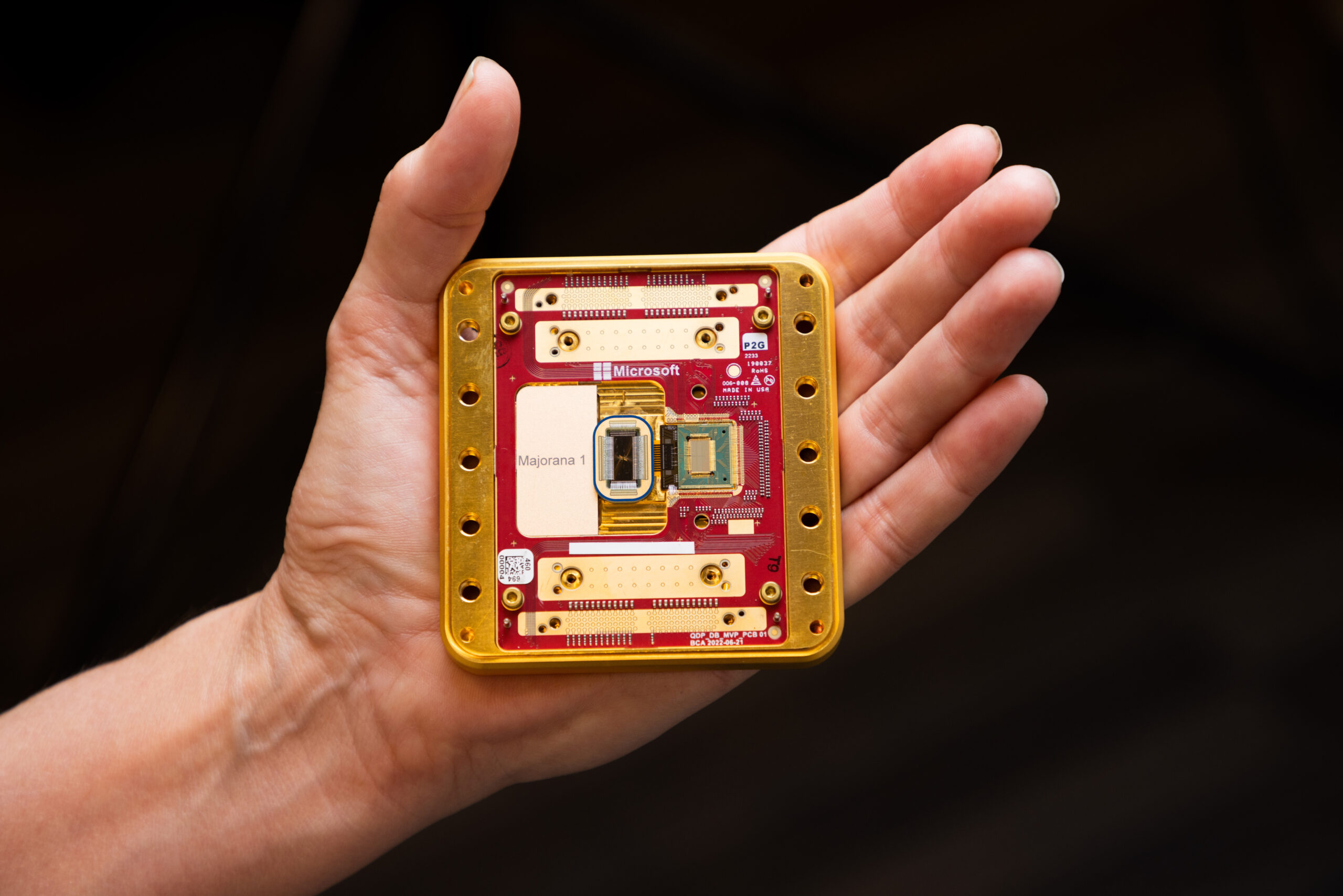
Microsoft has unveiled the Majorana 1 chip, a groundbreaking advancement in quantum computing. This chip introduces a novel Topological Core architecture, aiming to significantly enhance the scalability and reliability of quantum processors.
The Majorana 1 chip leverages topological qubits, which are designed to be more robust against errors compared to traditional qubits. This innovation is poised to address one of the most significant challenges in quantum computing: error correction. By utilizing a new state of matter known as a topological superconductor, the chip can host Majorana fermions—particles that are their own antiparticles. These fermions enable the creation of qubits that are inherently more stable and less susceptible to decoherence.
Microsoft’s approach differs from other industry leaders. While companies like Google and IBM have focused on superconducting qubits, Microsoft’s strategy centers on topological qubits. This method aims to reduce error rates and improve scalability. The company has been committed to this approach for nearly two decades, and the development of the Majorana 1 chip marks a significant milestone in its quantum computing journey.
The potential applications of the Majorana 1 chip are vast. Quantum computers powered by this technology could tackle complex problems that are currently beyond the reach of classical computers. This includes advancements in cryptography, optimization problems, and the simulation of molecular structures. Such capabilities could revolutionize industries ranging from finance to pharmaceuticals.
However, the path to practical, large-scale quantum computing remains challenging. While the Majorana 1 chip represents a significant leap forward, scaling the technology to millions of qubits is essential for solving real-world problems. Microsoft aims to achieve this scalability by the end of the decade. The company’s confidence is bolstered by recent experimental validations of topological qubits. Research published in Nature demonstrates the successful creation and control of Majorana zero modes in hybrid superconductor-semiconductor systems. These findings provide empirical support for Microsoft’s topological approach.
The introduction of the Majorana 1 chip has also influenced the broader quantum computing sector. Following the announcement, stocks of companies specializing in quantum technologies experienced an uptick. This surge reflects growing investor confidence in the commercial viability of quantum computing. Nevertheless, industry experts advise cautious optimism. While the Majorana 1 chip addresses critical issues, significant engineering challenges remain. Building a fully functional, error-corrected quantum computer requires not only scalable qubit architectures but also advancements in quantum algorithms and error correction techniques.
Microsoft’s commitment to quantum computing is evident in its substantial investments and strategic partnerships. The company’s quantum research facilities in Washington state and Denmark have been instrumental in the development of the Majorana 1 chip. Collaborations with academic institutions and research organizations have further enriched Microsoft’s research endeavors. These partnerships have facilitated the exchange of knowledge and resources, accelerating progress in the field.
Follow Arabian Post
Select Arabian Post as your preferred source on Google and MSN News for trusted business news and Arab politics and updates.