News related to
Abu Dhabi

Arabian Post Staff -Dubai A substantial move by Investcorp Capital to strengthen its presence in the US industrial real estate market has taken shape through the acquisition of a diversified portfolio valued at $400 million. The Abu Dhabi-listed alternative investment firm confirmed the purchase of a 35-building portfolio covering 2.6 million square feet across key coastal markets, reflecting an accelerated shift toward logistics-led strategies and income-generating assets […]

By T N Ashok NEW DELHI: Russian President Vladimir Putin arrived in India Thursday evening for a two-day state visit that has become a diplomatic flashpoint, testing New Delhi’s ability to maintain strategic independence amid mounting pressure from Washington and European capitals. The arrival marks Putin’s first trip to India since the Ukraine war began […]

The article Putin’s India Visit: A Stress Test Of Strategic Autonomy Amid Global Pressure appeared first on Latest India news, analysis and reports on Newspack by India Press Agency).

Urban development in the UAE is undergoing a noticeable shift toward environments that support long-term physical and mental wellbeing. As cities across the Emirates continue to grow, architecture and planning agencies increasingly treat wellness not as an amenity but as a structural principle shaping buildings, public spaces, and residential communities. Recent projects, including PASSO by Beyond, reflect this new direction in which design is guided by light, airflow, […]

A new specialised laboratory for testing and certifying sustainable aviation fuel is being set up in Fujairah, marking a significant expansion of the UAE’s ambitions to become a leading hub for low-carbon aviation fuels across the Middle East and North Africa. The project, developed by MENA Biofuels in partnership with Saybolt, is positioned as the first facility of its kind in the country dedicated to sustainable aviation fuel testing and is expected to strengthen the supply chain for carriers adopting cleaner fuel blends.

The laboratory will be located within the Fujairah Oil Industry Zone, one of the region’s key energy storage and logistics centres. According to the developers, the facility will operate under internationally recognised standards and provide independent verification and certification services for SAF produced in the UAE and the wider region. This will allow aviation fuel suppliers to meet the stringent quality and sustainability benchmarks required by global regulators and airlines, many of which are targeting large-scale SAF adoption over the coming decade.

MENA Biofuels and Saybolt have indicated that the lab is being designed to serve both domestic producers and international clients moving fuel through Fujairah’s terminals. Industry analysts note that Fujairah’s strategic location on the global maritime route linking the Gulf to Asia and Europe gives the new testing operation considerable potential to influence regional fuel flows. The developers said the initiative reflects growing demand among airlines for certified SAF, which is viewed as one of the most immediate pathways to reducing aviation emissions.

The UAE has been expanding investments in biofuels as part of its broader decarbonisation strategy, with several aviation stakeholders stepping up procurement of SAF blends for commercial flights. Etihad Airways and Emirates have both trialled SAF operations, while Abu Dhabi and Dubai authorities have emphasised the need for stronger regional production capacity. Industry data indicates that SAF supply remains constrained worldwide, making certification infrastructure a critical component for scaling up output. The new Fujairah lab aims to close a gap in regional capabilities by offering end-to-end testing that aligns with international requirements established by organisations such as ASTM International, which governs SAF specifications.

Saybolt, an inspection and testing group with long-standing operations in global energy markets, is expected to lead the technical management of the laboratory. Its role will involve implementing fuel-testing protocols, quality assurance systems and sustainability verification frameworks. Executives familiar with the arrangement said the partnership combines Saybolt’s technical expertise with MENA Biofuels’ regional network and logistics access. Market observers believe this gives the venture a strong foundation to support both emerging SAF producers and established energy companies evaluating diversification into aviation biofuels.

The decision to anchor the lab within the Fujairah Oil Industry Zone aligns with local authorities’ push to broaden the zone’s portfolio beyond crude and refined products. The zone already hosts significant tank storage, bunkering and refining infrastructure, and expanding into sustainable fuels aligns with the UAE’s national energy transition commitments. Investors and analysts have pointed to Fujairah’s ability to handle large volumes of fuel as an advantage for SAF certification, particularly for producers that require rapid turnaround on testing to meet airline delivery schedules.

Aviation industry figures have highlighted that the move addresses a structural bottleneck in the SAF market. Certification processes are often conducted in Europe or the United States, adding cost and delay for producers operating in the Gulf. By offering testing capacity locally, the Fujairah lab is expected to reduce lead times and encourage investment in regional SAF manufacturing. Some analysts say the initiative may draw interest from energy companies in neighbouring Gulf states exploring SAF pathways as part of their decarbonisation agendas.

Airline industry targets have accelerated demand for SAF, with global carriers collectively aiming for significant emissions reductions by 2030. Several Gulf-based airlines, including those operating through Abu Dhabi, Dubai and Sharjah, have pledged to expand their use of sustainable fuel blends once supply becomes more stable. SAF production in the region remains at an early stage, but energy firms have been evaluating waste-to-fuel pathways, renewable feedstocks and partnerships with technology providers to scale output. The establishment of credible certification capacity is viewed as an essential precursor to commercial production.

A fully digital escrow service for vehicle ownership transfers has been introduced through a partnership between SlashData and the Integrated Transport Centre, marking a significant shift in how transactions between buyers and sellers are executed in the UAE. The rollout of the platform known as Shary signals an effort to reduce paperwork, lift administrative burdens, and strengthen confidence in a market where used-car transactions continue to expand. […]

Manchester City and Etihad Airways unveiled a new immersive content piece, “Lights Out”, which places players Erling Haaland, Rayan Aït-Nouri and Nico O’Reilly inside a virtual version of the Yas Marina Circuit, blending advanced augmented-reality highlights and player-tracking data to re-imagine key moments from Manchester City’s season. The launch coincides with heightened interest in the 2025 Etihad Airways Abu Dhabi Grand Prix, adding a fresh digital spectacle to build fan excitement ahead of one of motorsport’s biggest weekends.

This marks the latest collaboration between the club and airline following their “Beyond Borders” campaign earlier this year, which first brought match highlights into stylised virtual worlds tied to Etihad’s expanding global destinations — notably highlighting new routes including Krabi, Hanoi and Sumatra. The “Lights Out” video replicates defining plays and celebrations from the 2024/25 campaign such as deft finishes and memorable goals, now reframed within the futuristic circuit environment of Yas Marina.

Beyond just replaying match footage, the content integrates virtual storytelling features. Fans witness Haaland’s trademark celebration as a robotic animation, while Aït-Nouri appears to race through Hanoi’s iconic Train Street — a nod to Etihad’s global network and its commitment to linking sport with travel experiences. This blend of sport and travel marketing reflects a broader trend among major clubs and sponsors seeking to expand engagement beyond traditional media into immersive digital formats.

For supporters of the Abu Dhabi Grand Prix, the timing amplifies the atmosphere surrounding the 2025 season finale. Organisers say this edition will be the largest yet, with enhanced fan experiences, expanded cultural access and expected turnout surpassing past years. The convergence of a high-stakes motorsport finale and a high-tech football release highlights how sports entities are increasingly cross-pollinating content across disciplines to tap into global fan bases.

Arabian Post Staff -Dubai The Abu Dhabi Securities Exchange Group has launched a new index — the FTSE ADX Dividend Stars Index — aimed at giving investors exposure to companies listed on ADX with strong dividend records. The index, now live, initially comprises 17 constituent companies selected for their consistent dividend performance and diversified operations across multiple sectors of Abu Dhabi’s economy. Those 17 constituents accounted for […]

Advertisements

Finding the best conference room in Abu Dhabi is essential for hosting productive meetings, impactful presentations, and memorable corporate events. As the emirate continues to grow as a global business hub, its meeting and event spaces have evolved to match world class standards.  Whether you are planning a board meeting, training session, investor presentation, or full scale corporate gathering, Abu Dhabi offers state of the art venues […]

Abu Dhabi-headquartered Mubadala Energy and PLN Energi Primer Indonesia have formalised a Heads of Agreement to supply natural gas from the Andaman Sea, a step set to reshape Indonesia’s energy supply landscape. The arrangement centres on output from the Tangkulo gas field, located roughly 65 kilometres off North Sumatra, which is estimated to hold over two trillion cubic feet of gas-in-place. Under the pact, resources from Tangkulo […]

Abu Dhabi is on track to deliver roughly 8,000 new residential units by the end of 2025, driven by a wave of strong demand and buoyant off-plan sales across the city’s housing market. Real-estate consultancy Cavendish Maxwell reports that developers completed around 2,700 apartments, villas and townhouses during the first nine months of the year, and have lined up an additional 12,800 units for handover in 2026. […]

Abu Dhabi is preparing to host what organisers describe as the world’s largest debut media and entertainment gathering, with the BRIDGE Summit 2025 scheduled to run from 8–10 December at the Abu Dhabi National Exhibition Centre. The summit is expected to draw more than 60,000 participants from around the globe and bring together over 400 speakers and 300 exhibitors under a single roof.

Organisers envisage BRIDGE as an immersive platform that merges content, technology, culture, and commerce, structured across seven thematic tracks: Media; Creator Economy; Music; Gaming; Tech & AI; Marketing; and Picture — the latter covering film, streaming, and visual storytelling. The schedule includes more than 300 activities: roughly 200 panels, 50 workshops and interactive showcases, masterclasses and matchmaking zones designed to connect creators, investors, policymakers and media platforms.

Participation confirmed by high-profile figures signals the summit’s global ambition. International actor, filmmaker and DJ Idris Elba will join the line-up, bringing his cross-sector experience in entertainment and advocacy to the Summit’s discussions. Alongside traditional media heavyweights and cultural leaders, the Summit aims to spotlight emerging voices in the digital creator economy. The Creator Economy track alone is slated to feature more than 80 global contributors across 50 sessions investigating how influence, ownership and monetisation are reshaping creative industries worldwide.

Central to the Summit’s narrative is the challenge facing modern media: trust, credibility and sustainability. As traditional broadcast gives way to streaming and social platforms, and as generative AI reshapes production, issues of editorial independence, content verification, audience dynamics and revenue stability are moving to the forefront. The Media track is expected to convene over 100 global editors, founders, policymakers and investors to discuss funding models, algorithmic distribution, content integrity and the very ethics of influence in media today. The Summit’s ambition is to provoke debate and propose frameworks that can guide media’s future in an era of rapid technological disruption.

Beyond content and discussion, BRIDGE is designed as a marketplace for partnerships — blending culture, commerce and policy. Conversations already under way include cross-sector collaborations between media companies, tech firms, venture capital, and energy and infrastructure players. For example, recent talks involving global tech leadership have highlighted an alignment of media innovation with digital infrastructure capacity and clean energy, reflecting how foundational resources are becoming integral to media’s next frontier.

For countries and organisations navigating the tension between creative independence, monetisation and regulatory frameworks, the Summit offers a testbed. Delegates include creators seeking sustainable revenue, investors eyeing cultural-sector returns, technology firms exploring policy-driven AI integration, and governments looking to harness media’s influence in soft power projection. That diversity suggests the Summit could influence not just entertainment and content markets, but regulatory norms, global standards, and potentially the geopolitics of information dissemination.

Attendance projections and speaker rosters aside, the Summit’s scale poses logistical and structural challenges. Managing 60,000 attendees across multiple tracks, workshops and networking zones demands rigorous coordination. Questions around equitable representation — of global South artists, independent creators and regional media voices versus established global brands — remain. Observers are watching whether BRIDGE can balance commercial ambition with inclusivity and whether media integrity and creative freedom will be genuine priorities.

If execution aligns with vision, BRIDGE Summit 2025 could mark a turning point for the media and entertainment industry — reimagining how content, community, technology and commerce converge in the coming decade.


Abu Dhabi’s major energy players have agreed a US$1.9 billion transaction that hands over the power and water generation facilities of Emirates Global Aluminium at Al Taweelah to a joint venture between Abu Dhabi National Energy Company PJSC and DUBAL Holding LLC. The assets include a 3.1 gigawatt combined-cycle gas-fired plant and a desalination facility with 6.25 million imperial gallons per day capacity. Operational control will rest […]

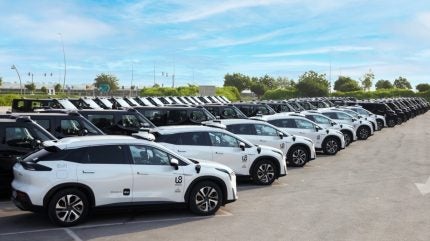
Abu Dhabi now offers public rides in fully driverless robotaxis operated jointly by WeRide and Uber, marking the first deployment of such services on the Uber platform outside the United States. Passengers can hail an autonomous vehicle on Yas Island using the Uber app — either through UberX or Uber Comfort — or select the newly added “Autonomous” ride option for a dedicated robotaxi.

The launch follows grant of a city-level commercial permit for Level 4 autonomous driving, issued in late October to WeRide, allowing the company to operate robotaxis without a safety driver on board. Local transport authorities approved the licence after WeRide demonstrated its technology and safety protocols through extensive testing over several months. This regulatory clearance and licensing represent a breakthrough in public acceptance of self-driving mobility in the region.

Initial operations are restricted to the tourist and leisure enclave of Yas Island, home to the Formula 1 Grand Prix circuit, where road traffic and infrastructure are relatively controlled. WeRide and Uber plan to expand coverage into central Abu Dhabi by the end of the year, aiming to broaden the footprint beyond the initial zone. The fleet — managed in collaboration with local operator Tawasul Transport — includes GXR-class robotaxi vehicles equipped with multiple sensors and cameras to navigate urban streets autonomously.

WeRide retains what it describes as a four-year first-mover advantage in deploying robotaxis in Abu Dhabi, having operated test and pilot robotaxi services since 2021. The company’s broader Middle East fleet already includes more than 100 robotaxis, with ambitions to scale into thousands over the coming years. This launch fits into Uber’s global vision for autonomous mobility, which aims to expand driverless operations to at least 10 cities by the end of next year.

Ride-hailing firms and autonomous-vehicle companies have long eyed the Middle East as a favourable terrain for self-driving deployment, thanks to relatively predictable urban layouts, supportive regulators, and growing appetite for smart mobility solutions. For Uber and WeRide, the Abu Dhabi rollout demonstrates that regulatory, technological and commercial challenges can be addressed in unison.

City officials from the Integrated Transport Centre have emphasised that the licensing process required rigorous review of safety standards and compliance steps before granting commercial operator status. WeRide had earlier secured a national-level licence for self-driving vehicles in 2023, and the new city-level permit is among the first of its kind outside the United States. That dual-licence history helped accelerate trust among authorities and the public.

Drivers and ride-hailing staff will still be involved behind the scenes — Uber, through Tawasul Transport, will handle fleet maintenance, cleaning, charging and vehicle readiness, while WeRide retains responsibility for sensor calibration, software updates and compliance. That model reflects a hybrid approach aimed at balancing technology, operations and safety.

Passengers have reacted with cautious optimism. Some early users welcomed the novelty and convenience of driverless rides, especially in a region with extreme weather and limited public transport options. Others raised concerns over reliability, data privacy, and how the autonomous system would respond to unpredictable road events such as pedestrians or errant drivers.

Abu Dhabi’s Modon Holding has taken a strategic equity stake in Wellington Lifestyle Partners, signalling its first foray into a high-end equestrian and real estate development project in the United States. The investment is slated to support the expansion of Wellington International showgrounds in Florida and underpin an ambitious ultra-luxury development that blends horse sport, upscale residences, hospitality and leisure amenities. The funding will go toward completing […]

Abu Dhabi: Financial executives from over 20 Arab countries gathered this week at the newly formed Sanadak unit to examine its dispute-resolution model designed for banks and insurance firms, marking a push by the UAE to raise consumer-protection standards across the region. Sanadak cited engagement with the 50 delegates as an opportunity to showcase how its independent mechanism can serve as a regional benchmark, while participants praised the UAE’s pro-consumer frameworks and stressed transparent regulation as vital for financial trust.

Sanadak operates under the oversight of the Central Bank of the UAE and was established to adjudicate complaints between consumers—or small to medium-sized enterprises—and licensed financial institutions or insurance companies. Its core functions include receiving complaints online or via app, verifying that 15 calendar days have passed from the institution’s response or a lack thereof, and moving the matter into resolution or referral to appeal-committees.

At the gathering, Sanadak emphasised that its role extends beyond the UAE, as the first financially-regulated specialised ombudsman unit in the Middle East and North Africa region. The unit highlighted how its jurisdiction, rules and structure could offer a template for cross-border alignment among Arab states seeking stronger consumer redress in banking and insurance. The discussion touched on the unit’s values of impartiality, accessibility, efficiency and integrity.

The session underscored several key trends: First, financial-services regulators globally are moving toward early-intervention powers, unified licensing for banks and insurers, and forward-looking oversight of fintech and digital-asset services. The UAE’s newly enacted Federal Decree-Law No. 6 of 2025 consolidates banking, finance and insurance regulation and confirms Sanadak’s independent mandate for complaints resolution.

Second, consumer-protection mechanisms are gaining regulatory prominence as market participants cope with rising complexity in product offerings, from digital banking to insurance-linked investment products. Sanadak’s model aims to provide a single portal of access and streamline resolution without resorting to litigation. Officials say this helps build consumer confidence, enhance financial inclusion and strengthen institutional integrity.

Third, regional cooperation and benchmarking among Arab states were highlighted as emerging priorities. Delegates at the meeting emphasised that harmonised complaint-handling standards will bolster cross-border financial activity and investor trust. One delegate observed that adopting a model such as Sanadak’s “sends a strong signal that consumer rights are integral to banking-sector stability”.

Sanadak’s leadership also outlined practical outcomes: the resolution of insurance-sector disputes via permanent committees including independent judges and experts was mandated by Administrative Resolution No. 10-A/1/2024, issued by the Central Bank. That rule establishes minimum timelines, virtual-hearing options and defined fee structures—from AED 100 for fixed-value disputes up to AED 30,000 for higher-value claims.

The initiative aligns with the UAE’s broader ambition — underpinned by its “digital-first” strategy — to present its financial sector as accessible, regulated and globally competitive. Sanadak states its mission to support trust in the financial system and foster financial-inclusion goals through education and accessible redress.

Nonetheless, challenges loom. Ensuring that external, regional institutions adopt the same discipline and that complaints-resolution outcomes are enforceable across jurisdictions remains uncertain. Some financial-services observers caution that consumer-protection frameworks must evolve as digital-asset services proliferate and as cross-border financial activity expands. One expert described the regulatory change as “about future-proofing the UAE’s financial system by ensuring it remains resilient, inclusive and responsive to emerging technologies”.

Abu Dhabi-listed NMDC Energy has launched a full branch in Taiwan and a commercial office in Shanghai, marking a strategic move into the Asia-Pacific region to support its project pipeline and strengthen supply-chain relationships. The company also sealed a memorandum of understanding with CITIC Steel, one of China’s largest steel producers, signalling a concerted effort to lock in reliable sourcing for its energy-services operations. NMDC Energy’s decision […]

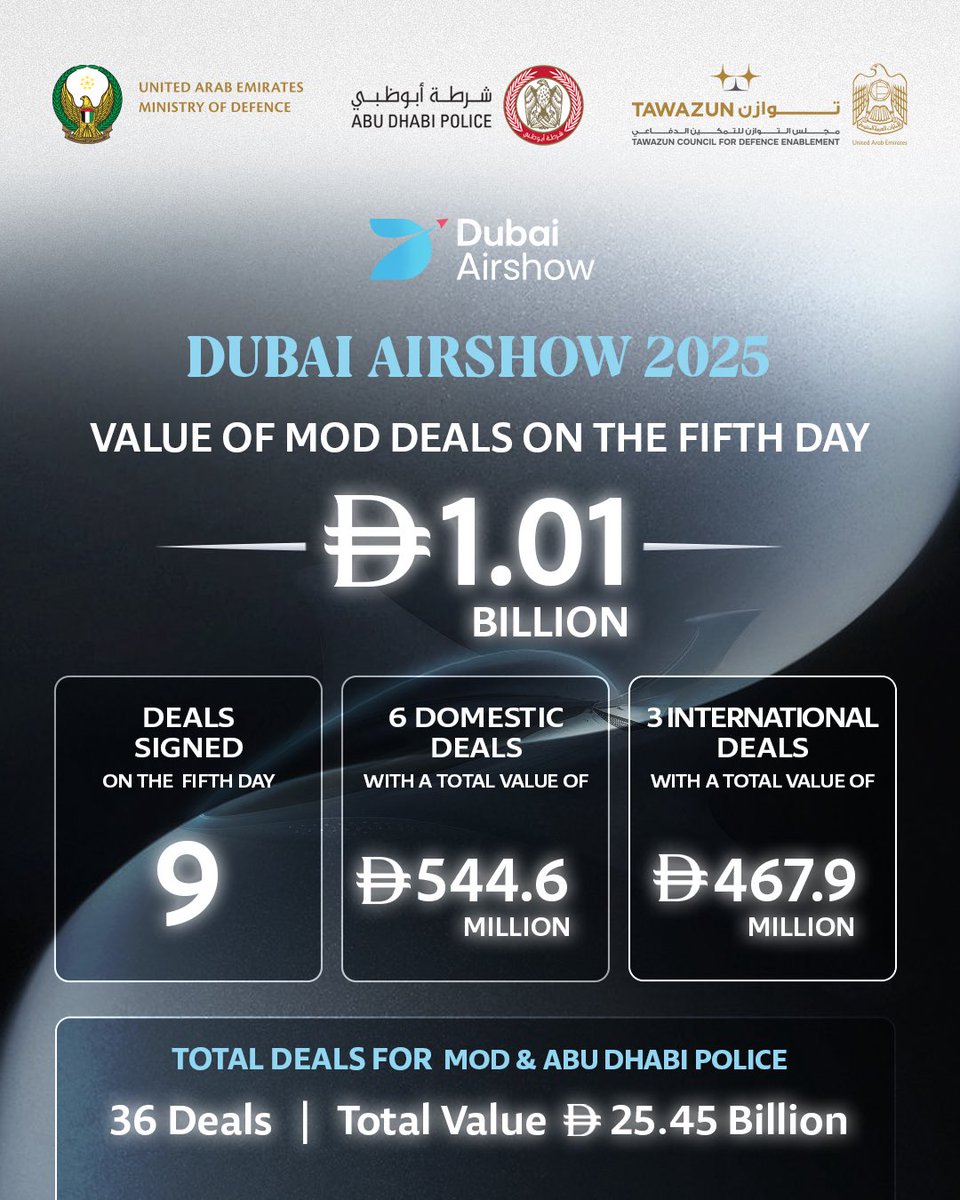
The Tawazun Council for Defence Enablement recorded nine new contracts worth AED 1.012 billion on behalf of the Ministry of Defence on the fifth and final day of the Dubai Airshow 2025, elevating the event’s five-day total to 36 agreements with a cumulative value of AED 25.455 billion.

At a press conference in Dubai attended by spokespersons Majed Ahmed Al Jaberi, Abdulla Ahmed Al Saeedi and Manea Abdulkarim Al Mansoori, the council detailed that six of the final-day contracts, sized at AED 544.675 million, were with local firms, while the balance, AED 467.913 million, involved international companies.

Among the domestic deals, two contracts with the Abu Dhabi-based M4 Trading comprised a AED 57.636 million order for a Grand Control Station and a AED 161.634 million deal for aircraft procurement. A AED 29 million contract went to Al Taif Technical Services Company for cooling-equipment and power-generator maintenance, while MP3 Company secured a AED 154.5 million agreement for aerial-rescue systems and spare parts. International Golden Group received AED 65.905 million for aerial drop systems and AED 76 million went to Abu Dhabi Autonomous Systems Investments for drone procurement.

On the global front, two agreements with Lockheed Martin amounted to AED 184 million and AED 63.551 million respectively for maintenance and spare-parts support. A third contract with Raytheon Technologies was valued at AED 220.362 million for friendly-force identification systems.

Across the event, earlier announcements show the council had already signed 20 contracts worth AED 18.01 billion during the first three days of the airshow. This underlines a consistent pace of deal-making spanning both national and international industrial partners.

The contract portfolio highlights the UAE’s emphasis on building a robust domestic defence-and-security-industrial ecosystem, spanning aircraft systems, drones, radars, simulation and service-support infrastructure. Analysts note this reflects a shift from traditional procurement towards localisation, technology transfer and national capability building.

Tawazun’s officials emphasised that the partnerships frame more than incremental orders; they represent structural steps toward embedding industry in sovereign defence strategy. Ms Mansoori observed that the council “continues to foster a competitive and enabling environment for the private sector” and that the outcomes achieved through the airshow “reflect the UAE’s vision of developing an integrated, innovative and strategically driven defence and security sector.”

While the headline figure of AED 25.455 billion positions Dubai Airshow 2025 among the region’s most commercially active defence gatherings, some independent observers caution that the true measure of success will rest on execution, delivery timelines and domestic-industry uptake. Questions remain about how many contracts include meaningful offsets, R&D components and long-term local value-creation versus straightforward procurement.

Nevertheless, the event’s records reinforce Dubai’s growing role as a hub for aerospace-defence engagement, with deals touching both military and dual-use capabilities. Compared with earlier editions, this year’s flow involves a higher proportion of contracts that combine hardware, maintenance-services and technology-transfer features — signalling deeper industrial ambition rather than purely kit acquisition.

The spread of contract-values — from tens of millions of dirhams for niche specialised systems to multi-hundred-million agreements with global primes — reveals a multipronged strategy. Domestic SMEs are being drawn into the supply chain alongside major established defence-sector players, thereby diversifying participation and reducing reliance on external supply.

As the UAE moves ahead with its national defence-industrial roadmap, the final-day flurry of deals from Tawazun brings the focus firmly onto the implementation phase of those agreements and the strategic partnerships that will underpin them over the coming years.

Arabian Post Staff -Dubai A major Abu Dhabi conglomerate has confirmed that it has formally expressed interest in acquiring overseas assets of a large Russian oil group, aligning with other global energy players eyeing the same prize. International Holding Company said it has notified the U. S. Treasury Department of its interest in buying foreign-based assets of Lukoil, placing it in active contention alongside the likes of […]

Abu Dhabi’s infrastructure expansion enters an ambitious phase with the Abu Dhabi Projects and Infrastructure Centre announcing a capital-projects pipeline valued at US$54 billion over the next five years, and ambitions to double the size of this programme by 2040. Officials described the initiative as a broad invitation to overseas and regional contractors to engage in major new developments spanning housing and social infrastructure. During a road-show […]

Arabian Post Staff -Dubai During a private audience at the Vatican, Pope Francis offered high praise for the United Arab Emirates, describing the country as a “global model” for promoting the values of coexistence and human fraternity. He underlined the readiness of the Holy See to deepen cooperation with the Higher Committee of Human Fraternity, an initiative rooted in the landmark February 2019 document on human fraternity. […]

The Abu Dhabi Securities Exchange has marked its 25th year, standing today as one of the world’s top 20 stock markets by market value. Founded in 2000 with just 12 listed companies, the exchange now hosts more than 200 securities, carries a market capitalisation in excess of AED 3 trillion and counts 1.2 million investors drawn from over 200 nationalities. This milestone comes as the ADX embarks […]

Abu Dhabi-listed NMDC Energy PJSC has opened a new branch in Taiwan and established a commercial office in Shanghai as it taps deeper into the Asian energy services market and seeks to strengthen its upstream supply-chain links. The company confirmed the Taiwan branch and Shanghai office during its latest expansion move. The move follows NMDC Energy’s award of a US $1.136 billion engineering, procurement and construction contract […]

A collaboration between the Technology Innovation Institute and Space42 will deliver the first space-to-ground quantum-communication network in the United Arab Emirates, signalling a significant step in national cyber-security strategy. The partnership, unveiled at the Dubai Airshow, brings together TII’s advanced research into Quantum Key Distribution and Space42’s satellite infrastructure to form a sovereign system capable of ultra-secure data transfer between orbiting platforms and terrestrial stations. TII and […]

First Abu Dhabi Bank has mandated a group of global and regional banks to arrange investor calls on Wednesday, 19 November, signalling the preparation of a benchmark USD-denominated Additional Tier 1 capital issuance. The Abu Dhabi-based lender, rated Aa3 by Moody’s and AA- by both S&P and Fitch, is targeting a fixed-rate, resettable perpetual instrument with a non-call six-year structure, expected to be rated Baa3 by Moody’s, subject to market conditions.

FAB has appointed Abu Dhabi Commercial Bank, Barclays, Emirates NBD Capital, itself, HSBC and Standard Chartered Bank as joint lead managers and bookrunners for the issuance, reflecting a strong syndicate backing. According to institutional-market briefings, the period of investor calls is intended to gauge pricing, demand, and issuance size ahead of launch.

This move marks FAB’s first benchmark AT1 issuance in approximately five years and comes as the bank seeks to bolster its capital buffer amid evolving regulatory expectations. Market-specialist commentary notes that such securities serve a dual purpose: providing permanent capital that counts towards Tier 1 regulatory ratios while offering issuers the flexibility of a call option after a set period — in this case six years — to redeem, subject to certain conditions.

FAB’s prior issuance of a senior green bond earlier this month — a €850 million deal priced at mid-swaps plus 70 basis points after opening at plus 100 basis points — underlined its readiness to access capital markets. That deal illustrated investor appetite for the bank’s funding instruments and the bank’s willingness to tap diverse instruments and jurisdictions. The proposed AT1 issuance broadens FAB’s capital-raising toolkit further.

In assigning an expected rating of Baa3 by Moody’s for the proposed issue, the bank is effectively targeting the lowest investment-grade category from that agency for this level of instrument. Such ratings reflect the subordinated nature of AT1 securities; they rank lower than senior debt in the creditor hierarchy and often incorporate features such as coupon discretion and loss-absorption mechanisms — factors that carry higher credit risk for investors compared to senior bonds.

Emerging-markets commentators note that demand for Gulf-region AT1 securities has been relatively scant over the past year as investors have weighed macro-economic headwinds, rising interest-rate environments and regulatory adjustments. The Gulf region’s total primary issuance of bonds and sukuk for the first quarter of the year was reported at USD 51.5 billion, down from USD 55.5 billion in the same period a year prior; within this, financial-institution capital instruments formed a subset of activity. Nevertheless, select banks continue to tap issuance windows that align with investor sentiment.

For FAB, the timing appears strategic: the bank’s common equity Tier 1 ratio stands at 13.7 per cent — a figure comfortably above its internal threshold of 13.5 per cent but lower than the 14.3 per cent recorded a year earlier. This suggests room for issuing capital-absorption securities like AT1 to reinforce buffers without triggering market concern. Regulatory changes also loom: UAE banks are due to face a 50-basis-point increase in the counter-cyclical buffer next year, which will raise total capital requirements and heighten the capital-management imperative.

Investor calls scheduled on 19 November are expected to cover structuring options, timing of launch, target size and investor syndication. Initial market commentary anticipates that FAB may aim for a headline size in the region of USD 750 million — consistent with its last AT1 benchmark in 2020 — although precise sizing will hinge on demand and market dynamics.

The joint bookrunners assemble a strong global footprint: Barclays, HSBC and Standard Chartered provide global investor access while Emirates NBD Capital and Abu Dhabi Commercial Bank offer regional distribution strength. That reflects FAB’s dual aim of tapping both GCC-based and international institutional investors. Market observers believe that if oversubscription builds, pricing could tighten relative to initial guidance and the syndicate may consider increasing sizing accordingly.

VISHNU RAJA
RYO YAMADA
HITORI GOTOH
IKUYO KITA