News related to
Bitcoin

The cryptocurrency market is currently experiencing heightened volatility, with the Bitcoin Fear and Greed Index indicating a significant surge in fear among investors. This sentiment shift has prompted a closer examination of alternative digital assets, particularly memecoins like DOGEN, which are gaining traction as potential high-reward investments.

As of February 19, 2025, Bitcoin is trading at $95,389, reflecting a decrease of $753 from the previous close. This downward trend has contributed to the elevated fear levels in the market. In contrast, memecoins such as DOGEN are capturing investor interest due to their unique market positioning and community-driven momentum.

DOGEN, a memecoin inspired by popular internet culture, has seen a notable increase in trading volume. Its appeal lies in its vibrant community and the potential for rapid appreciation, characteristics that have historically driven the success of similar tokens. Market analysts suggest that during periods of market fear, investors often explore alternative assets like memecoins, which, despite their inherent risks, offer opportunities for substantial gains.

Hong Kong’s Securities and Futures Commission has granted a license to Bullish, a prominent virtual asset trading platform, marking a significant milestone in the city’s ambition to become a leading hub for digital assets. This approval allows Bullish to operate within Hong Kong’s regulated framework, offering trading services to both institutional and retail investors.

The SFC’s decision to license Bullish is part of a broader strategy to enhance Hong Kong’s competitiveness in the global digital asset market. Financial Secretary Paul Chan announced that, to date, nine digital asset trading platform licenses have been issued, with eight additional applications under review. This initiative underscores the city’s commitment to fostering a robust and secure environment for virtual asset trading.

Julia Leung, the SFC’s Chief Executive, highlighted that the regulatory body is evaluating the introduction of new cryptocurrency products, including derivatives and margin lending, specifically tailored for professional investors. Speaking at Coindesk’s Consensus Hong Kong 2025 conference, Leung emphasized that these considerations aim to expand the range of services available to investors, thereby solidifying Hong Kong’s position as a regional digital assets hub.

Bullish’s entry into Hong Kong’s regulated market is expected to enhance the city’s digital asset ecosystem. The platform, known for its innovative trading solutions, integrates advanced technologies to provide deep liquidity and secure transactions. By obtaining the SFC license, Bullish demonstrates its commitment to adhering to stringent regulatory standards, offering users a trustworthy platform for virtual asset trading.

The SFC has been proactive in refining its regulatory framework to accommodate the evolving digital asset landscape. In January 2025, the commission introduced a streamlined licensing process for virtual asset trading platforms. This new procedure requires a single external assessment report, replacing the previous two-phased assessment, thereby expediting the approval process for applicants. This move aims to attract more virtual asset service providers to establish operations in Hong Kong, contributing to the city’s growing digital economy.

Hong Kong’s efforts to position itself as a digital asset hub come amid increasing global competition. Jurisdictions such as Singapore and Dubai are also vying for prominence in the virtual asset sector, offering regulatory incentives and establishing comprehensive frameworks to attract blockchain and cryptocurrency enterprises. Hong Kong’s strategic approach, characterized by rigorous regulatory oversight combined with industry-friendly policies, seeks to balance investor protection with innovation.

The city’s regulatory advancements have coincided with notable movements in the cryptocurrency market. Bitcoin, the leading cryptocurrency, experienced a significant surge, reaching an all-time high of $109,071 in January 2025 before stabilizing around $96,000. This upward trajectory reflects growing investor confidence and increased institutional adoption of digital assets. Analysts attribute this trend to favorable regulatory developments and the mainstream acceptance of cryptocurrencies as a legitimate asset class.

In addition to licensing trading platforms, Hong Kong is advancing regulations for stablecoins—digital currencies pegged to stable assets like fiat currencies. The SFC is formulating guidelines to govern the issuance and management of stablecoins, aiming to mitigate risks associated with their use and ensure financial stability. This regulatory clarity is anticipated to encourage the development of stablecoin projects within the region, further diversifying Hong Kong’s digital asset offerings.

Market participants have responded positively to these regulatory developments. The introduction of new licensed platforms is expected to enhance market liquidity and provide investors with a wider array of trading options. Furthermore, the presence of regulated entities like Bullish is likely to attract institutional investors seeking compliant and secure avenues for digital asset exposure. This influx of institutional capital could contribute to the maturation and stabilization of the cryptocurrency market in Hong Kong.

Australian digital assets market maker Zerocap has unveiled the nation’s inaugural options-based structured product linked to the CoinDesk 20 Index . Announced at Consensus Hong Kong, this partnership with CoinDesk Indices aims to provide sophisticated investors with diversified exposure to leading digital assets.

The CoinDesk 20 Index serves as a benchmark, capturing the performance of the top 20 digital assets by liquidity and volume. Over the past five years, the index has demonstrated significant growth, offering a broader alternative to traditional bitcoin-ether portfolios by including a range of prominent cryptocurrencies.

Mark Hiriart, head of sales at Zerocap, highlighted the significance of this development: “This partnership with CoinDesk Indices brings sophisticated, structured options to the crypto market for the first time, offering our clients enhanced ways to invest in digital assets with tailored risk and diversification benefits.”

The introduction of this product reflects a growing demand among institutional investors for advanced financial instruments in the cryptocurrency sector. By incorporating options-based strategies, the offering allows for customized risk management, potential yield enhancement, and exposure to a diversified basket of digital assets.

Grayscale Investments, a prominent digital asset management firm, has unveiled the Grayscale Pyth Trust, a new investment vehicle designed to provide accredited investors with exposure to PYTH, the governance token of the Pyth Network. This initiative marks a significant expansion of Grayscale’s product suite, aiming to bridge traditional finance with decentralized finance ecosystems.

The Pyth Network, operating on the Solana blockchain, serves as a decentralized oracle network that delivers high-fidelity financial data to smart contracts. By aggregating real-time data from a consortium of over 50 leading financial institutions and trading platforms, Pyth ensures the accuracy and reliability of on-chain information. The introduction of the Grayscale Pyth Trust offers investors a direct avenue to participate in the governance and future development of this critical infrastructure within the DeFi landscape.

Michael Sonnenshein, CEO of Grayscale Investments, emphasized the strategic importance of this launch, stating, “As the DeFi sector continues to evolve, providing our clients with diversified exposure to foundational elements like the Pyth Network aligns with our commitment to offering innovative investment solutions.” He further highlighted the role of oracles in bridging on-chain and off-chain data, underscoring their significance in the maturation of decentralized financial systems.

The Grayscale Pyth Trust is structured to cater to accredited investors, adhering to regulatory standards while broadening access to digital assets associated with emerging blockchain technologies. This move reflects a growing trend among institutional investors seeking to engage with decentralized networks that offer real-world applications and governance opportunities.

Solana’s blockchain, known for its high throughput and low transaction costs, provides the underlying infrastructure for the Pyth Network. The synergy between Grayscale’s investment products and Solana’s technological capabilities is poised to attract investors interested in the scalability and efficiency of next-generation blockchain solutions.

Industry analysts view Grayscale’s expansion into oracle-based tokens as a strategic diversification, recognizing the increasing demand for reliable data feeds in smart contract execution. The Pyth Network’s approach to sourcing data directly from market participants addresses concerns about data latency and manipulation, offering a robust solution for decentralized applications.

In the broader context of the cryptocurrency market, the introduction of the Grayscale Pyth Trust signifies a maturation of investment opportunities, moving beyond traditional cryptocurrencies like Bitcoin and Ethereum. By focusing on infrastructure components essential to the DeFi ecosystem, Grayscale is positioning itself at the forefront of digital asset management, catering to investors seeking exposure to the foundational technologies driving blockchain innovation.

The launch of the Grayscale Pyth Trust also coincides with a period of heightened regulatory scrutiny in the cryptocurrency sector. Grayscale’s adherence to compliance standards in offering this trust reflects an understanding of the importance of regulatory alignment in fostering investor confidence and ensuring the longevity of digital asset investment products.

As the DeFi landscape continues to expand, the role of decentralized oracles like the Pyth Network becomes increasingly critical. They serve as the connective tissue between real-world data and blockchain-based applications, enabling a myriad of use cases from decentralized finance to gaming and beyond. Grayscale’s initiative to provide investment exposure to this segment indicates a recognition of the pivotal role that data accuracy and reliability play in the ecosystem’s growth.

Tokyo-based investment firm Metaplanet has announced a 10-for-1 stock split, effective April 1, following a staggering 3,900% surge in its share price over the past year. This remarkable growth is largely attributed to the company’s strategic acquisition of Bitcoin, positioning it as a significant corporate holder of the cryptocurrency.

Since initiating its Bitcoin investment strategy in April 2024, Metaplanet has amassed approximately 2,031 bitcoins, valued at nearly $200 million. The firm’s aggressive accumulation has drawn parallels to U.S.-based MicroStrategy, known for its substantial Bitcoin holdings. Metaplanet’s stock price escalation has been directly linked to its cryptocurrency investments, prompting the decision to implement a stock split to enhance market accessibility and liquidity.

The upcoming stock split aims to reduce the financial barrier for potential investors by lowering the price per share, thereby broadening the company’s shareholder base. In an official statement, Metaplanet expressed that the stock split is intended to “lower the price per trading unit, thereby improving liquidity, expanding our investor base, and strengthening our connection with a broader range of shareholders.”

In its latest acquisition, Metaplanet purchased an additional 269.43 bitcoins at an average price of ¥14,846,322 per Bitcoin, equating to approximately $25.8 million. This purchase increased the company’s total holdings to over 2,000 bitcoins, reinforcing its commitment to a Bitcoin-centric investment approach. The firm has set ambitious targets to expand its reserves to 10,000 bitcoins by the end of 2025 and 21,000 by the end of 2026.

The company’s strategic shift towards Bitcoin investments has not only bolstered its financial standing but also significantly impacted its market valuation. The 3,900% increase in Metaplanet’s stock price over the past year underscores the market’s positive response to its cryptocurrency-focused strategy. This surge mirrors a broader trend among companies adopting Bitcoin as a treasury asset, inspired by pioneers like MicroStrategy.

Metaplanet’s approach includes diversifying its business model to integrate Bitcoin into various facets of its operations. The firm has ventured into developing a Bitcoin-themed hotel and an educational branch aimed at promoting cryptocurrency adoption. These initiatives reflect a comprehensive strategy to capitalize on the growing interest and acceptance of Bitcoin in mainstream finance and commerce.

However, the company’s aggressive Bitcoin accumulation strategy is not without risks. The inherent volatility of cryptocurrency markets poses potential challenges to financial stability. Analysts caution that a significant downturn in Bitcoin’s value could adversely affect Metaplanet’s financial health, given its substantial exposure to the digital asset. Additionally, geopolitical tensions and regulatory uncertainties surrounding cryptocurrencies add layers of complexity to the firm’s investment approach.

Despite these challenges, Metaplanet remains steadfast in its belief in Bitcoin’s long-term value proposition. The company’s leadership views the cryptocurrency as a hedge against traditional market fluctuations and a strategic asset for future growth. This conviction is evident in their continued investments and the structural adjustments, such as the forthcoming stock split, designed to align with their Bitcoin-centric vision.

The broader market has taken note of Metaplanet’s performance, with investors closely monitoring the outcomes of its bold investment strategy. The forthcoming stock split is anticipated to attract a more diverse group of investors, potentially leading to increased trading volume and liquidity. As the April 1 effective date approaches, market participants are keen to observe how this move will influence Metaplanet’s stock performance and whether it will sustain its upward trajectory.

Bitcoin’s value has fallen below the $94,000 threshold, influenced by macroeconomic factors and investor sentiment. Despite this downturn, some financial analysts continue to project a long-term surge, with estimates suggesting the cryptocurrency could reach $500,000 in the coming years.

On February 19, 2025, Bitcoin’s price dropped to $93,882.60, marking a 1.74% decrease for the day. This decline is attributed to rising bond yields and expectations of a robust U.S. jobs report, which have bolstered the U.S. dollar’s strength against other currencies. The dollar’s appreciation has made alternative assets like Bitcoin less attractive to investors, leading to a sell-off in the cryptocurrency market.

The recent inauguration of President Donald Trump’s second term has also impacted Bitcoin’s trajectory. Since January 20, when Bitcoin reached a record high, the cryptocurrency has experienced a 14% decline. This downturn is partly due to dissatisfaction with the new administration’s cryptocurrency policies. Notably, while the Securities and Exchange Commission has established a digital-asset task force, the anticipated creation of a Bitcoin strategic reserve has not materialized, leading to uncertainty among investors.

Despite the current bearish trend, some analysts remain optimistic about Bitcoin’s long-term potential. Geoffrey Kendrick, Standard Chartered’s global head of digital assets research, has predicted that Bitcoin could surpass $500,000 by the end of 2028. This forecast is based on factors such as improved investor access and a decrease in Bitcoin’s volatility, which could enhance its appeal as a mainstream asset class.

Similarly, financial analyst Michaël van de Poppe has suggested that Bitcoin’s price could reach $500,000, driven by institutional adoption and macroeconomic shifts. He points to the U.S. government’s pro-cryptocurrency stance and the potential for Bitcoin to serve as a strategic reserve asset as catalysts for this projected growth.

However, not all experts share this bullish outlook. BCA Research, a firm that has been optimistic about Bitcoin for the past two years, is now signaling a potential peak in the cryptocurrency market. The firm cites indicators such as the proliferation of memecoins and excessive bullish sentiment as signs that the market may be overheating. They suggest that a price point of $75,000 might be a more attractive entry for investors, considering current economic conditions and market dynamics.

FloppyPepe , a meme-inspired cryptocurrency, is rapidly gaining attention, with projections suggesting it could outperform established assets like Solana by an astonishing 10,300% in the current market cycle. While Solana has seen significant price increases due to optimism surrounding an upcoming exchange-traded fund approval and network improvements, the emergence of FloppyPepe signals a new wave of interest in meme tokens, potentially reshaping investor expectations.

Solana’s price surge has captured the crypto community’s focus, with many analysts forecasting a rise to $300 within the next month. This bullish sentiment stems from two key factors: the expected approval of Solana’s ETF, which could drive more institutional investment, and the recent upgrades to the Solana network aimed at improving scalability and performance. These developments have led to a renewed sense of optimism among SOL holders, some of whom are betting that the asset could once again rival top cryptocurrencies like Bitcoin and Ethereum.

Despite these positive developments, the market’s attention is increasingly divided as new contenders emerge in the meme-token sector. FloppyPepe, based on the popular “Pepe the Frog” meme, has gained traction in the crypto world with its growing following. Initially a niche meme coin, it has now sparked excitement due to its aggressive price predictions. The token’s rapid rise is fuelled by social media buzz and a cult-like following, typical of meme-based cryptocurrencies, which have historically seen dramatic increases in value based on viral trends and online hype.

FloppyPepe’s meteoric growth potential lies in its ability to capitalise on the volatile nature of meme coin markets. Similar to the explosive rises of tokens like Dogecoin and Shiba Inu, FloppyPepe thrives on community engagement, social media momentum, and speculative trading. In fact, some analysts predict that the token could see gains surpassing 10,000% if the momentum continues. This level of growth would make it one of the most significant stories of the current crypto cycle, challenging even established players like Solana.

On the other hand, Solana’s long-term viability faces a set of challenges that could affect its current optimism. Although the upcoming ETF approval is expected to bring institutional investors into the fold, it also raises questions about whether Solana can maintain its market position when other blockchain projects continue to emerge with similar technological advancements. While Solana’s network upgrades promise to enhance its functionality, the broader market still wrestles with concerns over scalability, security, and its ability to differentiate itself in a crowded field.

FloppyPepe, with its meme token status, operates in a much different market segment. While the meme-token market is often criticised for being speculative and volatile, the sheer unpredictability of these assets is what attracts traders looking for massive short-term gains. Additionally, the token’s success is tied not only to its meme origins but also to its engagement with the broader cryptocurrency community, which frequently fuels the rise of such assets. Its ability to capture the zeitgeist of internet culture may help it continue to grow, even in the face of potential market corrections.

It is important to note that the cryptocurrency market is notoriously volatile, with prices frequently shifting based on broader macroeconomic trends, regulatory news, and technological advancements. The rise of meme coins like FloppyPepe challenges traditional investment principles, as these tokens often lack the fundamental backing seen in more established assets like Solana. Yet, their appeal lies in the speculative gains they offer in the short term, making them a high-risk, high-reward asset class for adventurous investors.

For now, FloppyPepe’s future trajectory remains unclear, and its ability to continue growing at its current pace will depend on several factors, including the level of continued community support and its integration into broader crypto exchanges. The token’s surge in popularity highlights the growing trend of meme-based cryptocurrencies, which continue to captivate retail investors and provide new opportunities for speculative trading. While Solana’s infrastructure improvements may help it sustain its growth over time, FloppyPepe offers an example of how meme tokens can reshape the landscape in unexpected ways.

Advertisements

A staggering 500 ETH, valued at around $1.3 million, has been sent to Ethereum’s zero address in what has become one of the most cryptic blockchain events in recent memory. The transaction, which has captured the attention of the cryptocurrency community, was accompanied by an enigmatic message referencing a Chinese-grade brain-computer interface, claiming its mass implantation in the military and workforce. The unusual act has sparked widespread speculation about its meaning, implications, and the individual or group behind the act.

Ethereum’s zero address, often referred to as the “black hole” of the network, is a location where cryptocurrency sent to it becomes irretrievable, effectively removing the tokens from circulation. While blockchain transactions are typically transparent, the anonymity of the sender and the content of the message have raised more questions than answers.

The cryptic note that accompanied the burn transaction alluded to a highly advanced brain-computer interface, purportedly similar to Neuralink, the much-publicised project from Elon Musk’s company. The message hinted that this technology, often regarded as a cutting-edge innovation in both neuroscience and artificial intelligence, has already been implemented on a massive scale. The sender claimed that this brain-computer technology was not just in experimental stages but was being actively used by a military force and across civilian workforces, implying a potential shift in global power dynamics or technological supremacy.

The mention of a “Chinese-grade” brain-computer interface adds another layer of intrigue, as it alludes to the potential advancements in China’s technological sector. Over the past decade, China has increasingly focused on research in artificial intelligence, neural interfaces, and brain-computer technology, signalling its ambition to dominate these fields. While Neuralink has garnered significant media attention, there are growing concerns about the competition in the race to develop sophisticated mind-computer interfaces.

Blockchain enthusiasts and experts are scrambling to decipher the meaning of the act. The burner of the ETH has remained anonymous, with no clear link to any prominent individual or group. It is unclear whether this is the work of a rogue individual, a collective of hackers, or a state actor trying to communicate a geopolitical message. However, many in the blockchain community are starting to hypothesize that this could be a form of “digital protest” or a warning related to the growing reliance on artificial intelligence and neural interfaces in various sectors, including defence.

Such a bold move has placed the spotlight back on Ethereum, a blockchain renowned not only for its cryptocurrency but also for its smart contract capabilities, which enable the execution of decentralized applications . Ethereum’s open-source nature has allowed the technology to foster innovation across multiple industries, and while this particular act seems to be a disruption, it is also a reflection of the growing complexity of the Ethereum ecosystem. The zero address has previously been used for symbolic acts of defiance or statements, but this particular incident is unlike anything seen before in scale or content.

There has been no official statement or credible confirmation that the message is anything more than a hoax or a coordinated stunt. However, the possibility that the message is legitimate has prompted discussions around the potential consequences of such a technological leap. If brain-computer interfaces are being used to the extent suggested in the message, it could reshape global economies, militaries, and workforces in profound ways. The implications for personal privacy, ethics in warfare, and even human cognition are far-reaching.

The role of blockchain in this incident cannot be overstated. Blockchain’s fundamental promise of transparency, security, and decentralisation offers a stark contrast to the centralised control often associated with the technology giants and governments behind brain-computer projects. Some analysts are suggesting that this incident could be a symbolic confrontation between the world of decentralised technologies and the increasing centralisation of technological advancements by state actors or large corporations.

The fact that this burn occurred on the Ethereum network adds an additional layer of complexity. Ethereum, which has transitioned from proof-of-work to proof-of-stake, is viewed by some as the “world computer,” offering the infrastructure to decentralise everything from finance to data storage. Its use in this context seems particularly fitting, as the blockchain’s pseudonymity allows for anonymity in such a high-stakes act. While blockchain’s public ledger ensures transparency, it simultaneously offers the opportunity to mask the identity of those behind its most mysterious actions.


KUALA LUMPUR, MALAYSIA – Media OutReach Newswire – 18 February 2025 – The global cryptocurrency market has seen unprecedented growth in the previous year, spearheaded by Bitcoin and Ethereum. Institutional participation was very important in driving prices higher, with Bitcoin reaching an all-time high above $100,000 in December 2024. With the spreading adoption of crypto assets, regulators have paid even more attention to the industry. Kar Yong […]

El Salvador is set to make a significant stride in the global cryptocurrency space with the introduction of a dedicated Bitcoin section at its National Library. The initiative aims to promote the understanding of Bitcoin’s role in the modern financial landscape, with the library becoming the first in the world to feature a permanent collection dedicated to the digital currency.

The new section will not only house a variety of books and resources on Bitcoin, but will also include an interactive display that demonstrates the operation of a full Bitcoin node in real-time. This demonstration will showcase the network’s fundamental role in facilitating peer-to-peer transactions, decentralised consensus, and the security of the global Bitcoin system. The library’s innovative move underscores the growing importance of cryptocurrency and blockchain technologies in shaping the future of finance.

El Salvador’s push to integrate Bitcoin into its national framework has been met with both enthusiasm and skepticism. In 2021, the country made headlines as the first in the world to adopt Bitcoin as legal tender, a bold move aimed at fostering financial inclusion and reducing dependency on traditional banking systems. The decision, spearheaded by President Nayib Bukele, generated widespread debate among economists, policy makers, and the global financial community, with concerns ranging from volatility risks to the broader implications for global monetary policy.

The National Library’s Bitcoin section is part of a larger effort by the government to support Bitcoin literacy and educate the public on how the cryptocurrency functions. El Salvador’s decision to incorporate Bitcoin into its official monetary system was a pivotal moment in the global conversation about digital currencies, and the library initiative represents a continuation of that effort. By making Bitcoin more accessible and understandable to the public, the library aims to demystify the technology and encourage individuals to engage with it in a meaningful way.

The section will feature a range of resources, including literature on the history of Bitcoin, its technological underpinnings, and its potential to disrupt traditional financial systems. Additionally, the live Bitcoin node demonstration will allow visitors to see firsthand how transactions are validated and how the network operates, offering a tangible understanding of the underlying infrastructure that powers the cryptocurrency.

Experts in the field of blockchain technology and cryptocurrency have praised El Salvador’s commitment to education and its progressive stance on integrating digital assets into the mainstream. By promoting Bitcoin literacy, the library is helping to build a foundation of knowledge that could enable the next generation of financial professionals to better navigate the evolving digital economy. The initiative also complements the country’s broader strategy of positioning itself as a leader in cryptocurrency adoption, which includes the creation of “Bitcoin Beach” – a community-focused initiative aimed at fostering the use of Bitcoin for everyday transactions.

However, the decision to embrace Bitcoin has not been without controversy. Critics argue that the volatility of Bitcoin poses significant risks to the stability of El Salvador’s economy, particularly given the country’s reliance on remittances, which make up a large portion of its GDP. The price fluctuations of Bitcoin could create instability in the value of these remittances, which are often sent by Salvadorans working abroad. Additionally, concerns have been raised about the environmental impact of Bitcoin mining, which requires significant energy consumption.

Despite these concerns, President Bukele has remained steadfast in his belief that Bitcoin represents a transformative force for economic growth, particularly in emerging markets. By introducing a Bitcoin-focused educational initiative, the National Library is helping to build the groundwork for future developments in blockchain and cryptocurrency technology. The initiative is also part of a broader effort to align El Salvador with the global trend of digitisation, as governments and businesses worldwide increasingly explore the potential of digital currencies and decentralised technologies.

As more countries and institutions around the world begin to explore the possibilities of cryptocurrencies, El Salvador’s National Library stands as a symbol of the country’s forward-thinking approach to technological innovation. The Bitcoin section, along with the live node demonstration, provides a unique opportunity for individuals to engage with the technology in a hands-on way, gaining a deeper understanding of its potential impact on the financial system.

The Bitcoin section at the National Library is expected to attract both local visitors and international tourists, many of whom are keen to learn more about El Salvador’s pioneering role in the cryptocurrency space. It will also serve as a hub for academic research, with scholars and students having access to a wealth of information on Bitcoin and its applications. This initiative could potentially inspire similar efforts in other countries looking to embrace the digital future.

SafeMoon is preparing to release a new memecoin on the Solana blockchain, marking a significant shift for the company and its investors. The announcement follows the recent burning of most of the circulating supply of its native token, SFM. With this strategic move, the company aims to attract new interest and drive liquidity, despite the token’s current low trading volume.

SafeMoon’s decision to burn a substantial portion of the SFM supply has garnered attention in the crypto community. The burn, which reduced the total token count by a considerable margin, is seen as a way to enhance scarcity and increase the value of remaining tokens. As a result, SFM holders now have an opportunity to sell their holdings, though the liquidity remains low. This initiative aligns with SafeMoon’s broader plan to maintain its relevance within the highly competitive cryptocurrency space.

The memecoin launch on Solana represents a new direction for SafeMoon, which had previously been associated with the Binance Smart Chain. By integrating with Solana, the company aims to tap into a growing ecosystem known for its fast transactions and low fees. Solana’s scalability has made it an attractive platform for both developers and investors, with an increasing number of projects migrating to the blockchain.

Solana’s technical advantages, such as its high throughput and lower transaction costs, have made it a favoured choice for memecoins and other decentralized applications. This move may signal a shift in how SafeMoon plans to diversify its offerings and potentially widen its user base. However, the success of this transition remains contingent on several factors, including the broader market sentiment and the response from the Solana community.

As part of the launch, SafeMoon will also introduce new utility features to the memecoin, aiming to distinguish it from other coins in the meme category. While details remain scarce, the company has hinted at unique staking opportunities and integration with decentralized finance platforms. Such features could help the token gain traction beyond speculative trading and offer long-term value to holders.

The timing of SafeMoon’s venture into the memecoin sector is notable, as the meme coin market has seen significant fluctuations. Despite the volatile nature of these assets, the trend of memecoins continues to thrive, with new coins emerging almost daily. SafeMoon’s decision to burn a large portion of its supply may be seen as an attempt to position itself strategically in a market dominated by high-profile coins like Dogecoin and Shiba Inu.

For SFM holders, the new memecoin could offer an alternative investment opportunity. While the value of SFM itself remains uncertain due to the ongoing low liquidity, the introduction of a memecoin on a platform like Solana could reinvigorate interest in the SafeMoon ecosystem. However, the challenge lies in converting the existing SFM tokens into assets that hold tangible value in the broader market.

Despite the potential for growth, SafeMoon will need to address several challenges. The cryptocurrency market is notoriously volatile, and the performance of the new memecoin will depend on various external factors, including regulatory changes, investor sentiment, and competition from other projects. Additionally, the lack of liquidity in the current market may make it difficult for holders to realise significant returns on their tokens.

SafeMoon’s move also raises questions about the long-term sustainability of its model. Critics have pointed out the risks associated with burning large portions of a token’s supply and launching new assets in an already saturated market. While burning tokens can create a sense of scarcity, it does not guarantee that demand will follow, particularly in an environment where many tokens are vying for attention.

Despite these concerns, SafeMoon remains optimistic about its future. The company has expressed confidence in its ability to innovate within the crypto space and provide value to its community. By tapping into Solana’s fast-growing ecosystem, SafeMoon is positioning itself to capitalise on the increasing interest in blockchain-based assets. Whether this strategy will be enough to reinvigorate the SafeMoon brand and attract new investors remains to be seen.

A growing trend in the meme coin sector has seen FloppyPepe surpass its predecessor, Pepe , capturing the attention of both investors and cryptocurrency enthusiasts alike. Recently, a notable Dogecoin millionaire garnered media attention after staking a massive $1 million on meme coins, marking a strategic shift from PEPE to FPPE. This bold move, backed by the promising features of FloppyPepe, signals a potentially significant change in the meme coin landscape.

FloppyPepe’s rise is partly driven by its advanced AI-powered utilities and its promise of creating a tangible, real-world impact. Unlike traditional meme coins, which are often criticized for lacking utility, FPPE stands out due to its sophisticated technology that appeals to a more discerning investor base. Its presale event has been nothing short of remarkable, with the coin raising $907,200 within just 24 hours, an indication of both high demand and investor confidence.

Currently priced at $0.0000002 during its ongoing presale, FloppyPepe offers an accessible entry point for those looking to capitalise on what some are calling the next big thing in the meme coin market. This pricing strategy positions the coin for potential mass adoption, especially as it attracts a broader demographic beyond the typical meme coin investor.

The market is taking notice of FloppyPepe’s trajectory. While PEPE continues to hold a significant presence within the meme coin ecosystem, its growth seems to have plateaued as newer contenders with added value start gaining attention. The influx of investors and major players shifting their focus to FloppyPepe reflects a growing trend within the cryptocurrency community to seek projects with both meme potential and solid technological foundations.

Critics of meme coins have often highlighted the speculative nature of these digital assets, with many questioning their long-term viability. However, FloppyPepe is positioning itself as a response to these concerns by adding value through its AI-powered features. These technological advancements are geared towards providing real-world applications, which could elevate the coin’s status from a mere joke to a legitimate player in the broader cryptocurrency market.

FloppyPepe’s private presale was only the beginning. The project’s developers are currently gearing up for a wider public sale, with plans to increase the coin’s exposure to mainstream investors. This effort to build a broad base of supporters is critical to its long-term success, as the market for meme coins continues to evolve. Unlike traditional cryptocurrencies like Bitcoin or Ethereum, which are often defined by their underlying technology and use cases, meme coins like FloppyPepe rely heavily on community support and viral momentum to drive their value.

The increased focus on FloppyPepe has also been accompanied by heightened interest from social media influencers and cryptocurrency advocates, who have taken to various platforms to promote the coin’s potential. These endorsements have further fueled speculation that FloppyPepe could become the next big meme coin to make a significant impact, particularly in a market that thrives on hype and social sentiment.

The surge in FloppyPepe’s presale earnings underscores the coin’s growing popularity. As of now, the presale remains open, with investors keen to secure their share before the public launch. The coin’s affordability during the presale phase has attracted both seasoned investors and newcomers to the cryptocurrency space, each hoping to capitalise on its rapid rise.

With PEPE’s dominance beginning to wane, FloppyPepe is stepping into a vacuum left by older meme coins that have failed to evolve or add meaningful use cases. As more investors flock to FPPE, it becomes evident that the meme coin market is becoming more sophisticated, with an increasing demand for projects that combine meme appeal with innovative features. This shift could potentially reshape the landscape of meme coins, moving beyond the often volatile and speculative nature of past successes.

FloppyPepe’s focus on AI integration is also noteworthy. The coin’s developers have emphasised that the use of AI will play a crucial role in expanding its real-world impact. By utilising cutting-edge technologies, FloppyPepe aims to create a sustainable platform that goes beyond mere speculation, providing value to its users and investors alike. These advancements are expected to create a new wave of meme coin projects that incorporate utility into their ecosystems, setting them apart from older, less innovative alternatives.

Cryptocurrency analysts are forecasting a significant upward trajectory for XRP, Ripple’s native token, with projections suggesting a potential rise to $17 in the coming year. This optimistic outlook is bolstered by recent market developments and technical analyses indicating a robust bullish trend.

As of February 17, 2025, XRP is trading at $2.71, reflecting a slight decrease of 0.025% from the previous close. The token experienced an intraday high of $2.80 and a low of $2.70, with a 24-hour trading volume of approximately $2.9 billion.

The recent acknowledgment by the U.S. Securities and Exchange Commission of Grayscale’s application to list an XRP Exchange-Traded Fund has injected renewed enthusiasm into the market. Although this acknowledgment does not equate to approval, it signifies a step forward in regulatory recognition, potentially paving the way for increased institutional investment.

Technical analysis reveals that XRP is forming a bullish pennant pattern, a continuation pattern that often precedes significant price movements. Analyst Egrag Crypto has highlighted this formation, suggesting that upon confirmation of a breakout above the $3.40 resistance level, XRP could rally towards the $15 to $17 range. He emphasizes the importance of surpassing this critical threshold to validate the bullish momentum.

In addition to the ETF developments, XRP’s decentralized exchange has reported a surge in activity, with daily trading volumes reaching $17 million. This uptick in DEX usage indicates growing confidence among retail investors and may serve as a catalyst for further price appreciation.

Market sentiment is further buoyed by the broader cryptocurrency landscape, where assets like Bitcoin have demonstrated resilience amidst economic fluctuations. The recent stabilization of Bitcoin’s price, despite inflationary pressures, suggests a maturation of the crypto market, with XRP poised to benefit from this stability.

A significant shift in American financial trends has emerged: the number of U.S. adults owning Bitcoin now exceeds those carrying student loan debt. This development highlights the growing adoption of cryptocurrency amidst ongoing concerns over educational debt.

Recent data indicates that approximately 65.7 million American adults, or 28% of the adult population, currently own cryptocurrency, with Bitcoin being the predominant asset. This marks a substantial increase from 15% in 2021, suggesting a rising public confidence in digital currencies. In contrast, about 42.7 million Americans hold federal student loan debt, collectively amounting to $1.693 trillion. This figure represents a 42% increase over the past decade, reflecting both the escalating costs of higher education and the broader accessibility of college degrees.

The surge in cryptocurrency ownership can be attributed to several factors. The “crypto winter” of 2022, characterized by significant market downturns, appears to have been a temporary setback. Since then, the market has rebounded, with Bitcoin’s value reaching record highs. Notably, in December 2024, Bitcoin rallied past $107,000, fueled by President-elect Donald Trump’s proposal to establish a U.S. Bitcoin strategic reserve. This policy initiative, coupled with the inclusion of companies like MicroStrategy in major stock indices, has bolstered investor confidence and attracted substantial capital inflows.

Demographic analyses reveal that cryptocurrency adoption varies across different groups. Men aged 18 to 29 are the most prominent investors, with 42% reporting that they have engaged with cryptocurrencies. This contrasts with 17% of women in the same age bracket. Racial and ethnic disparities are also evident: 28% of Asian adults have invested in cryptocurrencies, compared to approximately 20% of Black and Hispanic adults, and 14% of White adults. Income levels further influence investment patterns, with 23% of adults in upper-income households participating in the crypto market, versus 14% in lower-income households.

Despite the increasing popularity of cryptocurrencies, skepticism persists. A survey conducted in October 2024 found that 63% of U.S. adults lack confidence in the safety and reliability of cryptocurrencies. This sentiment underscores the volatile nature of digital assets and the regulatory uncertainties surrounding them.

Conversely, the student loan landscape presents its own challenges. The percentage of households with student debt has more than doubled from 10% in 1992 to 21% in 2022. This rise is partly due to more Americans pursuing higher education and the escalating costs associated with it. The financial burden of student loans has far-reaching implications, affecting borrowers’ ability to purchase homes, start businesses, and save for retirement.

Policy responses to these issues have been varied. The Trump administration has expressed skepticism towards widespread student debt forgiveness, favoring targeted relief measures instead. In contrast, Vice President Kamala Harris has advocated for more comprehensive solutions, including significant debt cancellation and the promotion of free college education to address systemic inequalities.

The cryptocurrency market witnessed an unprecedented surge in token creation in January 2025, with over 600,000 new tokens minted, a twelvefold increase from the monthly average of 50,000 observed between 2022 and 2023. This rapid expansion has raised significant concerns among analysts regarding potential liquidity fragmentation and its impact on the market’s stability.

The acceleration in token issuance became particularly notable in the fourth quarter of 2024, with monthly figures reaching 400,000 before escalating to January’s record levels. Bobby Ong, co-founder of CoinGecko, highlighted this trend, attributing it to the emergence of user-friendly token creation platforms. One such platform, Pump.fun, operating on the Solana blockchain, enables users to launch meme coins without requiring technical expertise. This democratization of token creation has lowered barriers to entry, allowing a broader spectrum of individuals to participate in the crypto ecosystem.

While the proliferation of new tokens reflects a vibrant and innovative market, it also poses challenges. Gabriel Halm, a research analyst at IntoTheBlock, expressed concerns that the sheer volume of new tokens could lead to liquidity fragmentation. With investor attention and capital spread across an ever-growing number of assets, the liquidity of individual tokens may diminish, potentially resulting in increased volatility and difficulties in executing large trades without significant price impacts.

The surge in token creation is not occurring in isolation. The broader cryptocurrency market has experienced notable fluctuations. In January 2025, the overall market capitalization saw gains, with Bitcoin’s price increasing by 9% month-over-month, reaching an intramonth high of approximately $109,000. However, this growth has been accompanied by heightened volatility, partly attributed to macroeconomic factors such as elevated U.S. Treasury yields, which have exerted pressure on risk assets, including cryptocurrencies.

The influx of new tokens also raises questions about the quality and viability of these assets. The ease of token creation may lead to an oversupply of tokens with limited utility or value, potentially diluting investor confidence and capital. This environment necessitates rigorous due diligence from investors to discern valuable projects from those lacking substantive foundations.

The rapid expansion of the token landscape could have regulatory implications. As the market becomes increasingly saturated, regulators may scrutinize the legitimacy and compliance of new token offerings more closely. This could lead to stricter regulatory frameworks aimed at protecting investors and ensuring market integrity.

In response to these developments, market participants are advocating for enhanced transparency and standards in token issuance. Establishing clear guidelines and best practices could help mitigate risks associated with the proliferation of new tokens and support the sustainable growth of the cryptocurrency market.

The current landscape presents a paradox: while the surge in token creation signifies innovation and growth, it also introduces complexities that could undermine market stability. Balancing the enthusiasm for new digital assets with prudent risk management and regulatory oversight will be crucial in navigating the evolving dynamics of the cryptocurrency market.

Blockchain.com, a prominent digital asset exchange, has appointed Justin Evans as Chief Financial Officer and Mike Wilcox as Chief Operating Officer as it advances towards a potential initial public offering . Evans, formerly the head of crypto investment banking at Goldman Sachs Group Inc., brings extensive experience in financial strategy and capital markets. Wilcox, who previously served as Chief Financial Officer at Velocity Global and was an investment manager at Point72 Asset Management, adds significant operational expertise to the team.

These strategic hires align with Blockchain.com’s objective to position itself for a public listing, capitalizing on the growing institutional adoption of cryptocurrencies and a more favorable regulatory environment. The company joins a cohort of cryptocurrency firms aiming to enter public markets, reflecting a broader trend within the industry.

In parallel, other major cryptocurrency firms are also exploring public listings. BitGo, a cryptocurrency custodian services provider, is reportedly considering an IPO as soon as the second half of this year. The firm is in discussions with potential advisers, although no final decision has been made. BitGo, founded in 2013, serves over 1,500 institutional clients across 50 countries and processes approximately 8% of global Bitcoin transactions by value. In 2023, the company raised $100 million, achieving a valuation of $1.75 billion.

Similarly, Gemini, the cryptocurrency firm backed by the Winklevoss twins, is considering an IPO as early as this year. This move underscores the increasing trend of cryptocurrency companies seeking public listings to access broader capital markets and enhance transparency.

The momentum for crypto-related IPOs is further evidenced by Circle Internet Financial’s plans. The company, known for issuing the stablecoin USDC, announced its intention to relocate its headquarters from Boston to New York City’s One World Trade Center in early 2025, ahead of its planned IPO. This relocation signifies the cryptocurrency industry’s deeper integration with traditional financial hubs.

The surge in IPO considerations among cryptocurrency firms is influenced by several factors, including increased institutional adoption of digital assets and evolving regulatory landscapes. The U.S. IPO market experienced significant growth in 2024, with companies raising over $41 billion, marking the most successful year since 2021. This resurgence is anticipated to continue into 2025, driven by favorable economic conditions and a more supportive regulatory environment.

However, not all major players are rushing to go public. Companies like SpaceX and OpenAI, despite substantial investor interest, are expected to delay their public offerings due to strong private funding. This trend indicates that while the IPO market is becoming more attractive, some firms prefer to remain private, leveraging ample private capital to fuel their growth.

In the retail trading sector, eToro has submitted confidential filings to the U.S. Securities and Exchange Commission for an IPO in New York, potentially valuing the company at over $5 billion. This move follows eToro’s previous attempt to go public in 2022 via a $10.4 billion deal with a blank-check company, which was halted due to unfavorable market conditions.

The increasing number of cryptocurrency and fintech firms pursuing public listings reflects a strategic shift towards greater transparency, regulatory compliance, and access to capital. As the industry matures, these public offerings are poised to reshape the financial landscape, bridging the gap between traditional finance and the burgeoning digital asset economy.

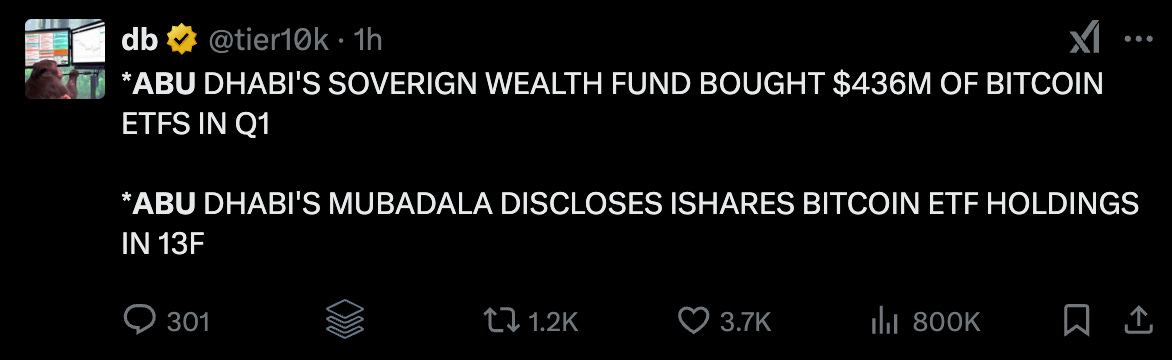
Abu Dhabi’s sovereign wealth fund, Mubadala Investment Company, has made a significant entry into the cryptocurrency market by acquiring $436.9 million worth of shares in BlackRock’s iShares Bitcoin Trust ETF during the fourth quarter of 2024. This move underscores the growing institutional interest in digital assets among sovereign wealth funds.

According to the latest 13F filings with the U.S. Securities and Exchange Commission, Mubadala purchased approximately 8.2 million shares of IBIT, marking its inaugural investment in a Bitcoin exchange-traded fund. This acquisition aligns with a broader trend of institutional investors increasing their exposure to cryptocurrency-linked financial products.

The fourth quarter of 2024 witnessed a surge in Bitcoin’s value, with the cryptocurrency appreciating by 47%. This upward trajectory has been a catalyst for various asset managers, including wealth management firms, hedge funds, and pension funds, to bolster their investments in Bitcoin ETFs. Notably, the State of Wisconsin Investment Board more than doubled its holdings in the iShares Bitcoin Trust ETF to 6 million shares by the end of December. Similarly, Tudor Investment Corp, a prominent hedge fund, increased its stake to 8 million shares, valued at $426.9 million at the close of the year.

Mubadala’s strategic investment reflects a growing confidence among sovereign wealth funds in the viability of digital assets. This move is particularly significant given the Middle East’s increasing engagement with blockchain technology and cryptocurrencies. In 2023, Abu Dhabi demonstrated its commitment to the digital asset space by investing in Bitcoin mining operations, collaborating with Marathon Digital and local firm Zero Two to develop a large-scale mining facility in the capital.

The iShares Bitcoin Trust ETF, managed by BlackRock, has emerged as a leading product in the market, amassing over $55 billion in assets under management. BlackRock’s expansion into Abu Dhabi in November 2024, securing a commercial license to operate, may have further facilitated Mubadala’s investment decision.

Industry experts view Mubadala’s substantial allocation to Bitcoin ETFs as a pivotal moment in the institutional adoption of digital assets. Anthony Pompliano, a well-known Bitcoin advocate, highlighted the strategic implications of such investments, suggesting that sovereign wealth funds’ involvement could prompt other nations to consider integrating Bitcoin into their reserves.

Financial advisory firms have also been active in this domain. Cetera Advisors and NewEdge Advisers, for instance, have increased their holdings across multiple Bitcoin ETFs, including those offered by Fidelity, ARK Investments, and Invesco. This trend indicates a rising demand from clients seeking exposure to digital assets through traditional investment vehicles.

While Mubadala’s investment marks a significant milestone, it is part of a broader pattern of institutional investors recognizing the potential of cryptocurrency assets. As digital currencies continue to gain mainstream acceptance, the involvement of sovereign wealth funds like Mubadala could signal a transformative shift in the global financial landscape.

The 13F filings provide a window into the investment strategies of large institutional players, offering insights into their positions at the end of each quarter. These disclosures, while not reflective of real-time holdings, are instrumental in understanding market dynamics and the evolving sentiment toward emerging asset classes like cryptocurrencies.

Mubadala’s foray into Bitcoin ETFs not only enhances its diversified investment portfolio but also positions Abu Dhabi as a forward-thinking participant in the rapidly evolving digital economy. As other sovereign wealth funds observe and assess the outcomes of such investments, a ripple effect leading to broader adoption of digital assets in institutional portfolios worldwide is plausible.

Elon Musk’s social media platform, X, is advancing its initiative to incorporate cryptocurrency payments, aiming for implementation by the end of 2025. This move is set to transform the platform into a comprehensive financial services hub.

X has partnered with Visa to develop ‘X Money,’ a payment system designed to facilitate seamless transactions for its users. While the initial phase focuses on traditional payment methods, the infrastructure is being built to support cryptocurrency transactions in the future. This strategic collaboration underscores X’s commitment to integrating digital currencies into its ecosystem.

Industry experts anticipate that X Money will be equipped to handle cryptocurrency transactions by the end of 2025. Ran Goldi, Senior Vice President at Fireblocks, noted that, based on current information, X Money is expected to be crypto-ready by the end of the year. This development aligns with Musk’s vision of transforming X into a multifaceted platform that encompasses social media, financial services, and more.

The introduction of the ‘$’ button within X Payments has been confirmed by Musk to enable direct cryptocurrency transactions on the platform. This feature positions X to become a leader in integrating digital currencies into everyday user interactions, offering functionalities such as sending and receiving payments, tipping content creators, and purchasing products using cryptocurrencies.

Despite these advancements, X’s partnership with Visa for financial services currently does not include cryptocurrency transactions. The platform is initially focusing on traditional payment methods, with plans to incorporate digital currencies at a later stage. This phased approach allows X to establish a solid foundation in financial services before expanding into the cryptocurrency domain.

The potential integration of cryptocurrencies into X’s payment system has sparked discussions about which digital assets will be supported. While specific cryptocurrencies have not been officially confirmed, there is speculation that popular digital currencies like Bitcoin and Dogecoin could be among the options available to users. This anticipation is fueled by Musk’s known advocacy for cryptocurrencies and his previous endorsements of digital assets.

In addition to enhancing user experience, the move towards cryptocurrency payments is expected to open new revenue streams for X. By facilitating crypto transactions, X could attract a broader user base interested in digital currencies, thereby increasing engagement and transaction volumes on the platform.

However, this initiative is not without challenges. The integration of cryptocurrency payments necessitates robust security measures to protect users’ digital assets. X will need to implement advanced encryption and fraud detection systems to ensure the safety and integrity of transactions. Additionally, navigating the complex regulatory landscape surrounding cryptocurrencies will require careful planning and compliance efforts to adhere to financial regulations across different jurisdictions.

As X progresses with its plans, the platform is poised to play a significant role in mainstreaming cryptocurrency usage. By embedding digital currency transactions into a widely used social media platform, X could drive broader adoption of cryptocurrencies, bridging the gap between traditional finance and the emerging digital economy.

GameStop Corp., the video game retailer known for its volatile stock history, is reportedly considering investments in Bitcoin and other cryptocurrencies. This strategic move aims to diversify the company’s assets and align with emerging financial trends.

The company’s stock experienced a significant uptick, rising approximately 8% in after-hours trading following the news. This surge reflects investor optimism about GameStop’s potential entry into the cryptocurrency market.

Speculation intensified after GameStop CEO Ryan Cohen shared a photo on social media featuring himself alongside Michael Saylor, the co-founder of Strategy , a firm renowned for its substantial Bitcoin holdings. This post fueled discussions about GameStop’s possible shift towards cryptocurrency investments.

In December 2023, GameStop’s board authorized a new investment policy, permitting the allocation of funds into various asset classes, including equities and alternative assets. This policy change has led to deliberations about investing in cryptocurrencies as a means to leverage the company’s cash reserves.

Analysts have noted that GameStop’s potential move into cryptocurrency could mirror Strategy’s approach, where significant investments in Bitcoin have been used as a hedge against traditional market fluctuations. Such a strategy could provide GameStop with a diversified asset base, potentially enhancing its financial stability amid the evolving retail landscape.

However, this potential shift is not without risks. The cryptocurrency market is known for its volatility, and substantial investments could expose GameStop to financial uncertainties. Moreover, the company has previously ventured into the crypto space with initiatives like launching crypto wallets in 2022, which were later discontinued due to regulatory concerns.

The Bank of Montreal , one of Canada’s leading financial institutions, has significantly increased its Bitcoin exchange-traded fund holdings to $150 million, according to recent Securities and Exchange Commission filings. This marks a substantial rise from its previous holdings of $13 million.

The SEC filings reveal that BMO’s investments are diversified across several prominent Bitcoin ETFs, including those managed by Ark Invest, Fidelity, BlackRock, and Grayscale. This strategic move aligns BMO with other major financial institutions that are expanding their presence in the cryptocurrency sector.

In addition to its increased Bitcoin ETF holdings, BMO has made notable adjustments to its investment portfolio. The bank added approximately 2.67 million shares of MicroStrategy Incorporated , a company known for its substantial Bitcoin holdings, representing an increase of about 4,817% over its previous position. Conversely, BMO reduced its positions in companies like NVIDIA Corporation and Amazon.com, Inc. , decreasing its holdings by 19% and 13%, respectively.

This development comes amid a broader trend of traditional financial institutions increasing their exposure to Bitcoin and related assets. For instance, PNC Bank, a top 10 U.S. bank by assets, recently reported a five-fold increase in its Bitcoin ETF holdings, rising from $10 million to $67 million over the past year. Goldman Sachs leads in this arena with $710 million invested in Bitcoin ETFs.

The growing interest in Bitcoin ETFs among major banks reflects a shift towards integrating cryptocurrency assets into traditional investment portfolios. Analysts suggest that this trend is driven by increasing client demand for digital asset exposure and the recognition of Bitcoin’s potential as a hedge against inflation.

BMO’s substantial increase in Bitcoin ETF holdings underscores the bank’s strategic initiative to align with evolving market dynamics and client interests. As the cryptocurrency landscape continues to mature, it is anticipated that more financial institutions will follow suit, further bridging the gap between traditional finance and digital assets.

Robinhood Markets Inc. has reported a significant increase in its fourth-quarter earnings, driven by a substantial rise in cryptocurrency trading activity. The company’s total revenue for the quarter reached $1.01 billion, marking the first time it has surpassed the billion-dollar threshold. This performance exceeded analysts’ expectations, which had projected revenue of $934 million.

A key contributor to this growth was the surge in cryptocurrency trading revenue, which escalated by 700% year-over-year to $358 million. This increase accounted for more than half of Robinhood’s transaction-based revenue, which itself saw a 200% rise to $672 million. The heightened interest in digital assets, particularly Bitcoin, which recently surpassed the $100,000 mark, played a significant role in this development.

In addition to the rise in crypto trading, Robinhood experienced growth in other areas. Options trading revenue increased by 83% to $222 million, while equities trading revenue rose by 144% to $61 million. The company’s assets under custody expanded by 88% to $193 billion, with net deposits reaching a record $16 billion during the quarter.

In a significant legal determination, the Jiangsu Provincial High People’s Court has ruled that investments in overseas cryptocurrency projects are not safeguarded under Chinese law. This decision underscores the nation’s stringent stance on virtual currency transactions and their associated legal protections.

The case involved a “Cooperation Agreement” between individuals identified as Tian and Pan, along with a third party, to jointly operate the “MFA Blockchain Project.” Pan transferred approximately 15.74 million yuan to Tian and the third party for the acquisition of MFA virtual currency, as stipulated in their agreement. Subsequently, Tian transferred 10.6 million yuan back to Pan. However, complications arose when the Singapore-based trading platform MEXC delisted the MFA/USDT spot trading pair in September 2020, leading to the locking of the associated virtual account and a total loss of the investment. Pan sought legal recourse, demanding the return of the remaining funds and payment of interest. The Yancheng Intermediate People’s Court initially ruled that the virtual currency trading activities were invalid, resulting in the dismissal of Pan’s lawsuit. Dissatisfied, Pan appealed the decision. Upon review, the Jiangsu High Court upheld the lower court’s ruling, emphasizing that providing services to Chinese residents through overseas virtual currency exchanges constitutes illegal financial activity. Consequently, the related civil legal acts were deemed invalid, and the court concluded that any resulting losses should be borne by the individuals involved.

This ruling aligns with China’s broader regulatory framework, which has progressively tightened restrictions on cryptocurrency activities. In September 2021, Chinese authorities implemented a comprehensive ban on all cryptocurrency transactions and mining, citing concerns over financial stability and the potential for illicit activities. The People’s Bank of China declared all virtual currency-related business activities illegal, reinforcing the country’s firm opposition to cryptocurrencies.

The Jiangsu High Court’s decision is not an isolated incident. In August 2021, the Shandong Provincial High Court ruled against a plaintiff seeking to recover lost cryptocurrency investments, stating that investing or trading in cryptocurrency is not protected by law. Similarly, in October 2024, a Shanghai court recognized cryptocurrencies as legal property, allowing individuals to hold, buy, and sell digital assets like Bitcoin. However, the court maintained that crypto-related business activities, such as token issuance and trading, remain prohibited in China.

Channel 4 has unveiled a new documentary titled “Seeking Satoshi: The Mystery Bitcoin Creator,” aiming to shed light on the elusive figure behind Bitcoin’s inception. The film embarks on a surreal exploration, suggesting a potential conspiracy among Silicon Valley elites to obscure the true identity of Satoshi Nakamoto. The program is scheduled to premiere on YouTube on Monday, February 17.

This release follows HBO’s documentary “Money Electric: The Bitcoin Mystery,” which posited that Bitcoin developer Peter Todd might be Nakamoto. Todd has vehemently denied these claims, labeling them as “ludicrous.” The documentary’s assertion has been met with skepticism within the cryptocurrency community, with many questioning the evidence presented.

KUALA LUMPUR, MALAYSIA – Media OutReach Newswire – 12 February 2025 – Coming into 2025, the cryptocurrency market is on the upswing. Bitcoin has reached another all-time high (ATH), surpassing $109,000 on 20 January 2025, ahead of Donald Trump’s inauguration. The overall market growth is driven by institutional investors‘ crypto adoption, a change in regulatory sentiments, and general interest in digital assets, retail investors included. Considering this, […]

VISHNU RAJA
RYO YAMADA
HITORI GOTOH
IKUYO KITA