Publicly listed companies now hold approximately 1.3 million Bitcoin, an increase of 31% over 14 months, although most of the expansion came from a single company, according to new figures released by blockchain analytics firm CryptoQuant. Strategy, the Bitcoin investment company chaired by Michael Saylor, accounted for 71% of the increase in corporate holdings, highlighting the growing concentration of digital assets among listed businesses despite wider adoption […]
Kerala faces the prospect of renewed power restrictions from November 1 as its temporary electricity supply arrangement with Himachal Pradesh expires on October 31, with the state government yet to approve a replacement agreement. The Kerala State Electricity Board (KSEB) is seeking urgent clearance to continue purcha…
Kerala faces the prospect of renewed power restrictions from November 1 as its temporary electricity supply arrangement with Himachal Pradesh expires on October 31, with the state government yet to approve a replacement agreement. The Kerala State Electricity Board (KSEB) is seeking urgent clearance to continue purcha…
Led by Blockchain Capital, the funding will accelerate the expansion of PhotonPay’s stablecoin-centric Financial OS, connecting stablecoin liquidity with global fiat networks to unlock digital assets for everyday corporate operations and cross-border settlement.
HONG KONG SAR – Media OutReach Newswire – 29 October 2026 – PhotonPay today announced the closing of a $40 million Series C funding round led by Blockchain Capital, with participation from new investor SBI Group and follow-on investments from existing investors IDG Capital, GL Ventures, and Lightspeed Faction. Blacksheep Technology acted as exclusive financial advisor to PhotonPay on the transaction.
The new capital will support the expansion of PhotonPay’s stablecoin-centric Financial Operating System (Financial OS), with investment focused on enhancing multi-asset wallet capabilities, expanding global card issuing, strengthening local clearing infrastructure in key markets, and developing an agent-ready financial execution layer.
As of August 2026, PhotonPay’s annualized transaction volume reached US$65 billion. The company has secured 34 payment and financial licenses and regulatory authorizations across the Americas, Europe and Asia, and serves over 200,000 business customers across more than 200 countries and territories.
As stablecoins move beyond crypto-native use cases into corporate treasury, settlement and commercial spending, PhotonPay sees the next phase of global finance not as a choice between stablecoins and fiat currencies, but as the convergence of both. Its Financial OS connects on-chain liquidity with the banking, clearing and card networks businesses rely on for everyday operations.
“Moving money across borders in seconds means little if it still takes days to put that capital to work,” said Lewison Chen, Founder and CEO of PhotonPay. “Stablecoins are accelerating global money movement, while local clearing and global card issuing connect that liquidity to local settlement and everyday business spending. Our Financial OS brings these capabilities together, making the underlying infrastructure far less visible to businesses, even as it becomes more essential than ever.”
“At the same time, business software is becoming increasingly autonomous,” Chen added. “AI is shifting financial workflows from people manually operating fragmented tools toward systems that understand business intent and coordinate execution across assets, accounts and financial rails. That creates the foundation for agentic commerce. Stablecoins change how money moves. AI changes how it gets put to work. But commerce is still what money is for.”
Moving Money Across Assets and Markets
PhotonPay’s Financial OS brings together multi-asset wallets, global money movement, foreign exchange, local clearing, and global card issuing through an integrated API-first architecture. This unified system gives businesses access to the financial capabilities they need to manage and deploy funds across markets.
Stablecoins sit at the core of this architecture. PhotonPay’s multi-asset wallet connects stablecoin liquidity with fiat balances, integrating asset conversion, foreign exchange, and local clearing into a single connected workflow. This enables businesses to move funds across supported on-chain and traditional financial networks, turning digital asset liquidity into purchasing power for local payments and everyday corporate spending.
Supporting this dual-rail infrastructure is PhotonPay’s established global financial network. Businesses can open local collection accounts in 17 key markets and receive funds in more than 60 currencies. On the payout side, the network supports over 100 payment routes across local clearing systems, bank transfers, and digital wallets, including payouts to 74 major local e-wallets. Approximately 97% of payout transactions reach recipients within hours or on the same day, with 68% arriving in real time.
Global card issuing extends these capabilities into programmable business spending. Through PhotonPay’s APIs, businesses and platforms can issue virtual and physical cards, configure granular spending controls, and embed card payments directly into their software and automated workflows. Over the past 12 months, PhotonPay issued 4.4 million cards, up 275% YoY.
Beyond its first-party payment solutions, PhotonPay makes its infrastructure available through embedded finance, enabling technology platforms to natively integrate global accounts, payments, and card issuing into their own products. The company now serves more than 100 enterprise and platform partners, extending the reach of its Financial OS into industry-specific workflows.
From Financial Intent to Agentic Commerce
As AI agents assume active operational roles, financial infrastructure must evolve beyond API access to enable programmable, policy-governed execution. It requires systems capable of translating high-level instructions into coordinated financial actions, with deterministic controls governing how those actions are executed.
In May 2026, PhotonPay and Mastercard completed a live agentic payment demonstration using a tokenized PhotonPay card, validating AI-initiated transactions across existing global card networks.
Building on this milestone, PhotonPay is developing standardized financial interfaces designed for developers and AI agents. With planned support for the Model Context Protocol (MCP), PhotonPay aims to make account information, balances, card functions, and payments accessible as composable financial primitives, allowing AI agents to securely retrieve context and initiate financial workflows within defined authorization boundaries.
To govern this agent-ready layer, PhotonPay is developing a policy-based execution framework designed to enforce programmable authorization rules, spending limits, and transaction-level controls. The framework is intended to enable AI agents to coordinate financial tasks across supported accounts and assets, while ensuring that execution remains subject to explicit, enforceable policies set by businesses.
PhotonPay is also advancing its AI-assisted risk review capabilities, designed to identify complex cases for human assessment. Together, these initiatives reflect a foundational principle of autonomous finance: AI may interpret intent and coordinate tasks, but financial execution must remain governed by verifiable authorization, deterministic controls, and auditable records.
“Connecting financial networks is only the beginning. The real breakthrough is abstracting that complexity behind a unified, programmable financial layer, so businesses and AI agents can move from intent to execution within clearly defined boundaries,” said Chen.
Simple on the Surface, Deep by Design
The promise of a Financial OS is simplicity: enabling businesses to manage assets, route money, and execute payments through a unified financial operating layer. Yet delivering that simplicity requires deep financial infrastructure beneath the surface.
While stablecoins accelerate borderless value transfer, turning that liquidity into local settlement, supplier payments, and corporate spending still depends on established banking relationships, domestic clearing rails, foreign exchange infrastructure, and global card networks. Each market brings its own regulatory and operational requirements.
For PhotonPay, building a Financial OS means abstracting these fragmented global networks into a programmable, interconnected financial system. The objective is not to eliminate financial complexity, but to manage it within the underlying infrastructure, so businesses can operate without having to navigate these systems themselves.
“AI can simplify how businesses interact with financial services, but it cannot replace the infrastructure required to deliver them,” said JP Pi, Chief Compliance Officer at PhotonPay. “Establishing local financial capabilities takes years of investment, institutional partnerships, and regulatory engagement. Software or AI models alone cannot replicate that depth. The simplicity businesses experience is the result of that heavy lifting, not a substitute for it.”
PhotonPay has engineered a financial foundation spanning both stablecoin and fiat rails, connecting multi-asset conversion with local clearing networks. Institutional partnerships with J.P. Morgan, Standard Chartered, and DBS, alongside connections to domestic payment systems such as Brazil’s Pix and Mexico’s SPEI, form the backbone of this network.
The new capital will enable PhotonPay to strengthen its local clearing and compliance infrastructure in existing markets while expanding into new jurisdictions, scaling the reach of its Financial OS across corporate spending, embedded finance, and agentic commerce.
“Businesses want one provider that can handle their payments across currencies and markets, whether they’re using bank transfers, stablecoins or cards. Lewison and his team have spent a decade building the banking relationships, licenses and local payment infrastructure to deliver that. We believe PhotonPay’s ability to bring these capabilities together gives it a strong advantage as businesses adopt stablecoins for everyday payments.” – BCAP,Yuanhan Li,Partner
“As stablecoins become increasingly integrated into global payment systems, bridging digital assets with traditional financial infrastructure will be essential to unlocking their real-world potential. PhotonPay’s established global payment network and its vision for a stablecoin-centric Financial OS align closely with SBI Group’s strategy to advance digital financial infrastructure and expand the practical adoption of digital assets. We look forward to supporting PhotonPay’s continued growth and exploring opportunities for strategic collaboration across the SBI Group ecosystem.” – Eiichiro So, CEO & Managing Director of SBI Ven Capital
The issuer is solely responsible for the content of this announcement.
About PhotonPay
Founded in Hong Kong in 2015, PhotonPay is a global fintech company building a next-generation, stablecoin-centric Financial Operating System (Financial OS). Its API-first architecture brings together multi-asset wallets supporting stablecoins and fiat currencies, global money movement, foreign exchange, global card issuing, embedded finance, and local clearing infrastructure, connecting digital and traditional financial rails within an integrated financial system.
PhotonPay operates 16 offices worldwide, employs nearly 600 people, and holds 34 payment and financial licenses and regulatory authorizations across the Americas, Europe and Asia. The company serves businesses across more than 200 countries and territories.
Singapore-founded company marks 17 years of growth as it builds a new category around everyday hydration and wellness
SINGAPORE – Media OutReach Newswire – 29 October 2026 – Singapore-founded water brand AOXhas been named ‘Top Collagen Renewing Water 2026′ by Healthcare Business Review APAC, marking a new milestone for a brand that has spent more than 17 years developing a differentiated approach to drinking water.
The recognition comes as AOX seeks to build the Collagen Renewing Water category – moving the conversation beyond the appliances that dispense water towards the properties of the water people drink daily.
Unlike conventional water dispensers, which tend to compete on temperature settings, design or convenience, AOX’s central proposition is its proprietary approach to filtration and mineral formulation. Its systems combine filtration with a formulation that includes calcium, magnesium, potassium, sodium, and silica to deliver what the company describes as Collagen Renewing Water.
This latest recognition reflects AOX’s water-first approach, built around its proprietary mineral formulation, including the specific sourcing of minerals and the process used to create its final water profile. It adds to a long track record of business, brand and design awards accumulated over more than 17 years.
“A water dispenser can have all the features in the world, but ultimately, what matters most is the water you drink from it every day,” said John Tan, Chief Executive Officer of AOX. “That belief has shaped AOX for more than 17 years and is why we continue investing in Collagen Renewing Water, our proprietary formulation and the research behind it. This recognition encourages us to keep building that category and challenging consumers to look beyond the machine.”
The award also signals AOX’s next chapter under John Tan’s leadership. After working across finance, operations and marketing at AOX before becoming CEO, he is leading its next phase of research, product innovation and market growth, with a goal to reach new audiences and respond to changing consumer expectations around water quality and everyday wellness.
AOX has commissioned laboratory and preclinical research into the properties of its water, including collagen-related fibroblast activity, cell migration, antioxidant activity, and metabolic markers in preclinical models. The company will continue to invest in research while communicating its findings responsibly and within appropriate scientific boundaries.
Founder Jeffrey Tan said the recognition was a reminder of the original idea that shaped the business. “When we started AOX, we wanted people to think more carefully about the water they drink every day,” he said. “Over the years, the technology, products and people’s expectations have evolved, but that belief has remained the same. It is encouraging to see AOX recognised as we continue to build on that foundation.”
AOX’s product range includes direct-piped water systems for homes and organisations, spanning hot and cold, ambient and compact formats. The company’s focus remains on growing its Collagen Renewing Water category while continuing to develop products around the needs of modern households and workplaces.
The issuer is solely responsible for the content of this announcement.
About AOX
Founded in Singapore in 2009, AOX is a homegrown water brand focused on the quality of the water itself. At the heart of AOX is Collagen Renewing Water, produced through its proprietary filtration and mineral formulation and delivered consistently across its range of water dispensers.
Over more than 17 years, AOX has grown to serve more than 10,000 households and organisations, while developing water systems that combine water quality, practical design and long-term after-sales support.
AOX has also commissioned laboratory studies using human cells and preclinical research into the properties of its water, including collagen-related activity, antioxidant activity, weight gain and liver-lipid accumulation. In 2026, AOX was recognised by Healthcare Business Review APAC as the Top Collagen Renewing Water Dispensers in APAC 2026.
JOHANNESBURG, SOUTH AFRICA – Media OutReach Newswire – 28 October 2026 – On October 27, ahead of the BAIC FOTON Africa Partners Conference, BAIC FOTON inaugurated its Africa Regional Training Center in South Africa and held its first training session. CEO Lu Zhenghua, BAIC FOTON International President Wu Zongtian, other leaders and local partners attended.
As global commercial vehicle competition intensifies, international growth requires strong products and manufacturing as well as professional full-lifecycle service. BAIC FOTON’s growing African lineup creates diverse sales, maintenance and technical-support needs, making local talent development essential. Since early 2026, the company has delivered nearly 100 specialized training sessions in key markets, including heavy-duty truck engine disassembly in Argentina, all-electric bus fault diagnosis in Türkiye, and one-day intensive training for five rotating groups in Uruguay. The programs turn headquarters’ technical standards into practical frontline diagnostic and repair skills.
Lu Zhenghua said the center will support Africa’s regional operating system and deeper localization by connecting technical standards, service experience and local team capabilities, while improving coordination among product supply, after-sales support and talent development. Wang Zhuozhong, VP of BAIC FOTON INTERNATIONAL, introduced the center’s background and development plan. Local partners discussed service cooperation, support for service providers and future opportunities.
Centered in South Africa and serving the wider continent, the center will share technical standards and service experience and help dealers improve spare-parts stocking, maintenance processes and response efficiency, advancing standardized, professional services.
The 900-square-meter facility allocates 450 square meters each to theoretical and practical training. A 140-square-meter classroom seats 80, and a 35-square-meter classroom seats 24. Offices and rest areas support five practical zones: complete vehicles, engines, transmissions, electrical and electronic systems, and new-energy vehicles. The facility supports training across BAIC FOTON’s product range and job roles.
After touring the center, Lu Zhenghua and his delegation met local dealers and customers to discuss regional business. African dealers welcomed its contribution to local talent and service capability, and looked forward to deeper technical and business cooperation.
Building on local manufacturing in South Africa, BAIC FOTON is integrating manufacturing, spare-parts supply, after-sales support and professional training. It will continue working with African partners to deepen internationalization and localization and promote high-quality growth across the continent.
Hashtag: #BAICFOTON
The issuer is solely responsible for the content of this announcement.
By K Raveendran The greatest mistake Narendra Modi and his Bharatiya Janata Party can make is to mistake the silence of the streets for the consent of the people. The government may have succeeded in shrinking the space for organised resistance, intimidating critics and making dissent increasingly costly. But political resentment does not disappear simply […]
Arabian Post Staff -Dubai Abu Dhabi Islamic Bank reported a 6 per cent rise in nine-month profit before tax to Dh6.4 billion, supported by expanding customer financing, higher income and improving credit quality. Net profit after tax reached Dh5.6 billion in the nine months ended 30 September 2026, also increasing 6 per cent from a year earlier. Revenue rose 6 per cent to Dh9.7 billion, while the […]
Peru’s exports are projected to reach $110.794 billion by the end of 2026, an increase of 21.16% over the previous year, as higher mineral prices and strong international demand lift the country’s overseas sales. The Lima Chamber of Commerce released the forecast based on estimates prepared by its Institute for Foreign Trade Research and Development (Idexcam), identifying mining as the principal contributor to the anticipated expansion. The […]
Dubai has approved a development programme exceeding Dh2 billion alongside new population planning and digital government policies, as authorities seek to align economic expansion with infrastructure capacity and residents’ needs. Sheikh Hamdan bin Mohammed bin Rashid Al Maktoum, Crown Prince of Dubai, Deputy Prime Minister and Minister of Defence of the UAE, chaired Tuesday’s Executive Council meeting at Emirates Towers, where the three initiatives were endorsed. The […]
General Motors will transfer its stock market listing from the New York Stock Exchange to Nasdaq on November 17, aligning its market identity with an expanding emphasis on artificial intelligence, autonomous driving and software-driven vehicles. The Detroit-based automaker announced the decision on Tuesday, confirming that its shares will continue trading on the NYSE until November 16 before moving to the Nasdaq Global Select Market. The company will […]
Europe’s maize harvest is shrinking sharply as prolonged drought and extreme summer heat damage crops in Hungary and Romania, prompting farmers to abandon vulnerable fields and reconsider what they plant. The European Commission’s latest crop assessment, published on 23 October, confirms that summer crop yields remain below their five-year averages across much of the European Union. Persistent moisture shortages have also disrupted preparations for the next growing […]
Dubai’s flexible office market has substantial capacity for expansion, but a shortage of suitable buildings is preventing operators from fully meeting growing demand for furnished workplaces and shorter lease commitments. Flexible offices represent only 2.6 per cent of Dubai’s total office stock, according to Cushman & Wakefield Core’s UAE Trends in Flexible Office 2026 study, published on 22 October. The proportion is considerably lower than in several […]
HONG KONG SAR – Media OutReach Newswire – 28 October 2026 – Prudential plc (“Prudential”), a leading insurer and asset manager in Asia and Africa, brought together senior leaders from key banking and strategic partnerships for its inaugural Prudential Partnership Summit in Chengdu, China. Held under the theme “Catalyst for the Next Wave”, the two-day event gathered over 150 participants, including economists, banking and fintech leaders, and Prudential executives, to strengthen collaboration, expand capabilities and accelerate innovation.
The Summit explored the trends reshaping customer expectations and the future of financial services. Discussions focused on rising wealth, increasing cross-border mobility, and the growing convergence of data, artificial intelligence and human expertise. Participants exchanged perspectives on how deeper partnerships can enhance customer outcomes and unlock new opportunities for the next phase of growth.
Chengdu’s history provided a fitting backdrop for the Summit. More than a thousand years ago, the city pioneered “jiaozi”, widely regarded as the world’s first paper money. Its success depended on trust in the promise behind it, a principle that remains equally important in successful partnerships today.
Dennis Tan, Regional CEO, Thailand, Vietnam, Cambodia, Myanmar; Group Partnership Distribution, Prudential plc, said: “Keeping promises sits at the heart of every partnership for Prudential. Founded on trust and strengthened through collaboration, these relationships help us meet customers’ increasingly interconnected health, protection and wealth needs.
“The Summit demonstrated the strength of Prudential’s partnership ecosystem and the opportunities ahead. By bringing together distribution expertise, digital capabilities and market insights, we are working to create better customer experiences and drive long-term, sustainable growth with our partners.”
The programme also featured guest speaker Pierluigi Collina, FIFA’s Chief Refereeing Officer and referee of the 2002 FIFA World Cup Final. Drawing on his experience at the highest level of international football, he shared perspectives on leadership, accountability and sound decision-making in complex and rapidly changing environments.
Partnership distribution at Prudential
Prudential harnesses the strength of its partnership ecosystem to translate shared priorities into action, helping more customers achieve greater financial security and confidence for the future.
Partnership distribution has long been central to Prudential’s growth strategy. Since establishing its first strategic bancassurance partnership in 1998, Prudential has built one of Asia’s largest bancassurance franchises, comprising more than 180 banking partnerships across markets. In the first half of 2026, the bancassurance channel delivered US$586 million in new business profit, up 13 per cent on a constant exchange rate basis from US$505 million in the same period last year.
Hashtag: #Prudentialplc
The issuer is solely responsible for the content of this announcement.
About Prudential plc
Prudential provides life and health insurance and asset management in Greater China, ASEAN, India and Africa. Prudential’s mission is to be the most trusted partner and protector for this generation and generations to come, by providing simple and accessible financial and health solutions. The business has dual primary listings on the Stock Exchange of Hong Kong (HKEX: 2378) and the London Stock Exchange (LSE: PRU). It also has a secondary listing on the Singapore Stock Exchange (SGX: K6S) and a listing on the New York Stock Exchange (NYSE: PUK) in the form of American Depositary Receipts. It is a constituent of the Hang Seng Composite Index and is also included for trading in the Shenzhen-Hong Kong Stock Connect programme and the Shanghai-Hong Kong Stock Connect programme.
Prudential is not affiliated in any manner with Prudential Financial, Inc. a company whose principal place of business is in the United States of America, nor with The Prudential Assurance Company Limited, a subsidiary of M&G plc, a company incorporated in the United Kingdom.
The world’s dominant chipmaker now owns a slice of one of its largest customers. Nvidia’s $3 billion purchase of Meta stock, part of a share sale worth up to $95 billion, deserves far closer attention than it’s getting. The arrangement is easy to follow. Capital leaves the chipmaker as an investment and returns as revenue when Meta buys more processors and networking gear. Meta, for its part, […]
Transit cargo shipments through Russia’s Northern Sea Route are expected to exceed seven million tonnes in 2026, nearly doubling last year’s volume, according to a forecast by state nuclear corporation Rosatom. Vladimir Panov, Rosatom’s head of Arctic development, said the increase would establish a new record for cargo travelling through the Arctic corridor rather than originating from projects within the region. He also expects total freight movements […]
Mumbai’s benchmark stock indices declined on Tuesday as selling in information technology shares and elevated crude oil prices weighed on investor sentiment ahead of the US Federal Reserve’s monetary policy decision.
The 30-share BSE Sensex fell 0.16 per cent to 73,497.28, while the NSE Nifty 50 slipped 0.06 per cent to 22,738.55 during Tuesday’s trading. Losses were concentrated in technology stocks, although gains in several consumer and industrial companies helped contain the decline.
The Nifty IT index dropped approximately 1.8 per cent, making technology one of the weakest sectors. Infosys shares declined 2.8 per cent after the company lowered its revenue growth guidance for the financial year ending March 2027, prompting investors to reassess earnings expectations.
Other major technology companies also faced selling pressure. Tata Consultancy Services and HCL Technologies traded lower as investors examined the implications of weaker growth expectations for outsourcing companies dependent on overseas corporate spending.
Crude oil prices remained another concern. Brent crude hovered near $115 a barrel, close to its highest level in six months, following attacks on Saudi Arabia that intensified concerns about energy supplies and geopolitical tensions across West Asia.
Elevated petroleum prices present significant challenges for India’s economy because the country depends heavily on imported crude. Sustained increases can raise transportation and manufacturing costs, complicate inflation management and weaken profit margins for companies unable to pass additional expenses to customers.
Oil-sensitive businesses, including airlines, paint manufacturers, tyre producers and petroleum marketing companies, face particular exposure to changes in energy prices. Investors are monitoring whether higher input costs will affect corporate earnings during the current reporting season.
Attention has also shifted towards the Federal Reserve’s two-day policy meeting, which begins on Tuesday and concludes on Wednesday. Financial markets broadly expect the central bank to maintain its benchmark interest rate at 3.75 to 4 per cent.
The accompanying policy statement and remarks from Federal Reserve Chairman Kevin Warsh will be examined for indications of future interest rate adjustments, particularly whether persistent inflation could require additional monetary tightening.
Higher US interest rates can influence investment flows towards dollar-denominated assets, potentially reducing foreign portfolio investment in emerging markets. Changes in American Treasury yields and the dollar’s exchange rate therefore remain important considerations for domestic equities.
Ponmudi R, chief executive of Enrich Money, has identified elevated crude prices, geopolitical uncertainty and the Federal Reserve’s policy outlook as major influences on market sentiment. He has cautioned that tighter American monetary conditions could constrain foreign investment flows.
Tuesday’s weakness followed a recovery in the previous session, when the Sensex advanced 482.92 points to close at 73,606.75 and the Nifty gained 153.20 points to finish at 22,753.20.
Monday’s advance ended four consecutive sessions of losses, during which the Sensex had declined 2.15 per cent and the Nifty 2.36 per cent. The rebound reflected renewed buying in selected companies after the earlier market correction.
Despite Tuesday’s benchmark declines, broader market performance remained comparatively resilient. Small-cap shares gained approximately 1.7 per cent, while mid-cap stocks advanced around 0.5 per cent, indicating that selling pressure was not uniformly distributed.
Company-specific earnings developments also generated substantial movements. Tata Consumer Products rose approximately 5.9 per cent after reporting quarterly profits that exceeded market expectations, attracting buying interest despite the weakness in benchmark indices.
Automotive components manufacturer Sona BLW Precision Forgings advanced around 6.3 per cent following improvements in quarterly revenue and earnings. The gains demonstrated continued investor interest in companies delivering stronger operating results.
Astec Lifesciences, meanwhile, declined approximately 2.5 per cent after reporting lower quarterly profits, reflecting the market’s selective response to corporate financial disclosures.
Institutional investment patterns remained under scrutiny. Exchange data showed foreign portfolio investors sold shares worth approximately Rs 1,462.49 crore on Monday, while domestic institutional investors purchased equities valued at Rs 2,609.57 crore.
Domestic institutional buying helped support Monday’s recovery, although foreign investment decisions remain sensitive to international interest rates, currency movements and geopolitical developments.
Market participants are also awaiting September industrial production figures, scheduled for Wednesday, alongside further quarterly earnings announcements from major listed companies.
The October monthly expiry of Nifty derivatives contracts falls on Tuesday, adding another trading consideration as investors adjust outstanding positions before settlement.
Arabian Post Staff -Dubai Global Islamic finance assets are projected to exceed $10.5 trillion by 2030, driven by expanding banking operations, record sukuk issuance and growing adoption across emerging markets, according to a new industry assessment. The 2026 Islamic Finance Development Report, released by London Stock Exchange Group (LSEG) and the Islamic Corporation for the Development of the Private Sector (ICD), estimates that industry assets reached $6.5 […]
Microsoft has opened a voluntary departure programme to approximately 60,000 employees across four countries, offering severance support as the technology group adjusts staffing across several major businesses. The initiative, announced on Monday, covers eligible workers in the United States, United Kingdom, Canada and India. It encompasses more than a quarter of Microsoft’s global workforce, although the company has not specified how many departures it expects. Amy Coleman, […]
Arabian Post Staff -Dubai Dubai-based DIP Holding Plc attracted sufficient investor orders to cover its initial public offering within minutes of opening on Tuesday, as the company sought to raise up to $543 million despite continuing regional uncertainty surrounding the Iran war. The offering, the United Arab Emirates’ first IPO of 2026, marks a significant test of investor confidence in Dubai’s equity market after geopolitical tensions disrupted […]
Iron ore remained close to its lowest level in more than two years as weakening steel demand in China and rising global shipments kept pressure on prices, despite expectations of additional economic support from Beijing. The benchmark November contract on the Singapore Exchange traded around $90.60 a tonne on Monday, October 26, after falling below $90 earlier this month. The most-traded contract on China’s Dalian Commodity Exchange […]
Artificial intelligence has yet to produce measurable gains in profitability or revenue per employee across most major US companies, according to Apollo Global Management chief economist Torsten Slok, challenging expectations that heavy investment in the technology would rapidly improve business performance. Slok’s analysis, published on October 24, compares the seven largest technology-oriented stocks with the remaining 493 companies in the S&P 500. He found that revenue per […]
New Merck Hong Kong Centre to Connect Global Expertise with Local Innovators and Accelerate R&D Commercialisation
HONG KONG SAR – Media OutReach Newswire – 26 October 2026 – Hong Kong Science and Technology Parks Corporation (HKSTP) and Merck, a leading science and technology company in life science, healthcare and electronics, signed a collaboration agreement today to establish their strategic partnership. Under the agreement, Merck will establish the “Merck Hong Kong Centre” at Hong Kong Science Park, dedicated to bringing in advanced scientific products, showcasing live technological demonstrations, and providing expert consultation services. Through technical training and clinical advisory sessions, an innovation scouting programme, and the co-hosting of an annual flagship event, the partnership will connect HKSTP’s I&T ecosystem with Merck’s domain expertise and global networks, supporting local startups and I&T talent, accelerating the translation of R&D outcomes into real-world applications, and jointly capturing opportunities across the Guangdong-Hong Kong-Macao Greater Bay Area (GBA) and international markets.
Witnessed by Dr Annika Bolten-Drutschmann, Consul General of Germany (Second row middle), Ms Cordelia Chung, Chairman of HKSTP (Second row first from left), and Mr Peter Yan, Director-General of the OASES (Second row first from right), Mr Terry Wong, Chief Executive Officer of HKSTP (Front row first from left), and Mr Rogier Janssens, President of Merck China (Front row first from right), signed the partnership agreement to establish their strategic partnership.
The HKSAR Government’s recently announced First Five-Year Plan places a strong focus on strategic industries, including life and health technology, artificial intelligence (AI), and new industrialisation, while the latest Policy Address sets out Hong Kong’s ambition to accelerate its development into an international health and medical innovation hub, progressively expanding access to the GBA, international markets, and capital markets. Arriving at a pivotal moment as Hong Kong I&T development enters a new phase, the partnership will bring together top-tier global scientific resources and inject fresh momentum into the city’s I&T sector.
Witnessed by Dr. Annika Bolten-Drutschmann, Consul General of Germany, Ms Cordelia Chung, Chairman of HKSTPand Mr. Peter Yan, Director-General of the Office for Attracting Strategic Enterprises (OASES), Mr. Terry Wong, Chief Executive Officer of HKSTP, and Mr. Rogier Janssens, President of Merck China, signed the partnership agreement. The signing was followed by the “Merck x HKSTP Groundbreaking Ceremony”, marking the official commencement of the Merck Hong Kong Centre and turning the partnership to a new chapter.
Mr. Terry Wong, Chief Executive Officer of HKSTP, said, “We are delighted to welcome Merck, a leading science and technology company, in establishing a strategic partnership with HKSTP and Hong Kong’s I&T ecosystem. As Hong Kong enters an exciting new phase of I&T development, collaboration with global leaders like Merck is crucial to foster the growth of the life and health tech sector. Our shared vision goes beyond offering physical space: we are bringing Merck’s advanced technologies, scientific expertise and global networks closer to our startups and researchers, helping them turn discoveries into practical solutions and explore opportunities for pilot projects, commercial partnerships and investment. Powered by the city’s unique positioning as the super connector between the Chinese Mainland and global markets, this partnership will catalyse collaboration between Merck’s global excellence in life sciences and HKSTP’s thriving ecosystem — taking the discovery and commercialisation of R&D results in the life and health sector to the next level, creating global impact and benefiting humankind.”
Mr. Rogier Janssens, President of Merck China, said, “Hong Kong’s first Five-Year Plan places innovation and technology at the heart of the city’s future, giving science and technology companies like Merck a clear direction for lasting engagement. For 358 years, Merck has advanced science and technology with a patient, generational outlook, and we are now deepening our presence in the Greater Bay Area’s innovation landscape. Merck Hong Kong Centre is the first step of that commitment in Hong Kong. Located next to HKSTP’s shared biomedical laboratory, it places our products and experts alongside the scientists and startups driving the research. We can help them build reliable, reproducible workflows from early experimentation to scale-up, and we can understand earlier what their science needs. Together with HKSTP, we aim to prove this approach in Hong Kong and replicate it elsewhere in China and beyond.”
Under the agreement, the collaboration will focus on four key initiatives:
Merck Hong Kong Centre: The dedicated physical facility at Hong Kong Science Park will provide Park startups and researchers with advanced scientific product supply, live demonstrations of cutting-edge technologies and expert consultation services. The Centre will serve as a physical hub connecting local innovators with Merck’s technology resources.
Training and Consultation Initiative: Connecting Merck’s industry experts with HKSTP’s startups and researchers through technical training, clinical advisory and professional consultation services to promote knowledge exchange and strengthen research and application capabilities.
Innovation Scouting Program: Establishing a structured mechanism to identify, evaluate and connect high-potential startups directly with Merck’s global innovation network, exploring collaboration opportunities including commercial partnerships, proof-of-concept pilot projects and strategic venture investment opportunities.
Merck Innovation Day: An annual flagship event held at Hong Kong Science Park focusing on life science, healthcare and electronics, bringing together startups, academia and industry leaders to showcase innovations and foster cross-sector exchange and co-development.
HKSTP is committed to building a vibrant I&T ecosystem and is currently home to around 400 life and health technology companies, supported by comprehensive R&D infrastructure and one-stop support services that help turn ideas into real-world applications. The partnership will further connect Park companies with Merck’s global resources, while providing Merck with a platform to access emerging technologies, research talent and high-potential companies in Hong Kong and the GBA, fostering two-way innovation exchange and opening up long-term collaboration opportunities.
Hashtag: #HKSTP
The issuer is solely responsible for the content of this announcement.
HKSTP
More information about HKSTP is available at www.hkstp.org.
Joint study shows emerging markets will generate 60% of new online spending over the next decade — most of it from consumers without a credit card
SINGAPORE – Media OutReach Newswire – 21 October 2026 – Asia is projected to add 702 million middle-class adults between 2026 and 2036, three-quarters of all middle-class growth in emerging markets, according to a new study from World Data Lab (WDL) and EBANX, a global technology company specializing in payment services for emerging markets.
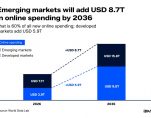
Emerging markets will add USD 8.7T in online spending by 2036
But this new consumer class will not shop the same way developed-market consumers do: by 2036, only 20% of adults in emerging markets will hold a credit card, against 66% in developed markets.
Global online spending is projected to grow from USD 11 trillion in 2026 to USD 25.6 trillion in 2036. Emerging markets add USD 8.7 trillion of that increase (60% of all new online spending), with China (USD +4.7 trillion) and India (USD +1.3 trillion) leading this growth. Indonesia (USD +243 billion), Brazil (USD +249 billion) and Mexico (USD +191 billion) form the next tier.
The categories matter as much as the markets. Online gaming spending in emerging markets grows 14% a year over the decade, the fastest of any category, and SaaS nearly 10%. Emerging markets will generate 76% of global growth in social media spending and 64% in SaaS.
The demographic picture challenges a common assumption. Consumers aged 45 and over account for 51% of emerging markets’ online spending growth through 2036, and spending by those aged 65 and over grows 12% a year, faster than any other age group.
The outlook was discussed during “Navigating Payments: How innovation and fragmentation are changing the game for e-commerce,” a webinar co-hosted by World Data Lab (WDL) and EBANX.
“Over the next ten years, people aged 45 and over will add USD 4.4 trillion in online spending in emerging markets, half of all the growth. Some of them already shop on their phones and will keep doing so as they get older. Others will buy online for the first time in their fifties or sixties. Merchants who build their checkout only for a 25-year-old will miss both groups,” explained Wolfgang Fengler, CEO of WDL.
The study models consumer spending, demographics, and financial access across 184 countries to 2036, drawing on the World Bank’s Global Findex and WDL’s consumer models, combined with EBANX’s experience processing payments for global merchants in emerging markets since 2012.
“If your checkout only takes credit cards, you are competing for one in five adults in emerging markets and conceding the other four”, said Marie-Elise Droga, Chief Revenue Officer of EBANX. “The merchants growing fastest with us didn’t wait for cards to arrive: they added the payment rails their customers already use, and they’re taking new buyers, bigger baskets and recurring revenue that card-only competitors can’t even see.”
834 million new online buyers, 281 million new credit cards
Between 2026 and 2036, the global economy will add 834 million online buyers but only 281 million credit card holders—a ratio of nearly three to one. In emerging markets, two in three new online buyers (67%) will arrive without a credit card. Adults without it already account for 55% of online spending in emerging markets, a share that rises to 90% in India and 93% in Sub-Saharan Africa. Credit cardless adults also represent 52% to 59% of spending in every digital category, from gaming and SaaS to streaming and travel.
Digital payment use is also running ahead of online shopping. Of the 2.6 billion emerging-market adults spending between USD 6 and USD 25 a day, 70% already pay merchants digitally while only 33% buy online, leaving at least 957 million digitally active consumers who are not yet online buyers. Many hold a bank account or mobile wallet but no card that works at an international checkout.
“This is closely tied to the innovation that came out of the financial industry in emerging markets, which developed solutions for an increasingly mobile economy and for the habits of local consumers. Today, we call them local payment methods, or LPMs, and they allowed e-commerce growth to decouple from the credit card, which still has very low penetration in these countries,” said Estelita Hass, head of Market Intelligence at EBANX.
Subscriptions are the next frontier — and India shows why
Recurring categories such as streaming, SaaS and online education will reach USD 2.1 trillion a year in emerging markets by 2036, with USD 1.1 trillion coming from adults without a credit card. In India, 82% of recurring online spending will be cardless. Account-based recurring rails are beginning to close that gap: a global SaaS company saw a 20% uplift in new subscribers after adding UPI at checkout in India, and cybersecurity company Nord Security now generates 28% of its revenue in Brazil through Pix Automático, Brazil’s recurring instant payment, six months after launching it with EBANX.
The issuer is solely responsible for the content of this announcement.
ABOUT EBANX
EBANX is the leading technology platform connecting global businesses to the world’s fastest-growing digital markets. Founded in 2012 in Brazil, EBANX was built with a mission to expand access to international digital commerce. Leveraging proprietary technology, deep market expertise, and robust infrastructure, the platform enables global businesses to offer hundreds of local payment methods and streamline cross-border payments across Latin America, Africa, and Asia. With a global footprint, it established a technology and regulatory headquarters in Singapore in 2026. More than just payments, EBANX drives growth, enhances sales, and delivers seamless purchase experiences for businesses and end users alike.



 https://www.photonpay.com














 https://www.linkedin.com/company/ebanx/




