News related to
NASA's

Astronomers have identified a giant exoplanet whose passages across its star disappeared from telescope observations after seven years, apparently because the gravitational pull of an unseen neighbouring planet shifted its orbit out of Earth’s line of sight. The finding, announced by the University of California, Los Angeles, on 9 November, concerns TOI-2535 b, a gas giant approximately 1,000 light-years away. Researchers describe it as the first confirmed […]

SpaceX has unveiled plans to invest $100 billion in a vast Louisiana spaceport designed to become its largest launch complex and support thousands of Starship missions each year. The project, named Starbase Louisiana, will occupy about 125,000 acres in Vermilion Parish near Pecan Island on the Gulf Coast. Construction is expected to begin in 2027, while SpaceX is targeting its first Starship launch from the site in […]

NASA has successfully launched the highly anticipated Europa Clipper spacecraft, marking a pivotal step in the quest to understand whether life might exist beyond Earth. This mission, centered around Jupiter’s moon Europa, aims to explore the potential habitability of its ice-covered ocean, concealed beneath a thick crust. The spacecraft, which lifted off from Kennedy Space Center, represents NASA’s most ambitious attempt yet to unravel the mysteries of […]

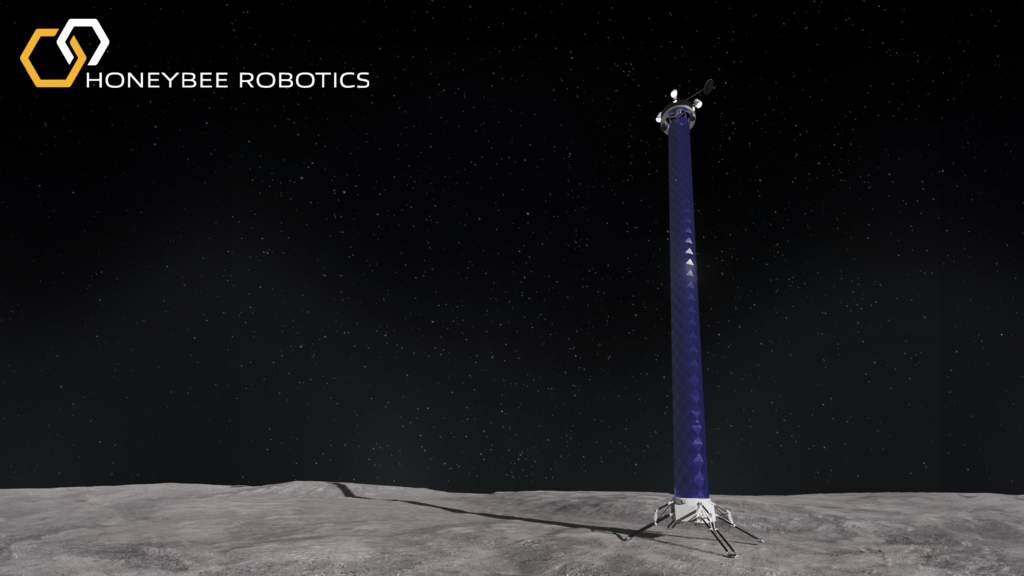
Honeybee Robotics, a Colorado-based technology company, has developed a cutting-edge power and communication solution for NASA’s Artemis program, aiming to facilitate human exploration of the Moon. The Lunar Surface Autonomous Beaming and Energy Relay (LunarSABER) towers, designed by Honeybee, are set to play a critical role in establishing a sustainable presence on the lunar surface.

The LunarSABER towers are designed to operate independently or as part of a larger network, providing a robust infrastructure for energy distribution and communication on the Moon. Each tower is equipped with photovoltaic cells that capture solar energy, which is then converted into electricity and transmitted wirelessly to various lunar assets, including habitats, rovers, and scientific instruments. Additionally, these towers are capable of beaming communication signals across long distances, ensuring continuous contact between lunar explorers and mission control.

The primary objective of the LunarSABER system is to support NASA’s ambitious goal of creating a permanent human presence on the Moon by the end of this decade. With the ability to deliver power and communication services over vast distances, the towers are expected to overcome one of the most significant challenges of lunar exploration: the harsh and variable environment of the Moon, which includes long periods of darkness, extreme temperatures, and difficult terrain.

Honeybee Robotics has a long-standing history of collaboration with NASA, contributing to several high-profile missions, including the Mars rovers and the OSIRIS-REx asteroid mission. The company’s expertise in developing robust, reliable technologies for space exploration has positioned it as a key player in the Artemis program. The LunarSABER towers are a testament to Honeybee’s innovative approach to solving complex engineering challenges in space.

The LunarSABER system is currently undergoing rigorous testing and validation to ensure its reliability and performance in the harsh conditions of the lunar surface. NASA plans to deploy the first set of towers during the Artemis III mission, scheduled for later this decade. This mission will be the first crewed lunar landing since the Apollo program, and it will mark a significant milestone in humanity’s return to the Moon.

The towers’ modular design allows for flexibility in deployment, enabling NASA to expand the network as needed. This adaptability is crucial for supporting the growing infrastructure required for long-term lunar exploration and eventual human settlement. In addition to supporting NASA’s missions, the LunarSABER technology has the potential to be adapted for use in other space exploration endeavors, including missions to Mars and beyond.

As NASA continues to advance its lunar exploration plans, the partnership with Honeybee Robotics highlights the importance of collaboration between government agencies and private industry in achieving space exploration goals. The success of the LunarSABER system will not only contribute to the Artemis program but also pave the way for future exploration of other celestial bodies.

The development of the LunarSABER towers represents a significant step forward in the quest to establish a sustainable human presence on the Moon. By providing reliable power and communication infrastructure, these towers will enable astronauts to conduct scientific research, explore new territories, and ultimately lay the groundwork for a permanent lunar colony. As the Artemis program progresses, the contributions of companies like Honeybee Robotics will be instrumental in turning the vision of lunar exploration into reality.

Methane levels in the atmosphere have seen a significant rise since the early 2020s, with researchers pointing to La Niña events and warming wetlands as key contributors. According to a comprehensive study, these natural phenomena have amplified methane emissions, posing a greater challenge in combating climate change. Methane, a potent greenhouse gas, has more than doubled in concentration since pre-industrial times. Recent studies highlight that the spike […]

NASA’s Perseverance rover has made a potentially groundbreaking discovery in Jezero Crater on Mars. The spacecraft has identified a rock that could contain fossilized evidence of ancient microbial life. This discovery aligns with one of the rover’s primary missions: to search for signs of past life on the Red Planet. The rock in question was analyzed using Perseverance’s sophisticated instruments, including the Planetary Instrument for X-ray Lithochemistry […]

After a simulated year on Mars, a team of four NASA volunteers emerged from their isolated habitat on Saturday, marking a crucial milestone in the agency’s quest for the Red Planet. The crew, sequestered inside the 3D-printed environment at the Johnson Space Center in Houston, Texas, for 378 days, successfully completed the first mission of NASA’s Crew Health and Performance Exploration Analog (CHAPEA) project. Kelly Haston, the […]

Advertisements

Electric vehicle startup Fisker is facing a steep decline as the company seeks court approval to sell its remaining stock of SUVs at a fraction of the original price. The bankrupt company produced 3, 321 Ocean SUVs, initially priced around $70, 000 each. Now, Fisker is requesting permission to offload this inventory to a New York-based leasing company for just $14, 000 per vehicle. This fire sale […]

The vast, white expanse of Antarctica, a crucial component of the global climate system, is demonstrably losing ice mass at an alarming rate, according to a multitude of scientific studies. This stands in stark contrast to recent claims suggesting otherwise. A popular video, disseminated by an organization with a history of questioning climate science, downplayed the significance of ice loss in Antarctica. The video misleadingly suggested that […]

A recent NASA study sheds light on potential solutions for tackling the growing problem of orbital debris, with findings suggesting a more cost-effective approach than previously thought. The report, titled “Cost and Benefit Analysis of Mitigating, Tracking and Remediating Orbital Debris, ” was compiled by NASA’s Office of Technology, Policy, and Strategy (OTPS). It marks the second phase of the agency’s efforts to address the technical and […]

A new chapter has begun in the search for life beyond Earth. NASA’s James Webb Space Telescope has uncovered the presence of methane and carbon dioxide in the atmosphere of K2-18b, an exoplanet located roughly 120 light-years away. This discovery marks a significant advancement in our understanding of this intriguing world and adds K2-18b to the shortlist of promising candidates in the hunt for extraterrestrial life. K2-18b, […]

A recent report by NASA’s Office of Inspector General (OIG) casts doubt on the ambitious Mars Sample Return (MSR) program, highlighting significant challenges in design, cost, and scheduling. The program aims to bring pristine Martian rock and soil samples back to Earth for in-depth analysis in sophisticated laboratories, potentially revolutionizing our understanding of the Red Planet and its potential for harboring life. One major concern lies in […]

New York Times (NYT) article highlighting the 'crisis in cosmology'.

New York Times (NYT) article highlighting the ‘crisis in cosmology’

American taxpayers would hate to find NASA’s $ 10 billion James Webb telescope triumphed over by Europe’s $ 1 billion Eulcid telescope.

Three things cannot be long hidden: the sun, the moon, and the truth.”

— Gautama Buddha

INDORE, MADHYA PRADESH, INDIA, September 4, 2023/EINPresswire.com/ — Today, an article appeared in New York Times (NYT), which highlighted the ‘crisis in cosmology’ unraveled by the James Webb Space telescope (JWST). One of JWST’s first major findings is very uncomfortable for astronomers: it discovered the existence of fully formed galaxies far earlier than should have been possible according to presently accepted, standard model of cosmology. Reacting to the NYT article, Mr. Subhajit Waugh, a scientist (physicist) working in RRCAT (Raja Ramanna Centre for Advanced Technology), said that the authors of the article have not realized that it could have been a much more newsworthy article (even though it was newsworthy enough to appear in NYT). Mr. Waugh asserted that the article is just the tip of the invisible iceberg. Not only cosmology is in crisis; physics faces severe crisis too (the two pillars of physics are bitterly conflicting), and the NYT article authors have failed to see the link. Consequently, the article simply presents a BIG problem, but offers no satisfactory solution.

James Webb telescope can absolutely revolutionize science (especially physics and cosmology) and usher the greatest ever paradigm shift in science. Mr. Subhajit asserted that two next generation telescopes (the European Euclid and Japanese XRISM X-Ray telescopes) are just about to do that. James Webb might still triumph over both telescopes; but time is running out fast.

Mr. Waugh warned that if American scientific communities do not seize the opportunity to turn science upside down by following JWST’s startling revelations, then Europe will win the race, and Europe will be the leader of another scientific revolution. Or else, Japan, the ‘land of the rising sun’, will soon become the ‘rising sun’ in Science.

The NYT article wrote: “Physicists and astronomers are starting to get the sense that something may be really wrong. It’s not just that some of us believe we might have to rethink the standard model of cosmology; we might also have to change the way we think about some of the most basic features of our universe – a conceptual revolution that would have implications far beyond the world of science.” Mr. Waugh wholeheartedly agrees with the above paragraph. He agrees enthusiastically with another paragraph as well “We may be at a point where we need a radical departure from the standard model, one that may even require us to change how we think of the elemental components of the universe, possibly even the nature of space and time.” Mr. Waugh could not hide his joy and excitement when another paragraph was mentioned “But a (scientific) revolution may end up being the best path to progress. That has certainly been the case in the past with scientific breakthroughs like Copernicus’s heliocentrism, Darwin’s theory of evolution and Einstein’s relativity. All three of those theories also ended up having enormous cultural influence – threatening our sense of our special place in the cosmos, challenging our intuition that we were fundamentally different than other animals, upending our faith in common sense ideas about the flow of time.”
But when asked to elaborate, he simply smiled and said “You cannot run the ‘Tokaido Shinkansen’ bullet train on tracks built for steam locomotives. Similarly, you cannot run modern science on a century-old concept of SpaceTime.” He added “SpaceTime is the arena in which everything happens. It is the very fabric of reality. If you get that concept wrong, you are hopelessly lost and directionless.”

Mr. Waugh summarized: Physics is derailed (Ref. 1) and cosmology is in crisis (Ref. 2). Our concept of SpaceTime is faulty (Ref. 3, 4) and our mathematics is shaky (Ref. 5, 6). We are wrong about shape and size of the universe (Ref. 7). A tsunami sized ‘scientific revolution’ is coming (Ref. 8, 9, 10).

REFERENCE

Ref. 1 (A): Physicist congratulates ‘International Physics Olympiad’ awardees, and urges them to rescue Physics from present crisis
https://www.abc27.com/business/press-releases/ein-presswire/645953145/physicist-congratulates-international-physics-olympiad-awardees-and-urges-them-to-rescue-physics-from-present-crisis/
Ref. 1 (B): World’s largest physics conference in Las Vegas will be grand; but will it be worthwhile?
https://www.kron4.com/business/press-releases/ein-presswire/619040511/worlds-largest-physics-conference-in-las-vegas-will-be-grand-but-will-it-be-worthwhile/

Ref. 2 (A): Six major cracks have appeared in the standard model of cosmology. Is it wrong?
https://bigthink.com/13-8/6-cracks-standard-model-cosmology-wrong/
Ref. 2 (B): Shape and size of our universe: challenging the Standard Model of Cosmology
https://www.researchgate.net/publication/371487379_Shape_and_size_of_our_universe_challenging_the_Standard_Model_of_Cosmology

Ref. 3: The biggest mistake in Science: Space and Time do not fuse into SpaceTime continuum.
https://www.einnews.com/pr_news/645681233/the-biggest-mistake-in-science-space-and-time-do-not-fuse-into-spacetime-continuum

Ref. 4: Time itself is not the fourth dimension, but emerges due to motion along fourth space dimension
https://www.einnews.com/pr_news/624584265/time-itself-is-not-the-fourth-dimension-but-emerges-due-to-motion-along-fourth-space-dimension

Ref. 5: Science is standing on shaky mathematical pillars, which guarantees a scientific revolution
https://www.einpresswire.com/article/617977207/science-is-standing-on-shaky-mathematical-pillars-which-guarantees-a-scientific-revolution

Ref. 6: RRCAT Physicist Claims Correct Representation of Imaginary Numbers May Unify General Relativity and Quantum Mechanics
https://finance.yahoo.com/news/rrcat-physicist-claims-correct-representation-202518538.html

Ref. 7: We are wrong about the shape and size of our universe: RRCAT Physicist provides a new model of universe.
https://www.einpresswire.com/article/645279059/we-are-wrong-about-the-shape-and-size-of-our-universe-rrcat-physicist-provides-a-new-model-of-universe

Ref. 8: Euclid telescope will revolutionize science, overthrow ruling scientific theories, and usher paradigm shift in science.
https://www.headlinesoftoday.com/topic/press-releases/euclid-telescope-will-revolutionize-science-overthrow-ruling-scientific-theories-and-usher-paradigm-shift-in-science.html

Ref. 9: Europe’s Euclid telescope can beat NASA’s James Webb telescope, making Europe the leader of another scientific revolution.
https://www.msn.com/en-us/news/technology/europe-s-euclid-telescope-can-beat-nasa-s-james-webb-telescope-making-europe-the-leader-of-another-scientific-revolution/ar-AA1fIRFl

Ref. 10: Scientist predicts Japan, the ‘land of the rising sun’, will soon become the ‘rising sun’ in X-ray astronomy
https://www.einnews.com/pr_news/652994910/scientist-predicts-japan-the-land-of-the-rising-sun-will-soon-become-the-rising-sun-in-x-ray-astronomy

subhajit waugh
RRCAT (Raja Ramanna Center for Advanced Technology)
email us here
Visit us on social media:
YouTube
Other



Two UAE astronauts conduct spacewalk training at NASA’s neutral buoyancy lab


HOUSTON, Texas, 14th August, 2023 (WAM) — As part of NASA’s 2021 astronaut candidate class training

Arabian Post Staff As part of NASA’s 2021 astronaut candidate class training programme, Emirati astronauts Nora AlMatrooshi and Mohammad AlMulla are on track with their extensive training regimen, with both conducting spacewalk training at NASA’s Neutral Buoyancy Laboratory (NBL) at the Johnson Space Center in Houston, Texas. Following the recent series of demanding exercises including survival training at Alabama’s Fort Novosel and a detailed orientation at the Marshall Space […]

Vehicle Tires Designed for Extreme Temperatures in One Sixth Gravity on Crater-Filled Terrain AKRON, OHIO – Media OutReach – 28 July 2022 – The Goodyear Tire & Rubber Company supplied essential products for NASA’s Apollo program, including the Apollo 11 mission which landed on the Moon 53 years ago today. The company will continue that tradition—focusing on lunar vehicle tires—by joining Lockheed Martin (NYSE:LMT) in its development […]

NASA’s Mars Exploration Rover Opportunity has reached the main destination of its current two-year extended mission — an ancient fluid-carved valley incised on the inner slope of a vast crater’s rim. (via WSJ)

The National Aeronautics and Space Administration (NASA) recently confirmed that the Space Launch System (SLS) rocket and Orion Spacecraft will have an unmanned maiden flight despite earlier plans for a crewed mission. According to the NASA, it is already too late into the mission planning schedule to accommodate changes from its original plan for the Exploration Mission 1 (EM-1), which was designed to have an unmanned first flight […]

By Irene Klotz | CAPE CANAVERAL, Fla. CAPE CANAVERAL, Fla. NASA has delayed the first launch of its heavy-payload rocket until 2019 and decided against an idea floated by the White House to put astronauts aboard the capsule that is set to fly around the moon, the U.S. space agency said on Friday. The National Aeronautics and Space Administration had hoped to launch the Space Launch System, […]

Nearly 50 student teams from middle and high schools, colleges and universities in 22 states demonstrated advanced rocketry and engineering skills in NASA’s 2017 Student Launch challenge. Teams spent eight months building and testing rockets designed to fly to an altitude of one mile, deploy an automated parachute system, and safely land for reuse. Source link

The grand finale of NASA Cassini spacecraft has set one more milestone after the successful second dive on May 2 between the Saturn and its rings. With its camera — equipped with CL1 and CL2 filter — pointed at its rings and away from the planet’s surface, Cassini offered amazing images with an eerie touch. The second dive also gave Cassini a broader proximity to the planet’s outer […]

The shadow of NASA’s P-3 aircraft is seen over an iceberg on a May 8, 2017 flight supporting NASA’s Operation IceBridge mission. IceBridge began its final week of Arctic Spring 2017 surveys with a glacier-packed mission in Greenland, called Southeast Glaciers 01. Source link

From February to April this year, NASA’s Curiosity Mars rover probed into four sites near a linear dune on the Red Planet to compare the samples of dark sand taken here to those that was found in 2015 and 2016 when it investigated the crescent-shaped dunes. Dark Sand From Mars’s Linear Sand Dune The newly taken samples from the linear sand dune, which is located uphill of Mount […]

In a newly released image, NASA’s Hubble Space Telescope has displayed many distant galaxies that were previously unseen or faintly seen. One is the galaxy cluster Abell 370 with a huge assortment of galaxies in different shapes guarding it and bound by mutual gravity in the immense cluster. Located at 4 billion light-years away and belonging to Cetus constellation, Abell 370 is a huge galaxy cluster imaged in the Frontier […]

VISHNU RAJA
RYO YAMADA
HITORI GOTOH
IKUYO KITA