Telegram’s temporary blocking across India has turned a medical entrance scandal into a wider test of digital governance, platform liability and telecom-sector influence, as the messaging company challenges the order in the Delhi High Court. The restriction, imposed until June 22 ahead of the NEET-UG 2026 re-examination on June 21, was justified by authorities as a measure to curb paper-leak rackets and exam-related fraud. Telegram’s message-editing feature […]
Abu Dhabi sovereign investor Mubadala has acquired $200 million of Equitix’s stake in Greenlink, deepening its exposure to European energy infrastructure as power markets seek stronger cross-border capacity and more flexible grids. The transaction gives Mubadala a place alongside Equitix and Baltic Cable in Greenlink, the operator of a 504MW subsea electricity interconnector linking Great Britain and Ireland. The deal was announced on Tuesday and follows regulatory […]
Arabian Post Staff -Dubai A proposed $300 billion private investment fund has become the most sensitive economic element in the US-Iran framework agreement, with more than half of the target committed as Washington and Tehran prepare for a formal signing ceremony on Friday. The vehicle, described by a person with direct knowledge as the Reconstruction and Development Fund, is intended to create a commercial incentive for both […]
Elon Musk’s personal fortune of $1.3 trillion exposes a flaw in one of investing’s most widely accepted ideas. The financial advice industry has for decades championed diversification as the answer to almost every investment challenge. Build a broad portfolio, spread risk, own the market and stay patient. Indeed, it’s sensible advice and, for many investors, entirely appropriate. Yet diversification has gradually evolved from a risk-management tool into […]
Chainguard has launched Athena, a coalition backed by major financial, technology and security groups to repair open-source software flaws before attackers can use artificial intelligence to find and weaponise them. The initiative brings together BNY, Cisco, Cloudflare, Corridor, DepthFirst, Docker, JPMorganChase, Kyndryl, LTM and PwC, with Chainguard acting as the coordinating platform. Athena is already operational with more than two dozen participating organisations, having processed over 20,000 […]
The Centre has ordered a nationwide temporary block on Telegram until June 22, escalating its crackdown on online cheating rackets ahead of the NEET-UG 2026 re-examination scheduled for June 21.
The restriction, issued through the Ministry of Electronics and Information Technology under Section 69A of the Information Technology Act, 2000, follows complaints that groups on the messaging platform were being used to sell, advertise or fabricate claims about leaked question papers. A separate direction requires Telegram to disable, within the country, the editing of already published messages until June 30, a feature investigators say has been exploited to alter posts after publication and mislead candidates about when alleged leak material first appeared.
The National Testing Agency, which conducts NEET-UG, welcomed the move and said the intervention was intended to protect candidates from fraud, impersonation and misinformation before the retest. The agency has also opened an online reporting mechanism for claims linked to fake paper leaks, suspicious social-media groups and attempts to contact candidates with offers of access to the examination paper.
The June 21 test follows the cancellation of the May 3 NEET-UG examination, which affected more than 2.2 million medical aspirants. The original test was annulled after allegations of a question-paper leak and organised cheating led to widening investigations, student protests and criticism of examination governance. The re-examination has become a test of the authorities’ ability to restore confidence in a high-stakes admission system that determines access to medical colleges.
Officials involved in the crackdown have focused on Telegram because of its large channels, rapid forwarding systems and privacy-oriented architecture, which have made it attractive both to legitimate users and to networks selling purported exam material. Investigators have examined groups that allegedly claimed to possess NEET papers, sought payments from anxious candidates and used screenshots of edited posts to suggest advance access to confidential material.
The role of message editing has drawn particular scrutiny. Authorities say some posts were modified after circulation to create the impression that a question paper, answer key or inside information had been available before the examination. That method can fuel panic even where no genuine paper leak has occurred, because altered timestamps and viral screenshots are difficult for candidates and parents to verify quickly.
Cybercrime teams, including the Indian Cyber Crime Coordination Centre, Bihar Police and the Ahmedabad Cyber Cell, have been involved in action against suspected digital fraud networks. Gujarat cyber officials have also arrested two people accused of promising access to NEET papers, underlining that the threat extends beyond one platform and includes paid deception, impersonation and panic-driven extortion.
The government’s decision marks one of the most visible temporary app restrictions since the sweeping blocks imposed on Chinese-linked apps in 2020, though this order is narrower in duration and linked to an examination-security objective. Telecom operators are expected to comply with blocking directions, while app-store availability and platform-level functionality may vary as implementation proceeds.
Telegram has not issued a detailed public response to the order. The platform has faced scrutiny in several countries over alleged misuse by fraud groups, piracy networks and extremist channels, even as it remains widely used for education, business updates, news distribution and community communication.
Civil-liberties groups have criticised the measure as disproportionate, saying a temporary shutdown penalises ordinary users and small businesses that rely on Telegram while leaving deeper vulnerabilities in examination management unresolved. They have called for publication of the blocking order, the reasons cited by the authorities and details of why channel-specific enforcement was judged insufficient.
By Asad Mirza The framework peace agreement between the United States and Iran has reduced the immediate risk of a wider regional war. Yet the accord leaves unresolved the central issues that have fuelled four decades of confrontation, making its long-term survival far from assured. The announcement of a framework peace agreement between the United […]
Greenlogue/AP Nearly half the world’s children are living under at least three overlapping climate threats, with heat, drought and storms pushing risks to health, schooling and survival into the daily lives of about 1.1 billion children, UNICEF findings show. The Children’s Climate Risk Report 2026 maps exposure to eight common hazards: coastal floods, drought, extreme heat, fires, heatwaves, river floods, sand and dust storms, and tropical storms. […]
President Lee Jae Myung has invited Pope Leo XIV to visit South Korea next year for World Youth Day in Seoul, using his first Vatican audience as president to seek support for efforts to lower tensions with North Korea and revive dialogue on the Korean Peninsula.
Lee met the Pope at the Apostolic Palace on Monday during the Vatican leg of a wider European tour, accompanied by first lady Kim Hea Kyung. The meeting placed religion and diplomacy at the centre of Seoul’s outreach strategy, as the Lee administration looks for channels beyond formal security talks to keep a peace agenda alive despite Pyongyang’s weapons programme.
The invitation was tied to World Youth Day 2027, the Catholic Church’s largest youth gathering, which Seoul will host from August 3 to 8. The event is expected to bring large numbers of young Catholics and other visitors to the capital, giving South Korea a global platform and offering Pope Leo his first major Asian pastoral journey if he accepts.
Lee and Pope Leo agreed to cooperate on the successful staging of the event, while the South Korean leader briefed the pontiff on his government’s approach to peace-building. Seoul wants the Vatican to sustain moral and diplomatic attention on the peninsula at a time when inter-Korean contact remains frozen and North Korea has shown little interest in official exchanges.
The meeting also touched on the possibility of a papal visit to North Korea, a move that would be unprecedented and politically sensitive. No pope has visited Pyongyang, and any such trip would require a formal invitation and guarantees from the North Korean authorities. The late Pope Francis had repeatedly signalled willingness to go if invited, but the plan never progressed beyond exploratory diplomacy.
Lee’s Vatican stop followed a peace Mass at the Basilica of Saint Paul Outside the Walls in Rome, celebrated by South Korea-born Cardinal Lazzaro You Heung-sik. Lee told the congregation that the “ember of hope” for dialogue and cooperation with North Korea remained alive, recalling the June 15, 2000 inter-Korean declaration that opened the way for family reunions, exchanges and humanitarian cooperation before relations deteriorated again.
The president has sought to present his North Korea policy as a shift from confrontation towards risk reduction. His administration has suspended propaganda loudspeaker broadcasts across the border and has said it does not seek unification by absorption or ideological competition. Officials frame those steps as confidence-building measures aimed at preventing accidental clashes and rebuilding basic military trust.
Pyongyang has not responded positively. North Korea has continued to define relations with Seoul as those between hostile states and has maintained its commitment to nuclear weapons and missile development. That position limits the scope for diplomacy and makes any papal role dependent on choices by Kim Jong Un’s government rather than on Vatican willingness alone.
After meeting Pope Leo, Lee held separate talks with Cardinal Secretary of State Pietro Parolin and Archbishop Paul Richard Gallagher, the Holy See’s senior diplomat for relations with states and international organisations. Those discussions covered bilateral ties, World Youth Day, regional affairs and the contribution of the local Catholic Church to education, welfare and democratic development.
The Vatican and the Republic of Korea established diplomatic relations in 1963. Pope John Paul II visited the country in 1984 and 1989, while Pope Francis travelled there in 2014 for Asian Youth Day. The 2027 event will return the papacy to a society where Catholics are a minority but hold a visible role in civic life and social services.
South Korea’s Catholic population surpassed 6 million at the end of 2025, representing about 11.4 per cent of the population. The Church has grown steadily over the past two decades, though it faces the same demographic pressures as the wider country, including ageing congregations and fewer vocations. World Youth Day is therefore being treated as both a diplomatic opportunity and a test of the Church’s appeal to younger generations.
Middle East governments moved to endorse a preliminary US-Iran peace deal on Monday, casting it as the strongest diplomatic opening yet to end a four-month conflict that has disrupted energy flows, strained Gulf security and unsettled global markets. The agreement, brokered after mediation led by Pakistan and supported by regional diplomacy, is due to be formally signed in Switzerland on Friday. It provides for a halt to […]
Oil prices fell to three-month lows as a US-Iran framework to reopen the Strait of Hormuz and place Tehran’s enriched uranium stockpile under international control moved towards a planned June 19 signing in Geneva, easing fears of a deeper Gulf energy shock. Brent crude slipped to about $83 a barrel on Tuesday after a sharper fall at the start of the week, while West Texas Intermediate traded […]
Iran twice came from behind to draw 2-2 with New Zealand in their 2026 FIFA World Cup opener, taking one point from a turbulent Group G match shaped as much by the protests outside the Los Angeles venue as by the exchanges on the pitch. The match at Los Angeles Stadium in Inglewood gave both teams a foothold in a group that also includes Belgium and Egypt, […]
Brussels has moved to assess the fallout from Washington’s order cutting foreign users off from Anthropic’s most powerful artificial intelligence models, turning a corporate shutdown into a test of allied trust in critical digital infrastructure. The European Commission is examining the practical consequences for users across the bloc after Anthropic disabled Fable 5 and Mythos 5, saying it had received a US export-control directive barring access by […]
Attackers tampered with JavaScript served by three widely used WordPress marketing plugins, exposing more than 1.2 million websites to rogue administrator accounts and concealed backdoors. The incident affected OptinMonster, TrustPulse and PushEngage, products operated under the Awesome Motive umbrella and embedded on sites for pop-ups, lead generation, social proof alerts and push notifications. The compromise did not arrive through a normal plugin update. Instead, malicious code was […]
Attackers are probing vulnerable Jenkins servers after disclosure of a high-severity deserialisation flaw that can let a low-privileged user impersonate others, reach sensitive controller files and, in some cases, execute code through the Script Console. The bug, tracked as CVE-2026-53435, affects Jenkins 2.567 and earlier and Jenkins LTS 2.555.2 and earlier. Fixed versions, Jenkins 2.568 and LTS 2.555.3, were issued on 10 June as part of a […]
A network of 23 Chrome browser extensions has exposed about 758,000 users to privacy and phishing risks by taking control of default search settings and routing queries through monetised redirect systems. The campaign, tracked as SearchJack, shows how ordinary-looking browser tools can turn search traffic into affiliate revenue while giving users little practical visibility into who handles their queries. The extensions were presented as satellite imagery tools, […]
Hyderabad-based Drogo Aerospace has delivered 41 JK 250e surveillance drones to the Indian Army, advancing a ₹72-crore order that places the defence technology firm among a growing group of domestic companies supplying unmanned systems for frontline military use.
The first batch was received by officials of the Army’s Southern Command in Nashik, Maharashtra. The delivery forms part of a 217-drone contract, with the company aiming to supply the remaining 176 units by August 2026. The schedule gives Drogo Aerospace a tight execution window at a time when demand for tactical drones is rising across reconnaissance, border monitoring and battlefield support roles.
The JK 250e drones have been developed and built by Drogo Aerospace for surveillance, reconnaissance and other military missions. The platform can fly for up to three hours on a single charge, giving field units extended aerial coverage without depending on conventional runway infrastructure. The drone’s role is centred on intelligence gathering and real-time observation, areas that have become central to ground operations as armies adapt to a battlefield shaped by low-cost aerial systems, loitering munitions and sensor-driven targeting.
Drogo Aerospace founder and chief executive Yeshwanth Bonthu said the delivery validates the company’s technology base, manufacturing capability and commitment to national security. The company is now working on indigenous loitering munitions, long-endurance UAVs, AI-powered aerial intelligence platforms, advanced surveillance systems and reconnaissance products aimed at future operational requirements.
The order also marks a transition point for the company, formerly known as Drogo Drones Pvt Ltd. Its rebranding as Drogo Aerospace reflects a broader move beyond conventional drone manufacturing into defence, aviation, unmanned systems, satellite-linked platforms and aerospace technologies. Headquartered in Madhapur, Hyderabad, the firm has positioned itself as a next-generation unmanned systems developer at a time when procurement policy is opening more space for private manufacturers and specialised start-ups.
The company is setting up a 100,000-square-foot drone manufacturing facility at Maheshwaram in Telangana’s Ranga Reddy district. The state government has allotted about 4.5 acres to the firm within the Electronics Manufacturing Cluster for the project. The facility is expected to generate around 500 additional jobs, adding to an existing workforce of about 300. The investment is designed to support scale production as defence orders move from prototypes and limited trials to larger supply commitments.
The delivery comes as the armed forces are accelerating induction of drones for tactical and operational roles. Planned domestic military drone orders may exceed $2 billion this year, with deliveries expected over 18 to 24 months. More than 600 drone and component companies now operate in the country, including over 100 focused on defence applications. The sector includes large industrial groups as well as specialist start-ups developing reconnaissance platforms, logistics drones, loitering munitions, precision-strike systems and critical components.
Battlefield developments over the past three years have sharpened the focus on unmanned systems. The war in Ukraine demonstrated how inexpensive drones can alter artillery targeting, logistics interdiction and frontline surveillance. Conflicts in West Asia have further highlighted the value of layered air defence, counter-drone technology and rapid intelligence cycles. Along the northern and western frontiers, persistent surveillance has become a core requirement for ground formations operating across difficult terrain and extended lines of control.
The Ministry of Defence has also widened support for smaller firms through innovation challenges and procurement pathways aimed at turning prototypes into deployable systems. Under the iDEX framework, hundreds of start-ups, MSMEs and individual innovators have entered the defence innovation ecosystem since 2018. Dozens of prototypes have received procurement clearance, and contracts worth thousands of crores have moved from concept development into acquisition. This has helped shorten the distance between battlefield requirements and production-ready technology.
For Drogo Aerospace, execution of the JK 250e order will test its ability to deliver at scale while maintaining quality and mission reliability. Military drone contracts require not only airframe performance but also secure communications, rugged field handling, dependable batteries, payload integration, training, maintenance support and spare availability. The Army’s experience with the first batch is likely to shape follow-on acceptance, deployment tempo and confidence in the remaining units due by August.
Nintendo is facing an unverified data-extortion claim after a threat actor alleged it obtained nearly 859MB of employee-linked corporate records and demanded $2 million to prevent publication. The claim, attributed to an online actor using the handle SHADOWBYT3$, centres on data allegedly connected to TINYpulse, an employee engagement and feedback platform associated with WebMD Health Services. The material is said to include workforce survey records, corporate email […]
A China-nexus hacking group maintained covert access to a segregated critical-infrastructure network for nearly a decade by tampering with Linux authentication tools that administrators rely on to control access. The operation, tracked as Velvet Ant and labelled Operation Highland by investigators, exposed a high-risk tactic in cyber espionage: rather than relying only on conventional malware, the intruders replaced trusted OpenSSH binaries and Pluggable Authentication Modules with altered […]
Arabian Post Staff -Dubai Donald Trump’s pledge that the Strait of Hormuz will be “completely opened” by Friday has left European partners pressing for details before committing naval assets to clear mines and escort commercial vessels through the world’s most sensitive energy chokepoint. The US president arrived at the Group of Seven summit in Évian-les-Bains saying a preliminary US-Iran accord had settled the immediate question of shipping […]
Oil prices slid to their lowest levels since March on Monday after Washington and Tehran said they had reached an initial deal aimed at ending the war and restoring traffic through the Strait of Hormuz, easing fears that months of disruption to one of the world’s most important energy corridors would deepen. Brent crude futures fell $4.08, or 4.7 per cent, to $83.25 a barrel by 0415 […]
Arabian Post Staff -Dubai DMCC has rolled out a business acceleration package aimed at lowering costs, freeing cash flow and giving companies in its 26,000-plus member ecosystem more room to expand as competition for global trade and investment intensifies. The initiative offers licence renewal incentives, penalty waivers, administrative flexibility and set-up discounts for new entrants, positioning the Dubai business district to support established firms and companies weighing […]
Arabian Post Staff -Dubai Washington and Tehran have accepted a preliminary framework aimed at ending their war, lifting the U. S. blockade of Iran and reopening the Strait of Hormuz, a move that pushed oil prices lower while leaving Iran’s nuclear programme for another round of negotiations. President Donald Trump declared the agreement “complete” on Truth Social on Sunday evening in Washington, shortly after Pakistan’s Prime Minister […]
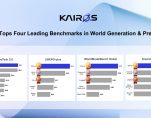
SHANGHAI, CHINA – Media OutReach Newswire – 15 June 2026 – ACE ROBOTICS today announced that its open-source Kairos world model has achieved leading results across four global embodied-intelligence benchmarks: RoboTwin 2.0, LIBERO-Plus, WorldModelBench Robot and DreamGen. Kairos ranked first among evaluated world models and vision-language-action (VLA) systems on these benchmarks’ public leaderboards as of 12 June 2026, leading across the core capabilities of embodied intelligence, including complex robotic manipulation, scene-level generalization, physical-world modeling and zero-shot transfer. The project is openly available on GitHub, Hugging Face and ModelScope, giving researchers and developers a public reference point for the model, benchmark results and technical materials.
Tops Four Leading Benchmarks in World Generation & Prediction
Embodied intelligence faces a fundamental challenge: generalization. A robot must operate reliably in environments it has never seen, adapting to new lighting, layouts, objects, embodiments and noisy real-world conditions. While VLA models have become a prevailing approach by directly mapping perception and language inputs to robot actions, ACE ROBOTICS believes world models offer a more scalable path by explicitly learning the underlying dynamics of the physical world and predicting how environments evolve. Kairos is designed to validate that approach.
Leading scene-level generalization on LIBERO-Plus
One of Kairos’ most significant results comes from LIBERO-Plus, a scene-level generalization benchmark proposed by the Shanghai Innovation Institute with Fudan University, Tongji University and the National University of Singapore. It evaluates robustness under seven real-world variables: camera angle, robot embodiment, language instruction, lighting, background, sensor noise and spatial layout.
Kairos achieved an overall score of 89.0, ranking first among all evaluated world models and VLA systems. It surpassed leading VLA models including ACoT-VLA (88.0), Pi 0.5 (85.7) and ProGAL-VLA (85.5), as well as the Being-H0.7 world model (84.8). It also showed strong environmental robustness, with near-ceiling performance on lighting (97.7), noise (96.8) and background (95.8), and ranked highly on camera angle and language instruction.
According to ACE ROBOTICS, this marks the first time a world-model approach has outperformed leading VLA systems on LIBERO-Plus for scene-level generalization, pointing to a path where robots adapt to homes, factories, retail spaces and other environments with far less environment-specific retraining.
A compact model with strong physical modeling efficiency
On WorldModelBench Robot, a physical-modeling benchmark proposed by researchers from UC Berkeley, UC San Diego, NVIDIA and MIT, Kairos-4B achieved an overall score of 9.30, ranking first on the benchmark. With only 4 billion parameters, it outperformed larger systems including 28-billion-parameter Lingbot, 16-billion-parameter Cosmos 3, 14-billion-parameter Abot-PhysWorld and 5-billion-parameter Wan 2.2, setting a new record for parameter efficiency in embodied world models.
Kairos matched the top instruction-following score (2.36) of the 16-billion-parameter Cosmos 3 with about one quarter of the parameters, a fourfold efficiency gain. It scored 4.96 on physics adherence, with perfect marks on Newtonian mechanics and gravity, and a perfect score on temporal quality, reflecting strong temporal consistency and visual continuity over long horizons.
A unified architecture, not a modular pipeline
ACE ROBOTICS attributes Kairos’ performance to its native unified “multi-modal understanding-generation-prediction” architecture. Unlike modular approaches that stitch together separate components for world understanding, generation and prediction, Kairos integrates these within a single backbone that shares one global world state, reducing the information loss and coordination latency between modules for more consistent physical modeling, stronger long-horizon prediction and more reliable action planning.
ACE ROBOTICS first introduced this architecture in December 2025, and the broader industry is now converging on a similar path: NVIDIA’s Cosmos 3.0, introduced in 2026, adopts a comparable single-system design that brings vision reasoning, world generation and action prediction into one architecture. Built on this foundation, Kairos-4B is, in ACE ROBOTICS’ description, the first embodied world model able to drive a physical robot directly on-device, closing the perception-to-action loop without intermediate translation latency.
Leading on synthetic data transfer and complex robot manipulation
Kairos also ranked first on DreamGen Bench, a benchmark led by NVIDIA with the University of Washington, UC Berkeley and UCLA that measures how well synthetic data generated by world models transfers to unseen objects, behaviors and environments, a key predictor of downstream robot-training value. Kairos ranked first on both average physics adherence (AVG_PA 0.538) and overall average score (AVG_Score 0.618), and led globally on new-behavior execution and new-environment adaptation.
On RoboTwin 2.0, a demanding dual-arm manipulation benchmark proposed by Shanghai Jiao Tong University and the University of Hong Kong with Shanghai AI Laboratory, Kairos scored 96.1% — a state-of-the-art result on the benchmark’s public leaderboard as of 12 June 2026. Across the benchmark’s 50 complex two-arm tasks it scored 96.9% in clean scenarios and 95.2% in randomized scenarios, ahead of VLA models such as G0.5 (93.2) and starVLA (88.3) and world models including AIM (93.1), Fast-WAM (91.8) and MotuBrain (96.0).
From benchmark leadership to commercial deployment
Together, these results validate Kairos’ technical direction across the core dimensions of embodied intelligence, from physical-rule understanding and zero-shot generalization to environmental robustness and fine-grained dual-arm manipulation, supporting ACE ROBOTICS’ aim to move robots beyond task imitation toward physical-world understanding, long-horizon reasoning and real-world execution.
The results come as ACE ROBOTICS accelerates commercialization. The company says it has raised several hundred million U.S. dollars across financing rounds in the first half of 2026, including a recent Angel+ round backed by investors such as Geely Capital, Dachen Caizhi, Shenzhen Capital Group and the Shanghai Sci-Tech Innovation Fund, with existing shareholder SenseTime’s Guoxiang Capital increasing its stake. The proceeds will support continued world-model research and integrated hardware-software solutions for sectors including smart retail, security and inspection, tourism and hospitality.
“Embodied intelligence is the next era of AI, and a world model is the key to unlocking it,” said Wang Xiaogang, Chairman of ACE ROBOTICS. “Our mission is to give every robot a capable brain.”
The issuer is solely responsible for the content of this announcement.
About ACE ROBOTICS – Equipping robots with intelligent “brains” and engaging “souls”
ACE ROBOTICS is a pioneering robotics company dedicated to advancing the field of embodied intelligence. Through breakthrough technological innovations and deep insights into embodied intelligence scenarios, we aim to empower robots with the ability to autonomously understand and explore the physical world, thereby accelerating their commercial implementation.
The company pioneered the ACE R&D paradigm and built a vision-based “environmental data engine, real-world cognition, embodied interaction generalization” technology chain. Using full spatiotemporal and multi-perspective environmental capture as its engine, along with Kairos 3.0 – China’s first open-source and commercially applicable world model – plus the Embodied Foundation Model as its technical backbone, ACE ROBOTICS addresses core industry challenges such as data scarcity, common sense gaps, poor generalization, and limited versatility. Simultaneously, the company unveiled its flagship A1 Embodied Super Brain Module, accelerating the large-scale commercial deployment of embodied intelligence across diverse scenarios.
ACE ROBOTICS is both a technology pioneer and an ecosystem builder. Through strategic cooperation with top hardware manufacturers, cloud service providers, and vertical scenario partners, we have broken through the “model-hardware-scenario” industrial deadlock, providing standardized and customized solutions that are driving the development of China’s embodied intelligence industry.





 https://www.linkedin.com/company/acerobotics/posts/?feedView=all&viewAsMember=true%EF%BD%9C
 https://x.com/ace_robotics




