

Arabian Post Staff -Dubai
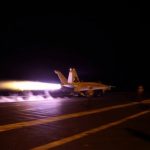
US Central Command said the two-hour operation struck Islamic Revolutionary Guard Corps command centres, missile and drone installations, coastal surveillance systems, air-defence sites and maritime capabilities. The bombardment began on Wednesday night and was described by the command as a powerful response to Tehran’s attempted surprise attack a day earlier.
Iran had fired multiple ballistic missiles towards American forces on Tuesday. US officials said all the projectiles were intercepted before reaching their targets. President Donald Trump later said five missiles travelling at high speed had been destroyed and warned that Iran would be hit “very hard”.
The retaliatory operation marked a sharp escalation in a conflict that has persisted for five months despite intermittent diplomatic contacts. Washington said the strikes were intended to reduce threats to American personnel, commercial vessels and Gulf countries exposed to Iranian missiles and drones.
Iranian authorities reported explosions on Qeshm Island, a strategically important territory in the Strait of Hormuz, and in the south-western province of Khuzestan. Two people were injured on Qeshm, though the full extent of the damage remained unclear. Tehran did not immediately provide a detailed assessment of military casualties or infrastructure losses.
The strikes followed an attack on a base in Jordan hosting US troops. Washington characterised the operation as a direct Iranian attempt to hit American forces, rather than an assault conducted through one of Tehran’s regional allies. Trump said retaliation was unavoidable even as he suggested that negotiations could still resume.
The confrontation widened hours earlier when US and Saudi fighter aircraft attacked weapons and logistics sites belonging to Iran-backed groups in eastern and northern Iraq. The Popular Mobilisation Forces said at least 20 fighters were killed and 32 wounded. Six Iranian military advisers were also reported killed.
The Iraqi coalition is formally incorporated into the country’s security forces but includes factions with substantial operational autonomy and close links to Tehran. Several groups possess missiles, drones and air-defence weapons and have previously attacked US military and diplomatic facilities.
Saudi Arabia said the Iraqi factions had launched drones against oil installations during the preceding two days. The militias denied involvement, while Yemen’s Houthi movement separately claimed attacks on Saudi energy infrastructure.
The joint US-Saudi action represented a significant change in Riyadh’s posture. Saudi Arabia had sought to limit its exposure to the US-Iran confrontation while strengthening air defences and backing negotiations. Attacks on oil facilities, including infrastructure linked to Saudi Aramco, increased pressure on the kingdom to respond militarily.
Iraq condemned the strikes on its territory, warning that attacks against units connected to the state risked undermining sovereignty and destabilising the country. Baghdad has struggled to balance its relationships with Washington, Tehran and Riyadh while attempting to prevent armed factions from drawing Iraq into the wider conflict.
The renewed fighting also placed additional pressure on efforts to reopen the Strait of Hormuz. Iranian attacks and maritime restrictions have disrupted traffic through the waterway, which carries a major share of internationally traded oil and liquefied natural gas. An interim understanding designed to reduce military activity around the strait collapsed after further clashes.
Elsewhere, suspected drone attacks caused fires aboard two natural gas vessels at Egypt’s Damietta port. One was a US-owned floating storage facility and the other a Greek-owned tanker. No injuries were reported, and responsibility for the attack had not been established.
Egypt has largely avoided direct military action during the war while working as a regional intermediary. Any confirmed strike by Iran or an allied force on Egyptian territory would expand the conflict into another strategically important state and threaten energy infrastructure in the eastern Mediterranean.
Also published on Medium.
Follow Arabian Post
Select Arabian Post as your preferred source on Google and MSN News for trusted business news and Arab politics and updates.



