

Arabian Post Staff -Dubai

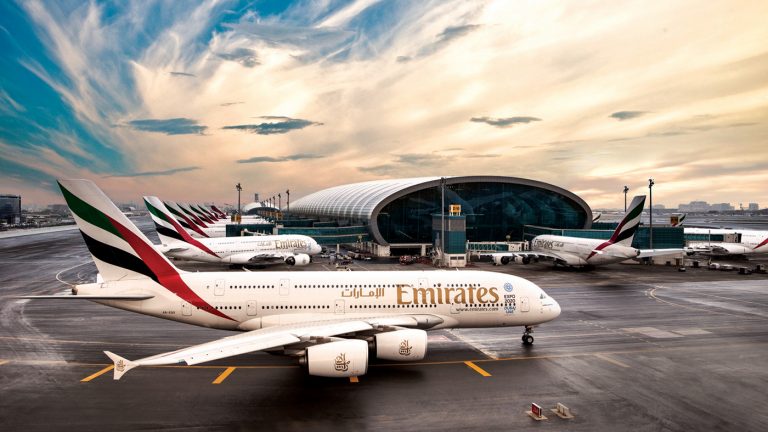
Emirates strengthened its standing in 2025 as the world’s largest international airline, carrying 55.6 million passengers across almost 180,580 flights and reinforcing Dubai’s role as a central hub for long-haul air travel. The carrier said the scale of its operations during the year equated to circling the Earth more than 29,000 times, underlining the breadth of its global network at a time when international aviation demand continued to normalise after years of disruption.
The airline also placed orders for 73 new aircraft, signalling confidence in sustained long-term growth and in the resilience of global travel demand. Fleet expansion remains a central pillar of Emirates’ strategy, aimed at maintaining capacity on high-traffic routes while opening or strengthening links to emerging markets across Asia, Africa and the Americas. Industry analysts view the order book as one of the most closely watched indicators of the carrier’s outlook, given its dependence on wide-body aircraft and ultra-long-haul connectivity.
The airline’s expanding global footprint in 2025 was framed by a milestone anniversary, with Emirates marking four decades since the launch of its operations in October. In a statement issued on Wednesday, the airline said the year reflected a “clear vision for shaping the future of travel through sustained excellence”, pointing to operational consistency, service standards and network breadth as defining features of its performance.
Passenger numbers remained below pre-pandemic peaks on certain routes due to aircraft delivery delays affecting the wider aviation sector, yet load factors were described by industry data providers as robust across most regions. Demand on Europe-Asia and Middle East-Americas corridors continued to anchor traffic flows, while routes to South Asia and parts of Africa saw steady growth, driven by both leisure and labour mobility.
Operationally, Emirates’ near-180,000 flights highlighted the scale at which the airline manages complex scheduling and logistics. Aviation specialists note that maintaining punctuality and service quality across such volumes requires heavy investment in crew training, digital systems and ground operations. Emirates has increasingly leaned on data-driven planning to optimise turnaround times at Dubai International Airport, one of the world’s busiest for international passengers.
The aircraft order announced during the year included a mix of next-generation wide-body jets intended to replace older models and support future expansion. These aircraft are expected to deliver improved fuel efficiency and lower emissions per seat, a key consideration as regulators and investors place greater scrutiny on aviation’s environmental footprint. While long-haul flying remains carbon-intensive, Emirates has signalled incremental steps towards sustainability, including operational efficiencies and participation in sustainable aviation fuel initiatives, though large-scale adoption remains constrained by supply and cost.
Competition among global network carriers intensified during 2025, with rivals in Europe, North America and Asia restoring capacity and adding frequencies on overlapping routes. Despite this, Emirates retained its edge in international passenger volumes, largely due to its hub-and-spoke model centred on Dubai, which allows the airline to aggregate demand from multiple regions and deploy high-capacity aircraft efficiently. Analysts say this structure continues to give Emirates flexibility that point-to-point operators struggle to replicate on intercontinental routes.
The airline’s performance also had broader implications for Dubai’s economy. Aviation remains a cornerstone of the emirate’s tourism, trade and services sectors, supporting thousands of jobs directly and indirectly. Passenger throughput through Dubai International Airport feeds into hospitality, retail and logistics, reinforcing the city’s positioning as a global crossroads. Government data have consistently linked airline capacity growth with higher visitor numbers and stronger non-oil economic activity.
Internally, Emirates focused on workforce stability after years of volatility across the aviation labour market. Recruitment and training programmes were expanded to ensure sufficient pilots, cabin crew and engineers to support the enlarged schedule. Industry observers note that staff availability has become as critical as aircraft supply in determining how quickly airlines can scale operations.
Also published on Medium.
Follow Arabian Post
Select Arabian Post as your preferred source on Google and MSN News for trusted business news and Arab politics and updates.




