Arabian Post Staff -Dubai Dubai’s Roads and Transport Authority (RTA) opened the 1,650-metre Al Khaleej Street Tunnel on Sunday, creating a new route between Infinity Bridge and Deira with capacity for 12,000 vehicles an hour. The tunnel has three lanes in each direction and runs from the end of the Infinity Bridge ramp in Deira to the junction of Al Khaleej Street and Al Wuheida Street. It […]
A dispute over the portrayal of communist leader T. V. Thomas in a commemorative publication has triggered an exchange between the CPI and CPI(M), exposing differences over the history of Punnapra-Vayalar uprising. The controversy concerns a special edition of Chintha, the CPI(M)’s ideological weekly, marking 80 years…
By Nitya Chakraborty As I read the despondent news of the passing of Jogen Chowdhury, a towering figure of modern Indian art, on Sunday morning in the online edition of a Bengali daily, sitting in my Delhi flat, my memory went 62 years back when Jogen and I, along with a bunch of other close […]
Arabian Post Staff -Dubai Dubai Municipality has introduced comprehensive advertising content guidelines aimed at improving the quality of outdoor advertisements, protecting the emirate’s visual identity and ensuring promotional displays complement its evolving urban landscape. The Advertising Content Regulation Guidelines for the Emirate of Dubai establish unified standards governing advertising messages, creative designs and visual presentation. The framework seeks to bring greater consistency to outdoor advertising while allowing […]
By Dr. Nilanjan Banik The public argument over Tata Sons has been told as a story of power: a board and a set of trusts pulling in different directions, a regulator applying pressure from outside. Lost in that framing is the party with the least say and the most at stake, the ordinary investor. This […]
Google has released Nano Banana 2.1, cutting image-generation costs by approximately half while improving editing accuracy, visual consistency and text rendering, as developers face a deadline to migrate from its predecessor. The new artificial intelligence model, introduced on 6 October, targets developers, businesses and creative professionals using automated image production. Google says the upgrade delivers stronger visual quality, better adherence to instructions and greater consistency when users […]
Via the integration with EBANX, Canva becomes the first merchant on Capitec Pay’s new recurring A2A payment
SYDNEY, AUSTRALIA, SINGAPORE, and STELLENBOSCH, SOUTH AFRICA – Media OutReach Newswire – 4 September 2026 – Canva, the global visual communication platform, has become the first international company to offer recurring subscription payments to South African customers via Capitec Pay, the account-to-account payment method built by South Africa’s largest personal bank — Capitec. The milestone is made possible through Canva’s ongoing partnership with EBANX, a global technology company specializing in payment services for emerging markets.
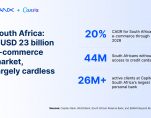
South Africa: a USD 23 billion e-commerce market, largely cardless.
The announcement represents a shift in how global subscription businesses can reach South African consumers. Credit card penetration in the country ranges between 8% and 10% of the adult population, according to the South African Reserve Bank and the World Bank. This limitation has historically restricted the reach of traditional card-on-file subscription models, excluding 44 million people in South Africa who do not own credit cards.
Instead of needing a credit card, Capitec Pay lets clients approve a recurring payment once in the Capitec app. After that, participating businesses can collect future subscription payments automatically. Canva is the first international subscription service to offer recurring payments with Capitec Pay.
Capitec is South Africa’s largest personal bank by customer base, with 26 million clients and over 16 million app users. According to Capitec, one in three South African adults uses its mobile app. “For Canva, going live as the first global merchant on this infrastructure is a removal of a structural barrier that was preventing a large portion of South Africans from accessing our platform at all,” said Bianca Sibiya, Canva Africa Lead.
The offering of recurring payments through Capitec Pay by Canva in South Africa is possible thanks to its partnership with EBANX, which helped enhance the solution and became the first global payment service provider (PSP) to integrate it into cross-border payment flows.
“For years, card-based billing has been treated as the default model for global subscription products, but that default was built around consumer behavior in the United States and Western Europe, not South Africa,” explained Wiza Jalakasi, Commercial Lead for Africa and the Middle East at EBANX.
EBANX has become a leading enabler of recurring alternative payment methods (APMs) in cross-border digital commerce across the world. Including South Africa, the company supports recurring APMs across 12 emerging markets, enabling global merchants to reach more than 1 billion consumers, many of whom lack access to credit or debit cards.
“Capitec’s philosophy is to ensure that our clients experience simple, affordable and innovative services. Recurring payments through Capitec Pay is just one of the many ways we bring that simplicity to life, offering clients a payment experience they already know and trust. Through this partnership with Canva, we are expanding our trusted payment experience and giving clients access to international merchants in an accessible way,” said Francois Viviers, Group Executive of Marketing and Client Experience at Capitec.
South Africa’s digital commerce market continues to grow rapidly, reaching 74% of adults and annual growth projected at 20% through 2028, according to Payments and Commerce Market Intelligence (PCMI) data analyzed by EBANX. By that year, South Africa’s e-commerce market is expected to represent a USD 23 billion opportunity, based on PCMI insights featured in EBANX’s Beyond Borders study.
The issuer is solely responsible for the content of this announcement.
About EBANX
EBANX is the leading technology platform connecting global businesses to the world’s fastest-growing digital markets. Founded in 2012 in Brazil, EBANX was built with a mission to expand access to international digital commerce. Leveraging proprietary technology, deep market expertise, and robust infrastructure, the platform enables global businesses to offer hundreds of local payment methods and streamline cross-border payments across Latin America, Africa, and Asia. With a global footprint, it established a technology and regulatory headquarters in Singapore in 2026. More than just payments, EBANX drives growth, enhances sales, and delivers seamless purchase experiences for businesses and end users alike.
Launched in 2013, Canva is a free online visual communications and collaboration platform with a mission to empower everyone in the world to design. Featuring a simple drag-and-drop user interface and a vast range of templates ranging from presentations, documents, websites, social media graphics, posters, apparel to videos, plus a huge library of fonts, stock photography, illustrations, video footage, and audio clips, anyone can take an idea and create something beautiful.
Capitec Limited (JSE: CPI) is South Africa’s largest retail bank by active client numbers, serving 26 million active clients. It is recognized as the country’s leading digital bank, with 16 million active app users. Capitec offers simple, affordable and transparent banking solutions through innovative technology and personalized service via its app, online banking, and a network of 866 branches and 8,771 ATMs and cash-accepting devices. The Group uses data and technology to understand client needs and provide tailored solutions across Personal Banking, Business Banking, value-added services, insurance, and international consumer lending through its subsidiary AvaFin. Capitec aims to make a meaningful difference and unlock growth opportunities for all.
An autonomous security agent developed by Wiz uncovered and exploited a serious vulnerability in a Snowflake GitHub Actions workflow that had passed GitHub Advanced Security checks, highlighting emerging risks as artificial intelligence becomes increasingly embedded in software development and cyber defence. The flaw affected the public snowflakedb/snowflake-connector-net repository and allowed an unauthenticated GitHub user to execute arbitrary commands simply by opening an issue containing a specially crafted […]
BEIJING, CHINA – Media OutReach Newswire – 14 August 2026 – The “YOU BRING CHARM TO THE WORLD — The 18th Global Chinese Awards” came to a close at the Phoenix Center in Beijing on the evening of August 12.
On the evening of August 12, the “YOU BRING CHARM TO THE WORLD — The 18th Global Chinese Awards” concluded at the Phoenix Center in Beijing. The photo shows award recipients posing with presenters.
At this year’s awards ceremony, Academician Zhang Boli of the Chinese Academy of Engineering received the Global Chinese Lifetime Achievement Award, while actress Sylvia Chang received the Global Chinese Special Tribute Award. Academician Pan Jianwei of the Chinese Academy of Sciences, Lu Chaoyang, Chair Professor at the University of Science and Technology of China, picture-book illustrator Cai Gao, Chinese freestyle skier Xu Mengtao, Gao Du, professor at the Beijing Dance Academy, and actress Xin Zhilei received the Global Chinese Award.
In his speech, Xu Wei, Chairman of the Board and CEO of Phoenix TV, said: “Each generation of Chinese people has its own responsibilities. The older generation worked hard with their roots in their homeland, while the younger generation embraces innovation and the world, becoming connectors between different cultures.” Phoenix TV will continue to serve as an on-the-ground reporter of major global events, an international storyteller of Chinese culture, and a platform builder for international exchange, enabling audiences around the world to see more of the vibrant and diverse achievements of Chinese people.
The tribute section of the ceremony opened with an immersive children’s picture-book theatrical performance based on classic works including The Story of the Peach Blossom Spring and Bao’er. Both works were created by Cai Gao, who received the Hans Christian Andersen Award for Illustration in April this year. During the ceremony, the host recalled the children’s song Cai sang at the Andersen Award ceremony, prompting her to smile and sing “The Cuckoo” once again.
Upon receiving the Global Chinese Award, Cai Gao said that the splendid and outstanding artistic heritage of China has been a source of inspiration for her work, and that she has a deep love for the culture of this land. Seeing so many Chinese people achieve remarkable accomplishments in different fields has also given her spiritual strength. Quoting the phrase, “As long as life goes on, the struggle continues,” she encouraged herself to keep creating with passion and curiosity. “Life and creation require dedication and perseverance. I am willing to devote myself to them, as I always have.”
Joining the ceremony via video link, Lu Chaoyang shared his joy and said that the honor belongs to all Chinese researchers who have climbed, generation after generation, along the long and steep road of quantum science. Looking to the future, he offered this message: “The quantum world is very small, so small that it cannot be seen with the naked eye; but China’s dreams in science and technology are immense. Through fundamental innovation, we should illuminate a farther future for human civilization.”
In her acceptance speech, Xin Zhilei said she particularly liked the phrase “YOU BRING CHARM TO THE WORLD.” “Everyone is a unique ray of light in this world. Through our efforts and down-to-earth dedication, we each make our own small contribution to the beauty of the world. As an actress, what I can do is put my heart into every role and bring to the world a little bit of the unique color that belongs to me.” Lu Yang, director of Brotherhood of Blades II: The Infernal Battlefield, also sent his congratulations via video, expressing hope for continued collaboration and for the creation of more outstanding Chinese-language stories.
“If the dance steps of a people disappear, that chapter of history will also lose its voice.” Over the past 50 years, Gao Du and his team have traveled across more than 20 provinces and autonomous regions throughout China, venturing deep into remote mountains and visiting people’s courtyards and fireside gatherings. They learned from local communities dances that had no names, no stages and sometimes not even an audience, devoting themselves to the creation of the Chenxiang series.
Gao Du said he would continue dancing, both in the classroom and on larger stages, bringing folk dance traditions rooted in the land to the world and fostering dialogue among different cultures, so that the world can see the beauty of the East.
Wu Qingcai, Deputy Editor-in-Chief of China News Service, presented Xu Mengtao with the Global Chinese Award. Xu shared that August 13, 2026, marked exactly 24 years since she began competing in the aerials discipline of snow sports. She hopes everyone can create something extraordinary through perseverance and dedication. “In the future, I will once again stand on the starting platform and set off again. See you again at the summit.”
As one of the creators of the song Tomorrow Will Be Better, Sylvia Chang said that she and fellow Chinese-language singers hope to use music to build a bridge for peaceful communication. She expressed gratitude for being able to continue pursuing a career she loves and for having a wonderful family. “I hope to share this gratitude and these blessings with everyone.”
At the ceremony, the host recounted the eight-character motto that Academician Zhang Boli has followed throughout his life: “Uphold virtue to broaden its influence; use medical skills to serve humanity.” Now approaching 80, Zhang Boli continues to see patients at a clinic every week. When patients have difficulty walking, he takes the initiative to go downstairs and see them in their cars.
Zhang Boli said that the concepts of traditional Chinese medicine—including health preservation, wellness and preventive treatment—represent one of the best practices of “proactive health management.” Looking to the future with the compassion of a physician, he said: “Let traditional Chinese medicine benefit Chinese people around the world, and let traditional Chinese medicine benefit people everywhere. The world will be healthier because of traditional Chinese medicine.”
It is reported that the “YOU BRING CHARM TO THE WORLD — Global Chinese Awards” was initiated by Phoenix Media Group in collaboration with China News Service and numerous Chinese-language media organizations in China and overseas. Together, they select and honor outstanding Chinese people who have achieved excellence and made a global impact in different fields, helping to amplify the achievements of exceptional Chinese individuals and inspire more generations to come.
Hashtag: #PhoenixTV
The issuer is solely responsible for the content of this announcement.
Pokémon trading cards are evolving from childhood collectibles into a multibillion-dollar alternative asset market, prompting blockchain companies to build digital trading systems around physical cards stored securely in vaults. The technology can speed up transactions, but attracting enough buyers and sellers remains the larger challenge. Estimates put the wider trading-card market at roughly $10 billion to $15 billion, while the value of graded cards alone has been […]
By K Raveendran India’s political conversation appears to be acquiring a new address. It is no longer confined to Parliament House, party headquarters, election rallies or television studios. Increasingly, it begins with a mobile phone placed at a flattering angle, a carefully chosen background and the familiar instruction to look into the camera and speak […]
Tobe Hooper’s landmark horror film The Texas Chain Saw Massacre is being transformed into a fully hand-animated feature using rotoscoping, offering audiences a new visual interpretation of the 1974 production while retaining its original performances and unnerving atmosphere. Dark Sky Films and Exurbia Films have confirmed that the project is in production for a planned 2027 release. Artists will trace the original live-action footage frame by frame, […]
Telegram has introduced a rich text editor that allows users to publish structured, article-length content directly inside chats, groups and channels, marking a significant expansion beyond conventional instant messaging. The editor supports headings, tables, numbered and bulleted lists, quotations, code blocks, mathematical formulas and media embedded within the body of a message. Users can compose posts of more than 32,000 characters, removing the need to divide detailed […]
By Paul Murray, CEO Life & Health Reinsurance, Swiss Re
SINGAPORE – Media OutReach Newswire – 9 July 2026 – Op-ed by Paul Murray, CEO Life & Health Reinsurance, Swiss Re.
Ten years.
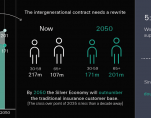
That is roughly how long we have before many societies reach one of the most defining demographic tipping points of our era: the point at which the “new” silver economy (over 65’s) outnumber people aged 30-59 who have traditionally been the bedrock of the life and pensions system.
The intergenerational contract needs a re-write
The significance of this shift goes far beyond demographics.
It represents a symbolic moment that forces us to rethink the intergenerational contract: how we provide care and financial security for people as they move into later life – and how we finance a new set of needs.
The demographic evidence is already visible across major economies. In the US, adults aged 65 and over already outnumber children in 11 states. Singapore’s over-65 population has nearly doubled in a decade to 21%. Japan is approaching 30%. The UK, France and Germany are not far behind
These numbers are well-known. But their meaning is not yet fully reflected in our industry’s existing product strategy.
The tipping point is also more than a statistical curiosity. We will experience it through the decisions we make coming into retirement and to secure the future of the generation coming after us. We will need to make new choices on how we fund care. We will need to make new assumptions about when to retire. And we will face a new reality around how much of the financial burden falls on the state, families or the individual.
Families have always carried the weight of old age, even as pensions, healthcare systems and social care programmes have broadened that responsibility across society.
But the arithmetic underpinning the system is breaking. Globally, the ratio of working-age people financially supporting each person over 65 is projected to fall from around five-to-one in 2021 to three-to-one by 2050. Across developed markets, debates about pension reform, healthcare funding and retirement ages reflect the same underlying question: how do we maintain security and dignity later in life when there are fewer hands to carry the weight?
It’s not a crisis of demographics. It’s a crisis of design – our systems were built for shorter lives and larger workforces, and they haven’t been rebuilt for the world we are actually entering.
That insight matters because it challenges how we think about insurance’s role. I believe we have less than a decade to develop the products that the older consumers who make up the Silver Economy – and their families – will need.
There will be no silver bullet. We cannot return to a single solution based around family care versus public provision. The individual retiree will be the focus, but our thinking will need to be based on a more collaborative model in which families, governments, communities and the private sector work together.
Recent Swiss Re consumer research in France and Germany revealed something striking. People don’t think about later life in terms of pensions or insurance policies. They think about practical outcomes: staying independent, being resilient when health shocks hit, not becoming a burden to their children.
Our industry has spent decades optimising for wealth accumulation and income protection during working years. Ageing societies demand we apply the same rigour to what happens after.
That does not mean the intergenerational contract has failed. It means it is evolving.
We are already seeing what that evolution looks like in practice.
Senior health products in Asia are closing a real gap —The median age of cancer diagnosis is 67, yet many critical illness policies expire before retirement even begins. The result is high out-of-pocket expenses, stressed public healthcare, and increased burden on families. With dedicated products to cover later life illnesses, such as senior cancer products we are effectively closing a protection gap.
Long term care in France has had some success with private solutions alongside public provision. With over 1.4 million people covered by private long term care insurance, France has built a strong risk pool that directly addresses one of the strongest concerns expressed by consumers: not becoming a burden on the next generation.
Deferred annuities offer a third path beyond the binary “draw-down versus annuity” thinking. By combining flexibility today with guaranteed income later, they help transform longevity from an individual financial risk into one that can be shared more broadly.
At first glance these solutions appear very different. In reality, they are pieces of the same puzzle. Each expands the circle of support around the individual. They help families carry less of the burden alone, and they complement the work of state safety nets.
That is what the next evolution of the intergenerational contract looks like in practice.
Ageing societies are one of humanity’s great achievements. But if our products and institutions stay built for a demographic reality that no longer exists, achievement curdles into liability.
We have a decade to close that gap. Let’s treat it as a product-development window, not a deadline.
Disclaimer Certain statements and illustrations contained herein are forward-looking and are made for informational purposes only. These statements (including as to plans, objectives, targets, and trends) and illustrations provide current expectations of future events based on certain assumptions and include any statement that does not directly relate to a historical fact or current fact. Readers are cautioned not to place undue reliance on forward-looking statements. Swiss Re undertakes no obligation to publicly revise or update any forward-looking statements, whether as a result of new information, future events or otherwise. Further information on forward looking statements and the use of information contained in this publication can be found in the Legal Notice section on Swiss Re’s website.
The issuer is solely responsible for the content of this announcement.
About Swiss Re
The Swiss Re Group is one of the world’s leading providers of reinsurance, insurance and other forms of insurance-based risk transfer, working to make the world more resilient. It anticipates and manages risk – from natural catastrophes to climate change, from ageing populations to cyber crime. The aim of the Swiss Re Group is to enable society to thrive and progress, creating new opportunities and solutions for its clients. Headquartered in Zurich, Switzerland, where it was founded in 1863, the Swiss Re Group operates through a network of around 70 offices globally.
OpenClaw’s rapid rise from an open-source personal assistant to a flashpoint in boardroom and regulatory discussions has turned the software into one of the clearest illustrations yet of the cybersecurity dangers surrounding agentic AI. Security specialists, regulators and large technology firms are converging on the same point: the problem is no longer limited to what an AI model can say, but what an AI agent can do […]
Circle moved about $68 million within half an hour using its own stablecoin infrastructure, offering a glimpse of how digital assets could reshape internal corporate payments traditionally handled through banks. The payments were carried out through the company’s Mint platform, a system designed to allow businesses to create and redeem the USDC stablecoin while managing liquidity across accounts. Chief executive Jeremy Allaire said the transfers took roughly […]
Arabian Post Staff -Dubai Sharjah has announced architecture as the central focus of the 17th cycle of its Artistic Criticism Research Award, directing scholarly attention to the role of built spaces in Arab visual culture. The Secretariat of the Sharjah Award for Artistic Criticism Research confirmed that the new theme, “Architecture in Arab Visual Arts: Homes and Approaches”, will guide submissions for the upcoming edition. Organisers said […]
Automattic has introduced an expansive artificial intelligence assistant for WordPress. com, enabling users to edit text, generate images and reshape site designs through conversational prompts, marking a decisive turn in how websites are created and maintained. The new assistant, embedded directly within the WordPress. com interface, allows publishers and businesses to instruct the platform in plain language to draft blog posts, refine copy, adjust layouts, alter colour […]
Arabian Post Staff -Dubai Sharjah Public Libraries has drawn its centennial programme to a close after a year of events that traced a century of public access to knowledge in the emirate, ending with a children’s puppet theatre performance at the Heart of Sharjah and creative workshops at Kshisha Park. The finale brought together families, educators and cultural practitioners, reflecting the institution’s long-standing focus on literacy, learning […]
By Nitya Chakraborty Something incredible is happening in Beijing as also in other cities of China in the last five days. The cinema halls showing the American animation film “Zootopia 2” produced by the famous Disney studio are full and the Chinese cine lovers who have not yet seen the film are going mad online […]
The Tor Project has marked a significant milestone in its multi-year effort to reengineer its core software by advancing Arti, the Rust-based implementation of the anonymity network, with the launch of version 1.8.0. The update introduces enhanced circuit isolation to reduce fingerprinting risks and new tools designed to streamline the migration of critical onion service keys from the legacy C codebase — part of a broader shift […]
By K Raveendran Rahul Gandhi’s reaction to the Bihar election outcome, framed by surprise and a sense of unfairness, must reopen a debate about the structural imbalances that shape electoral competition in India. His argument, on its surface, reflects the opposition’s frustration after a contest that produced a seat tally far more skewed than the […]
The Public Investment Fund and Jones Lang LaSalle Saudi Arabia Company Limited announced a memorandum of understanding to deepen collaboration in Saudi Arabia’s real-estate sector. The agreement, inked during the Future Investment Initiative in Riyadh, lays out a strategic partnership aimed at leveraging PIF’s infrastructure ambitions and JLL’s global real-estate expertise.
Under the MoU, PIF and JLL intend to focus on critical areas such as market-insight generation, valuation services, project-management frameworks and talent development within the real-estate industry. The goal is to increase private-sector participation, accelerate technology adoption in property development and support the transformation of Saudi Arabia’s built environment.
PIF’s local real-estate strategy positions the fund as a driver of urban innovation, economic diversification and quality-of-life enhancements in line with Vision 2030. As head of PIF’s Local Real Estate Investment Division, Saad Alkroud signed the agreement alongside Sue Aspre y Price, EMEA CEO and global head of Portfolio Services, Work Dynamics at JLL.
Real-estate activity in Saudi Arabia has come under the spotlight as the economy looks beyond oil and prioritises new sectors such as urban development, tourism and infrastructure. Data from real-estate-consultant estimates show that rents and purchase-prices have surged in major urban areas, prompting policymakers to explore responsive measures. Once largely dominated by public-sector investment, the market is shifting toward private-sector engagement — a key objective in the MoU. The agreement signals JLL’s commitment to the Kingdom, where the firm already has operations and plans to expand offerings in valuations, asset management and advisory services.
Execution will be critical. While the MoU is non-binding, it lays the foundation for joint initiatives to build local capacity, deploy digital and prop-tech solutions and drive more efficient project delivery. For JLL the partnership offers a fast-growing real-estate market with the backing of a sovereign investor. For PIF it opens global know-how and operational discipline in property-sector value chains. Analysts observe that the real-estate sector must contend with affordability pressures, consumer-demand dynamics and a need for asset-liability management frameworks in a transitional economy.
The collaboration also supports the broader push for sustainability in built-environment projects. As PIF steers giga-projects and landmark initiatives, JLL’s experience in global sustainability standards and ESG frameworks may be applied to help the Kingdom meet international benchmarks and investor expectations. According to the official statement, acceleration of new-technology adoption and fostering of local talent were emphasised as pillars of growth.
Industry watchers point out that the significance lies not just in the signing but in implementation. The proof will be in how swiftly joint programmes roll out, how private-sector engagement increases and how efficiently project pipelines convert into deliverables. The agreement comes at a time when Saudi policymakers are intensifying efforts to unlock private capital for real-estate, logistic and urban-development assets, with PIF central to that agenda.
With Saudi Arabia targeting a home-ownership rate of 70 per cent and major urban developments underway, the PIF-JLL alliance could become a cornerstone of the real-estate-ecosystem overhaul. Effective governance, transparency and strong monitoring mechanisms will be needed to ensure the partnership delivers the intended economic and social outcomes.
Seoul and Beijing accelerated bilateral engagement on Saturday when their leaders met on the sidelines of the Asia-Pacific Economic Cooperation summit in Gyeongju. President Lee Jae Myung of South Korea and President Xi Jinping of China signed a new five-year currency swap worth about 70 trillion won between their central banks, and agreed six memorandums of understanding covering economic cooperation, agriculture and services trade. This financial pact mirrors one that expired last month and signals a stronger push by both Seoul and Beijing for deeper economic synchronisation.
At the same time, the two administrations flagged potential restoration of cultural exchange channels that were effectively shut down more than a decade ago. China’s informal ban on South Korean entertainment—spanning K-pop, television dramas and film—was imposed following Seoul’s deployment of a U. S. missile defences system, which Beijing viewed as a strategic threat. At the summit, Lee and Xi agreed on the need to expand cultural cooperation, though Lee’s office cautioned that the dialogue reflected “courtesy comments” rather than final decisions.
Analysts describe the summit as a signal of warming relations after years of tactical distancing around security issues. Lee pressed for China’s constructive involvement in facilitating dialogue with North Korea, emphasising that high-level exchanges between Pyongyang and Beijing had ramped up. Xi reaffirmed China’s policy of strategic consistency and pledged deeper communication with Seoul. In parallel, the Korean and Chinese law-enforcement authorities signed an MOU to combat transnational voice-phishing and online scam crimes. Other MOUs addressed cooperation in the silver industry, innovative start-ups and agricultural exports from South Korea to China, reinforcing the emphasis on citizen-facing and practical cooperation.
Still, important caveats remain. While the swap agreement and MOUs represent tangible results, they come against a backdrop of prominent domestic dissent in South Korea. Thousands of protesters rallied in Seoul ahead of the summit, chanting anti-China slogans and highlighting a rising climate of nationalist sentiment. The South Korean government has acknowledged that such unrest risks undermining its diplomatic efforts and international standing. On the cultural front, though the possibility of lifting the ban on Korean content in China was raised, officials stressed that legal and procedural constraints remain in place and the matter is “premature” to reinterpret as a full reopening.
Commercially, the new swap line aims to bolster market stability for both nations amid global economic uncertainty and an intensifying U. S.–China rivalry. For cultural industries in South Korea—home to major firms such as Hybe, SM Entertainment and CJ ENM—the prospect of access to China’s vast audience is tantalising but still uncertain. For Beijing, deeper cultural ties with Seoul could ease past tensions and bolster the role of cultural-and-creative industries in economic growth, as alluded to in the summit’s wider Asia-Pacific framework which emphasises the importance of such sectors alongside digital transformation and artificial intelligence.



 https://www.ebanx.com/en/
 https://www.linkedin.com/company/ebanx






 By K Raveendran Rahul Gandhi’s reaction to the Bihar election outcome, framed by surprise and a sense of unfairness, must reopen a debate about the structural imbalances that shape electoral competition in India. His argument, on its surface, reflects the opposition’s frustration after a contest that produced a seat tally far more skewed than the […]





