

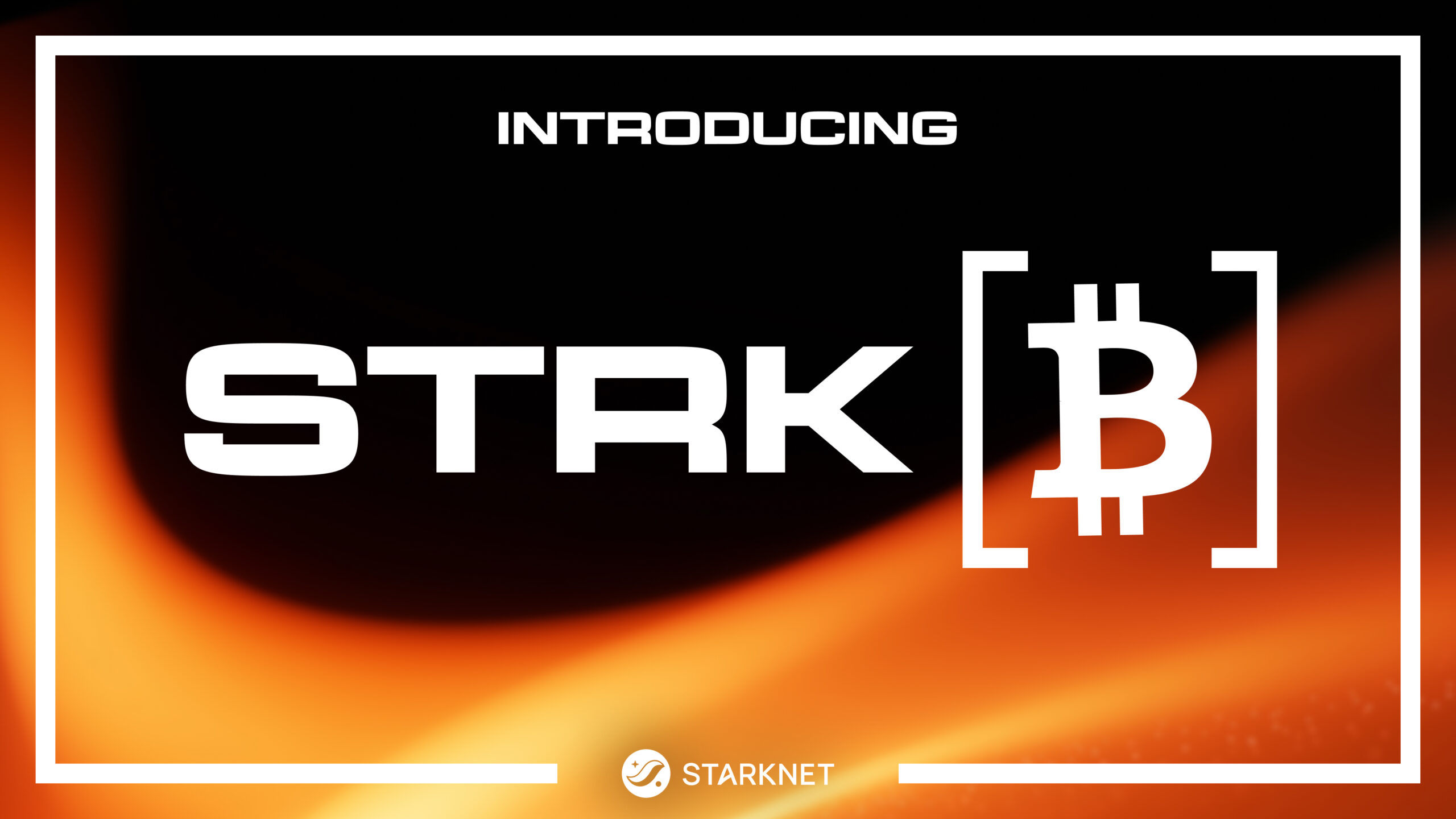
Starknet is moving Bitcoin deeper into decentralised finance with strkBTC, a 1:1 Bitcoin-backed wrapper designed to let holders choose between public transfers and shielded transactions while keeping access to Starknet-based trading, lending, staking and collateral markets. The asset is due to go live on May 12, 2026, after governance approval for proposals defining the wrapper and making it eligible for staking on the network.
strkBTC’s central pitch is that Bitcoin can become more useful on-chain without forcing every balance, counterparty and transfer into permanent public view. The unshielded version behaves like a standard ERC-20-style asset, with balances and transfers visible on public explorers. The shielded version, marked as [strkBTC], is intended to protect balances and transaction details while allowing selective disclosure through viewing-key arrangements when lawful or compliance requirements apply.
That design places Starknet in a fast-developing contest over BTCFi, the segment seeking to make Bitcoin productive beyond simple holding. Bitcoin’s base layer remains focused on security and settlement rather than complex financial applications, leaving layer-2 networks, wrapped assets and bridges to compete for liquidity. strkBTC is Starknet’s attempt to combine three features that are often difficult to reconcile: Bitcoin exposure, decentralised finance utility and transaction privacy.
Governance proposal SNIP-38 introduced strkBTC as a Bitcoin wrapper for Starknet’s DeFi ecosystem, while SNIP-39 sets out its eligibility as a stakable asset. The initial design relies on a federated multisignature model for BTC deposits and withdrawals, with a stated path towards more trust-minimised systems over time, including BitVM and OP_CAT-based approaches if the underlying technical and governance conditions mature.
A five-member federation will support BTC movement into and out of Starknet at launch. Twinstake, NEAR Intents, Luganodes, UTXO and Xverse have been named as the institutions handling infrastructure around minting, burning and bridging. The structure gives the rollout a defined operational perimeter, but it also means early users must accept bridge and signer assumptions that are not equivalent to native Bitcoin self-custody.
Starknet’s privacy push follows its v0.14.2 “Privacy Engine” upgrade, which went live on April 20. The upgrade introduced native in-protocol proof verification, allowing transactions to reference off-chain execution proofs directly rather than forcing applications to verify large STARK proofs through expensive smart-contract workarounds. That infrastructure underpins STRK20 encrypted balances and the private transaction logic required for strkBTC.
The model is not designed as a mixer in the conventional sense. Starknet is trying to position strkBTC as a privacy-preserving but auditable asset, where users can shield activity from general public visibility while retaining a mechanism for controlled disclosure. That balance is important at a time when regulators remain wary of crypto privacy tools that can obstruct sanctions screening, asset tracing and anti-money-laundering enforcement.
Atomiq and Garden are expected to provide direct routes into strkBTC. Atomiq is being positioned as a native BTC-to-strkBTC transfer route using Bitcoin settlement and Starknet-side verification, with incoming funds screened through Elliptic. Garden is expected to support BTC and WBTC swaps into strkBTC through an intent-based model, broadening access for users already active across multiple DeFi ecosystems.
Once users hold strkBTC, they are expected to be able to shield balances, transfer funds, lend through platforms such as Vesu, stake through Endur, provide liquidity on Ekubo, or use the asset as collateral to borrow stablecoins. The strongest commercial case for the asset lies with larger holders, treasuries, funds and traders that may want Bitcoin-linked liquidity without exposing every wallet movement and position to competitors, counterparties or blockchain analytics tools.
The challenge is adoption. Wrapped Bitcoin markets are already crowded, and users have become cautious after bridge exploits, depegging risks and failures across centralised yield platforms. Any privacy-enabled Bitcoin wrapper will also need to prove that its compliance architecture is credible, that the federation can operate reliably, and that liquidity is deep enough to make the asset useful beyond early adopters.
Arabian Post – Crypto News Network
Follow Arabian Post
Select Arabian Post as your preferred source on Google and MSN News for trusted business news and Arab politics and updates.



