Dubai in 2008 was a different place to do business. The city was mid-boom, construction cranes were everywhere, and the interior design industry was running to keep pace with a market that wanted everything built fast. Standards existed, but they were applied loosely. Clients were moving quickly. So was everyone else.
Then the correction came. The market contracted hard, and a lot of firms that had been riding the volume disappeared. The ones that stayed — and kept delivering through the slowdown — came out the other side with something that cannot be bought or manufactured: a real track record in the Dubai market across multiple cycles.
Spazio Interior Decoration LLC has been operating here since that year. Seventeen years of residential, commercial, and hospitality projects across the UAE and international markets. What follows is an honest account of what this market has taught us — and what it is still asking for.
2008 to 2012: Learning to Survive
The years immediately after the correction were instructive in ways that growth years never are. Clients who had been signing off on anything during the boom became cautious, specific, and demanding. Budgets shrank. Timelines tightened. The conversations got harder.
What that period taught us was discipline. Not just financial discipline — though that mattered — but design discipline. When a client is spending carefully, every decision gets scrutinized. Materials have to earn their place. Layouts have to justify themselves. Detailing has to be right because there is no budget to fix mistakes after the fact.
It also taught us something about relationships. The clients who stayed with us through that period did so because they trusted the work. Not because of marketing, not because of a showroom, but because projects were delivered on time and looked the way they were supposed to look. In a contracting market, that is the only currency that holds value.
Most of the firms that didn’t survive had the same problem. They’d grown fast by farming everything out — no in-house manufacturing, no real project management structure. Works fine on the way up. Doesn’t work at all on the way down.
2013 to 2019: The Market Finds Its Standard
The recovery years brought a different kind of client. Not the kind of client who gets excited by a showroom. They’d seen the real thing somewhere else, and they knew the difference.
Villa briefs got properly specific around this time. Clients turned up with Pinterest boards, material samples, and measurements they’d already thought about. The brief was a conversation, not a blank cheque. Which, honestly, produces better work — a client who knows what they want is easier to design for than one who just wants it to feel expensive.
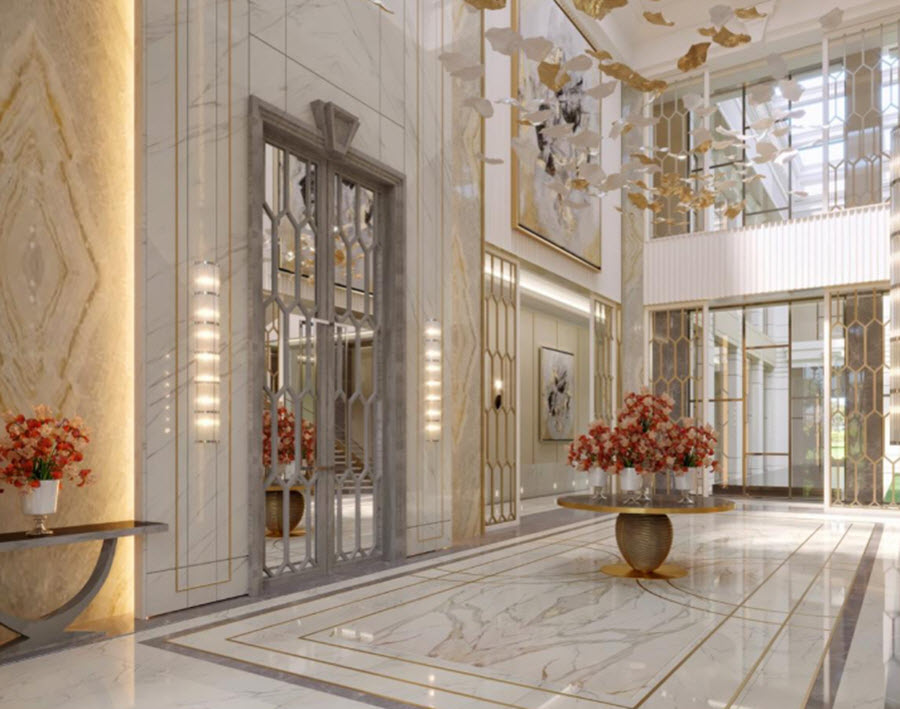
Zabeel Luxury Villa, Dubai — grand entrance foyer with double-height ceiling and bespoke joinery. The kind of residential brief that became standard in Dubai’s premium segment from 2015 onwards. | Spazio Interior Decoration LLC
The hospitality sector went through a parallel shift. Dubai had always had good hotels, but the F&B revolution that took hold from around 2015 changed what good meant. Restaurants were no longer just places to eat — they were destinations. The design of a dining room became part of its commercial proposition. Operators started understanding that a poorly designed space would underperform regardless of the food, and a well-designed one could sustain a premium that the food alone could not justify.
For a firm like Spazio, this period meant investing in capability. In-house joinery and manufacturing became essential, not optional. When a client specifies a bespoke piece — a custom reception desk, a millwork wall unit, a fitted wardrobe with specific proportions — the difference between a firm that makes it in-house and one that outsources it is the difference between getting the piece you designed and getting something approximately like it.
The International Dimension
Something that does not get discussed enough in coverage of the UAE design market is how much of the work actually happens outside the UAE. Interior design and fit-out companies in Dubai have been operating regionally and internationally for years — the expertise built here travels.
Spazio has worked in Saudi Arabia, Ethiopia, Turkey, Tanzania, and a few others too. Each one is genuinely different. The approval process in Riyadh doesn’t work the way it does in Dubai. The supply chain in Addis Ababa requires a different approach entirely. What stays the same is the standard the client expects at the end of it.
What the international work has confirmed is something we already suspected — the fundamentals travel. Every client, in every market, wants the space to look like what was sold to them and to be ready when they were told it would be ready. Everything else is local detail.
Hospitality: Where Dubai Is Setting the Benchmark
Hospitality is where Dubai has arguably pushed hardest over the past ten years. The number of serious hotel brands operating here, the F&B market that grew up alongside them, the sheer standard of what guests now walk into — it’s a different industry from what it was in 2012.
What that means for firms delivering these projects is there’s very little margin for a bad call. A hotel lobby that feels wrong — cramped, confusing, tonally off — gets reviewed. Literally. Dubai guests are experienced; they share everything, and a poorly designed space will show up in the feedback before the first month of trading is out. Design stopped being a branding exercise and became a performance metric.
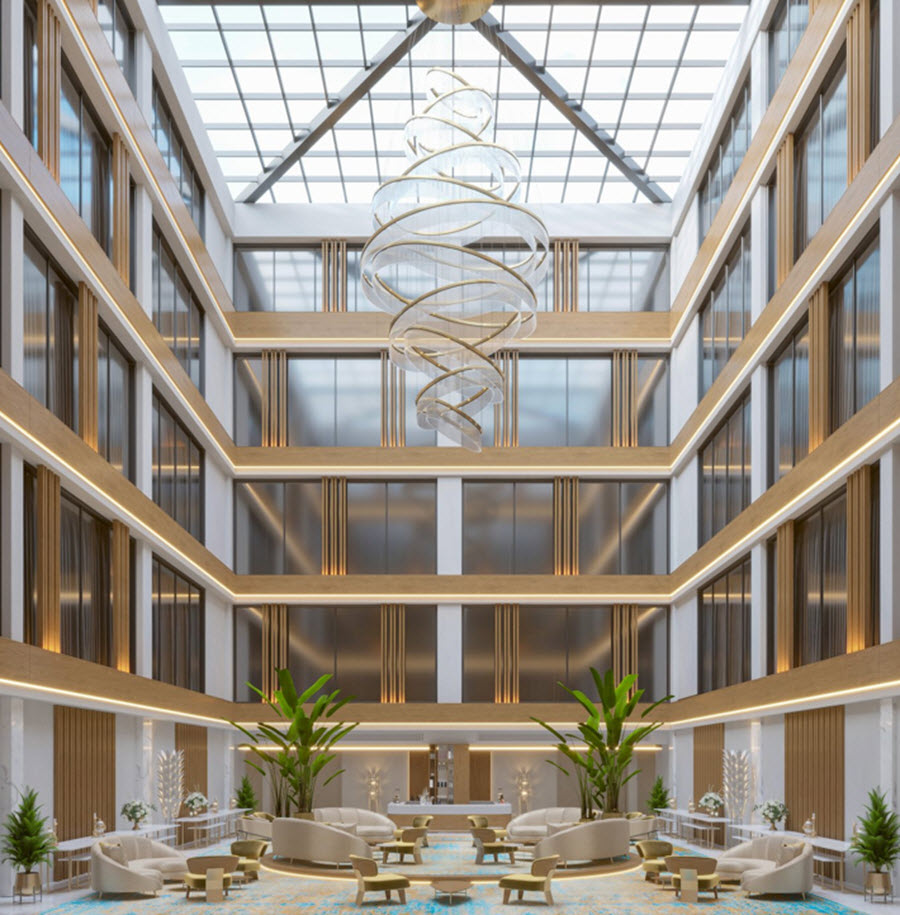
Two Seasons Hotel, Dubai — grand atrium lobby. Four floors, a skylight roof, and a custom spiral chandelier that took weeks to coordinate. The kind of brief where design and delivery have to work as one operation or the whole thing falls apart. | Spazio Interior Decoration LLC
On a project like this one, you’ve got zones that serve completely different purposes — a lobby handling arrivals and departures, a lounge running from morning coffee to late drinks, dining rooms turning over covers twice a night. Each needs to work on its own and still feel like the same hotel. That only happens when the same team holds the whole thing from concept to handover.
The boundary between a hotel’s public spaces and its F&B offering has dissolved. Guests don’t move through a hotel in sections — they experience it as one thing. The moment the lobby and the restaurant start feeling like they were designed by different people, the whole experience breaks. You only avoid that by keeping design authority in one place throughout.
What the Market Is Asking For Now
Something shifted in the last couple of years. The client conversations feel different.
Speed has become a genuine competitive requirement. Dubai’s real estate market moves fast, and the window between a project being greenlit and needing to be operational has compressed. Developers launching new residential products want sales offices ready before the launch event. Hospitality operators have lease commitments and opening dates that do not move. The firms that can deliver quality on a compressed timeline have a real advantage.
Clients are also more educated about the delivery process. The developer who has been through three fit-out projects knows what a variation order looks like and why it happens. They are asking harder questions upfront: who manufactures your joinery, how do you manage the programme, what happens when a material has a long lead time. The expectation of integrated delivery — design and fit-out managed by the same team — has moved from a differentiator to a baseline requirement for serious projects.
And the design bar keeps moving too. Expensive materials stopped being enough a while back. Clients have walked through enough marble lobbies to know the finish isn’t the point. What they’re actually asking for now is harder to specify but easy to feel — does the room work, does the light feel right, does the scale make sense? The gap between a good space and a costly one has never been more visible.
Seventeen Years
The thing about operating in a market through multiple cycles is that you stop being surprised by it. Corrections happen. Booms happen. The regulatory environment changes. Supply chains break. Markets cool. Clients who were signing off on everything start asking hard questions about every line item.
The work hasn’t changed. A space that was done properly does what it’s supposed to do — the units sell, the guests return, the family that lives there actually feels at home. Seventeen years in, that’s still the job. The only thing that’s moved is how quickly the market works out when you haven’t done it.
Dubai is one of the hardest interior design markets in the world to operate in. Honestly, that’s why it’s worth being here.
About Spazio Interior Decoration LLC
Spazio has been in Dubai since 2008. One team, one contract, everything made in-house. The portfolio speaks for itself — spazio.ae established in 2008. The firm delivers residential, commercial, and hospitality projects across the UAE and international markets, with in-house manufacturing, fit-out execution, and interior design under one roof. Over 500 projects across four countries and 17 years in the Dubai market — through the corrections, the booms, and everything in between.
Also published on Medium.
Follow Arabian Post
Select Arabian Post as your preferred source on Google and MSN News for trusted business news and Arab politics and updates.