

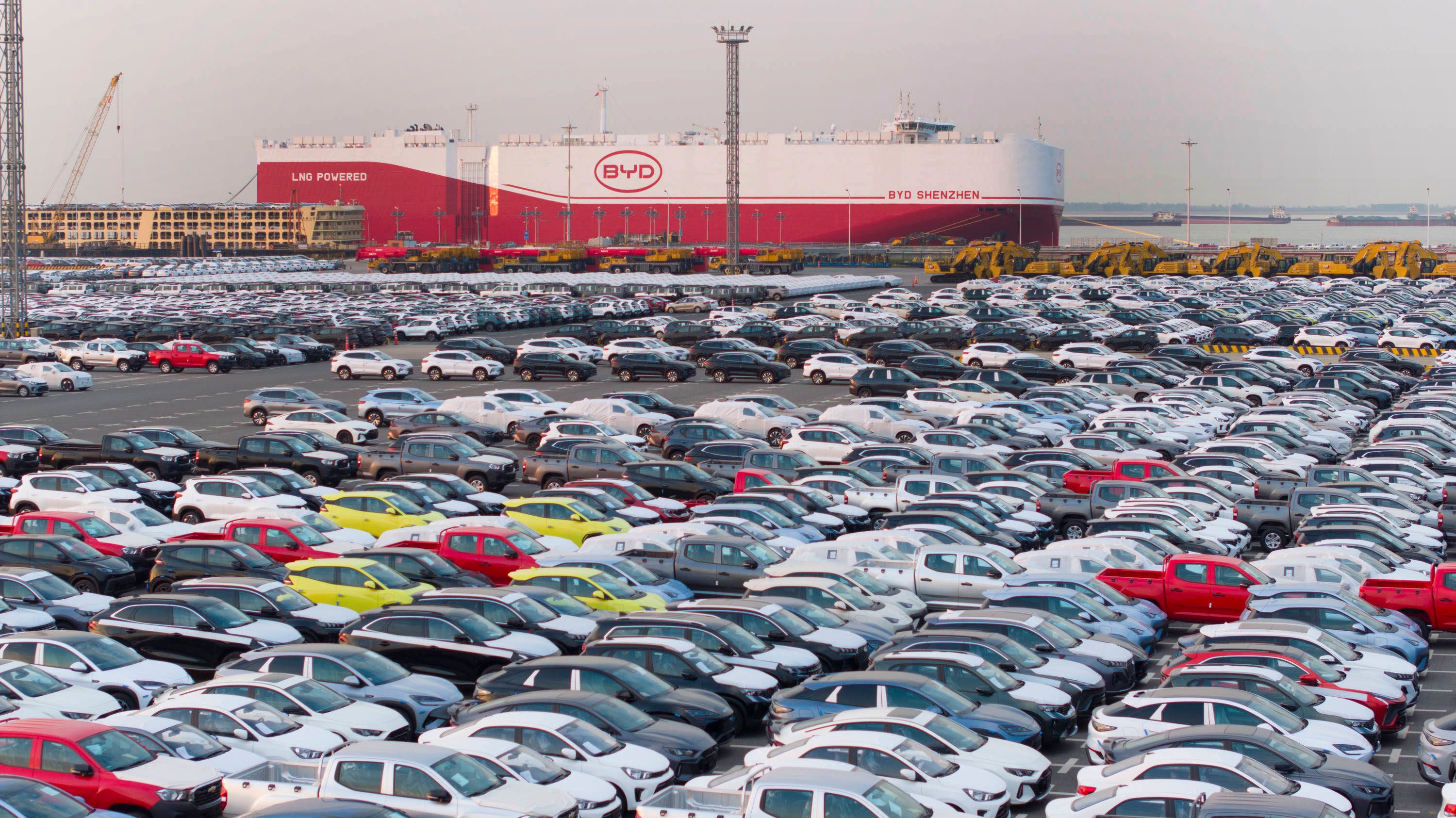
BYD’s overseas business accelerated in March as higher fuel costs linked to the Iran war pushed more buyers towards electric vehicles, offering the carmaker a crucial buffer while its home market performance remained under pressure from fierce competition and softer demand. The Shenzhen-based group’s vehicle sales fell for a seventh straight month in March, but exports and overseas sales climbed sharply, underlining how quickly BYD is leaning on foreign markets to offset weakness in China.
March total vehicle sales fell 20.5% from a year earlier to 300,222 units, according to company data cited by Reuters, marking a slower decline than February’s drop but still extending a difficult stretch for the world’s largest electric-vehicle maker by volume. First-quarter sales were down 30% from the same period a year earlier. Overseas sales, however, remained a bright spot, with 320,673 vehicles sold abroad in the first quarter, equal to 45.8% of total sales, and Reuters reported BYD is targeting 1.5 million overseas vehicle sales in 2026.
That external demand has been helped by a broader energy shock. Reuters reported that disruption to oil and gas shipments through the Strait of Hormuz during the Iran war has lifted fuel costs across Asia-Pacific and triggered stronger consumer interest in electric vehicles in markets including Australia, Japan, South Korea and New Zealand. The International Energy Agency’s Fatih Birol said global oil losses were likely to worsen in April, while the European Union’s energy commissioner warned that oil and gas prices would not quickly return to normal even if the war ended soon.
For BYD, that has created a timely opening. The company has been pushing aggressively into overseas markets just as traditional carmakers and even some Chinese rivals grapple with rising shipping costs, supply uncertainty and a more complex geopolitical backdrop. Reuters said consumer frustration with higher fuel prices and stronger policy support in some markets are accelerating the move towards electrification, especially in parts of Southeast Asia and the wider Asia-Pacific region where BYD has expanded its model lineup and dealer footprint.
Domestic conditions remain far less forgiving. BYD’s first annual profit decline in four years, disclosed last week, reflected an intense price war in China’s electric-vehicle market, weakening demand and shrinking margins. Net profit for 2025 fell 19% to 32.6 billion yuan, while automotive gross margin slipped to 20.5% and revenue growth slowed to 3.5%, the weakest pace in six years. The group also cut its workforce by 10.2% to 869,622 employees, the first headcount reduction in its history.
Part of the strain stems from where BYD has traditionally been strongest. Reuters reported that 61% of the company’s domestic sales came from budget models priced below 150,000 yuan, leaving it exposed as policy support shifted and consumers increasingly weighed affordability against newer premium offerings from competitors. Rivals such as Geely and Leapmotor have intensified pressure in the domestic market, while NIO and Li Auto posted stronger March delivery performances than BYD, highlighting the uneven nature of China’s slowing electric-vehicle sector.
BYD has responded with a technology push aimed at restoring momentum. Reuters said it launched its first major battery upgrade in six years, focusing on higher-end models priced above 150,000 yuan. That move is intended to improve charging performance and strengthen the brand’s appeal beyond entry-level buyers, though analysts cited by Reuters questioned whether the strategy would be enough while many consumers still favour cheaper vehicles.
The wider market backdrop suggests BYD’s export-led strategy may become even more important over the coming quarters. Oil prices have surged because of the conflict around Iran, and the pressure is rippling through transport and consumer spending patterns. Reuters separately reported that carmakers such as Maruti Suzuki have warned of price increases linked to war-driven commodity costs, while the luxury-car trade into the Gulf has also been disrupted by turmoil around shipping routes. Those disruptions do not affect every segment in the same way, but they reinforce the advantage enjoyed by manufacturers with scalable electric offerings and broad overseas distribution.
Follow Arabian Post
Select Arabian Post as your preferred source on Google and MSN News for trusted business news and Arab politics and updates.




