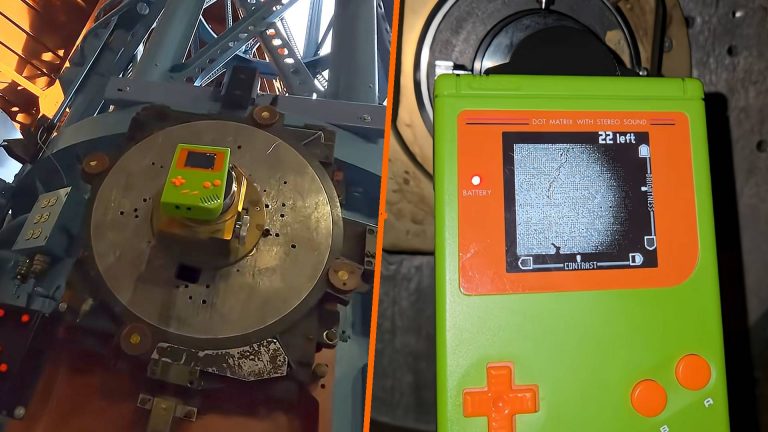
The design became public after Graue used Nintendo’s low-resolution camera accessory with Mount Wilson Observatory’s historic 60-inch telescope in California. The unconventional arrangement produced a pixelated image of Jupiter, including part of the planet’s curved edge and faint indications of its cloud bands.
Graue has also published a brief video tutorial explaining how the adapter fits into the optical chain. The downloadable model is designed as a tube that pressure-fits inside a standard 1.25-inch telescope eyepiece or focuser assembly, one of the most widely used formats among consumer telescopes.
The project requires more than printing a single component. Graue’s adapter builds on the Game Boy Camera+ modification developed by retro-hardware designer 2BitToy. That system places the camera electronics and sensor inside a replacement housing that accepts C-mount lenses, a common fitting used in industrial cameras, security systems and specialist imaging equipment.
A male C-mount component must be fixed into Graue’s printed tube before the modified camera can be attached. Graue has provided both STL and editable STEP files, allowing users to adjust dimensions when differences in printers, materials or telescope fittings produce an imperfect fit.
The original Jupiter image was made with the help of Drew Van Oort and other collaborators during a visit to Mount Wilson Observatory near Los Angeles. A chain of adapters connected the 1.25-inch printed tube to the four-inch eyepiece assembly used on the observatory’s 60-inch reflector.
Some coverage of the experiment identified the instrument as the Hooker Telescope. Mount Wilson operates both telescopes, but the photographs and project documentation show that Graue used the older 60-inch instrument. The 100-inch Hooker Telescope is housed separately at the observatory.
Completed in 1908, the 60-inch telescope was the world’s largest operational telescope at the time. Its current Cassegrain configuration has a focal length of about 24,384 millimetres. When combined with the Game Boy Camera’s small imaging sensor, the installation produced a field of view comparable to using an exceptionally long telephoto system, estimated at roughly 730,000 millimetres in 35mm-equivalent terms.
The telescope, rather than the Nintendo accessory, supplied the light-gathering power and magnification needed to photograph Jupiter. The Game Boy Camera records monochrome images at 128 by 128 pixels and renders them using four shades of grey. Released in 1998, it was primarily intended for portraits, simple animations and novelty images displayed on Nintendo’s handheld console.
Graue initially tested the arrangement on the Moon. The enormous effective magnification made the lunar surface difficult to frame, prompting the team to turn the telescope towards Jupiter. The resulting view captured only a section of the gas giant, but enough detail remained to distinguish its limb and broad atmospheric structure.
He also transferred the image to an original Game Boy Printer, preserving the experiment entirely within Nintendo’s late-1990s hardware ecosystem. The thermal printer produces small monochrome pictures on adhesive-backed paper, although surviving units frequently require replacement paper and maintenance.
Graue, who performs with the music project Loser, has included the band’s logo in the printable adapter. He described the design as a practical route for other users to experiment with telescope photography rather than a component limited to observatory-class equipment.
The 1.25-inch connection means the adapter can fit many amateur telescopes, although results will vary sharply with aperture, focal length, atmospheric conditions and focusing accuracy. Smaller backyard instruments are unlikely to reproduce the Mount Wilson image, but they may capture the Moon, bright planets or distant terrestrial subjects.
Follow Arabian Post
Select Arabian Post as your preferred source on Google and MSN News for trusted business news and Arab politics and updates.