News related to
world

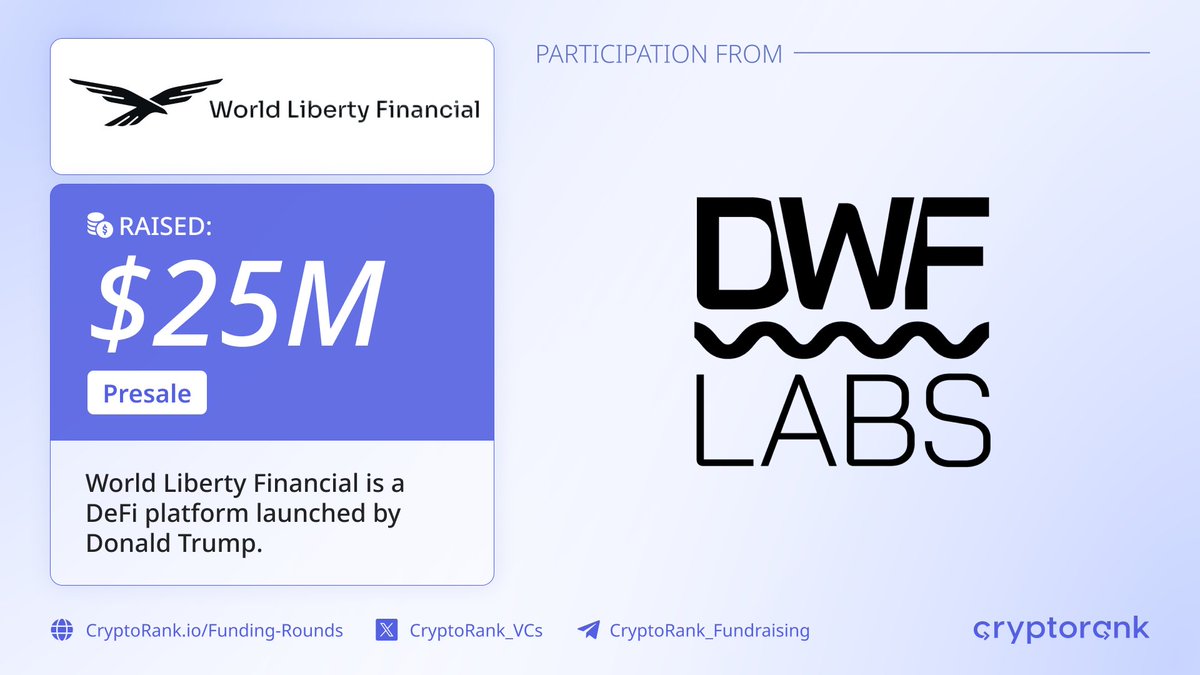
DWF Ventures, the investment arm of Web3 market‑maker DWF Labs, has delivered a detailed evaluation of $WLFI, World Liberty Financial’s newly issued utility token. Published via X, the analysis emphasises $WLFI’s integration into World Liberty’s broader ecosystem and its potential as a key enabler in connecting traditional finance with on‑chain liquidity. Unlike World Liberty’s $TRUMP memecoin, $WLFI is purpose‑built to power the upcoming “WLFI super app”, which will streamline access through web wallets and bank on‑ramps, and underpin planned lending and borrowing services.

The report highlights the success of the USD1 stablecoin—backed by short‑term US Treasuries and cash equivalents—which now commands a market capitalisation approaching $2.5 billion and enjoys listings on major exchanges such as Binance and Coinbase. These developments have significantly boosted investor attention toward the $WLFI token.

World Liberty has raised approximately $500 million across two funding rounds by selling about a quarter of its 100 billion token supply. Among its backers are DWF Labs itself and crypto figure Justin Sun, while ALT5 Sigma has outlined a $1.5 billion treasury strategy centred around $WLFI. DWF Ventures expects that the token could soon be integrated by several DeFi protocols, including Falcon Finance, Ethena and Mantle.

Importantly, DWF Ventures positions $WLFI’s launch as more than a token debut; it sees the initiative as a structural pivot that could catalyse institutional adoption and facilitate compliant capital onboarding—possibly even drawing interest from sovereign investors.

But $WLFI’s entry into the market has triggered concerns. Reports reveal technical difficulties involving the Lockbox contract, intended to unlock 20 percent of token allocations for early investors, which have left many users unable to activate the mechanism. Pre‑market trading responded with a 40 percent drop, raising doubts about launch readiness. Coupling these issues with the political profile of its founders, the token has become entangled in financial and reputational risks.

Indeed, WLFI’s connection to the family of the former president has cast a shadow over its market potential. The token’s political dimensions have already affected diplomatic engagements—such as withdrawals from the Bitcoin Asia 2025 conference—and prompted ethical criticism over conflicts of interest.

Broader scrutiny of World Liberty Financial underscores such tensions. Investigations have revealed that the Trump family commands a substantial share of revenue from token sales and that governance design reflects unusual centralisation for a DeFi project. Further concerns relate to self‑dealing practices: for instance, ALT5 Sigma—a firm acquired by World Liberty—purchased $750 million worth of WLFI tokens. As part of this arrangement, its leadership includes Eric Trump and WLFI co-founder Zach Witkoff, a structure that regulators and critics view as raising red flags.

Ethics experts warn that such close ties between ruling office, private enterprise and foreign investment could undermine democratic safeguards. The New Yorker, for one, described the venture as stretching the norms of political ethics, with World Liberty seen by some as a mechanism for influence through token‑based access channels.

The $WLFI launch is clearly more than a token generation event—it is shaping into a test case for the nexus of politics, finance and regulation in the emerging Web3 era.

HUZHOU, CHINA – Media OutReach Newswire – 2 September 2025 – A series of activities highlighting ecological progress were held on August 15th as the country embraces its third National Ecology Day. The focus is on protecting the ecological environment, addressing climate change and how China’s meteorological departments are taking action. This year it was Yucun Village, nestled in Anji County of Zhejiang Province in eastern China […]

Novacore Innovations, based in Mumbai, has launched India’s inaugural GPU cloud platform built around NVIDIA’s Blackwell‑based B200 servers. The platform, powered by a ₹44.6 crore line of credit led by Rashi Fincorp with backing from U. S. and Abu Dhabi investors, is being deployed in Hyderabad to serve startups, researchers and enterprises across India, the U. S. and the Middle East.

This GPU‑as‑a‑service offering centres on the NVIDIA B200, an iteration of the Blackwell architecture that boasts up to 2.3× higher peak performance and double the real‑world AI speed over its predecessors. It is equipped with 192 GB of HBM3e memory, 8 TB/s bandwidth, fifth‑generation tensor cores and dual transformer engines, which collectively accelerate training by up to 3× and inference throughput by as much as 15×, while enhancing energy efficiency up to 25×.

Novacore’s co‑founders, Ranbir Badwal and Aryamaan Singhania, credit India’s low energy costs, technical workforce and Hyderabad’s robust data‑centre ecosystem for enabling this development. They emphasise that the platform offers lower hosting costs, rapid provisioning, and scalable compute for generative AI, large language models, scientific computing and real‑time analytics.

As an incentive to foster uptake, Novacore is offering trial access to qualifying startups and research labs across its target markets.

The platform also aligns with wider developments in India’s AI infrastructure. NVIDIA is collaborating with major domestic firms such as Reliance and Tata to expand locally hosted AI data‑centre capabilities powered by renewable energy, supporting India’s sustainability and net‑zero objectives. Meanwhile, the domestic AI‑as‑a‑service market is forecast to expand at a compound annual growth rate of roughly 26.4 percent, reaching an estimated $31.94 billion by 2031.

The launch of this platform by Novacore marks a significant enhancement in India’s ability to support advanced, high‑performance AI workloads locally. Transactions such as a similar move by CoreWeave in North America—deploying Blackwell Ultra GPUs commercially in July 2025—highlight a global push toward increasingly capable and efficient AI infrastructure.

OKB, the native token of the OKX exchange, surged past the $200 threshold in the wake of a sweeping tokenomics overhaul and landmark ecosystem upgrades. These strategic shifts have reshaped the token’s role within the OKX ecosystem, igniting both market interest and institutional focus.

A decisive blow to token supply was delivered on 13 August 2025, when OKX executed a one‑off burn of approximately 65 million OKB—equivalent to around $7.3 billion—effectively halving circulating supply and capping total supply at 21 million tokens. The smart‑contract upgrade also eliminated future minting or discretionary burns, solidifying this deflationary model.

That scarcity shock triggered an explosive price rally. OKB vaulted from roughly $45 to a range between $135 and $200, with reported gains of 160–170% in the immediate aftermath. Trading volumes followed suit, rising sharply—in some accounts by as much as 383%, with daily turnover exceeding $1 billion.

Parallel to the token burn, OKX launched its upgraded X Layer blockchain, powered by Polygon’s CDK and zkEVM technology. This infrastructure now delivers throughput of 5,000 transactions per second, near‑zero gas fees and enhanced Ethereum compatibility, positioning OKB as the exclusive gas token across OKX Wallet, Exchange and Pay services. By migrating more than 90% of OKB tokens to X Layer and phasing out Ethereum Layer‑1 and OKTChain, OKX has consolidated liquidity and simplified its token architecture.

OKX also introduced a $100 million X Layer Ecosystem Fund to support developers and drive adoption in areas such as DeFi, payments and real‑world assets, while exploring entry into regulated markets in Europe and pursuing an IPO in the U. S..

Analysts caution that the token’s meteoric rise has pushed key technical indicators into overbought territory. Yet, many argue that OKB’s redefined scarcity model and expanded utility offer a structural foundation for sustained value, rather than a fleeting speculative euphoria.

Amid lingering regulatory uncertainties, particularly across Asian markets, investor sentiment remains firm. Continued strength may hinge on user migration to X Layer and the successful rollout of incentive initiatives and application-building support.

By Nitya Chakraborty Prime Minister Narendra Modi’s bilateral talks with the Chinese President Xi Jinping on Sunday at Tianjin in China on the sidelines of Shanghai Cooperation Organisation (SCO) summit have sent some very positive signals which may herald the evolution of an independent foreign policy of India voicing the interests of the Global South. […]

MACAU SAR – Media OutReach Newswire – 1 September 2025 – In a landmark move to deepen regional ties and expand its international footprint, Galaxy Entertainment Group (hereinafter as “GEG”) proudly announces the opening of a new overseas office in Singapore. This strategic initiative marks a new chapter in GEG’s growth trajectory and underscores its commitment to promoting Macau as the “World Centre of Tourism and Leisure” […]

Greenlogue/AP The United Arab Emirates is elevating its contribution to the global clean‑energy shift through an ambitious expansion of solar generation capacity, backed by major state and private entities, spanning domestic projects and international initiatives. Domestically, the Al Dhafra Solar PV project near Abu Dhabi, boasting a capacity of 2 GW, remains one of the world’s largest single‑site solar power plants and significantly bolsters the UAE’s installed solar capacity […]

Advertisements

Choithrams Is Turning Everyday Shopping into Lifesaving Support at Choithrams.com and across outlets in UAE to support WFP’s nutrition programme for schoolchildren DUBAI, UNITED ARAB EMIRATES – EQS Newswire – 1 September 2025 – Choithrams (www.Choithrams.com), Dubai’s leading supermarket chain, and the United Nations World Food Programme (WFP) are launching the latest edition of the “End Hunger with Goodness” campaign to support school meal programmes across the […]

Dubai is poised to welcome a wave of new educational institutions in the 2025–26 academic year, with 25 private schools, early childhood centres, and universities slated to open their doors. This initiative is designed to add more than 11,700 school seats and 2,400 places at early childhood centres, significantly expanding learning options for families across the emirate.

Investors continue to express strong confidence in Dubai’s education sector. The new openings include six private schools offering a diversity of curricula—ranging from British to American and International Baccalaureate styles—16 early childhood centres, and three internationally renowned universities. These developments align closely with Dubai’s Education 33 strategy, which aims to elevate the emirate as a global centre for quality education and to boost its socio-economic growth.

The higher education expansion includes flagship additions: the Indian Institute of Management Ahmedabad, the American University of Beirut, and Fakeeh College for Medical Sciences. IIM Ahmedabad stands out with its global presence and reputation for top-tier business and management programmes, AUB holds a strong international ranking, and Fakeeh College brings expertise in medical sciences to the Dubai education landscape.

GEMS Education is also making headlines with the upcoming launch of the GEMS School of Research and Innovation in August 2025. Situated in Dubai Sports City, this school is being billed as Dubai’s most expensive to date, with a build cost of approximately US$100 million. It will follow the British National Curriculum and focus heavily on artificial intelligence, offering world-class facilities including an Olympic‑standard 50‑metre swimming pool and helipad. School fees are expected to be the highest in the country.

Regulatory oversight remains a critical component of Dubai’s educational expansion. The Knowledge and Human Development Authority has approved a 2.35 per cent Education Cost Index for tuition fee adjustments in for-profit private schools for 2025–26, based on audited financials. The ECI covers teacher and staff salaries, support services, and facility rentals. Established institutions—those operating for over three years—may apply for fee increases up to this limit, subject to KHDA review and quality assurance criteria.

This expansion comes amid growing enrolment demands. Sources suggest that student numbers across the UAE’s K‑12 segment are expected to rise sharply, with a forecast of over 150,000 new students by 2027. By 2040, higher education enrollment is also expected to more than double, necessitating an additional 10–15 branch campuses to cater to demand.

Dubai’s private education sector currently encompasses 331 early childhood centres, 233 private schools, and 44 higher education institutions. The forthcoming additions will further diversify program offerings and increase accessibility across the education spectrum.

Beyond capacity, this expansion reinforces strategic priorities. The new institutions are expected to support Dubai’s ambition to scale up educational tourism, foster a generation equipped for future-facing sectors, and reinforce its status as a major global economic and educational hub.

Borouge Plc confirmed shareholder approval at its 29 August General Assembly Meeting for an interim dividend of US$660 million, equating to 8.1 fils per share. The move underscores sustained financial strength driven by robust pricing premia, disciplined cost management and strategic inventory realisation.

The corporation reaffirmed its intention to deliver a total dividend of 16.2 fils per share for 2025—a rise from 15.88 fils in 2024—with the final instalment of 8.1 fils set to be disbursed in the first quarter of 2026. Since its IPO in June 2022, Borouge has returned US$4.24 billion in dividends, equating to a 30 per cent total shareholder return.

Chief executive Hazeem Sultan Al Suwaidi emphasised that the dividend distribution reflects the company’s “consistent track record of strong shareholder returns,” grounded in disciplined cost oversight, steady pricing margins and robust operations. He also pointed to progress toward forming Borouge Group International in early 2026 and remarked that the company remains committed to delivering resilient performance and one of the highest dividend returns on the ADX.

Financial results for the first half of the year reinforce the dividend decision. Borouge posted a net profit of US$474 million, lifted by sustained volumes, favourable pricing premia and cost efficiencies. Operationally, the pivotal Borouge 4 mega‑project has surpassed 90 per cent completion and is on target for delivery by the end of 2026. Upon completion, it will add 1.4 million tonnes of annual polyolefin capacity, unlocking substantial embedded value for shareholders.

Further details of the company’s broader strategic direction were outlined. Borouge Group International, the planned global entity, is on track for completion in the first quarter of 2026, with regulatory filings and integration processes already under way. The newly formed firm is projected to become a US$60 billion global petrochemicals powerhouse and the world’s fourth‑largest polyolefins company. Following completion, the intention is to maintain an annual minimum dividend of 16.2 fils per share through to at least 2030, subject to approval.

Earlier, Borouge had signalled its intent to distribute this interim dividend when the board proposed a US$663 million interim payout on 30 July, equivalent to 8.1 fils per share, inviting shareholders to convene on 29 August. Market commentary from the second quarter further framed the dividend rationale: net profit reached US$193 million in Q2, buoyed by the timely execution of the Borouge 3 turnaround—completed ahead of schedule and within budget. EBITDA stood at US$440 million with a margin of 34 per cent, reinforcing the company’s resilience amid asset maintenance.

SEOUL, SOUTH KOREA – Media OutReach Newswire – 1 September 2025 – Aon plc (NYSE: AON), a leading global professional services firm, today announced Bonjay Koo has been appointed Enterprise Client Leader, Asia Pacific in South Korea effective September 1. Bonjay Koo In this strategic role, Koo will be responsible for the delivery of integrated Risk Capital and Human Capital solutions to Aon’s enterprise and large multinational […]

SINGAPORE – Media OutReach Newswire – 1 September 2025 – Leading health insurance provider AIA Singapore today announced that it has engaged Singapore Airlines Academy, the training arm of Singapore Airlines, to develop a curated talent development program for AIA Singapore. This initiative will see AIA Singapore collaborating with Singapore Airlines Academy to create a series of workshops focused on enhancing customer experience (CX) capabilities and building […]

In Dubai, nobody’s impressed by a pair of trainers or a designer watch alone – here, your car does the talking. From Sheikh Zayed Road to Jumeirah Beach, the vehicle you roll in is your calling card, your vibe, your crown. And the beauty? You don’t need to break the bank to sit on the throne. With cheap 7 seater car rental Dubai, you can cruise the city […]

Mastercard and Circle have deepened their collaboration to enable settlement of transactions in USDC and EURC stablecoins for acquirers and merchants across Eastern Europe, the Middle East and Africa. Arab Financial Services and Eazy Financial Services are among the first institutions to access this capability, which integrates stablecoin payments into Mastercard’s established global network.

The initiative marks a clear shift towards tokenised money. Mastercard’s President for EEMEA, Dimitrios Dosis, emphasised the ambition to bring stablecoins into mainstream finance by investing in infrastructure, governance and partnerships, while leveraging the company’s longstanding expertise in security and compliance. Kash Razzaghi, Chief Business Officer at Circle, framed the move as a step towards “borderless, real‑time commerce,” seeking to make USDC as ubiquitous as traditional payments.

Arab Financial Services highlighted the tangible value of the new model: improved liquidity, operational efficiencies and dramatically reduced friction in high‑volume reconciliations. Eazy Financial Services underscored how the expanded settlement option aligns with its mission to offer faster, more secure, and efficient payment solutions, setting a fresh standard for digital settlements in EEMEA.

This development builds on existing collaborations such as crypto payment card solutions with the likes of Bybit and S1LKPAY, which already use USDC for settlement in the region. Mastercard further extends its stablecoin portfolio beyond USDC and EURC, already supporting USDG, FIUSD and PYUSD across various use‑cases spanning remittances, B2B, and payouts via platforms like Mastercard Move and the Multi‑Token Network, underpinned by its Crypto Credential and Crypto Secure frameworks.

Financial infrastructure experts view the rollout as particularly meaningful for emerging markets. World Bank data indicates cross‑border transfer costs remain high—around 8% on average—far exceeding the UN’s Sustainable Development Goal threshold of 3%. Introducing stablecoin settlement is expected to trim costs, accelerate transfers, and bolster working capital and currency resilience for small and medium businesses.

Analyses point to early adopters witnessing significant gains: settlement speeds up by 30%, and liquidity costs drop around 20%, according to some reports. Mastercard’s compliance infrastructure, combined with evolving regulatory frameworks like the European MiCA and US GENIUS Act, fosters institutional trust in this digital settlement evolution.

Circle is working to fortify USDC’s global footprint beyond this initiative. Its broader strategy includes partnerships with Finastra to plug USDC into traditional payment hubs, OKX for zero‑fee USDC conversions, and ventures with SBI Group and Ripple in Asia—all aimed at building liquidity, interoperability and widespread adoption.

GUIYANG, CHINA – Media OutReach Newswire – 29 August 2025 – On August 28, the 2025 China International Big Data Industry Expo opened in Guiyang, Guizhou Province. Launched in 2015, it has become the world’s premier platform for the development of big data industry. Opening ceremony venue of the 2025 China International Big Data Industry Expo During the opening ceremony, head of the National Data Administration of […]

Digital Realty and Vultr have entered into a strategic global partnership to deploy enterprise‑grade, GPU‑accelerated AI infrastructure in key data‑hub markets. Through this alliance, Vultr’s cloud‑based GPU clusters – powered by NVIDIA HGX B200 and AMD Instinct MI325X chips – will be integrated into Digital Realty’s PlatformDIGITAL data‑centre network, offering high‑performance AI compute close to where enterprise data resides. The new offering allows organisations to access Vultr’s GPU resources via direct […]

Greenlogue/AP Veolia has moved to acquire the remaining 30 per cent stake in its Water Technologies and Solutions subsidiary from CDPQ, in a deal valued at around US$1.75 billion, positioning the company for greater strategic agility and cost-efficiency. The transaction is expected to bring about €90 million in run‑rate cost synergies by 2027, simplification of the group’s structure, and added value through streamlined decision‑making and integration. The move forms […]

Sotheby’s will stage its first auction series in Abu Dhabi this December as part of a broader push by the emirate to emerge as an international hub for art and luxury. The event, named Abu Dhabi Collectors’ Week, is set to run from 2 to 5 December and promises to captivate collectors with offerings spanning fine jewellery, rare watches, collector cars and premium real estate. The drive behind […]

3 Cross-regional fashion events kicking off at CENTRESTAGE in Hong Kong followed by a fashion show and exhibition in Seoul Bringing together 35 units of renowned and emerging designers from Guangdong-Hong Kong-Macao Greater Bay Area and Korea to present over 100 creations Breaking cultural boundaries with Cantopop, K-pop and films from Hong Kong and Korea to open a new frontier in cultural exchange HONG KONG SAR – […]

World Liberty Financial’s WLFI token is set to begin trading on the Ethereum mainnet on 1 September 2025, with only 20 per cent of the total supply unlocked for early supporters, while the remaining 80 per cent remains under community‑governance lock. Funding rounds have raised up to $2.26 billion, including significant equity backing from ALT5 Sigma, attributing a paper valuation—and potential risk—for retail traders.

Trading commences at 12:00 UTC on 1 September, when presale participants can claim and exchange the portion of tokens unlocked by activating the audited “Lockbox” smart contract. A week‑long activation window began on 25 August to prepare wallets. The initial release affects only a fraction of the total supply; community votes will determine release schedules for the locked remainder.

Pre‑launch futures activity offers a stark view of market sentiment. WLFI perpetual contracts debuted around $0.42, implying a fully diluted valuation of $40 billion. However, futures prices plunged 44 per cent shortly after, collapsing from $0.44 to below $0.25 and slashing the FDV to $24 billion, amid heavy shorting and a sharply negative funding rate of around ‑35 per cent.

Tokenomics reveal a further concentration of risk: insiders—including the Trump family—hold a vast share of true control. Estimates suggest between 75 per cent and over 80 per cent of the supply remains allocated to founders, team members, and affiliated entities, with release terms opaque and subject to governance decisions.

The project has drawn intense scrutiny for its centralised structure and ethical implications. Reuters reported that the Trump family raised approximately $550 million through WLFI token sales and now claims around 75 per cent of net revenue. That level of control starkly contrasts with the decentralised ideals usually associated with DeFi. Commentary in outlets such as The New Yorker emphasises how such arrangements echo a “raffle-ticket” model, whereby early purchasers gain governance power and speculative upside while insiders benefit disproportionately, fuelling concerns about influence‑peddling and conflicts of interest.

Further fuelling caution, benzinga commentary and crypto analysts warn that the small circulatable portion at launch, paired with concentrated insider holdings, could make WLFI’s valuation look inflated on paper—yet leave retail investors exposed if token dumps or sell pressure emerge post‑launch.

Pending regulatory clarity also looms large. With USD1 stablecoin already launched and tied to WLFI’s ecosystem, the project’s compliance with securities laws remains under question, especially given public funds, centralised control, and political ties.

Experts urge prospective investors to proceed with caution. The disparity between locked and unlocked supply, the volatility seen in derivatives markets, and the centralisation of control combine to form a high-risk scenario reminiscent of past politically affiliated crypto launches. While some anticipate short-term rallies driven by hype and governance claims, the sustainability and fairness of WLFI’s structure remain deeply uncertain.

South African President Cyril Ramaphosa unveiled a G20 taskforce led by Nobel Prize‑winning economist Joseph Stiglitz, aimed at scrutinising global wealth inequality and its consequences for economic growth, poverty and cooperation among nations. This pioneering effort marks the first time the G20 has deployed such a specialised group of independent experts, with findings due to be presented at the Johannesburg summit in November 2025. The six‑member panel […]

Arabian Post Staff -Dubai Pre‑orders for Huawei’s second‑generation Mate XTs smartphone have begun in China, ahead of its unveiling scheduled for 4 September. The device does not have an official US release at this time. The Mate XTs, slated for presentation on 4 September at 14:30 China time, retains the tri‑fold, or “S‑style”, design of its predecessor while introducing refinements such as two new finishes—white and crimson purple—and a more […]

A quarter of white‑collar professionals in the UAE express concern that artificial intelligence might one day replace their roles, yet more than half acknowledge that AI tools have made their work noticeably easier—presenting a complex picture of apprehension tempered by appreciation.

LinkedIn data shows that 80 per cent of professionals in the UAE now use AI tools “regularly,” a significant increase from 56 per cent in 2024. This puts the UAE second globally in AI adoption behind only India, where the figure stands at 85 per cent. Confidence in experimenting with AI is high, with 81 per cent of local professionals saying they enjoy exploring AI tools, and 73 per cent reporting more frequent and confident usage compared with the previous year. Many describe learning AI as “a second job.”

A survey by The National found that roughly 25 per cent of the 200 respondents worry about AI’s future impact on their jobs. Yet more than half affirm that AI has made their current tasks easier, and 7 per cent report that their roles have already been replaced—though they emphasise this is based on a small sample. Roles in media, advertising and marketing appear particularly vulnerable to automation. Nevertheless, David Mackenzie of recruitment firm Mackenzie Jones Middle East maintains that, at present, AI lacks the sophistication to supplant senior professionals in white‑collar roles.

Broader sentiment in the UAE workforce is largely optimistic. A Korn Ferry workforce report indicates that 82 per cent of employees in the UAE feel positive about AI’s potential—a stance mirrored in neighbouring Saudi Arabia. Moreover, a survey reveals only 7 per cent of UAE professionals would resist working alongside AI as a colleague, compared with 21 per cent globally. There is, however, cautious pragmatism: 35 per cent support limiting automation in sensitive sectors such as healthcare and education, and 61 per cent would endorse full automation only if accompanied by a universal basic income or welfare compensation, compared with 40 per cent worldwide.

These mixed perspectives take shape against a backdrop of national ambition and infrastructural investment. The UAE has broadened its Golden Visa programme to attract global talent in AI, climate technology and advanced digital industries—a strategic move to make itself a hub for technological innovation and sustainable growth. The country’s AI strategy also includes the establishment of dedicated institutions and leadership structures, such as the Ministry of State for Artificial Intelligence, Digital Economy and Remote Work Applications, led by Omar Sultan Al Olama, who was appointed in 2020 as the world’s first minister for artificial intelligence.

Academic insights reinforce the nuanced impact of AI across sectors. A recent study of creative professionals—including journalists and filmmakers—reveals that while AI enhances operational efficiency and reduces costs, it also raises concerns about authenticity, cultural integrity and skill erosion. The absence of sector‑specific guidelines leaves individuals to navigate AI adoption on their own.

On a global scale, developments are shaping discourse on AI’s real effects. A Stanford‑led study has documented a 16 per cent decline in employment among workers aged 22–25 in sectors vulnerable to automation, such as customer service and software development, between late 2022 and mid‑2025. Experienced workers remain comparatively shielded as AI takes over repetitive tasks. The report emphasises the importance of policies that favour human‑AI collaboration rather than outright replacement. Microsoft’s AI chief Mustafa Suleyman urges professionals not to fear job loss, but rather stagnation—championing reskilling, collaboration, and a growth mindset.

These threads converge as the UAE continues to pursue its goal of becoming an AI leader by 2031—anchored in education, infrastructure, investment and workforce transformation. Yet the responses of professionals remain varied: a blend of anxiety, adaptability and optimism defines the evolving relationship between AI and work in the UAE.

Global logistics investor GLP will receive up to $1.5 billion from a wholly owned subsidiary of the Abu Dhabi Investment Authority, signalling the sovereign wealth fund’s first move from limited partner to direct stakeholder in the firm. The initial capital deployment of $500 million is earmarked for expanding GLP’s operations in logistics, digital infrastructure, and renewable energy, with further investment to follow in coming months.

The capital infusion aligns with growing global demand across sectors driven by e‑commerce growth, artificial intelligence and cloud adoption, and the green energy transition. GLP’s data‑centre division is notably thriving: its annual revenue surged 43 percent year‑on‑year to US $193 million.

GLP oversees approximately US $80 billion in assets through its management arm, GLP Capital Partners. This move marks a strategic shift for ADIA—long an investor in GLP’s funds—into becoming a direct shareholder in the global investment group.

In a statement, GLP co‑founder and chief executive Ming Z Mei emphasised that the enhanced capital base and strategic partnership will enable the company to “accelerate growth” and capitalise on the “secular expansion of new economy sectors in which we operate.” Mohamed Al Qubaisi, executive director of ADIA’s real estate department, noted that the transaction deepens their longstanding relationship with GLP and supports its next growth phase while scaling exposure to new economy segments.

The investment supports GLP’s diversified global platform. The firm has operations across Brazil, China, Europe, India, Japan, the US, and Vietnam, spanning logistics real estate, data centres and renewables. Moreover, the investments come amid escalating interest in digital infrastructure, particularly data centres, which are seen as pivotal to AI and cloud services growth.

GLP’s momentum is further underlined by recent capital inflows from regional partners. In China, the company secured 2.5 billion yuan from Zhejiang government‑backed investors to boost its data‑centre operations. Earlier in the year, GLP completed the sale of its ex‑China funds management business to Ares Management for US $3.7 billion, in a deal partly financed with cash and equity. The company also retains stakes in those funds and has backed Ares’s first Japanese data‑centre fund, which completed a US $2.4 billion final closing in June.

GLP’s evolution over the past decade provides further context for this development. Founded in 2009 by Ming Z Mei and Jeffrey H Schwartz, the firm originated as Global Logistic Properties. It went public in 2010 in what was at the time Singapore’s largest IPO. It was taken private in 2018, following a leveraged buyout led by a private‑equity consortium. The company has since transformed into a multi‑sector platform across logistics, digital infrastructure and renewable energy.

On the other side, ADIA stands as one of the world’s largest sovereign wealth funds, managing a diversified global portfolio across asset classes including real estate, private equity and data‑centre platforms. This leap into a direct stake in GLP underscores the fund’s strategy of pursuing active positions in entities driving structural sectoral growth.

VISHNU RAJA
RYO YAMADA
HITORI GOTOH
IKUYO KITA