News related to
WLFI

AI Financial has warned that it may not remain viable over the next year after a steep fall in the value of its World Liberty Financial token holdings exposed the fragility of a balance sheet built around a volatile crypto treasury. The Nasdaq-listed company, formerly known as ALT5 Sigma, disclosed that it held 7,283,585,650 WLFI tokens at the end of its first quarter, carrying them at a [...]
World Liberty Financial’s leadership has moved to contain a wave of online speculation over the Trump-linked crypto venture, with Donald Trump Jr. and chief executive Zach Witkoff insisting the project remains intact even as its legal dispute with Tron founder Justin Sun deepens. Trump Jr., speaking at the Consensus crypto conference in Miami on Thursday, rejected claims that he and other members of the Trump family had [...]
World Liberty Financial, the cryptocurrency venture closely associated with President Donald Trump, unveiled plans to issue blockchain-based tokens backed by loan revenue interests tied to the Trump International Hotel & Resort in the Maldives, a luxury development slated for completion in 2030 and being built in partnership with the Trump Organization and Dubai-listed developer DarGlobal. The move forms part of WLFI’s broader real-world asset strategy aimed at [...]

Market attention turned sharply towards World Liberty Financial as its WLFI token climbed more than 7% on the daily chart, supported by renewed momentum in a buyback programme that has drawn heightened interest from traders. The jump in value, which pushed volumes higher across multiple exchanges, underscored a shift in sentiment around the project after a period of steady consolidation in its price trajectory.

Traders noted that the upswing aligned with the recommencement of the token buyback scheme, which had been announced earlier in the year as part of the platform’s strategy to stabilise circulating supply and incentivise long-term holding. The renewed activity around the programme appeared to signal confidence within the project’s core team, with market participants interpreting the move as an effort to strengthen liquidity and reinforce the token’s market position during a phase of broader volatility in digital assets.

The project, positioned as a decentralised finance ecosystem offering yield products and cross-border payment tools, has been attempting to carve out a more distinct space in the congested DeFi landscape. Its token performance has shown periods of sharp movement in line with broader market swings, but the latest rise stood out due to the targeted intervention through the buyback initiative. Analysts tracking on-chain data confirmed a noticeable reduction in WLFI circulating supply over the past 48 hours, indicating execution of the buyback in measurable volumes.

A senior market analyst at a Dubai-based digital asset fund said the token’s rebound reflected “a coordinated liquidity strategy combined with renewed user engagement,” adding that sustained price support would depend on whether the buybacks continue at a stable pace. The analyst also pointed to the rising interest in tokens backed by structured DeFi models, noting that these projects have gained traction as traders search for instruments offering more predictable mechanics compared with purely speculative assets.

WLFI’s latest surge coincided with a broad improvement in sentiment across mid-cap digital tokens, though its gain exceeded the general market trend. Data aggregators showed that while major assets such as Bitcoin and Ether recorded modest upward moves, WLFI’s performance outpaced most alternative tokens in its category. The increase was accompanied by a measurable uptick in wallet activity, with new holders entering the market as trading forums circulated speculation about further buyback rounds.

Company representatives had earlier disclosed that the buyback programme was designed to respond dynamically to market conditions, enabling the project to reinforce token value during periods of instability. Blockchain analysts have noted that such mechanisms, if implemented with transparency and predictable parameters, can help sustain community confidence and mitigate sharp sell-offs. The WLFI team’s renewed engagement, including technical updates and communication around upcoming ecosystem features, also contributed to the current sentiment shift.

Industry observers said market participants were also watching regulatory signals closely, as global jurisdictions continue to refine frameworks for digital assets. A clearer regulatory environment, particularly in markets influential to token liquidity, has historically contributed to greater investor participation. WLFI’s activity in markets such as the UAE and Southeast Asia has expanded over the past year, aided by partnerships with payment service providers and liquidity networks aiming to widen adoption.

Developments in DeFi have shown that buyback-driven appreciation, while effective in the short term, typically requires sustained platform growth to maintain momentum. This has put attention on WLFI’s roadmap, which outlines the rollout of additional financial tools and integrations aimed at strengthening ecosystem utility. Market analysts said user adoption metrics over the next quarter would be critical in determining whether the token can retain the gains recorded following the buyback revival.

The broader digital asset market has been characterised by alternating periods of risk appetite and caution, shaped by shifting macroeconomic indicators and geopolitical developments. WLFI’s rise occurred during a phase where traders were displaying a stronger preference for tokens linked to structured platforms with defined use cases. This positioned WLFI favourably as its developers highlighted enhancements to yield mechanisms and expansion into multi-chain support, which could increase platform accessibility.

Trading desks reported that the token’s order books reflected thicker buy-side interest as the session progressed, suggesting that momentum-driven traders were reinforcing the upward movement. Price analysts, however, cautioned that tokens experiencing sudden appreciation following buybacks may face corrections if broader market sentiment turns or if programme intensity decreases. Despite this, WLFI’s advocates argue that the project’s tokenomics structure is engineered to provide periodic support without distorting long-term market behaviour.

ADVERTISEMENT

Fight Fight Fight LLC, the company behind the TRUMP memecoin, has launched a capital-raising campaign of at least $200 million with ambitions that could scale up to $1 billion to establish a dedicated digital asset treasury that would accumulate holdings of the token, according to people with knowledge of the matter.

The undertaking is led by Bill Zanker, a long-time promoter and Trump ally, and signifies one of the most aggressive attempts yet to stabilise a creator-driven token through internal backing. The funds would be deployed primarily to purchase TRUMP tokens from the open market, an effort to shore up price and signal confidence in what has become a volatile asset.

TRUMP, launched just before Donald Trump’s second inauguration, operates on the Solana blockchain under two joint issuers—Fight Fight Fight LLC and CIC Digital—together controlling 80 percent of its total supply. The public tranche was released in January 2025, and the token rapidly gained speculative traction before encountering steep declines.

Insiders caution that the fundraising process is ongoing and not guaranteed to succeed in full. They also note that structuring such a treasury around a politically branded memecoin carries substantial market, regulatory and reputational risks.

Cryptocurrency analysts observe that the move is consistent with broader trends in 2025: increasingly, token issuers are creating “treasury models” to backstop flagging price action. Yet few of those are tethered so explicitly to a political figure or narrative, making the TRUMP case unique.

The token’s price trajectory has been volatile. After peaking earlier in the year, it has fallen sharply—losing more than 80 percent of its value from highs—attracting scrutiny about its speculative nature and sustainability. Meanwhile, TRUMP maintains strong social media backing and occasional high-visibility events, such as a dinner hosted by Trump in May for top token holders, which had triggered a notable price bump.

In June, plans were floated by the issuer to launch an “Official Trump Wallet” to facilitate trading and custody, but disputes emerged with World Liberty Financial. Those tensions underscored internal complexity and fragmented control within the broader Trump crypto ecosystem.

Analysts underline that for the treasury plan to have long-term impact, it must go beyond buybacks. Critics argue that stockpiling tokens may serve only short-term price support, lacking sustainable utility or integration into broader infrastructure. There is a risk that concentrated control over token issuance and vesting schedules could invite regulatory scrutiny or undermine confidence among external investors.

Institutional curiosity is emerging: Canary Capital Group has reportedly filed paperwork with U. S. regulators to launch a spot ETF tied to TRUMP. Yet the Securities and Exchange Commission’s cautious posture toward meme coins, and obstacles in listing a futures-based derivative market, could impede progress.

The broader Trump-adjacent crypto strategy has already stretched into multiple verticals. Trump Media & Technology Group announced a $2.5 billion initiative to build a bitcoin treasury, and World Liberty Financial has launched a $1.5 billion self-buy programme in its own token, WLFI. In that case, about half the funding is to be in WLFI itself, with the rest directed to debt settlement and resale.

World Liberty Financial, the crypto venture tied to Donald Trump’s family, has announced it will issue a debit card enabling users to spend digital assets as conventional currency, with a pilot slated next quarter and full deployment targeted by late 2025 or early 2026.

At Singapore’s TOKEN2049 conference, CEO Zach Witkoff stated that the underlying aim is to “bridge crypto assets with everyday spending,” forecasting that the card could go live in the fourth quarter or first quarter of 2026. Co-founder Donald Trump Jr. joined the presentation, underscoring the project’s ambition to integrate cryptocurrency more deeply into consumer payments.

Beyond payments, World Liberty is advancing a plan to tokenise real-world commodities, aiming to use blockchain infrastructure to trade assets like oil, gas, timber and cotton. Witkoff described these as “really interesting” domains for on-chain trading, pointing to what the company sees as excess transactional inefficiency in traditional markets. The firm also launched its governance token, WLFI, earlier this month, and has introduced USD1, a dollar-pegged stablecoin backed by U. S. Treasuries and other cash equivalents to cut dependency on conventional banking rails.

World Liberty has secured a high-profile institutional backer: the UAE-based Aqua 1 Foundation invested USD 100 million in WLFI tokens, becoming the venture’s largest public investor. The strategic pact aims to fuel World Liberty’s expansion in South America, Europe and Asia, and to jointly incubate blockchain initiatives.

The governance token WLFI currently is non-transferable, granting holders voting rights rather than direct tradeability; World Liberty has said it is “working behind the scenes” to make WLFI transferable in the future. A large portion of WLFI’s supply remains held by the Trump family and affiliated entities.

The stablecoin USD1 gained traction after a major crypto exchange deal: World Liberty was among the early adopters when the funds backed by an Abu Dhabi entity were routed through USD1 to a major crypto platform, helping to elevate USD1’s market position in the stablecoin ecosystem.

Regulatory and ethical concerns already shadow the venture. Critics argue the project blurs lines between private enterprise and public office, noting that much of the Trump family’s wealth could become entangled with policy outcomes. Donald Trump Jr. has dismissed conflict-of-interest allegations as “complete nonsense,” but scrutiny over the convergence of politics and crypto is intensifying.

WLFI has exhibited wide volatility since launch, riding speculative momentum across global exchanges. Meanwhile, competing crypto card offerings already exist, with established fintechs and digital-asset platforms offering crypto-linked cards in partnership with Visa and Mastercard. Witkoff contends World Liberty’s version will differentiate through tighter integration with its stablecoin and tokenisation strategy.

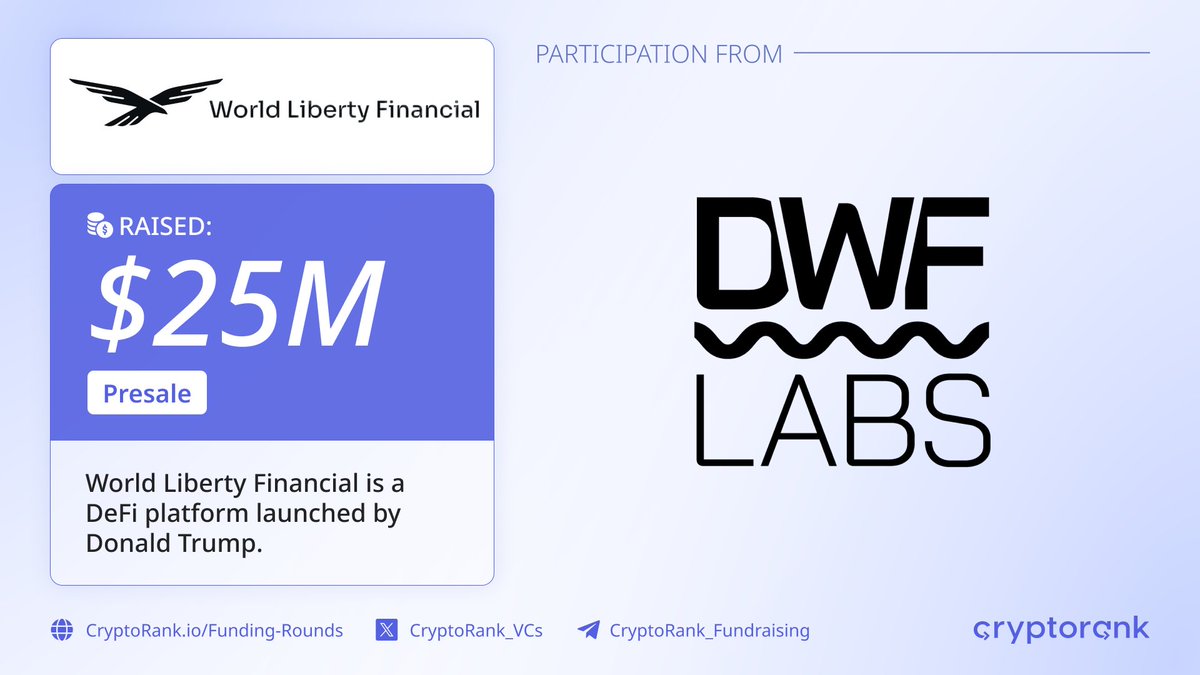
DWF Ventures, the investment arm of Web3 market‑maker DWF Labs, has delivered a detailed evaluation of $WLFI, World Liberty Financial’s newly issued utility token. Published via X, the analysis emphasises $WLFI’s integration into World Liberty’s broader ecosystem and its potential as a key enabler in connecting traditional finance with on‑chain liquidity. Unlike World Liberty’s $TRUMP memecoin, $WLFI is purpose‑built to power the upcoming “WLFI super app”, which will streamline access through web wallets and bank on‑ramps, and underpin planned lending and borrowing services.

The report highlights the success of the USD1 stablecoin—backed by short‑term US Treasuries and cash equivalents—which now commands a market capitalisation approaching $2.5 billion and enjoys listings on major exchanges such as Binance and Coinbase. These developments have significantly boosted investor attention toward the $WLFI token.

World Liberty has raised approximately $500 million across two funding rounds by selling about a quarter of its 100 billion token supply. Among its backers are DWF Labs itself and crypto figure Justin Sun, while ALT5 Sigma has outlined a $1.5 billion treasury strategy centred around $WLFI. DWF Ventures expects that the token could soon be integrated by several DeFi protocols, including Falcon Finance, Ethena and Mantle.

Importantly, DWF Ventures positions $WLFI’s launch as more than a token debut; it sees the initiative as a structural pivot that could catalyse institutional adoption and facilitate compliant capital onboarding—possibly even drawing interest from sovereign investors.

But $WLFI’s entry into the market has triggered concerns. Reports reveal technical difficulties involving the Lockbox contract, intended to unlock 20 percent of token allocations for early investors, which have left many users unable to activate the mechanism. Pre‑market trading responded with a 40 percent drop, raising doubts about launch readiness. Coupling these issues with the political profile of its founders, the token has become entangled in financial and reputational risks.

Indeed, WLFI’s connection to the family of the former president has cast a shadow over its market potential. The token’s political dimensions have already affected diplomatic engagements—such as withdrawals from the Bitcoin Asia 2025 conference—and prompted ethical criticism over conflicts of interest.

Broader scrutiny of World Liberty Financial underscores such tensions. Investigations have revealed that the Trump family commands a substantial share of revenue from token sales and that governance design reflects unusual centralisation for a DeFi project. Further concerns relate to self‑dealing practices: for instance, ALT5 Sigma—a firm acquired by World Liberty—purchased $750 million worth of WLFI tokens. As part of this arrangement, its leadership includes Eric Trump and WLFI co-founder Zach Witkoff, a structure that regulators and critics view as raising red flags.

Ethics experts warn that such close ties between ruling office, private enterprise and foreign investment could undermine democratic safeguards. The New Yorker, for one, described the venture as stretching the norms of political ethics, with World Liberty seen by some as a mechanism for influence through token‑based access channels.

The $WLFI launch is clearly more than a token generation event—it is shaping into a test case for the nexus of politics, finance and regulation in the emerging Web3 era.

Advertisements
ADVERTISEMENT

World Liberty Financial’s WLFI token is set to begin trading on the Ethereum mainnet on 1 September 2025, with only 20 per cent of the total supply unlocked for early supporters, while the remaining 80 per cent remains under community‑governance lock. Funding rounds have raised up to $2.26 billion, including significant equity backing from ALT5 Sigma, attributing a paper valuation—and potential risk—for retail traders.

Trading commences at 12:00 UTC on 1 September, when presale participants can claim and exchange the portion of tokens unlocked by activating the audited “Lockbox” smart contract. A week‑long activation window began on 25 August to prepare wallets. The initial release affects only a fraction of the total supply; community votes will determine release schedules for the locked remainder.

Pre‑launch futures activity offers a stark view of market sentiment. WLFI perpetual contracts debuted around $0.42, implying a fully diluted valuation of $40 billion. However, futures prices plunged 44 per cent shortly after, collapsing from $0.44 to below $0.25 and slashing the FDV to $24 billion, amid heavy shorting and a sharply negative funding rate of around ‑35 per cent.

Tokenomics reveal a further concentration of risk: insiders—including the Trump family—hold a vast share of true control. Estimates suggest between 75 per cent and over 80 per cent of the supply remains allocated to founders, team members, and affiliated entities, with release terms opaque and subject to governance decisions.

The project has drawn intense scrutiny for its centralised structure and ethical implications. Reuters reported that the Trump family raised approximately $550 million through WLFI token sales and now claims around 75 per cent of net revenue. That level of control starkly contrasts with the decentralised ideals usually associated with DeFi. Commentary in outlets such as The New Yorker emphasises how such arrangements echo a “raffle-ticket” model, whereby early purchasers gain governance power and speculative upside while insiders benefit disproportionately, fuelling concerns about influence‑peddling and conflicts of interest.

Further fuelling caution, benzinga commentary and crypto analysts warn that the small circulatable portion at launch, paired with concentrated insider holdings, could make WLFI’s valuation look inflated on paper—yet leave retail investors exposed if token dumps or sell pressure emerge post‑launch.

Pending regulatory clarity also looms large. With USD1 stablecoin already launched and tied to WLFI’s ecosystem, the project’s compliance with securities laws remains under question, especially given public funds, centralised control, and political ties.

Experts urge prospective investors to proceed with caution. The disparity between locked and unlocked supply, the volatility seen in derivatives markets, and the centralisation of control combine to form a high-risk scenario reminiscent of past politically affiliated crypto launches. While some anticipate short-term rallies driven by hype and governance claims, the sustainability and fairness of WLFI’s structure remain deeply uncertain.

A UAE-based investment vehicle, Aqua 1 Foundation, has acquired $100 million in governance tokens from World Liberty Financial, the cryptocurrency venture affiliated with the Trump family, making it the most prominent publicly disclosed investor to date. The move, confirmed by both parties, signals a strategic push to accelerate the creation of a blockchain-based financial ecosystem built on stablecoins and tokenised real-world assets.

Aqua 1 described the allocation of governance tokens—known as WLFI—as an opportunity to contribute to decisions on the platform’s development. Although WLFI is currently non-transferable, World Liberty has confirmed it is “working behind the scenes” to enable trading functionality. At the Permissionless conference in Brooklyn, WLF co‑founder Zak Folkman stated that WLFI could soon be tradable, with the stablecoin set for an independent audit “within days”.

Dave Lee, founding partner at Aqua 1, emphasised the synergy expected from the partnership, citing plans to jointly identify and foster high‑potential blockchain initiatives. The intention is to integrate WLF’s USD1 stablecoin infrastructure into global commercial payments and treasury systems. The move marks Aqua 1 as a key bridge between traditional finance and decentralised finance, aligning with its ambition to extend influence into South America, Europe, Asia and Middle Eastern markets.

Despite its substantial investment, Aqua 1 has maintained a low profile. Reports indicate its web presence is minimal—with just a handful of social media posts and evidence of a website only registered on 28 May.

WLF, launched in late 2024 by Donald Trump, three of his sons and associate Steve Witkoff, has raised well over half a billion dollars through token sales. The Trump family controls a significant stake—around 60% ownership and 75% of net token sales revenue—raising concerns over conflicts of interest. Democratic lawmakers and ethics watchdogs have repeatedly voiced apprehension that these financial interests may influence policy, amid reports that WLF proceeds reached hundreds of millions of dollars.

WLF’s stablecoin, USD1, is 100% backed and supported by U.S. dollar reserves, including Treasuries, and has already drawn sizeable institutional backing. In May, an Abu Dhabi firm used USD1 in a $2 billion transaction with Binance, while WLF prepares to publish an attestation of its stablecoin reserves as part of forthcoming audit disclosures.

The institutionalisation of WLFI governance aligns with the platform’s roadmap, which includes plans to launch a consumer‑friendly mobile app to streamline access to its digital ecosystem. The expected transition to transferable governance tokens is likely a precondition to broader distribution and potential listings on third‑party exchanges.

Regulatory scrutiny remains a key challenge. Critics argue that WLF’s entanglement of private financial interests with public office contradicts norms protecting against foreign influence. At least one senator has raised concerns after the Abu Dhabi stablecoin transaction. Additional worries stem from the Trump administration’s shift toward crypto deregulation, a change that coincides with WLF’s rise, prompting concerns from ethics groups about policy bias favoring the platform.

That overlap of influence has fuelled broader debates in Congress. Legislators have begun proposing amendments such as the GENIUS Act, which would regulate stablecoins more robustly, and restrictions on digital asset investments by sitting presidents. Observers note that WLFI’s new status and Aqua 1’s involvement could sharpen the need for regulatory clarity and transparency around token governance.

Meanwhile, WLF’s expansion plans are proceeding apace. The platform is reportedly developing a Middle East‑based Aqua Fund to support digital economy projects leveraging blockchain and artificial intelligence. The collaboration is expected to produce tokenisation platforms such as BlockRock, targeting institutional asset-digitisation markets.

Aqua 1’s governance stake marks a turning point. By becoming the lead institutional backer, the foundation now holds significant influence over decisions shaping WLF’s evolution. With token transferability and app launches on the horizon, WLFI stands poised for a new phase of adoption—though progress will likely be watched closely by regulators and investors alike.

Donald Trump’s family has quietly reduced its stake in World Liberty Financial, the crypto venture closely tied to his business and political interests, trimming its holding from 60 per cent to 40 per cent after June 8. The move marks a significant shift in the family’s involvement in the blockchain sector.

The reduction in equity coincided with a rising valuation for WLF, which earlier sold US$550 million in its native $WLFI tokens and has attracted substantial foreign investments, including a US$2 billion infusion from a UAE-backed entity using its stablecoin USD1 for Binance transactions. Analysts estimate the 20 per cent stake sale could have fetched around US$190 million, with approximately US$135 million potentially going to Donald Trump personally.

World Liberty Financial, launched during the 2024 election cycle, has been a central hub of the Trump family’s crypto strategy. The firm is a decentralised finance protocol that aggressively markets its connection to Trump, listing him as “chief crypto advocate” and involving his sons in senior Web3 roles. Under its structure, Trump-linked entities capture 60 per cent of ownership and 75 per cent of token sale revenues.

The firm’s high-profile stablecoin USD1, launched in March 2025, swiftly became one of the top five global stablecoins, with a circulating supply exceeding US$2 billion by April. In May, the WLF stablecoin was chosen by an Abu Dhabi investment fund to purchase US$2 billion in Binance shares—a deal criticised for merging private enterprise and diplomatic influence.

Critics have raised concerns that the share reduction, lacking any formal announcement, typifies the project’s secretive nature and the family’s opaque handling of crypto profits. DT Marks DEFI LLC—an entity renamed from DT Tower II LLC in 2024 and fully owned by Trump family—holds the WLF stake. Ownership structure has branched out to include Don Jr., Eric, and Barron Trump, each holding minor positions alongside their father within the DEFI entity.

The lack of disclosure prompted scrutiny, and no official response has emerged from the Trump Organisation or WLF regarding the transaction. This latest move mirrors an earlier reduction in January 2025, when the family lowered its control from 75 per cent to 60 per cent.

The pivot comes amid intensifying criticism of World Liberty’s entanglement with state and family interests. Steve Witkoff—Trump’s Middle East envoy—is linked to key dealmaking, with his son Zach co-founding WLF. Their collaborative efforts to court foreign investment from UAE and Pakistan have sparked concern over potential conflicts between diplomatic roles and private profit. Legal experts and ethicists question the blending of public service and personal gain in a venture that funnels income to the Trump and Witkoff families while concurrently lifting Trump administration deregulatory actions on digital assets.

The share reduction enters a broader regulatory moment. The US Senate recently passed stablecoin legislation that may reshape legal frameworks around such assets, while Circle, a peer stablecoin issuer, saw its valuation spike—heightening investor comparisons with WLF. With global crypto markets in flux and the Trump-linked coin ecosystem expanding, the timing of the sale aligns with strategic portfolio recalibration.

World Liberty continues to promote itself as the “official” Trump crypto brand, prompting its legal team to issue cease-and-desist directives against unauthorised token imitations. There is no indication that the stake reduction signals a retreat; rather, it appears to be a calculated liquidity event amid heightened scrutiny and shifting valuations.

ADVERTISEMENT
World Liberty Financial , a cryptocurrency initiative associated with U.S. President Donald Trump, has executed an airdrop, distributing 47 units of its USD1 stablecoin to each holder of its WLFI token. The distribution, conducted on the Ethereum blockchain, was automatic and required no action from recipients. The figure of 47 USD1 tokens per wallet is widely interpreted as a symbolic reference to Trump's position as the 47th [...]

The White House is set to host a significant summit on March 7, aimed at discussing the future of cryptocurrency and digital assets. The event will see the participation of high-profile figures from the crypto industry, alongside members of the Presidential Working Group on Digital Assets. The gathering will provide a platform for leaders to discuss policy and regulatory frameworks surrounding digital currencies and their potential impact on the economy.

Among the 20 to 25 invitees are key players from some of the most influential companies in the crypto and blockchain sectors. The summit will bring together individuals who have shaped the industry through their work in technology, finance, and digital innovation. Some of the most prominent names on the guest list include Michael Saylor, the CEO of MicroStrategy, who is known for his advocacy of Bitcoin, Brian Armstrong, CEO of Coinbase, and Vlad Tenev, CEO of Robinhood.

Also attending are Arjun Sethi, CEO of Kraken, David Bailey, CEO of Bitcoin Magazine, and Matt Huang, co-founder of Paradigm. These leaders represent a cross-section of the cryptocurrency ecosystem, spanning exchanges, media, and venture capital firms. Other notable attendees include JP Richardson, CEO of Exodus, Kyle Samani, managing partner of Multicoin Capital, and Zach Witkoff, co-founder of WLFI. Sergey Nazarov, the co-founder of Chainlink, will also be present, further emphasizing the blockchain industry’s influence on the digital assets conversation.

The event’s significance extends beyond the individual discussions among these leaders. With the Biden administration focusing on digital assets and their regulatory framework, the summit marks a critical moment in the government’s ongoing effort to better understand the complexities of cryptocurrency markets. Attendees are expected to engage in dialogues that could shape the regulatory environment surrounding digital assets in the United States.

Over the past year, the U.S. government has shown an increasing interest in regulating the cryptocurrency industry. This heightened focus comes amid concerns over the volatility of digital assets, their potential for illicit use, and their long-term impact on financial markets. The summit at the White House is seen as a way to bridge the gap between policymakers and industry leaders, with the goal of crafting policies that support innovation while ensuring consumer protection.

A key topic likely to dominate discussions at the summit is the role of digital assets in the broader financial ecosystem. As cryptocurrencies become more mainstream, there is growing pressure to ensure that they operate within a clear regulatory framework. Some experts argue that without proper regulation, the risk of fraud, money laundering, and market manipulation could undermine trust in digital currencies. Others, however, advocate for a hands-off approach, arguing that overregulation could stifle innovation and limit the potential benefits of digital assets.

The White House summit is expected to focus on a range of issues, from the regulatory treatment of cryptocurrencies to their use in traditional financial markets. A major point of contention has been whether cryptocurrencies should be classified as commodities, securities, or a new class of assets entirely. This distinction has major implications for how they are taxed, traded, and regulated.

For many in the crypto space, this summit represents a critical opportunity to engage directly with policymakers and advocate for policies that support innovation. The presence of prominent figures like Michael Saylor, who has been vocal about his support for Bitcoin as a store of value, and Brian Armstrong, who has been an outspoken advocate for clearer regulatory guidelines, suggests that the meeting will feature a candid and open discussion on the future of digital assets.

One of the critical issues that attendees may address is the potential for a central bank digital currency in the U.S. While other countries, such as China, have made significant strides in developing CBDCs, the U.S. has been cautious in its approach. Some industry leaders are concerned that the introduction of a government-backed digital currency could undermine the decentralised ethos of blockchain technology and compete with private cryptocurrencies like Bitcoin.

At the same time, the growing interest in decentralized finance and non-fungible tokens is likely to feature in conversations. DeFi, in particular, has emerged as one of the most disruptive trends within the cryptocurrency space, offering financial services such as lending and borrowing without the need for traditional intermediaries like banks. This fast-evolving sector could pose challenges for regulators, who will need to balance fostering innovation while ensuring these platforms comply with existing financial laws.

Another important aspect of the summit will be the broader international context. As global governments begin to take action on cryptocurrency regulation, the U.S. faces increasing competition from other countries in setting the pace for crypto innovation. European countries, for example, have introduced their own regulatory frameworks for digital assets, while nations like El Salvador have adopted Bitcoin as legal tender. How the U.S. positions itself in this global race for regulatory leadership could have far-reaching consequences for the industry.


World Liberty Financial, the cryptocurrency venture backed by U.S. President Donald Trump, has made a significant investment in the decentralized finance sector by purchasing 547,990 SEI tokens for $125,000 USDC. This strategic move has led to a notable increase in SEI’s market value, reflecting the growing influence of institutional investments in the cryptocurrency landscape.

The acquisition, executed on February 20, 2025, saw World Liberty Financial acquiring SEI tokens at an average price of $0.228 per token. This transaction was conducted on the Ethereum network, underscoring the platform’s continued prominence in facilitating significant cryptocurrency trades. Following the purchase, SEI’s price experienced an immediate surge, climbing approximately 12% to reach $0.24. This uptick highlights the market’s responsiveness to substantial investments from prominent entities.

World Liberty Financial’s portfolio, now valued at $117.052 million, reflects a 6.439% decrease in profit and loss, amounting to a $56.522 million loss. Despite this downturn, the firm continues to diversify its holdings, with recent acquisitions including 52.07 Wrapped Bitcoin worth $5 million and 2.53 million MOVE tokens valued at $1.14 million. These investments align with the company’s broader strategy to strengthen its position within the DeFi sector.

In addition to World Liberty Financial’s activities, notable movements have been observed among cryptocurrency whales. Two newly created multi-signature wallets, linked to the same creator, have collectively spent $20 million USDC to acquire 400 million WLFI tokens over the past two days. This substantial accumulation indicates a growing confidence among large-scale investors in the potential of WLFI tokens.

The SEI token, designed to enhance decentralized trading experiences, has garnered increased attention due to these high-profile investments. Market analysts suggest that such institutional interest could signal the onset of a bullish trend for SEI, as well as for the broader DeFi ecosystem. The infusion of capital from entities like World Liberty Financial is perceived as a vote of confidence in the viability and future growth of decentralized financial platforms.

World Liberty Financial’s strategic moves are not occurring in isolation. The cryptocurrency market as a whole has been experiencing a resurgence, with various tokens witnessing upward trajectories. The involvement of influential figures and substantial financial commitments are contributing to a renewed optimism within the crypto community.

However, these developments also prompt discussions about the potential implications of such concentrated investments. While the immediate market reactions are positive, questions arise regarding the long-term effects on market stability and the decentralization ethos that underpins the cryptocurrency space. The actions of large entities can significantly sway token valuations, which may lead to increased volatility and influence over decentralized networks.

World Liberty Financial has launched its WLFI token sale to the public, attracting significant attention from investors. Approximately 655 million tokens were sold at a price of $0.015 each, generating around $9.825 million in sales. Despite over 100,000 individuals signing up for the whitelist, the company has encountered hurdles, with a staggering 19.345 billion tokens still remaining available for purchase.

The WLFI token sale is part of World Liberty Financial’s strategy to raise $300 million by offering 20% of its total token supply, which is valued at $1.5 billion. However, the initial response to the token sale has highlighted challenges in reaching its ambitious financial goals. The sale’s low performance relative to its target has raised questions about investor confidence and market demand for the WLFI tokens.

Technical difficulties have also plagued the token sale. Many potential investors reported intermittent downtimes on the official sale website, which hindered access during critical moments of the launch. This limited availability could have impacted the ability of interested buyers to participate in the sale, potentially affecting the total amount raised.

World Liberty Financial, linked to former President Donald Trump, aims to position itself in the burgeoning cryptocurrency market, which has been experiencing both volatility and growth. The launch of the WLFI token is seen as a pivotal moment for the company as it attempts to carve out a space in an increasingly competitive landscape.

The WLFI token is designed to facilitate various transactions within the World Liberty Financial ecosystem, which aims to provide innovative financial solutions. The token’s intended utility includes enabling faster and cheaper transactions while offering a platform for various financial services. However, the initial market reception and the remaining token supply may pose significant challenges in achieving these objectives.

Market analysts are closely monitoring the developments surrounding the WLFI token sale, noting that the cryptocurrency market is experiencing a period of adjustment. The fluctuating prices of cryptocurrencies and the ongoing regulatory scrutiny in various jurisdictions have created an environment of uncertainty for investors. Consequently, the initial uptake of the WLFI token may reflect broader market sentiments regarding new cryptocurrency offerings.

Investor sentiment is also influenced by the broader implications of former President Trump’s involvement in the cryptocurrency space. While some investors may view this connection as a potential advantage, others may harbor skepticism based on past controversies associated with Trump’s business ventures. This complex dynamic could play a significant role in shaping the token’s perceived value and overall market performance.

The launch of the WLFI token sale comes at a time when the cryptocurrency market is witnessing a surge in initial coin offerings (ICOs) and token sales. Many projects are vying for investor attention, making it essential for new entrants like World Liberty Financial to differentiate themselves effectively. The current landscape requires not only innovative technology and robust business models but also transparent communication and trust-building with potential investors.

As the WLFI token sale progresses, the company’s ability to adapt to market challenges will be critical. Addressing technical issues, improving accessibility for investors, and fostering confidence in the WLFI token’s value will be paramount. Analysts suggest that a proactive approach in engaging with the investor community and enhancing the overall user experience on the sale platform could mitigate some of the initial setbacks.

The performance of the WLFI token in the coming weeks will likely provide crucial insights into its long-term viability and the company’s potential to achieve its financial goals. Market watchers will be keen to see whether World Liberty Financial can capitalize on the initial interest in its token and translate it into sustained investor support.

ADVERTISEMENT
Donald Trump's World Liberty Financial has entered the crypto arena with aspirations to redefine investment paradigms, led by his sons, Donald Jr. and Eric Trump. The launch event at Mar-a-Lago, broadcast via X Spaces and in collaboration with Rug Radio, set the stage for this ambitious project aimed at positioning the U.S. as a frontrunner in the cryptocurrency space. At the heart of World Liberty Financial is [...]
Donald Trump has taken a surprising turn by fully embracing cryptocurrency, unveiling a digital platform called World Liberty Financial. Once a vocal critic of Bitcoin, labeling it a "scam," Trump’s shift comes as part of a larger political strategy, aligning with his 2024 presidential campaign. The former U.S. president announced his new project, aimed at the decentralized finance (DeFi) space, during a livestream on X Spaces, where [...]
The Trump family is making its mark on the world of digital assets with the announcement of World Liberty Financial (WLFI), a new financial venture spearheaded by Donald Trump’s sons. The project centers around a governance token, which aims to offer a decentralized financial product tailored to accredited U.S. investors. WLFI plans to sell 63% of its tokens, ensuring the project remains compliant with regulatory frameworks, particularly [...]
ADVERTISEMENT
Eric Trump has officially introduced World Liberty Financial (WLFI), a decentralized finance (DeFi) project aimed at revolutionizing the financial sector. This venture is set to leverage blockchain technology to offer a range of financial services including lending, trading, and investment opportunities. The launch event highlighted WLFI's commitment to providing a transparent and efficient alternative to traditional financial systems. World Liberty Financial emerges at a time when the [...]

inNEW DELHI: Contrary to popular perception, India has little to worry about its product-specific support to agriculture exceeding the limits prescribed by the World Trade Organisation (WTO), a recent study has revealed.


This implies that New Delhi’s aggressive stance at the world body, seeking leeway from the cap on public stockholding for food security or even a total waiver from the restriction citing the resource-poor status of its farmers, lacked rationale.


The country’s product-specific subsidy for rice stood at minus 2.87% and that for wheat at minus 10.22% of the respective production values in 2010-11 when calculated on a fully inflation-adjusted basis, according to a joint paper by Icrier exper

VISHNU RAJA
RYO YAMADA
HITORI GOTOH
IKUYO KITA
Social Media Auto Publish Powered By : XYZScripts.com