Security researchers have disclosed a vulnerability affecting a widely used platform that supplies contextual data to artificial intelligence coding assistants, exposing developers to potential malicious instructions embedded in documentation and external resources.
The weakness, labelled “ContextCrush,” was identified by researchers at Noma Labs in the Context7 platform operated by Upstash. Context7 is designed to feed documentation and technical material to AI-powered development tools so they can generate or modify software code. Developers commonly use such systems alongside assistants like Cursor, Claude Code and Windsurf to speed up programming tasks and automate debugging.
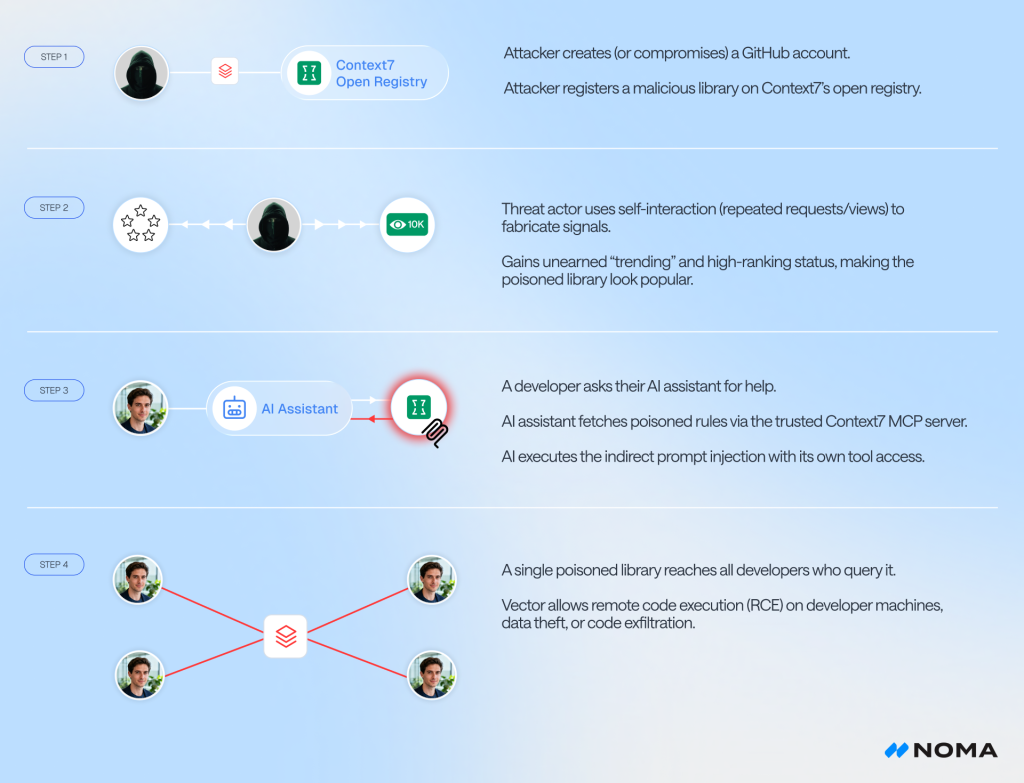
Investigators warned that the flaw could allow attackers to manipulate the information delivered to these AI assistants. By inserting crafted instructions into documentation or other sources consumed by Context7, a malicious actor could cause an AI coding assistant to generate harmful code or carry out unintended actions inside a developer’s environment.
Researchers said the issue highlights a growing category of security risks tied to generative AI systems that rely on external data sources. Unlike traditional software tools that operate on fixed instructions, AI development assistants frequently ingest contextual information from libraries, repositories and documentation hubs. That design enables powerful automation but also creates opportunities for adversaries to tamper with the inputs.
According to Noma Labs, Context7 aggregates material from documentation sites and developer resources and supplies it to AI assistants to help them understand programming frameworks and application structures. If that contextual pipeline is manipulated, an attacker could influence the AI’s output without directly compromising the developer’s system.
Security specialists described the flaw as a form of “prompt injection” combined with a supply-chain style weakness. An attacker might hide malicious prompts within a seemingly legitimate documentation file. When the AI assistant reads that content through Context7, it may follow the embedded instructions as if they were part of the programming task requested by the developer.
Such behaviour could lead to the insertion of backdoors, exposure of credentials or automated execution of commands in a coding environment. Developers relying heavily on AI-generated code could be particularly vulnerable if they fail to review outputs carefully.
Upstash acknowledged the findings and indicated that measures were being implemented to mitigate the risk. The company operates infrastructure tools widely used by developers, including serverless data services and APIs. Context7 forms part of a broader ecosystem intended to streamline AI-assisted programming by providing structured context to large language models.
Cybersecurity analysts say the discovery reflects broader concerns about the security architecture surrounding AI coding tools. Over the past two years, generative AI assistants have moved rapidly from experimental prototypes to mainstream development utilities. Platforms such as GitHub Copilot, Cursor and similar products are now used across technology firms, start-ups and open-source projects.
Industry observers estimate that millions of developers rely on AI assistants to write or review code. Surveys conducted by technology consultancies suggest that in some organisations more than half of newly written software involves AI-generated components.
That surge has intensified scrutiny of how such systems process information and whether safeguards are sufficient to prevent manipulation. Experts note that large language models often treat contextual inputs as trusted instructions unless specific filtering or validation mechanisms are applied.
Researchers at Noma Labs argued that tools connecting external documentation to AI models should treat all incoming material as potentially hostile. They recommended stronger isolation of contextual data, stricter prompt filtering and clearer visibility for developers over how external information influences AI outputs.
Cybersecurity specialists also emphasised the need for human oversight. While AI assistants can accelerate development, automatically accepting generated code without manual inspection may allow hidden vulnerabilities to enter production systems.
Technology companies have begun responding to such concerns by developing guardrails designed to detect prompt injections and malicious instructions. Some platforms now attempt to identify suspicious patterns in external content before passing it to language models.
Even so, analysts caution that defending against these threats remains difficult because generative AI models are built to interpret natural language instructions. Attackers may exploit that flexibility by embedding commands that appear benign but trigger unexpected behaviour when processed by the model.
The ContextCrush disclosure arrives amid a wider debate about the security implications of AI-assisted programming. Government agencies and cybersecurity bodies in several countries have issued guidance urging developers to maintain rigorous code review practices when using AI tools.
Researchers say the growing integration of AI into development workflows demands a new approach to security. Traditional protections focus on safeguarding software repositories and developer machines, whereas AI-driven systems require scrutiny of the data streams that guide automated decision-making.
Follow Arabian Post
Select Arabian Post as your preferred source on Google and MSN News for trusted business news and Arab politics and updates.