

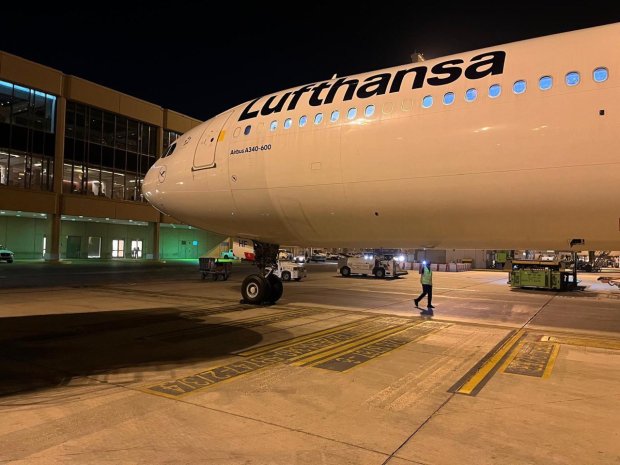
A Lufthansa passenger aircraft bound for Riyadh was diverted to Cairo after safety concerns prompted the crew to alter its route, according to the airline’s chief executive Carsten Spohr, drawing attention to mounting operational challenges for airlines navigating volatile airspace across the Middle East.
Spohr confirmed the diversion on Friday, stating that the decision was taken as a precautionary measure to ensure the safety of passengers and crew. The aircraft landed in Cairo without incident, and passengers were later assisted by airline staff while arrangements were made for the continuation of their journey.
Flight diversions are not uncommon in global aviation, yet the incident highlights how airlines are operating under heightened alert as security risks and geopolitical tensions continue to influence flight planning. Lufthansa, Germany’s flagship carrier and one of Europe’s largest airline groups, said its operational teams acted in accordance with established safety protocols.
The aircraft had been en route to the Saudi capital when the crew received information that prompted the diversion. Aviation safety rules require airlines to act immediately when potential risks arise, whether linked to security alerts, technical considerations or changing conditions along the planned route. Airlines typically redirect flights to the nearest suitable airport where authorities can assess the situation.
Passengers aboard the flight experienced delays but no injuries were reported. Airline representatives worked with airport authorities in Cairo to manage the disembarkation process and provide support to travellers awaiting onward travel.
Commercial aviation has faced growing operational complexities as conflicts and security warnings reshape flight corridors across parts of Europe, the Middle East and Asia. Airlines have increasingly adjusted routes to avoid regions considered high risk, often resulting in longer journeys, higher fuel consumption and scheduling disruptions.
Industry analysts say safety remains the overriding priority for airlines, particularly when flights traverse regions experiencing military tensions or heightened surveillance activity. Airlines rely on intelligence from aviation regulators, government agencies and global air traffic monitoring systems to evaluate potential threats.
Spohr’s comments reflected the cautious approach adopted by international carriers operating across the region. Lufthansa has been among several airlines adjusting its network in response to security assessments affecting routes connecting Europe with the Gulf and wider Middle East.
Diversions such as the one involving the Riyadh flight can stem from a variety of triggers. These may include reports of suspicious activity, onboard medical emergencies, technical irregularities or warnings received from security authorities. Airline executives typically refrain from disclosing precise details immediately after an incident while investigations or assessments are under way.
The episode comes at a time when aviation authorities worldwide are emphasising the need for continuous monitoring of geopolitical developments that could affect flight operations. Airspace restrictions or security advisories issued by regulators can rapidly alter airline schedules and require immediate operational responses.
Lufthansa operates an extensive network linking European hubs with destinations across the Gulf region, including Saudi Arabia, the United Arab Emirates and Qatar. Demand for these routes has grown steadily as travel and business links between Europe and Gulf economies expand.
Saudi Arabia has become an increasingly important destination for global airlines as the kingdom accelerates economic diversification programmes and tourism development projects. The aviation sector is playing a central role in that transformation, with Riyadh positioning itself as a major international travel hub.
Airline safety procedures are built around a layered risk management system designed to anticipate and respond to threats quickly. Pilots, dispatch teams and security analysts coordinate closely when irregular situations arise during a flight. Decisions to divert are taken swiftly when there is any indication that continuing along the planned route could present a risk.
Aviation regulators require airlines to maintain strict safety oversight and contingency planning. Aircraft are equipped with advanced communication systems enabling crews to remain in constant contact with airline operations centres and air traffic control. These systems allow rapid information sharing when circumstances change.
Passengers travelling through global aviation networks have become accustomed to occasional diversions as airlines prioritise precautionary measures. While such disruptions can cause inconvenience, aviation experts emphasise that diversions often demonstrate that safety systems are functioning as intended.
The Lufthansa incident also underscores how global airlines must continuously balance commercial efficiency with operational caution. Even minor uncertainties can prompt route changes, reflecting the aviation industry’s longstanding commitment to maintaining the highest safety standards.
Follow Arabian Post
Select Arabian Post as your preferred source on Google and MSN News for trusted business news and Arab politics and updates.



