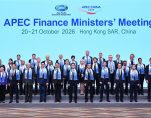
Yesterday (October 21), the FMM issued the 2026 APEC Finance Ministers’ Joint Statement, reaffirming the commitment to building an open, dynamic, resilient, and peaceful Asia-Pacific community by 2040 for the prosperity of all our people and future generations.

Minister of Finance and chair of the 2026 FMM, Lan Fo’an, said that all parties should firmly implement the consensus reached at the APEC Economic Leaders’ Meeting, uphold multilateralism, and deepen practical co-operation in fiscal and financial affairs, with a view to contributing to regional economic and financial stability and long-term sustainable growth.
Earlier, John Lee, Chief Executive of the Hong Kong Special Administrative Region (HKSAR) Government, welcomed participants to the FMM.
“This is a historic occasion for Hong Kong. The APEC Finance Ministers’ Meeting – part of APEC China 2026 – is taking place in our city for the very first time. We are honoured to support this significant international event, which brings together the member economies of the Asia-Pacific Economic Cooperation, representing some three billion people and accounting for over 60 per cent of global GDP,” Mr Lee said.
“Under the unique ‘one country, two systems’ principle, Hong Kong enjoys both the China advantage and the global advantage. We are the only common law jurisdiction in China, our country, and have a legal and regulatory regime similar to most of the world’s top financial hubs.”
Speaking during the discussion sessions, Paul Chan, Financial Secretary of the HKSAR, said that amid geopolitical tensions and uncertainties over trade policies, Asia-Pacific economies should strengthen co-operation to maintain the smooth flow of trade and investment, while guarding against financial risks and nurturing long-term growth drivers.
He said that Hong Kong would leverage its unique advantages under the “one country, two systems” principle, and make full use of its diverse financing channels and professional services as an international financial centre to serve as a “super connector” and “super value-adder”.
“Regionally, we need open channels for trade and investment, not new barriers. Connected markets allow capital to reach productive uses and technologies be adopted across borders,” Mr Chan said during a plenary session on Global and Regional Economic and Financial Outlook (October 20).
“Our collective task is to safeguard stability while strengthening the foundations for lasting prosperity. Hong Kong, China stands ready to work with fellow economies to seize opportunities, manage risks and support more resilient, sustainable and inclusive growth across the Asia Pacific.”
The Hong Kong Monetary Authority and the APEC Business Advisory Council (ABAC) held two thematic seminars (October 20) on “Fostering a digitalised, inclusive and sustainable supply chain ecosystem through finance” and “Mobilising capital for nature: scaling finance and regional cooperation across APEC” respectively.
In his welcoming remarks at the seminars, Christopher Hui, Secretary for Financial Services and the Treasury of the HKSAR, said: “In an era of profound economic transformation and evolving global challenges, prosperity will not be secured by any economy acting alone. It will be built through partnership, innovation and resilience. I am therefore delighted that this seminar brings together regulators, business leaders and experts from across the Asia-Pacific region for meaningful exchanges on how we can unlock new opportunities, strengthen financial resilience, and drive sustainable growth for all.”
Following the conclusion of the FMM, Mr Lee and other officials met Mr Lan at Government House to exchange views on economic and financial development of the Chinese Mainland and Hong Kong. Mr Lee expressed his heartfelt gratitude to the country for its trust in and support for Hong Kong, as well as its strong affirmation of Hong Kong’s status as an international financial centre.
During the FMM, a diverse range of tours and visits were arranged for members of delegations from participating economies and international organisations to enjoy the city’s cultural heritage and unique charm as an international metropolis.
The itineraries included visits to the Peak, Hong Kong Museum of Art, Hong Kong Palace Museum, Xiqu Centre, Chinese Culinary Institute and Ocean Park as well as a boat tour to enjoy the renowned views of Victoria Harbour.
Hashtag: #hongkong #brandhongkong #asiasworldcity #APEC #FMM
https://www.brandhk.gov.hk/
https://www.linkedin.com/company/brand-hong-kong/
https://x.com/Brand_HK/
https://www.facebook.com/brandhk.isd
https://www.instagram.com/brandhongkong
The issuer is solely responsible for the content of this announcement.
Arabian Post Staff -Dubai Central banks are increasing gold reserves and shifting bullion between international vaults, with new industry data showing a sharp rise in purchases and growing interest in reducing dependence on individual storage centres. The World Gold Council says official institutions bought an average of approximately 1,000 tonnes annually over the four years preceding its 2026 survey, compared with roughly 500 tonnes a year during […]
By Nitya Chakraborty U.S. Secretary of state Marco Rubio’s visit to India this week and talks with the Indian corporate leaders including Mukesh Ambani and Gautam Adani have roused unusual interest in the country’s business circles as also among diplomats globally. There are two aspects. First, Rubio gave priority to his visit to Jamnagar and […]
The article Marco Rubio, Mukesh Ambani, Elon Musk And Gautam Adani appeared first on Latest India news, analysis and reports on Newspack by India Press Agency).
By Dr. Gyan Pathak Denotification of Jantar Mantar as protest site on 12 October 2026 has given anti-CEC and anti-SIR protesters to decentralize and widen the scope and ambit of the movement. The call for the nationwide street protest on October 23 given by the umbrella organization People Against SIR is likely to create numerous […]
The article October 23 Nationwide Anti-CEC Anti-SIR Protests Deepen Centre’s Dilemma appeared first on Latest India news, analysis and reports on Newspack by India Press Agency).
By Nilotpal Basu The struggle over defending the right to vote has spilled over to issues which are more fundamental to Indian nationhood. At the same time, it has also inevitably brought to fore the question of right to peaceful protest and public assembly. These are the issues which were once thought to have been […]
The article Asserting The Tricolour And Right To Protest Is A Positive Development appeared first on Latest India news, analysis and reports on Newspack by India Press Agency).
Aldar Education has signed a memorandum of understanding with education technology company Toddle to introduce a unified learning management system across its 13 operated schools in Abu Dhabi, consolidating teaching, assessment and reporting while incorporating artificial intelligence into classroom activities. The agreement, announced on Thursday, October 22, will establish a common digital platform for schools delivering British, American and International Baccalaureate curricula. Implementation will proceed in phases, […]
Japanese banks, airlines and transport operators suspended digital services as companies rushed to install emergency security patches for critical vulnerabilities in PHP, a programming language widely used across the internet. The disruptions spread across Japan on Wednesday and Thursday, affecting online banking, airline applications, airport information systems and commercial websites. Companies temporarily disabled vulnerable services while assessing their exposure to two security flaws that could allow attackers […]
The opening on Wednesday marks a further step in the emirate’s efforts to develop trade and investment links with southern China. The office is intended to connect companies in Guangdong with opportunities in Ras Al Khaimah and provide a continuing point of contact for prospective business partners.
Sheikh Saud, a member of the UAE Supreme Council, inaugurated the facility during a working visit to China scheduled to continue until Friday. The programme includes discussions with provincial officials, meetings with corporate executives and engagements in Guangdong and Fujian.
The consultancy follows a cooperation agreement signed by Ras Al Khaimah and Guangdong in November 2024. That agreement identified the digital economy, technological innovation, advanced manufacturing, smart cities, culture and tourism as areas for collaboration.
The new Guangzhou presence gives the emirate a local platform through which to pursue those priorities beyond individual official visits and business delegations. Its establishment also provides Chinese enterprises with a designated channel for exploring commercial relationships with Ras Al Khaimah.
The opening comes as the emirate seeks to translate institutional agreements into direct contacts between companies and public agencies. Guangdong is a particularly significant partner because of its concentration of manufacturing, technology and export-oriented businesses.
The Ruler’s China itinerary began with his arrival in Shenzhen on October 17, accompanied by senior officials and representatives of Ras Al Khaimah government entities. UAE Ambassador to China Hussain bin Ibrahim Al Hammadi and UAE Consul General in Guangzhou Maryam Al Shamsi were among those who welcomed him.
A principal engagement of the visit was the Ras Al Khaimah–China Business Summit in Shenzhen, where the emirate presented investment opportunities to Chinese business leaders. The meetings form part of a broader effort to identify potential partners and encourage companies to examine the emirate as a base for operations and investment.
Officials have indicated that more than 400 Chinese companies operate in Ras Al Khaimah. The existing corporate presence offers a foundation for further commercial engagement, although the opening of the consultancy does not itself establish new investment commitments or completed transactions.
The emirate’s economic outreach also involves Ras Al Khaimah Economic Zone, which has previously organised business missions to China and pursued cooperation with Chinese enterprises. The economic zone has promoted opportunities for manufacturing and industrial projects, alongside other commercial activities.
During the current visit, Sheikh Saud has also met representatives of Chinese technology businesses. A visit to Guangzhou included an engagement with ARIDGE, a company developing advanced air mobility vehicles, as cooperation on emerging transport technology attracted attention from both sides.
The company presented an aircraft intended for testing within the UAE’s advanced air mobility regulatory environment. Its founder, Zhao Deli, described plans to begin with demonstrations and certification before pursuing potential commercial applications, including emergency services and tourism. Those plans remain subject to testing and regulatory requirements.
The wider commercial initiative is being pursued alongside government-to-government engagement. The distinction matters because cooperation agreements can establish areas of common interest without specifying individual projects, financing or delivery schedules. The consultancy is therefore expected to act as a practical point of contact rather than a substitute for negotiations between investors, regulators and commercial partners. Details of its staffing, operating budget and arrangements for assisting individual businesses have not been publicly specified.
The Guangzhou opening builds on contacts developed during Sheikh Saud’s two visits to China in 2024. The November agreement with Guangdong has subsequently been followed by cooperation involving institutions in education, transport, research, culture and archaeology.
Entities identified in that cooperation include the Ras Al Khaimah Transport Authority, the Sheikh Saud bin Saqr Al Qasimi Foundation for Policy Research, RAK Medical and Health Sciences University and the emirate’s Department of Antiquities and Museums.
Guangdong’s industrial base encompasses electronics, vehicles, pharmaceuticals and other manufacturing activities. Its size and commercial networks make it an important destination for international investment promotion, although specific outcomes from the new consultancy will depend on subsequent business engagement.
Sheikh Saud is also scheduled to visit Fuzhou, the capital of Fujian province, where an agreement establishing friendly relations between Ras Al Khaimah and Fujian is planned. The visit is due to conclude on October 23.

An annual global awards programme affiliated with the World Travel Awards, the World Culinary Awards celebrates excellence and innovation across the culinary industry.
The accolade recognises Vietnam Airlines’ continued investment in its inflight dining experience as part of its ambition to achieve five star service standards by 2030. Drawing on Vietnam’s rich culinary heritage and locally sourced ingredients, the airline’s menus bring together regional specialities, contemporary cooking techniques and thoughtful presentation. Dishes are tailored to individual routes and cabin classes, taking into account passenger preferences and the unique demands of dining at altitude.
From Pho and Hue style beef noodle soup to Quang style noodles and Banh Mi Hoi An, iconic Vietnamese dishes feature prominently on Vietnam Airlines’ menus. Each dish is carefully crafted to retain its authentic flavours, taking into account how changes in taste perception at altitude can affect the inflight dining experience. Vietnam Airlines also works closely with its catering partners and cabin crew to ensure consistent food quality, serving temperatures and presentation across its flights.
Beyond its signature dishes, Vietnam Airlines showcases the country’s agricultural diversity through locally grown produce. Seasonal ingredients include strawberries and plums from Son La, lychees from Luc Ngan, egg lychees and longan from Hung Yen, macadamia nuts from Dien Bien, cashews from Dong Nai, and dragon fruit and melons from Lam Dong. The selection varies according to seasonal availability and inflight catering requirements.
In the first nine months of 2026, Vietnam Airlines and its affiliated catering companies used a total of 2,260 tonnes of domestically grown fruits and vegetables, supporting local producers and bringing the flavours of Vietnam to passengers on board.
The airline also works with local authorities to share the stories behind these ingredients and the communities that produce them. Through Heritage magazine, inflight entertainment and other communication channels, passengers can discover the origins of the food served on board and the regional traditions behind each speciality.
Dang Anh Tuan, Executive Vice President of Vietnam Airlines, said: “This award is a proud milestone for Vietnam Airlines and a testament to our commitment to delivering an exceptional inflight dining experience. It also underscores the international appeal of Vietnamese cuisine and its potential to connect travellers with our country’s cultural identity. As Vietnam’s national flag carrier, we see every journey as an opportunity to share the richness of our culinary heritage, the diversity of our regional produce and the warmth of Vietnamese hospitality. As we work towards achieving five-star service standards by 2030, we remain focused on meeting the highest international standards while preserving the distinctive Vietnamese character that sets our service apart. Ultimately, we want every meal on board to be a memorable part of the journey and a reason for passengers to fly with us again.”
Beyond inflight dining, Vietnam Airlines incorporates Vietnamese cultural elements throughout the passenger journey, from airport services and Lotus lounges to its onboard products and services. The golden lotus in its brand identity, flight attendants’ traditional ao dai uniforms and the Lac bird motif on its aircraft all reflect the country’s heritage. Vietnamese cuisine adds another dimension to this cultural experience, introducing international passengers to the country’s regional flavours and culinary traditions.
Through these efforts, Vietnam Airlines continues to promote Vietnam’s cultural heritage and share its distinctive identity with the world as the country’s national flag carrier.
Hashtag: #VietnamAirlines
http://www.vietnamairlines.com/
The issuer is solely responsible for the content of this announcement.
The investment strategy comes as Japan’s government bond market shows signs of recovering demand after months of volatility driven by inflation, fiscal uncertainty and expectations of further monetary tightening by the Bank of Japan.
Ryutaro Kimura, senior bond strategist at BNP Paribas Asset Management, has identified improving demand from domestic investors, particularly life insurance companies, as an important development supporting longer-maturity government securities.
The strongest indication emerged at Japan’s 20-year government bond auction on Tuesday, when demand reached a record level. The bid-to-cover ratio climbed to 5.84, compared with 4.01 at the previous auction and a 12-month average of 3.73.
The exceptionally strong bidding reflected renewed appetite for securities offering higher returns than those available during Japan’s prolonged period of exceptionally low interest rates.
Kimura attributed the favourable auction outcome to recovering domestic demand, supported by elevated interest rates and easing concerns about the government’s fiscal position.
Japanese life insurers have increased their net purchases of super-long government bonds since June, providing additional evidence that institutions with long-term liabilities are rebuilding their holdings of domestic fixed-income assets.
The auction results also showed an improvement in pricing conditions. The difference between the average accepted price and the lowest accepted price narrowed to 0.07 from 0.15 at September’s sale, indicating stronger bidding competition.
The yield on 20-year government bonds subsequently declined by as much as six basis points to 3.710%, reflecting the immediate market response to the auction.
Japan’s yield curve remains unusually steep, offering investors considerably higher returns on securities with longer maturities. That difference has encouraged asset managers to reassess the balance between income opportunities and the risks associated with holding longer-duration bonds.
Official yield data showed the benchmark 10-year government bond yielding approximately 2.93% on October 20, compared with 3.99% for the 30-year maturity. The difference exceeded one percentage point, highlighting the additional compensation available to investors extending their investment horizons.
Longer-duration bonds also carry greater sensitivity to changes in interest rates. Their prices can fall sharply when yields rise, making portfolio positioning particularly important while monetary policy expectations remain unsettled.
Japan’s central bank is expected to remain a significant influence on market conditions. Investors are awaiting its next policy meeting for indications about the pace of further interest rate increases and the outlook for inflation.
The Bank of Japan’s policy rate stood at 1.25% in October, following successive adjustments intended to address persistent inflationary pressures. Further tightening could influence borrowing costs across the maturity spectrum, although movements in longer-term yields also depend on government borrowing requirements and investor demand.
BNP Paribas Wealth Management’s October fixed-income outlook anticipates additional monetary tightening by the Japanese central bank, with approximately quarterly increases and a terminal policy rate around 2.5% in 2028. That projection represents the institution’s assessment rather than an announced central bank policy path.
Government financing requirements remain another consideration for investors. Prime Minister Sanae Takaichi’s administration faces scrutiny over fiscal proposals and their implications for future bond issuance, particularly as higher yields increase the cost of financing public debt.
Nevertheless, improved auction demand suggests that higher interest rates are attracting buyers who previously found Japanese government securities insufficiently rewarding.
The potential return of domestic capital is particularly significant because Japanese banks and insurers have substantial overseas bond investments. Rising domestic yields can encourage these institutions to reconsider foreign allocations, especially where currency hedging reduces the returns available from overseas securities.
Japanese investors sold foreign bonds for a fifth consecutive week through October 17, with cumulative net disposals reaching approximately ¥3.43 trillion over that period. The withdrawals provide further evidence of changing investment preferences as domestic fixed-income yields become more competitive.
The Ministry of Finance has also adjusted issuance arrangements for longer-maturity securities, an important consideration for investors assessing the relationship between government bond supply and institutional demand.
Market participants will continue examining auction results alongside investment plans from major insurers to assess the composition of demand. Japan’s Ministry of Finance conducted another liquidity-enhancement auction on October 22, following its 20-year government bond sale earlier in the week.
SoftBank Group shares fell sharply on Thursday, bringing the Japanese investment company’s market value close to half its June peak as investors questioned the cost of financing its expanding artificial intelligence commitments. The stock dropped more than 5% in Tokyo trading, extending a retreat that has accompanied broader selling across Asian technology markets. The decline has put renewed attention on SoftBank’s reliance on borrowing and the uncertain […]
The company’s stock fell to HK$97.55 during morning trading, marking its steepest intraday decline in two months. Investors reacted to indications that Beijing could intensify scrutiny of online marketplaces, potentially increasing compliance costs for Alibaba and its competitors.
China’s State Administration for Market Regulation disclosed on Wednesday that it had convened a meeting in Beijing with representatives of leading digital commerce businesses to discuss improving product standards, strengthening consumer safeguards and addressing shortcomings in platform governance.
Shares of JD. com dropped approximately 4.7%, while Kuaishou declined more than 4%. Other technology companies, including Tencent, Meituan, Xiaomi and NetEase, also suffered losses as selling spread across the sector.
Hong Kong’s Hang Seng Index declined nearly 3%, touching a three-month low, while the Hang Seng Tech Index dropped more than 4%, reaching its weakest level since September 2024. The technology benchmark has lost more than 30% this year.
The regulatory announcement focused on persistent problems involving counterfeit merchandise, misleading advertising and products failing to match descriptions provided by online sellers. Authorities identified livestream shopping, instant retail services and social commerce as areas where product safety risks have become increasingly complex.
The regulator said platforms must strengthen their responsibilities as gatekeepers, establish comprehensive quality management systems and improve supervision throughout commercial supply chains. Companies were instructed to align their practices with existing regulatory guidance and the government’s 2026 quality improvement priorities.
Officials also emphasised greater transparency, improved aftersales services and more effective mechanisms for resolving consumer complaints. The measures seek to strengthen accountability among platform operators without necessarily introducing an entirely new regulatory framework.
Representatives from Alibaba’s Taobao and Tmall businesses attended the meeting alongside JD. com, Pinduoduo, Xiaohongshu, Kuaishou, Douyin, Vipshop and other online trading platforms.
The gathering followed guidance issued last year by ten government departments, including the market regulator, the Cyberspace Administration of China and the Ministry of Industry and Information Technology, concerning product and service standards across digital marketplaces.
Authorities acknowledged that companies had implemented improvements under those guidelines but said substantial challenges remained. Emerging business models were creating additional difficulties for regulators attempting to identify unsafe products, deceptive marketing and inadequate consumer safeguards.
For Alibaba, the renewed regulatory emphasis directly affects its domestic commerce operations, particularly Taobao and Tmall, which connect merchants with consumers across China’s vast online retail market.
Stricter monitoring requirements could oblige marketplace operators to devote additional resources to merchant verification, product inspections, complaint handling and supply chain oversight. The financial implications will depend on how existing requirements are implemented and enforced.
The announcement did not disclose fresh financial penalties against Alibaba or establish a timetable for additional enforcement measures. The market reaction therefore reflected concerns about possible regulatory consequences rather than confirmation of sanctions against the company.
Broader investor caution compounded the selling pressure. Mainland investors had reduced their exposure to Hong Kong equities during the preceding trading session, while technology valuations remained under pressure amid questions surrounding substantial expenditure on artificial intelligence infrastructure.
Alibaba has committed significant capital to expanding its computing capacity and artificial intelligence operations, making investor assessments of profitability and spending particularly important alongside regulatory developments.
The company completed an HK$80 billion share placement in August, allocating approximately 60% of net proceeds towards expanding global computing infrastructure and the remainder towards hyperscale artificial intelligence data centres and upgrades to cloud systems.
That financing underlined Alibaba’s commitment to technological investment even as its established ecommerce businesses face heightened expectations concerning operational standards and consumer safeguards.
The regulator also encouraged companies to use commercial data to improve product quality among suppliers, linking information gathered through online transactions with manufacturing improvements and better supply chain coordination.
Another proposal involved developing and publishing platform quality governance indices, intended to provide consumers with clearer information about standards maintained by different marketplaces.
Officials urged participating companies to strengthen cooperation with regulators and other stakeholders while making information about products and services more transparent.
The meeting included discussions of the ISO 9001 quality management framework and methods for businesses to assess their own governance arrangements. Platform representatives exchanged views on implementing quality improvements and addressing weaknesses identified by the authorities across online trading activities.

Paris police have prohibited unauthorised demonstrations across prominent parts of the capital on Thursday, including the presidential palace, parliament and tourist districts, as authorities seek to prevent further violence during nationwide protests. The order issued by the Paris Police Prefecture applies from 8am until 8pm on 22 October. It covers gatherings, marches and processions that have not been declared under French law, rather than imposing a blanket […]