News related to
Russian

On December 11, at W Dubai – The Palm, Entrepreneur Middle East hosted the Leadership Awards 2025 — one of the region’s key business events recognizing outstanding entrepreneurs and industry leaders whose work is shaping the economic and technological landscape of the Middle East. In the Fintech Leader of the Year category, the award was presented to Alexander Lozben, founder of INTERHASH and one of the notable […]

Matein Khalid When the rats scramble to escape a sinking ship as hungry sharks circle the blood red water, the end is near. 100 insider Johnnies sold $6.5 billion in OpenAI shares in a recent employee tender. Why bailout now at $500 billion if OpenAI is a slam dunk for a trillion dollar IPO next year? Simp​le. The 100 newly minted decamillionaires know that OpenAI can no […]

By Nitya Chakraborty The India-Russia joint statement issued on December 5 after two days of talks between President Vladimir Putin and the Indian Prime Minister Narendra Modi is more a vindication of India’s renewed exercise of its geopolitical status defying the pressure from the USA and the other western powers rather than a document on […]

The article Modi-Putin Summit Reinforces India’s Geopolitical Identity Amidst Headwinds appeared first on Latest India news, analysis and reports on Newspack by India Press Agency).

By T N Ashok NEW DELHI: Russian President Vladimir Putin arrived in India Thursday evening for a two-day state visit that has become a diplomatic flashpoint, testing New Delhi’s ability to maintain strategic independence amid mounting pressure from Washington and European capitals. The arrival marks Putin’s first trip to India since the Ukraine war began […]

The article Putin’s India Visit: A Stress Test Of Strategic Autonomy Amid Global Pressure appeared first on Latest India news, analysis and reports on Newspack by India Press Agency).

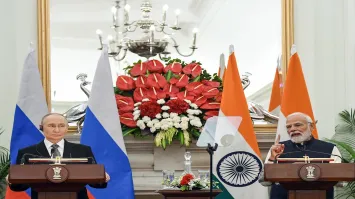
Crowds and cameras gathered at the Delhi airport as Vladimir Putin stepped off his aircraft and was received by Narendra Modi with a firm embrace that signalled the weight both leaders attach to a relationship tested by shifting global alignments. The state visit, framed by Moscow and New Delhi as an effort to reinforce political and economic cooperation, comes at a moment when both sides are seeking predictable partners amid geopolitical uncertainty.

Putin’s arrival on Thursday marked his first trip to the country in more than a year, timed to draw attention to long-standing strategic ties that have endured pressure from global sanctions on Russia and growing competition among major powers for influence in Asia. Modi’s greeting, captured widely by broadcasters, highlighted the government’s intention to maintain a working partnership with Moscow even as it deepens cooperation with Western governments on defence, technology and energy.

The two leaders are expected to focus on trade flows, defence equipment support, energy security arrangements and joint manufacturing proposals that have gained momentum since early 2024. Officials familiar with the agenda have pointed to Moscow’s push for expanded settlements in national currencies, aiming to mitigate complications arising from sanctions that have disrupted traditional payment channels. New Delhi has been looking for greater clarity on oil supply commitments, pricing transparency and long-term contracts, following fluctuations in global markets that prompted domestic refiners to diversify purchases.

Defence cooperation remains central to the partnership, though the balance has shifted over the past decade as New Delhi has widened procurement from the United States, France and other suppliers. Russia continues to service and upgrade a significant share of the armed forces’ equipment, and ongoing discussions cover spare-parts support, maintenance of legacy systems and joint development pathways that may offer greater flexibility than standalone purchases. Analysts tracking the talks say Moscow is keen to retain its foothold in the defence market while showcasing its willingness to adapt to collaborative production models.

Energy will feature prominently during the discussions as Russia seeks greater investment in its upstream projects and hopes to secure broader participation from New Delhi in pipeline and liquefied natural gas initiatives. Indian refiners have emerged as important buyers of Russian crude despite logistical and payment challenges, and both sides are expected to address delivery mechanisms that would reduce delays and improve predictability. Officials have also been reviewing possibilities for expanding cooperation in nuclear energy, where previous agreements have laid the groundwork for additional reactor units at existing sites.

Bilateral trade has risen sharply over the past two years, driven largely by energy imports, but New Delhi has expressed concerns about the wide imbalance, with exports to Russia trailing significantly. Commerce officials have been pushing for easier access for pharmaceuticals, agricultural goods and engineering products, arguing that a more balanced structure would strengthen the sustainability of the economic relationship. Russian representatives arriving with the delegation have proposed expanded use of logistics corridors passing through Central Asia, which they say would ease transport costs for exporters on both sides.

Regional security dynamics form another layer of the discussions, particularly Moscow’s role in Eurasia and its ties with Beijing. Diplomats note that New Delhi continues to walk a delicate line, maintaining cooperation with Russia while strengthening its partnerships across the Indo-Pacific. Strategic analysts caution that both sides must navigate sensitive points, including Moscow’s position on territorial disputes and broader alignments that could shape regional balances over the coming decade.

Putin’s schedule includes a ceremonial welcome, delegation-level talks and a review of key agreements under negotiation. Officials have indicated that deliverables may include frameworks on energy cooperation, updated defence industrial collaboration and initiatives supporting educational exchanges and technological research. Cultural diplomacy also features prominently, with both governments emphasising people-to-people connections that have historically underpinned the relationship.

The optics of the visit carry domestic significance for both leaders. Modi’s government seeks to project continuity in foreign policy through engagement with all major powers, underscoring its commitment to strategic autonomy. For Putin, the reception in New Delhi offers an opportunity to demonstrate that Russia retains influential partners beyond Europe and North America, reinforcing narratives about its engagement with Asia’s leading economies.

Analysts observing the visit note that the personal rapport between the two leaders has helped maintain channels of communication through periods of global stress. Their discussions routinely touch on multi-year strategic frameworks covering defence, energy, industrial cooperation and regional diplomacy, areas where incremental progress continues despite broader geopolitical complications.


Russia has blocked access to Apple’s FaceTime and messaging service Snapchat, escalating a sweeping campaign to curb foreign communication platforms across the country. The decision by the state regulator Roskomnadzor marks a significant shift from throttling public social media sites to restricting private and encrypted communication tools. Roskomnadzor said the two services were being used “to organise and carry out terrorist acts within the country” and for […]

VTB — Russia’s second-largest bank by assets — has announced plans to allow its clients to directly buy, sell and hold cryptocurrencies through its brokerage accounts starting in 2026. The move was disclosed by the head of its brokerage services at an investment conference in Moscow, signalling a shift from derivatives-based crypto exposure toward full asset-level trading.

At present, VTB already offers clients access to cryptocurrency derivatives. The planned service would enable investors to acquire digital assets such as Bitcoin through regular investment or brokerage accounts once regulatory approval is secured. The bank is canvassing regulators and expects authorisation to come through within months.

This development comes against a broader backdrop of rapid evolution in Russia’s digital-asset infrastructure. The Moscow Exchange has recently launched ruble-settled Bitcoin futures and other crypto-linked instruments for institutional investors — part of a broader effort to open new investment channels under carefully structured legal regimes.

Under the current regulatory framework, only “specially qualified” investors — those with high net worth or significant annual income — can directly engage in cryptocurrencies. VTB’s new offering may broaden participation beyond derivatives and institutional-only vehicles, assuming the financial regulator approves the shift.

For VTB, the initiative represents a diversification of its services at a time when Russian banks face mounting pressures. The bank is grappling with new capital requirements imposed by the Central Bank of Russia, which its chief has described as a major challenge going forward.

Advertisements

ARXAN, CHINA – Media OutReach Newswire – 3 December 2025 – The 20th Arxan Ice and Snow Festival kicked off on Nov. 15. Arxan, located at the southwestern foot of the Dahinggan Mountains and at the intersection of four major grasslands, has become an increasingly popular tourist destination in recent years thanks to its ice and snow and hot spring resources. The county-level region has a long […]

Belgium has rejected a proposal by the European Union to channel frozen Russian assets toward a major financial aid package for Ukraine, dealing a blow to efforts aimed at sustaining Kyiv’s war-time finances. The plan envisioned a €140 billion “reparations loan,” backed by immobilised Russian central-bank reserves held largely in Belgium’s Euroclear, but Belgian leaders argued the risks are too high—legal, financial and reputational.

The opposition centres on statements from Bart De Wever, Belgium’s prime minister, who described the plan as “fundamentally flawed”. He warned that using the frozen assets at this stage could trigger lawsuits, force Belgium to shoulder massive liabilities, and destabilise confidence in the euro. De Wever rejected broad incentives offered by the European Commission and demanded legally binding guarantees from other EU member states before any commitment.

Backing Ukraine with frozen Russian funds had gained traction as European leaders scrambled to meet Kyiv’s projected needs through 2026–2027. Analysts estimate that Ukraine faces a budget shortfall of more than €135 billion over the next two years, with defence expenditures alone ballooning. The EU had considered not just using interest on the frozen assets — which has supported a G7-backed aid programme so far — but deploying the assets themselves as collateral to unlock large-scale funding.

Yet the European Central Bank has refused to provide emergency liquidity for the proposed loan, citing its mandate forbidding direct monetary financing to governments under EU treaties. The refusal undermines the viability of the scheme, especially since liquidity back-stops were meant to reassure markets and protect institutions like Euroclear from sudden liability.

Some EU member states and financial experts contended that employing frozen assets would free up taxpayer money and symbolically re-affirm Europe’s stance that Russia must pay for its aggression. Academics have pointed out how using immobilised reserves could offer Ukraine immediate relief without expanding EU sovereign debt. The Commission is reportedly exploring fallback options, such as joint borrowing backed by the EU budget or bilateral loans, but those alternatives are expected to carry higher costs and slower disbursement timelines.

Opposing countries argue the plan violates property rights, jeopardises investor confidence and could provoke Russian retaliation, both legally and economically. Euroclear itself has warned of potential lawsuits and damage to its reputation as a global securities depository if assets are re-purposed in this way.

With less than three weeks remaining before a planned EU summit, Belgium’s refusal complicates efforts to finalise a unified approach. Brussels appears unlikely to shift position without assurances that risks will be shared evenly — a prospect many member states view as tantamount to signing a blank cheque.

Iraq’s Oil Ministry has launched a formal process to invite a handful of major US oil companies to directly negotiate the takeover of the 75 percent stake in the West Qurna-2 oil field — currently held by Lukoil — following international sanctions imposed on the Russian company. The ministry’s announcement emphasises that transferring control to a US operator would support global market stability while preserving Iraq’s vital […]

Russian President Vladimir Putin arrived in New Delhi for a two-day visit aimed at reviving and expanding energy and defence cooperation with India. His agenda includes proposals for increased Russian oil exports alongside renewed offers of missile systems and fighter jets, as part of efforts to restore ties challenged by global pressure on Moscow.

The visit coincides with heightened scrutiny of India’s oil and weapon imports from Russia, but also signals Moscow’s determination to deepen the “special and privileged strategic partnership” with New Delhi. Kremlin officials, including Russia’s deputy prime minister overseeing trade, emphasised that the India-Russia forum planned around the summit would explore ways to diversify bilateral trade, extend industrial cooperation and foster joint investments across high-technology and raw-material sectors.

On offer are new arms deals including advanced air-defence platforms and additional batches of combat aircraft. Negotiations are expected to cover the procurement of more units of the S-400 missile system and potential acquisition of fifth-generation Su-57 jets and the next-generation S-500 air-defence shield. Although India has widened its defence procurement sources over recent years, Moscow remains one of its leading suppliers, bolstered by long-standing familiarity and legacy hardware in the armed forces. Analysts note that these proposed arms deals would reaffirm Russia’s influence in India’s defence posture, even as New Delhi attempts to balance Western and Russian dependencies.

Energy cooperation is another key pillar. Russia is offering discounted crude oil supplies under new trade arrangements, including through intermediaries and possibly via joint ventures or extraction projects in Russia’s Far East and Arctic regions. This appears geared toward circumventing Western sanctions on Russian energy exports, while ensuring that India retains access to competitively priced hydrocarbons. At the same time, Indian officials are conscious of growing trade imbalances caused by large-scale Russian imports and have flagged the need to augment Indian exports to Russia, particularly in equipment, raw materials and food products.

Efforts to revive large-scale trade go beyond energy and defence. The India-Russia forum accompanying the summit is expected to chart cooperation in civil nuclear projects, space technology, and high-tech industrial ventures. Signals from the Russian side underscore a long-term vision of a resilient, multifaceted partnership rooted in historical ties. While geopolitical pressures from Western capitals and tariffs on Indian goods pose real challenges, both Moscow and New Delhi appear keen to insulate their bilateral engagement from external strains.

Platform operator Valve has come under sharp criticism for pulling the indie card game Flick Solitaire from its Steam storefront in Russia after authorities flagged the game’s queer-themed art decks as violating local laws. The game’s developer says the takedown was executed swiftly after multiple requests from Russia’s media regulator, shaping debate on platform responsibility and artistic expression. Flick Solitaire, developed by UK-based Flick Games, entered Steam’s […]

By K Raveendran An evolving convergence of political intent and economic pragmatism is giving fresh momentum to the India–Russia relationship, placing the forthcoming summit in New Delhi as a significant moment in a partnership that has already weathered decades of geopolitical shifts. The visit of President Vladimir Putin, framed within the terminology of a ‘Special […]

The article Delhi Summit To See A New Strategic Reset In India-Russia Partnership appeared first on Latest India news, analysis and reports on Newspack by India Press Agency).

By K Raveendran A quieter phase has set in around discussions on a potential trade agreement between India and the United States, yet the subdued optics conceal a period of more intense negotiation. Officials on both sides describe a process that has deliberately stepped away from public signalling, opting instead for steady and less visible […]

The article India, US Energy Alignment Shapes A Quieter Trade Push appeared first on Latest India news, analysis and reports on Newspack by India Press Agency).

India has initiated formal negotiations for a Free Trade Agreement with the Eurasian Economic Union, signalling a strategic shift in trade dynamics aimed at expanding commercial engagement beyond traditional markets. Commerce and Industry Minister Piyush Goyal announced in New Delhi that talks with the five-member bloc—comprising Russia, Armenia, Belarus, Kazakhstan and Kyrgyzstan—will begin with negotiations unfolding in the capital this week. The move marks the culmination of the Terms of Reference signed by India and the EAEU in Moscow on 20 August 2025, which laid out an 18-month roadmap for an agreement in goods and potentially services and investment.

Officials from India’s commerce ministry, including Commerce Secretary Rajesh Agrawal, have held preparatory talks in Moscow with EAEU trade officials and representatives of Russian industry to review the roadmap and coordinate next steps. The discussions focused on reinforcing supply-chain resilience, regulatory predictability and balanced growth, with long-term ambitions including an objective to reach USD 100 billion in bilateral trade by 2030.

India’s pivot towards the EAEU reflects a broader strategy to diversify export markets, particularly as trade relations with some Western economies become more uncertain amid shifting tariffs and sanctions regimes. The EAEU spans economies that collectively represent a significant regional market; access to these markets is expected to bolster opportunities for Indian exporters.

Key beneficiaries are expected to include micro, small and medium enterprises, agricultural producers such as farmers and fishermen, and sectors seeking broader market reach. The ToR signed in August emphasised support for these groups, intending to open new avenues for exporters who often face high barriers to entry in traditional trade corridors.

Analysts note that an India–EAEU FTA, if successfully concluded, could reshape trade flows for certain goods. Lower import duties and smoother customs regimes could make exports of textiles, agricultural produce, and processed goods more competitive. Simultaneously, Indian consumers and industries might gain access to competitively priced raw materials, machinery, and intermediate goods from EAEU nations, potentially easing input costs for domestic manufacturing.

Despite the promise, several challenges lie ahead. Disparate regulatory standards across EAEU countries, infrastructure bottlenecks, and logistical complexities could complicate the implementation of tariff liberalisation and non-tariff measures. Observers caution that negotiating consensus among five different economies will entail difficult compromises, especially on sensitive sectors such as agriculture or regulated commodities.

Moscow has moved to ease restrictions on investments tied to digital assets by announcing that major fund managers will be permitted to purchase derivatives linked to cryptocurrencies from early next year. Under this policy shift, the Bank of Russia plans to amend regulations in the first quarter of the upcoming year to allow capital-management firms, previously barred, to engage in futures and options referencing digital currencies.

The initiative marks a departure from earlier policy built around tightly defined access for “specially qualified” investors under a three-year pilot programme unveiled in March, which required individuals to hold over 100 million rubles in securities or earn above 50 million rubles annually. Deputy Finance Minister Ivan Chebeskov confirmed the government is also considering scrapping the “superqual” status entirely, a label proposed for crypto-investors under previous drafts.

The timing aligns with a broader regulatory realignment in which Moscow is both cautioning on crypto risks and expanding permissible use-cases. Earlier this year the central bank issued guidance emphasising that direct cryptocurrency holdings carry significant risk even as it proposed a stepped investment regime for qualified entities. Meanwhile legislators had sanctioned the use of crypto-assets for certain cross-border payments and legalised mining operations in July of last year.

Significant players in the Russian financial sector are already positioning themselves for the shift. Sberbank, the country’s largest lender by assets, reported it had raised 1.3 billion rubles through crypto derivative offerings in recent months and signalled plans to expand the business line further.

Market watchers interpret the regulatory loosening as part of a dual strategy: fostering new sources of capital amid constraints from sanctions, while maintaining supervisory controls on the evolving digital-asset ecosystem. “Allowing derivatives tied to cryptocurrencies is a big step—Russian funds were previously excluded,” said one analyst at a Moscow-based brokerage. At the same time, the analyst warned that “the oversight framework remains immature and the risks of liquidity, valuation and sanctions remain.”

Critics caution that letting traditional investment firms access crypto-linked instruments could raise systemic vulnerabilities. The European Union has recently targeted stablecoin-linked Russian entities under sanctions, and anti-money-laundering regulators flagged the region as high-risk, particularly in flows tied to offshore crypto trading.

Regulators in Moscow underline that the institutional gateway is intended to provide a controlled environment. The Bank of Russia’s earlier proposal for an experimental legal regime limited participation to investors meeting strict asset or income thresholds and required intermediaries to ensure transparency of transactions. It did not allow cryptocurrencies to be used as payment for goods and services.

As the investment window broadens, industry participants expect asset management firms to bring structured products to market, linking outcomes to benchmark crypto indices rather than direct holdings of tokens. “Derivatives give firms a means to hedge and gain exposure without custody of coins,” noted a fund-manager in Moscow. However, he added that regulatory clarity on taxation, disclosure, and cross-border transfers is still lacking.

The government’s removal of the “superqual” status could widen the investor base further, allowing mid-sized firms and high-net-worth individuals access to asset classes previously off-limits. This move may increase competition, as offshore platforms draw new Russian clients frustrated by domestic restrictions.

At the same time, the expanded framework raises questions about how Russia’s risk-management infrastructure will evolve. The central bank has repeatedly warned that cryptocurrencies remain speculative and not backed by the state; ongoing amendments to legislation will need to address issues of market integrity, investor protection and sanctions compliance.

Prepare for an evening where history comes to life. This December, the iconic Dubai Opera will become the epicenter of the musical universe as it hosts a once-in-a-lifetime convergence of talent. The legendary tenors José Carreras and Plácido Domingo will reunite for the “Stars of the Century” gala — a performance destined to be remembered for years to come. Scheduled for December 22, 2025, at 7:00 PM, this […]

Arabian Post Staff -Dubai A major Abu Dhabi conglomerate has confirmed that it has formally expressed interest in acquiring overseas assets of a large Russian oil group, aligning with other global energy players eyeing the same prize. International Holding Company said it has notified the U. S. Treasury Department of its interest in buying foreign-based assets of Lukoil, placing it in active contention alongside the likes of […]

Authorities in Washington have set new measures that could render nearly 48 million barrels of Russian crude oil stranded aboard tankers still at sea, disrupting key export flows and shaking global trade routes. The sanctions, targeting major producers Rosneft PJSC and Lukoil PJSC, take effect on 21 November and mark the most aggressive action yet under the current administration. Data from analytics provider Kpler suggest around 50 […]

By Nitya Chakraborty Prime Minister Narendra Modi will be attending G20 summit at Johannesburg on November 22 and 23 amidst the diplomatic crisis for India over the Bangladesh demand for deportation of the ousted Prime Minister Sheikh Hasina from her shelter in India. On November 17, the International Crimes Tribunal of Bangladesh indicted Hasina on […]

The article Winning Perception Battle Against Bangladesh Is The Main Task Of Narendra Modi At G-20 Summit appeared first on Latest India news, analysis and reports on Newspack by India Press Agency).

Ukraine’s drone-manufacturer SkyFall unveiled its latest unmanned aerial system, the P1-SUN interceptor, on the opening day of the Dubai Airshow. The P1-SUN marks the company’s first public display outside Ukraine and is designed specifically to neutralise enemy drones such as the Iranian-designed Shahed, a frequent threat in the conflict with Russia. A company representative said production runs into the thousands of units per month.

SkyFall has built a reputation with systems such as the Shrike FPV strike drone and the Vampire rotary-wing model, both widely used by Ukraine’s armed forces. The P1-SUN uses a modular architecture and a 3D-printed airframe, enabling rapid manufacturing and deployment. According to the representative, the ‘plug-and-play’ design allows for quick reconfiguration to meet evolving threats.

The broader context of this launch lies in Ukraine’s intensified efforts to counter drone swarms and asymmetric aerial threats. Ukrainian defence-sector officials estimate that Russian forces have been deploying Shahed-type loitering munitions in high numbers across multiple fronts. Earlier assessments placed the cost of Ukrainian-built interceptor drones at as low as US $300 to US $500 per unit, compared with US $35,000 for some adversary systems. SkyFall’s move thus signals a shift from purely offensive drone designs to dedicated counter-drone capabilities.

At the airshow, SkyFall’s exhibit drew attention from international defence-industry attendees. One senior visitor commented that modular interceptors like the P1-SUN could fill a gap between point-defence systems and networked air-defence layers. Ukraine’s defence-industry consortium has been actively seeking partnerships with foreign firms, and meetings held on the sidelines of the show reportedly included discussions with major aerospace and defence contractors.

While SkyFall did not disclose customers or specific contracts at the event, analysts believe that the demo aims to position Ukraine as a supplier of cost-effective UAV and counter-UAV systems. The company’s advertising emphasises “combat-proven” status in the Ukrainian conflict, enhancing its export appeal. Kiev-based industry sources note that local firms are now transitioning from ad-hoc war-time manufacturing to serial production with export-orientation in mind.

However, challenges remain. Experts caution that scaling production of complex interceptor drones demands robust supply chains, quality assurance and integration into broader air-defence networks. SkyFall’s claim of thousands-per-month output will likely be tested by logistical realities such as 3D-printing capacity, component sourcing in a war-economy and export-licensing hurdles. Additionally, while cost-effective interceptors are attractive, they must be supported by detection and command-and-control systems—which are more costly and slower to deploy.

On the defensive front, Ukraine is not relying solely on lightweight interceptors. Systems such as the Rheinmetall Skyranger 35, a self-propelled anti-aircraft gun system mounted on a Leopard 1 tank chassis, are being delivered to bolster protection across multiple fronts. The combination of high-end systems and low-cost interceptors indicates a layered approach is under development.

China, the world’s largest importer of oil, is feeling the pinch as expanded sanctions on key Chinese ports and refiners hinder the flow of Russian and Iranian crude. US sanctions targeting major producers such as Rosneft PJSC and Lukoil PJSC have caused a significant pause in the import of ESPO crude, which constitutes a major part of China’s oil imports from Russia. This disruption is also intensified […]

Donald Trump is poised to repeat a pattern of missteps that have troubled his foreign policy approach throughout his presidency. His handling of international relations often seems to confuse the appropriate balance between clarity and ambiguity, with significant consequences for both the United States and its global partners. This issue will come into sharp focus during his upcoming meeting with Saudi Arabia’s Crown Prince Mohammed bin Salman […]

A groundbreaking performance of Giuseppe Verdi’s Rigoletto by the renowned St. Petersburg Opera will soon grace Dubai’s Zabeel Theatre. Known for its lavish productions and exceptional vocal talent, the company, under the direction of acclaimed Russian director Yuri Alexandrov, brings a fresh and daring interpretation of this iconic opera. This marks the company’s return to Dubai after their successful appearance at Expo 2020, where they garnered international […]

VISHNU RAJA
RYO YAMADA
HITORI GOTOH
IKUYO KITA
Just in: