Abu Dhabi will add a Sphere entertainment venue to Yas Island by the end of 2029, placing a $1.7 billion immersive arena beside some of the emirate’s biggest visitor attractions and intensifying its drive to become a global leisure and live-events hub. The project, announced by the Department of Culture and Tourism – Abu Dhabi and Sphere Entertainment Co., will be the first Sphere venue outside the […]
New Delhi scrapped capital gains tax on foreign institutional investment in government securities, using an ordinance to sharpen the appeal of its sovereign debt market and draw overseas capital as the rupee faces pressure from higher energy costs and equity outflows.
The exemption, effective from 1 April 2026, covers interest income and capital gains arising from the sale, exchange or transfer of specified government securities by eligible foreign institutional investors and the Bank for International Settlements. President Droupadi Murmu signed the Income-tax Ordinance, 2026 while Parliament was not in session, amending the new direct tax framework that took effect at the start of the financial year.
Foreign investors had been subject to long-term capital gains tax of 12.5% on listed bonds held for more than 12 months and withholding tax of 20% on interest from government securities. By removing the tax burden for eligible investors, the Centre is seeking to improve post-tax returns and make rupee debt more competitive at a time when global funds are weighing currency risk, oil-market volatility and geopolitical uncertainty.
The policy shift comes as the rupee has weakened by more than 5% this year, pressured by crude prices and sustained foreign selling in equities. The currency recovered after the announcement of measures aimed at attracting foreign currency inflows, but traders continued to watch oil prices, reserve levels and the central bank’s market operations for signs of durable support.
Reserve Bank of India kept the policy repo rate unchanged at 5.25% and announced steps to encourage dollar inflows, including support for foreign-currency borrowing by public sector entities, incentives for non-resident deposits and a longer window for exporters to repatriate proceeds. The central bank also revised its growth forecast to 6.6% and raised its inflation estimate to 5.1%, underlining the pressure created by imported energy costs.
The tax relief is aimed at deepening overseas participation in government securities after the inclusion of rupee bonds in major global debt benchmarks. Fully accessible route bonds have already been added to J. P. Morgan’s emerging market debt index and Bloomberg’s emerging market local currency index, widening the pool of passive and active investors that can allocate funds to sovereign debt. A separate decision on inclusion in broader global bond benchmarks is being watched by investors because it could influence medium-term flows.
Debt inflows have remained more resilient than equity flows, but the scale has not been sufficient to offset pressure from the current account and stock-market exits. Foreign investors have pulled large sums from equities this year, while government debt has continued to attract selective buying. Higher hedging costs and expectations of currency weakness have limited enthusiasm among some global investors despite the comparatively attractive yield on rupee bonds.
Market participants expect the tax exemption to help long-only funds, pension funds, sovereign investors and reserve managers that focus on net returns after tax. The measure could also support liquidity in benchmark government securities and reduce borrowing costs at the margin if foreign demand rises. For the Centre, a broader investor base would help absorb a large borrowing programme without placing excessive pressure on domestic banks and insurance companies.
The effect may still depend on factors beyond tax policy. Currency stability, inflation expectations, oil prices, fiscal credibility and the central bank’s approach to liquidity will shape overseas appetite. Investors that hedge currency exposure must still account for hedging costs, while those that remain unhedged face the risk of rupee depreciation wiping out yield gains.
Block Inc’s Cash App has launched a pearlescent tap-to-pay wand, turning a routine card transaction into a visible accessory play aimed squarely at younger users and the growing market for personalised payment hardware. The Cash App Wand, priced at $25 plus applicable sales tax, is the first product in a new line called Cash App Tags, a set of NFC-enabled physical payment accessories linked to the Cash […]
Cybersecurity teams are warning that VECT 2.0, a ransomware strain promoted as a recovery-for-payment tool, can leave victims with files that even its operators may be unable to restore, widening concern over a campaign that behaves closer to a destructive wiper than conventional extortion malware. The latest technical findings show that VECT 2.0 suffers from multiple encryption and file-handling flaws, including a failure to preserve critical nonce […]
Microsoft’s unveiling of its Majorana 2 quantum chip has intensified debate over how quickly Bitcoin and other digital assets must prepare for a post-quantum security era. The chip, presented at the company’s Build conference in San Francisco, marks the next stage of Microsoft’s long-running push to develop a fault-tolerant quantum computer based on topological qubits. Microsoft says the new processor delivers a sharp improvement over Majorana 1, […]
ChangeNOW has been named Best Digital Assets Fintech at the BeInCrypto x Proof of Talk Institutional 100 Awards 2026, giving the non-custodial crypto platform fresh visibility as financial institutions deepen their involvement in blockchain-based services, tokenised payments and regulated digital asset infrastructure. The award was presented at a live ceremony at the Louvre Palace in Paris during Proof of Talk 2026, a two-day Web3 and digital finance […]
Asia and MENA’s video games market is on course to expand from $88.9 billion in 2025 to $103.6 billion by 2030, a 16.5% rise that underlines the region’s growing weight in the global games industry as publishers, platforms and investors look beyond slower mature markets for new growth. The latest market model points to revenue growth of 3.4% in 2026 to $91.8 billion, with the five-year compound […]
Premu has launched user-created leveraged prediction markets ahead of the 2026 FIFA World Cup, positioning the tournament as a major test for decentralised event-trading platforms seeking to turn fan forecasts into liquid, tradable markets. The Stockholm-linked platform is allowing participants to create markets tied to World Cup outcomes, make them available for trading and receive a share of fees generated by activity in those markets. The model […]
Saudi Arabia has moved to reassure global energy markets that it will remain a dependable supplier as geopolitical shocks, shipping risks and divergent demand forecasts intensify pressure on producers and consumers. Minister of Energy Prince Abdulaziz bin Salman told the 29th St. Petersburg International Economic Forum that stability in the energy sector had become an urgent global requirement. “We are a resilient energy supplier; we have been […]
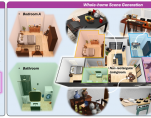
Kairos-HomeWorld is purpose built for embodied intelligence and represents the first unified framework capable of generating a complete, fully interactive home environment from a single text prompt. Extending indoor scene generation beyond individual rooms, it enables whole-home simulation in which every object is fully manipulable within an integrated simulation engine.
Kairos-HomeWorld employs a four-stage hierarchical architecture encompassing floorplan generation, 2D-to-3D lifting, recursive refinement, and manipulable object placement. This approach enables the production of globally coherent, physically accurate, and simulation-ready scenes. Each environment contains more than 15 manipulable objects and achieves a Footprint Object Density of 4.16, the highest among compared methods.
The accompanying open-source dataset is purpose-built for Chinese households, pairing 300,000 real residential floor plans with 5,000 fully furnished, simulation-ready homes and 50,000 physics-enabled interactive object assets. Already deployed in ACE ROBOTICS’ daily robot training, it significantly accelerates the simulation-to-reality transfer cycle.
SHANGHAI, CHINA – Media OutReach Newswire – 5 June 2026 – ACE ROBOTICS, in collaboration with the Multimedia Laboratory at The Chinese University of Hong Kong (CUHK) and Shenzhen Loop Area Institute, today announced the open-source release of Kairos-HomeWorld, the industry’s first unified World Model framework capable of generating full home-scale, object-level interactive 3D environments from a single text prompt. The solution addresses longstanding limitations in indoor scene generation, which has typically been restricted to single-room outputs with weak global consistency and limited interactivity. Kairos-HomeWorld overcomes these constraints by delivering structurally coherent, physically plausible, and functionally complete residential environments. These high-fidelity, large-scale simulations provide a robust foundation for advancing embodied intelligence applications and accelerating real-world robot training.
The long-term vision for embodied intelligence is the home environment. However, residential settings are inherently diverse and highly personalized, requiring robots to be trained across a broad range of realistic and differentiated scenarios before they can reliably operate in even a single household. High-fidelity simulation offers the most practical pathway to achieving this at scale, yet existing approaches typically involve a trade-off: synthetic environments lack realism, while scanned real-world scenes offer limited interactivity. Kairos-HomeWorld, together with its accompanying dataset, is designed to bridge this gap, delivering both realistic and interactive environments within a unified framework.
A four-stage architecture for whole-home, object-level generation Conventional approaches to indoor scene generation remain constrained to single-room outputs, often exhibiting weak global consistency, frequent physical inaccuracies, and limited or no interactivity. Kairos-HomeWorld takes a fundamentally different approach. It decomposes whole-home generation into a structured, four-stage process, redefining the underlying architectural paradigm from the ground up.
Stage 1 — Floor Plan Generation. A K-D tree-based approach translates real-world floor plans into a hierarchical text representation that can be efficiently processed by large language models (LLMs). This method mitigates common issues in conventional layout generation, including room overlaps and fragmented topologies, resulting in more coherent and structurally consistent spatial configurations.
Stage 2 — 2D-to-3D Lifting & Furniture Layout Generation. A “top-down global initialization combined with a first-person detail walkthrough” approach anchors the process to the 3D building shell generated in Stage 1. This methodology mitigates the geometric drift commonly associated with conventional 2D-to-3D lifting techniques, enabling more stable and spatially consistent scene generation.
Stage 3 — Recursive Refinement. A fine-tuned vision-language model performs iterative validation and correction, automatically identifying and resolving physical inconsistencies, such as obstructed doorways or object collisions. This recursive process materially reduces spatial errors, achieving among the lowest reported furniture-collision rates in the industry.
Stage 4 — Manipulable Object Placement. A surface-centric placement algorithm assigns each object detailed physical properties, including material composition, density, friction, and structural support relationships. Each generated scene incorporates an average of more than 15 manipulable objects and achieves a Footprint Object Density (FOD) of 4.16, a metric reflecting the concentration of items across furniture surfaces. All objects are natively compatible with simulation engines, enabling direct interaction for tasks such as grasping, movement, and stacking.
The resulting environments move beyond “viewable but not actionable” outputs. Their coherent spatial structure enables seamless, continuous navigation across multiple rooms, while objects embedded with realistic physical properties allow robots to simulate complex household tasks end-to-end. Taken together, this approach addresses key limitations in existing data pipelines, resolving the scarcity of high-quality 3D simulation data, the lack of realism in synthetic environments, and the limited interactivity of scanned scenes within a single unified framework.
The dataset: 300,000 real floor plans, 5,000 fully interactive homes, built for Chinese households ACE ROBOTICS and CUHK are open-sourcing a dataset of 300,000 structurally annotated residential floor plans, sourced from real-world listings and processed through a multi-stage automated pipeline. The pipeline vectorizes and labels key spatial elements, including door and window positions, room geometry, functional zoning, and connectivity. By comparison, widely used benchmarks such as RPLAN and ResPlan contain approximately 80,000 and 17,000 floor plans, respectively, underscoring the scale and comprehensiveness of the Kairos-HomeWorld dataset.
Building on this foundation, the dataset also includes 5,000 fully furnished residential environments, each featuring a complete furniture layout and an average of more than 15 physics-enabled, manipulable objects, powered by the PhysX-Omni model. All assets are sim-ready and can be directly imported into a simulation engine, enabling immediate use in interactive training scenarios.
Most existing open indoor-scene datasets are centered on North American and European residential formats, typically featuring open-plan kitchens, the absence of service balconies, and layouts and design elements that capture only a narrow segment of global housing. As a result, robots trained on these datasets often exhibit limited transferability when deployed in environments outside their scope. Kairos-HomeWorld ‘s dataset is purpose-built for Chinese households, with deliberate coverage of historically under-represented housing typologies. It spans a wide range of unit sizes, from approximately 30 m² (around 320 sq ft) studio apartments to residences exceeding 200 m² (approximately 2,150 sq ft). The dataset accurately reflects key architectural features common in these settings, including north-south cross-ventilated layouts, enclosed kitchens, dedicated service balconies, wet-and-dry-separated bathrooms, and entryway storage, as well as the irregular room configurations often found in older housing stock.
The dataset is being openly released to both academic and industry communities. Going forward, the team plans to expand its scope to include additional regions, interior styles, and interaction scenarios, further lowering barriers to real-world-ready training for embodied intelligence.
See it in action: one prompt to a fully interactive home Kairos-HomeWorld runs the full end-to-end pipeline, from initial text input to a fully interactive home environment, delivering global spatial consistency, physical realism, and seamless interactivity from a single prompt.
The system begins with a single-line prompt: “Generate a 90 m² (approximately 970 sq ft) two-bedroom apartment in neo-Chinese style.” Leveraging real floor plan data and its K-D tree representation, Kairos-HomeWorld first constructs an empty spatial layout aligned with real-world living patterns, incorporating cross-ventilation and well-defined functional zoning. Building on this foundation, a hierarchical “global layout plus first-person detail” approach furnishes the environment with stylistic coherence, while a PhysX-Omni rendering pass assigns full physical properties to all surfaces and objects, including articulated behavior, ensuring the scene is fully interactive and sim-ready.
A single natural-language instruction, “tidy the whole home”, is decomposed by the robot into a variety of discrete sub-tasks, executed sequentially along a complete navigation path spanning the living room, bedrooms, kitchen, bathroom, and dining area. The robot recognizes objects, plans efficient routes, and performs precise manipulation tasks, including articulated-object interactions for opening refrigerator and cabinet doors, fluid interactions for pouring laundry detergent, soft-body interactions for drawing curtains, irregular-object interactions for grasping apples, and gravity-based physical interactions for placing snacks.
Conventional simulation environments typically support navigation-focused training in isolation. By contrast, Kairos-HomeWorld integrates globally consistent spatial structures with objects that embody realistic physical properties. This enables robots to interact naturally with more than 15 object types, accurately modeling real-world dynamics such as collision, gravity, and friction, and to rehearse the full lifecycle of complex household tasks entirely within a virtual environment.
Across the industry, the same structural bottleneck, the scarcity of home-scale training data, is being addressed through multiple approaches. For example, Figure AI’s collaboration with Brookfield focuses on collecting human activity data across more than 100,000 residential units. Kairos-HomeWorld addresses this challenge through on-demand synthetic generation, delivering scalable training environments enhanced with object-level physical realism, capabilities that real-world data capture alone cannot fully provide.
In contrast, Kairos-HomeWorld delivers significantly lower costs and higher efficiency for household robot training. Powered by its world model, it can programmatically generate diverse Chinese home simulation scenes and physics-enabled interactive objects at scale.
Robots can complete a full range of household tasks training entirely within the virtual environment. New scene generation incurs near-zero marginal cost, eliminating substantial real-world testing expenses such as site operation and maintenance and furniture damage. Meanwhile, unconstrained by the limited stock of physical residential properties, it outperforms real-world data collection approaches in both training efficiency and scalable expansion.
Kairos-HomeWorld is already deployed in ACE ROBOTICS’ embodied intelligence training workflows, enabling full-pipeline simulation of long-horizon household tasks, including cross-room navigation and multi-room tidying. By allowing robots to rehearse complete task sequences in a virtual environment, the platform significantly shortens the simulation-to-reality transfer cycle. This approach lowers barriers to developing embodied intelligence systems and supports the accelerated, large-scale deployment of home robotics, particularly within the Chinese market. Kairos-HomeWorld is now available on GitHub.Hashtag: #ACEROBOTICS
The issuer is solely responsible for the content of this announcement.
About ACE ROBOTICS
Equipping robots with intelligent “brains” and engaging “souls”.
ACE ROBOTICS is a pioneering robotics company dedicated to advancing the field of embodied intelligence. Through breakthrough technological innovations and deep insights into embodied intelligence scenarios, we aim to empower robots with the ability to autonomously understand and explore the physical world, thereby accelerating their commercial implementation.
The company pioneered the ACE R&D paradigm and built a vision-based “environmental data engine, real-world cognition, embodied interaction generalization” technology chain. Using full spatiotemporal and multi-perspective environmental capture as its engine, along with Kairos 3.0 – China’s first open-source and commercially applicable world model – plus the Embodied Foundation Model as its technical backbone, ACE ROBOTICS addresses core industry challenges such as data scarcity, common sense gaps, poor generalization, and limited versatility. Simultaneously, the company unveiled its flagship A1 Embodied Super Brain Module, accelerating the large-scale commercial deployment of embodied intelligence across diverse scenarios.
ACE ROBOTICS is both a technology pioneer and an ecosystem builder. Through strategic cooperation with top hardware manufacturers, cloud service providers, and vertical scenario partners, we have broken through the “model-hardware-scenario” industrial deadlock, providing standardized and customized solutions that are driving the development of China’s embodied intelligence industry.
Arabian Post Staff -Dubai Crude loading at Oman’s Mina al Fahal terminal was suspended on Friday after an explosion near its single-buoy mooring berths, disrupting operations at one of the Sultanate’s most important oil export outlets. Two people familiar with the matter said the blast occurred between SBM 1 and SBM 2 and was believed to have followed a drone attack. The timing of the incident was […]
First Abu Dhabi Bank has entered a strategic partnership with Water. org and WaterEquity, placing capital behind an impact fund aimed at expanding access to safe water and sanitation across emerging markets. The Abu Dhabi lender has invested in the WaterEquity Everspring Fund, an open-ended vehicle designed to channel private capital into financial institutions and enterprises that serve low-income households and small businesses needing affordable water and […]
Dubai has launched SME in a Box, a digital platform intended to cut the time, cost and complexity faced by entrepreneurs setting up and operating small businesses in the emirate. The initiative, introduced by the Dubai Department of Economy and Tourism through the Mohammed Bin Rashid Establishment for Small and Medium Enterprises Development, gives founders a single entry point to access core services that are usually handled […]
Thailand’s richest man Sarath Ratanavadi is preparing a 140 billion baht expansion through Gulf Development Pcl over five years, placing data centres, digital infrastructure and power supply at the centre of one of Southeast Asia’s most ambitious corporate bets on artificial intelligence demand.
The plan, worth about $4.3 billion, reflects a sharp turn by Gulf from its traditional base as a power producer into a broader infrastructure group linking electricity generation, telecommunications, cloud services and industrial logistics. The investment push comes as Thailand seeks to position itself as a regional data hub, helped by rising demand for cloud computing, artificial intelligence workloads and data-localisation capacity across Southeast Asia.
Gulf’s strategy is built around a simple commercial premise: AI facilities need vast, reliable and increasingly low-carbon electricity. Data centres are among the most power-intensive assets in the digital economy, and operators are under pressure to secure stable energy supply while meeting sustainability commitments from global technology clients. Gulf’s existing position in gas-fired power, renewable energy and utilities gives it an advantage that pure technology infrastructure firms may struggle to match.
Sarath, Gulf’s chief executive and controlling figure, has spent years reshaping the group from a conventional energy developer into a conglomerate with exposure to telecoms, satellites, digital platforms and cloud infrastructure. The merger of Gulf Energy Development and Intouch Holdings created a larger listed platform linked to Advanced Info Service, Thailand’s biggest mobile operator, and Thaicom, the satellite company. That structure gives Gulf access to telecom traffic, enterprise clients and digital distribution channels that can support its data-centre ambitions.
The investment programme is expected to support new data-centre capacity, related infrastructure and power projects needed to serve hyperscale and enterprise customers. Gulf has already moved into the sector through partnerships involving global technology names and regional operators, while its digital arm has explored cloud and AI services designed for corporate and government clients. The company’s first major data-centre project has become a reference point for its expansion into facilities that can host high-density computing workloads.
Thailand’s broader investment environment has also shifted in Gulf’s favour. Authorities have approved large-scale data infrastructure projects from global technology players, including server and data-processing investments across Bangkok, Samut Prakan and Chachoengsao. Google, Amazon Web Services, Microsoft and ByteDance-linked operations have all announced or pursued major commitments in the country, intensifying competition but also validating Thailand’s role in the regional digital economy.
For Gulf, the opportunity lies not only in renting data-centre capacity but also in selling bundled infrastructure: power, connectivity, cloud access and long-term operational reliability. That model could create recurring income and reduce dependence on regulated returns from power generation. It may also help Gulf deepen its relationship with large technology clients seeking local partners that understand land, energy approvals, grid constraints and domestic regulatory requirements.
The group’s financial position gives it room to move, though the scale of the programme will be closely watched by investors. Gulf reported strong first-quarter earnings for 2026, helped by its energy operations and profit contribution from Advanced Info Service. Revenue growth and core profit gains have strengthened confidence in its ability to finance new projects, but data centres require heavy upfront spending and returns can depend on utilisation rates, long-term contracts and energy costs.
The timing is also sensitive. Across Asia, governments are competing for data-centre investment while confronting pressure on power grids, water use and land availability. Singapore’s cautious approach to new data-centre capacity has encouraged developers to look at Malaysia, Thailand, Indonesia and Vietnam, but each market faces its own constraints. Thailand has industrial land, policy incentives and improving connectivity, yet grid readiness and clean-energy availability remain decisive issues for hyperscale clients.
Gulf’s renewable energy targets are likely to form part of its sales pitch. The company has set out plans to raise the share of renewables in its generation portfolio and reduce carbon intensity, while continuing to rely on gas as a stable baseload fuel. Its long-term LNG supply arrangements also point to a strategy that balances energy security with transition commitments, even as customers demand cleaner electricity for digital operations.
Sarath’s expansion plan underscores how AI is redrawing corporate strategy beyond Silicon Valley. Energy groups, telecom operators and infrastructure funds are increasingly competing for the physical assets behind the digital boom. Gulf’s bet is that Thailand’s AI economy will be shaped as much by power plants, fibre networks and industrial sites as by software models and cloud applications.
MIT and IBM researchers have opened a new front in multimodal artificial intelligence by releasing ChartNet, a large synthetic dataset designed to teach smaller vision-language models how to read, extract and reason from charts with greater accuracy than far larger commercial systems. The dataset, available through Hugging Face, contains 1.7 million richly annotated core chart samples and a broader collection running into millions of synthetic examples. Its […]
Greenlogue/AP Dubai Electricity and Water Authority has raised clean energy’s share of its total production capacity to 21.5%, strengthening the emirate’s shift towards a lower-carbon electricity system as demand for power continues to rise across residential, commercial and industrial sectors. Saeed Mohammed Al Tayer, Managing Director and Chief Executive Officer of DEWA, said the increase reflects Dubai’s long-term strategy to align infrastructure growth with environmental sustainability, […]
MEXC has integrated with TradingView, allowing users to execute crypto trades directly from the charting platform and reducing the gap between market analysis and order placement in one of the fastest-moving areas of digital-asset trading. The Victoria, Seychelles-based exchange said the tie-up gives traders access to TradingView’s charting interface while connecting them to MEXC’s spot and derivatives markets. The move is aimed particularly at active crypto users […]
Hackers are using large-scale online advertising campaigns to deliver FlutterShell, a newly identified macOS backdoor that marks a sharper turn in financially motivated malware operations targeting Apple users. The campaign, tracked as Operation FlutterBridge, is linked to a broader cybercrime cluster known as CL-CRI-1089, which has operated since at least 2023. The group has used paid advertisements, verified advertiser accounts and shell companies to place malicious promotions […]
Arabian Post Staff -Dubai Abu Dhabi Exports Office has begun direct site visits to UAE-based manufacturers under its AED1 billion financing partnership with Emirates Development Bank, stepping up efforts to link industrial companies with export funding, working capital support and market-expansion tools. The visits covered MEDECO, Star Paper Mill and Dana Steel, three manufacturers operating in sectors closely tied to the country’s localisation and export-growth agenda. ADEX […]
Arabian Post Staff -Dubai Computex 2026 has turned the personal computer market into a three-way contest over AI laptops, handheld gaming and mid-range graphics, with Nvidia, Intel and AMD using Taipei to push new silicon into segments long shaped by Apple’s Mac ecosystem and AMD-powered portable consoles. Nvidia’s RTX Spark platform drew the sharpest attention after the company positioned it as a Windows-based alternative for developers, creators […]
Malicious agent-skill uploads have slipped past detection tools used by ClawHub, Cisco and Vercel-linked scanning services, raising fresh concern over the security of fast-growing marketplaces that distribute third-party capabilities for AI agents. The findings point to a widening supply-chain problem around “skills”, the modular instruction-and-file packages that allow AI agents to perform tasks such as editing documents, running scripts, managing workflows or connecting with external services. Unlike […]
Blockchain users searching for simpler wallet identities have pushed. bit into the wider debate over decentralised naming, digital ownership and cross-chain authentication, as Web3 developers look for alternatives to long alphanumeric addresses that remain difficult for mainstream users to manage.. bit is commonly called a “domain”, but its developers describe it more precisely as a decentralised identity and account system rather than a conventional internet domain. Unlike […]
Arabian Post Staff -Dubai UiPath has secured certification from the Dubai Electronic Security Center for its Automation Cloud Commercial UAE region, clearing a key compliance hurdle for wider deployment of its automation and artificial intelligence services across Dubai’s government, semi-government and regulated enterprise sectors. The certification places UiPath’s UAE cloud operations under the DESC Cloud Service Provider Security Standard, a framework required for cloud providers serving Dubai […]
Cybercriminal groups are shifting phishing campaigns from fake login pages to malware-led intrusions that silently extract passwords, browser cookies, session tokens, cryptocurrency wallet data and other sensitive information from infected devices. The change marks a significant turn in online fraud tactics. Classic phishing pages still imitate banks, cloud services, delivery firms and workplace platforms, but attackers are increasingly using emails, search ads, fake software installers, messaging apps […]