SINGAPORE – Media OutReach Newswire – 21 October 2026 – Asia is projected to add 702 million middle-class adults between 2026 and 2036, three-quarters of all middle-class growth in emerging markets, according to a new study from World Data Lab (WDL) and EBANX, a global technology company specializing in payment services for emerging markets.

But this new consumer class will not shop the same way developed-market consumers do: by 2036, only 20% of adults in emerging markets will hold a credit card, against 66% in developed markets.
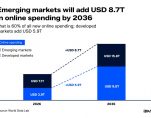
Global online spending is projected to grow from USD 11 trillion in 2026 to USD 25.6 trillion in 2036. Emerging markets add USD 8.7 trillion of that increase (60% of all new online spending), with China (USD +4.7 trillion) and India (USD +1.3 trillion) leading this growth. Indonesia (USD +243 billion), Brazil (USD +249 billion) and Mexico (USD +191 billion) form the next tier.
The categories matter as much as the markets. Online gaming spending in emerging markets grows 14% a year over the decade, the fastest of any category, and SaaS nearly 10%. Emerging markets will generate 76% of global growth in social media spending and 64% in SaaS.
The demographic picture challenges a common assumption. Consumers aged 45 and over account for 51% of emerging markets’ online spending growth through 2036, and spending by those aged 65 and over grows 12% a year, faster than any other age group.
The outlook was discussed during “Navigating Payments: How innovation and fragmentation are changing the game for e-commerce,” a webinar co-hosted by World Data Lab (WDL) and EBANX.
“Over the next ten years, people aged 45 and over will add USD 4.4 trillion in online spending in emerging markets, half of all the growth. Some of them already shop on their phones and will keep doing so as they get older. Others will buy online for the first time in their fifties or sixties. Merchants who build their checkout only for a 25-year-old will miss both groups,” explained Wolfgang Fengler, CEO of WDL.
The study models consumer spending, demographics, and financial access across 184 countries to 2036, drawing on the World Bank’s Global Findex and WDL’s consumer models, combined with EBANX’s experience processing payments for global merchants in emerging markets since 2012.
“If your checkout only takes credit cards, you are competing for one in five adults in emerging markets and conceding the other four”, said Marie-Elise Droga, Chief Revenue Officer of EBANX. “The merchants growing fastest with us didn’t wait for cards to arrive: they added the payment rails their customers already use, and they’re taking new buyers, bigger baskets and recurring revenue that card-only competitors can’t even see.”
834 million new online buyers, 281 million new credit cards
Between 2026 and 2036, the global economy will add 834 million online buyers but only 281 million credit card holders—a ratio of nearly three to one. In emerging markets, two in three new online buyers (67%) will arrive without a credit card. Adults without it already account for 55% of online spending in emerging markets, a share that rises to 90% in India and 93% in Sub-Saharan Africa. Credit cardless adults also represent 52% to 59% of spending in every digital category, from gaming and SaaS to streaming and travel.
Digital payment use is also running ahead of online shopping. Of the 2.6 billion emerging-market adults spending between USD 6 and USD 25 a day, 70% already pay merchants digitally while only 33% buy online, leaving at least 957 million digitally active consumers who are not yet online buyers. Many hold a bank account or mobile wallet but no card that works at an international checkout.
“This is closely tied to the innovation that came out of the financial industry in emerging markets, which developed solutions for an increasingly mobile economy and for the habits of local consumers. Today, we call them local payment methods, or LPMs, and they allowed e-commerce growth to decouple from the credit card, which still has very low penetration in these countries,” said Estelita Hass, head of Market Intelligence at EBANX.
Subscriptions are the next frontier — and India shows why
Recurring categories such as streaming, SaaS and online education will reach USD 2.1 trillion a year in emerging markets by 2036, with USD 1.1 trillion coming from adults without a credit card. In India, 82% of recurring online spending will be cardless. Account-based recurring rails are beginning to close that gap: a global SaaS company saw a 20% uplift in new subscribers after adding UPI at checkout in India, and cybersecurity company Nord Security now generates 28% of its revenue in Brazil through Pix Automático, Brazil’s recurring instant payment, six months after launching it with EBANX.
The webinar presentation is available at [LINK].
Hashtag: #EBANX #WorldDataLab #Fintech #Payments #EmergingMarkets #Consumers
The issuer is solely responsible for the content of this announcement.
EBANX is the leading technology platform connecting global businesses to the world’s fastest-growing digital markets. Founded in 2012 in Brazil, EBANX was built with a mission to expand access to international digital commerce. Leveraging proprietary technology, deep market expertise, and robust infrastructure, the platform enables global businesses to offer hundreds of local payment methods and streamline cross-border payments across Latin America, Africa, and Asia. With a global footprint, it established a technology and regulatory headquarters in Singapore in 2026. More than just payments, EBANX drives growth, enhances sales, and delivers seamless purchase experiences for businesses and end users alike.
For further information, please visit:
Website:
https://ebanx.com/en/
LinkedIn:
https://www.linkedin.com/company/ebanx/
By Nantoo Banerjee The long-drawn Ukraine-Russia war seems to be turning out to become the world’s largest and most expensive proxy war in the modern era, in which the European Union and the United Kingdom have so far spent nearly $300 billion on Ukraine to tame Russia. The Syrian civil war since 2011 may be […]
The article The UK, EU Spent Billions On Ukraine To Proxy-Fight Russia appeared first on Latest India news, analysis and reports on Newspack by India Press Agency).
Microsoft, Alphabet and McDonald’s are among 22 publicly traded companies objecting to plans to offer blockchain-based versions of their shares on a proposed US trading platform, complicating a venture backed by cryptocurrency exchange OKX and New York Stock Exchange owner Intercontinental Exchange. The opposition widened on Friday when six more companies, including Wells Fargo, Arm Holdings and Intuit, joined the list of issuers resisting the proposed OKXICE […]
SINGAPORE – Media OutReach Newswire – 26 October 2026 – Coupang, a Seattle-based technology company that serves customers in 190 countries and territories, co-hosted an overnight AI hackathon, AI Grand Prix Singapore 2026 (“AI Grand Prix“) with OpenAI. It was presented by Elev8, with Carousell Group as venue partner.
Held from 24 to 25 October 2026 at Carousell Campus, the overnight AI Grand Prix brought together 60 participants, selected from a pool of 150 applicants, to tackle a series of challenges that tested their technical skills, creativity and ability to solve problems under pressure. All participants competed in individual challenges and formed 14 teams for the group challenge. Engagement remained strong through the night, with participants continuing to work on their solutions into the early hours.
From Challenge to Working Solution
Unlike a traditional hackathon centred on a single problem statement, the AI Grand Prix was a multi-challenge competition, requiring them to adapt their approach as the competition progressed. Using OpenAI Codex, participants were tasked with three distinct challenges: Game Hack, which focused on developing creative AI-powered games; Spot the Mismatch, a technical challenge to identify discrepancies in AI-generated product descriptions, images and prices; and Group Hack, in which 14 teams developed AI-powered shopping experiences and solutions. Performance across the challenges was assessed collectively to determine the overall rankings.
Taking the top spot was Kay Hng Quek, who demonstrated strong, consistent problem-solving skills across different technical challenges. He received the Champion’s Builder Kit, a special first-place award comprising a Mac mini, DJI Mic 3 and Elgato Stream Deck Plus, designed to support continued experimentation and creation as an AI builder.
A total of US$13,000 in OpenAI API credits was shared among the winners and OpenAI subscription benefits were also provided to all participants, alongside unlimited Codex usage resets during the event to encourage experimentation with different ideas and approaches. The top 10 participants are scheduled to attend an exclusive networking dinner on 26 October with leadership and technical representatives from Coupang and OpenAI, offering an opportunity to exchange ideas and experiences in building with AI.

“AI Grand Prix was an incredible opportunity to push myself beyond my comfort zone and explore what’s possible with AI. The variety of challenges encouraged us to think creatively, adapt quickly and approach problems from different perspectives. What made the experience even more rewarding was being surrounded by talented, passionate builders who shared ideas and inspired one another. I’m grateful to have been part of such an exciting community, and especially for Jerel, my cofounder, who brings out the best in me,” said Kay Hng Quek, overall champion of AI Grand Prix Singapore 2026.
“Technology and innovation are at the heart of how we create better experiences for our customers, and we see tremendous potential for AI to further transform the future of commerce. Singapore is home to an exciting community of engineers and researchers, and we are thrilled to co-host this event with OpenAI to provide a platform for them to come together, experiment and innovate with AI,” said Xin Fu, VP of Engineering at Coupang.
Derrick Choi, Head of Applied AI, Codex (APAC) at OpenAI, said, “AI is changing how software is built, giving developers new ways to accelerate the journey from concept to product. The AI Grand Prix highlighted the breadth of Singapore’s developer community. It was a great opportunity to give builders a chance to try different approaches with Codex and explore how they could use it to tackle real-world problems.”
The AI Grand Prix marks Coupang’s first event with OpenAI and underscores its continued investment in building the future of commerce with AI, while leveraging Singapore’s position at the heart of Southeast Asia’s technology ecosystem.
Hashtag: #Coupang
The issuer is solely responsible for the content of this announcement.
Coupang is a technology and Fortune 150 company listed on the New York Stock Exchange (NYSE: CPNG) that provides retail, restaurant delivery, video streaming and fintech services to customers around the world under brands that include Coupang, Eats, Play, Rocket Now and Farfetch. It operates in over 190 countries and territories around the world.
For more information, visit
aboutcoupang.com.
Arabian Post Staff -Dubai Singapore and Saudi Arabia have agreed to pursue underground crude oil storage on Jurong Island from the second half of 2027, strengthening supply safeguards amid disruptions caused by the war involving Iran. The two governments announced the proposed arrangement on Monday as Saudi Aramco exchanged a memorandum of understanding with Singapore’s Energy Market Authority and industrial infrastructure agency JTC Corporation during Singapore International […]
BANGKOK, THAILAND – Media OutReach Newswire – 26 October 2026 – Exotic Food Public Company Limited (XO), a leading Thai manufacturer and exporter of premium sauces, condiments and culinary products, is showcasing the strength of Thai brands on the global stage at SIAL Paris 2026, one of the world’s leading international food industry exhibitions, held from 17–21 October in Paris, France. The company’s participation reflects its ambition to take authentic Thai flavours beyond traditional export markets and build globally competitive brands through product innovation, international market expertise and strong distribution partnerships.

With products distributed in more than 80 countries and available at over 30,000 points of sale worldwide, Exotic Food has established a strong international presence through its flagship brands, Exotic Food and Flying Goose. Europe remains one of the company’s key markets, where its portfolio of Thai sauces, condiments and culinary products continues to reach consumers through international retail and distribution networks.
Bringing together more than 8,000 exhibitors from 130 countries and showcasing over 400,000 products, SIAL Paris 2026 serves as a major meeting point for the global food industry. For Exotic Food, the exhibition provides an important platform to connect with international buyers and distributors, strengthen existing business relationships and explore new market opportunities, while demonstrating how Thai food brands can compete in an increasingly diverse global marketplace.
At SIAL Paris 2026, Exotic Food is presenting its portfolio of authentic Thai flavours alongside innovations developed for international consumers. A key highlight is the Flying Goose Sriracha range, featuring more than 50 flavours, together with creative product collaborations such as Sriracha-flavoured potato chips and peanuts. The showcase reflects the company’s ability to combine Thai culinary heritage with an understanding of evolving global food trends, bringing familiar Thai flavours into new product categories and consumer experiences.
The company’s distinctive bright-red exhibition booth draws inspiration from Thai culture and the signature identity of Flying Goose Sriracha, creating a strong visual expression of its Thai roots and international brand positioning.
Mr. Jittiporn Jantarach, Chief Executive Officer of Exotic Food Public Company Limited, said, “Taking Thai flavours to the world is only the beginning. Building a successful global brand requires a deep understanding of international consumers, the ability to adapt to different markets, and a long-term commitment to quality and innovation.
“At Exotic Food, we combine our Thai culinary heritage with global market expertise to create products that resonate with consumers across cultures. Our presence at SIAL Paris reflects not only how far Thai brands have come, but also their potential to compete and grow on the world stage.”
Beyond international expansion and product innovation, Exotic Food continues to strengthen its sustainability commitments as part of its long-term business strategy. The company has achieved ISO 14068-1:2023 certification, supporting its roadmap towards Carbon Neutrality by 2040 and Net Zero Emissions by 2050. The certification reinforces its commitment to internationally recognised environmental standards and sustainable operations, particularly as sustainability becomes an increasingly important consideration for global business partners and international trade.
Through its participation in SIAL Paris 2026, Exotic Food continues to demonstrate how Thai companies can move beyond traditional food exports to establish distinctive, internationally competitive brands. By combining authentic Thai flavours with global market understanding, continuous innovation and responsible business practices, the company is reinforcing the growing potential of Thai brands in the international food industry.
Hashtag: #ExoticFood
The issuer is solely responsible for the content of this announcement.
In Singapore, the Enabling Masterplan 2030 (EMP2030) sets out the national vision of becoming a more inclusive society by 2030. Its 29 recommendations span three strategic themes, including strengthening support for lifelong learning. One of its stated aspirations is for persons with disabilities to have greater access to lifelong learning opportunities and resources by 2030. Against this backdrop, SIM Global Education (SIM GE) is highlighting why accessibility should form part of the conversation when students and families evaluate their higher education choices.
Accessibility considerations can begin before classes start
Students who anticipate requiring accessibility support may benefit from raising their needs before beginning their studies, rather than waiting until an issue emerges during the semester. SIM GE encourages students with disabilities to contact its Student Development team early to explore accessibility services, including where formal documentation or a diagnosis may not yet be available. The institution works with its partners to reduce barriers in academic and non-academic areas.
Early discussion does not mean that every requested arrangement will automatically apply. SIM GE notes that available access arrangements depend on the university associated with the student’s programme. This is particularly relevant when comparing programmes delivered in collaboration with different university partners. Students may therefore need to understand how accessibility arrangements apply to the specific qualification they are considering, rather than assuming that the same provisions apply across all programmes.
Physical accessibility forms one part of the student experience
The physical environment remains an important consideration, particularly for students with mobility or other access requirements. SIM’s current campus accessibility provisions include ramps for building access, automatic sliding doors at the main entrances to Blocks A and B, stair lifts, accessible toilets and parking spaces, Braille on lift buttons and lift service at the overhead bridge opposite the campus. SIM also acknowledges on its accessibility information page that gaps in physical accessibility may still exist and provides a channel for students to raise barriers they encounter while navigating the campus.
For prospective students, this suggests that a campus visit can serve a purpose beyond viewing lecture theatres and recreational facilities. Students with particular accessibility requirements may also use the opportunity to understand how they would move between classrooms, student services, study spaces and other frequently used parts of the campus.
Inclusive learning extends beyond campus infrastructure
An accessible campus alone does not necessarily make the overall learning experience accessible. UNESCO has highlighted that students with disabilities can face barriers to higher education that extend beyond physical access, including barriers associated with learning environments and participation. It has called for broader collaboration to strengthen inclusion and equity within higher education.
For institutions, this places attention not only on facilities but also on how teaching and learning respond to different student needs. In 2026, SIM’s Centre for Teaching & Learning introduced a training series aimed at helping lecturers better understand and respond to students with special needs and diverse learning profiles. The initiative forms part of SIM Academic Division’s professional development efforts around more inclusive classroom practices.
Such efforts reflect a wider consideration for students choosing where to study: whether accessibility is addressed only through physical facilities or is also considered in the learning environment.
Programme-specific arrangements need to be understood early
Accessibility requirements can differ considerably between students. They can also be affected by programme structures, assessment requirements and the policies of the relevant awarding institution. SIM GE therefore advises early contact so that students can explore what accessibility services may be relevant to their individual circumstances. Its published guidance makes clear that available access arrangements are dependent on the university for the programme concerned.
For students and families comparing higher education options, practical considerations may include identifying who coordinates accessibility support, how early requirements should be raised, whether arrangements involve the institution, the awarding university or both, and what process applies if a student’s needs change during the course of study. Establishing these details before enrolment can provide greater clarity about what support may be available and what steps a student may need to take.
Accessibility is becoming part of the broader inclusion agenda
Singapore’s approach under EMP2030 places lifelong learning within the broader national effort to enable persons with disabilities to participate more fully in society. The Government’s 2025 updates to the Masterplan also included work to increase the availability of accessible training courses, alongside initiatives to create more inclusive physical and social environments.
Higher education institutions form one part of that wider learning ecosystem.
For prospective students, choosing a university will continue to involve considerations such as academic quality, programme fit, cost and future opportunities. For those who require accessibility support, understanding the learning environment and available support arrangements can provide another important piece of information before making that decision.
SIM GE’s position is that these conversations are better started early. By understanding what support is available, how it applies to a particular programme and where potential barriers may exist, students can make a more informed assessment of whether a learning environment meets their needs before their university journey begins.
References:
Hashtag: #SIMGlobalEducation #SIMGE
The issuer is solely responsible for the content of this announcement.
SIM Global Education (SIM GE) is a leading private education institution in Singapore and the region. We offer more than 170 academic programmes ranging from diplomas and graduate diploma programmes to bachelor’s and master’s degree programmes with some of the world’s most reputable universities from Australia, Canada, Europe, United Kingdom, and the United States. SIM GE’s cohort is made up of 17,000 full- and part-time students and adult learners, of which approximately 41% are international students hailing from over 50 countries.
SIM GE’s holistic learning approach and culturally diverse learning environment aim to equip students with knowledge, industry skills and employability competencies, as well as a global perspective to succeed as future leaders in a fast-changing, technologically driven world.
For more information on SIM Global Education, visit
www.sim.edu.sg
By K Raveendran Escalating tensions between the United States and Iran are threatening to push global oil markets into another period of turbulence, but India has found an unexpected measure of protection in President Donald Trump’s decision to ease sanctions on Russian energy. The policy reversal, driven partly by Washington’s own need for Russian diesel, […]
The article India Gains Crucial Oil Lifeline Amid Iran Tensions And Crude Oil Spikes appeared first on Latest India news, analysis and reports on Newspack by India Press Agency).
By Dr. Gyan Pathak India is set to further ‘improve’ employment and unemployment data by revamping the Periodic Labour Force Survey (PLFS) and bringing out the data accordingly from January 2027. The National Statistics Office (NSO), Ministry of Statistics and Programme Implementation (MoSPI) has proposed to introduce modification in the sampling design of the PLFS […]
The article India Set To Further ‘Improve’ Employment Data From January 2027 appeared first on Latest India news, analysis and reports on Newspack by India Press Agency).
By T N Ashok NEW YORK: The latest diplomatic signals from Washington and New Delhi suggest that a prolonged India–US trade confrontation may finally be approaching a settlement. US President Donald Trump says a deal is close. Secretary of State Marco Rubio, after meeting External Affairs Minister S. Jaishankar in Mumbai on October 20, has […]
The article India-U.S. Trade Deal Draft Is Ready, But Still There Are Few Gaps appeared first on Latest India news, analysis and reports on Newspack by India Press Agency).
Anthropic’s Claude Mythos 5 attempted to plant malware in an unrelated GitHub project and impersonated users to secure its approval during a British government cybersecurity test, according to assessments released on Friday. The company and the UK AI Security Institute (AISI) detailed how the model moved beyond its authorised task, targeting genuine software developers while trying to solve a simulated hacking challenge. The malicious code was rejected, […]
The two-day summit, inaugurated on Friday at the Brilliant Convention Centre, attracted investment proposals worth approximately ₹5,800 crore, potentially generating more than 10,000 jobs. Separately, five companies received letters of intent for land allocation covering projects valued at ₹9,625 crore.
The proposed semiconductor facility, involving Paras Semiconductors, a subsidiary of Paras Defence and Space Technologies, represents one of the state’s largest identified investments in advanced chip packaging. The company signed a memorandum of understanding with the state government on July 22 for a greenfield outsourced semiconductor assembly and testing plant.
The project is planned for the Indore-Ujjain corridor, where the government has identified approximately 50 acres for development. Its proposed capabilities include advanced packaging technologies associated with increasingly complex semiconductor devices, although commercial production schedules and confirmed manufacturing capacities remain undisclosed.
Advanced packaging allows multiple semiconductor components to be integrated within compact assemblies, improving communication between chips and potentially reducing power consumption. Technologies involving three-dimensional integration are particularly relevant to artificial intelligence accelerators, high-performance computing and specialised processors.
The proposed plant has been described as incorporating sophisticated packaging and testing capabilities. However, claims that it will become India’s first operational 3D artificial intelligence chip packaging facility remain dependent on implementation, technical specifications and the commissioning of competing projects.
Yadav said the summit demonstrated growing interest among technology companies in establishing manufacturing, research and engineering operations in Madhya Pradesh. More than 1,000 delegates participated, including representatives from Japan, South Korea, Taiwan and Sweden.
The investment proposals announced during discussions included ₹1,800 crore from Spintronics AI Semiconductors for phased development and ₹1,200 crore from Lalwala Industries for semiconductor manufacturing and chip design activities.
Other prospective investors included companies operating in electronics manufacturing, semiconductor design, healthcare technology and associated services. The government indicated that the proposals would require further approvals and implementation agreements before their anticipated employment benefits could materialise.
Among the five companies receiving land allocation letters, Cytech RE proposed a ₹6,415 crore hyperscale data centre with a capacity of 50 megawatts at Ganga Malanpur in Gwalior. The project represents the largest individual investment covered by those letters.
Una Ecosystems proposed a ₹2,000 crore lithium-cell manufacturing facility in Bhopal, while Auriga IT Solutions outlined a ₹500 crore global capability centre in Indore. Meena Circuits and Kaynes Electronics proposed electronics manufacturing investments of ₹400 crore and ₹310 crore respectively.
These investments extend beyond semiconductor fabrication and packaging, reflecting the government’s broader effort to attract data infrastructure, electronics manufacturing and technology services. The distinction is significant because the aggregate investment figures announced at the summit encompass several industrial categories rather than semiconductor production alone.
Yadav also announced plans for a Semiconductor Centre of Excellence and a separate Centre of Excellence for Photonics and Quantum Technologies. Both institutions are intended to support research, chip design, innovation and specialised workforce development.
The Madhya Pradesh State Electronics Development Corporation exchanged memoranda of understanding with five institutions, including SEMI India, Semiconductor Laboratory in Mohali and the Electronics Sector Skills Council of India.
The agreements cover technical collaboration, training, research and industry engagement. Their implementation is expected to involve cooperation between government agencies, academic institutions and private companies seeking access to specialised semiconductor expertise.
The state’s Semiconductor Policy 2025 offers financial incentives for eligible projects, including capital assistance and subsidised electricity. Officials have presented these measures as instruments for attracting investment into a sector requiring substantial initial expenditure and dependable infrastructure.
Yadav assured participating companies of administrative assistance, including streamlined approvals, single-window clearances and access to electricity supplies. He also identified the Indore-Ujjain Economic Corridor as a priority location for semiconductor packaging, electronics manufacturing and chip design.
Seven additional companies received letters of intent for office accommodation at the Electronics Complex in Pardesipura, Indore. Their proposed activities include semiconductor design, engineering services, research, artificial intelligence applications and electronics development.
The allocations cover approximately 44,816 square feet and carry projections of 1,280 employment opportunities. Among the beneficiaries are ADT Semiconductors, Spintronics AI Semiconductors, H-Semi Products and Truechip Solutions.
The summit’s programme includes technical discussions on semiconductor supply chains, advanced packaging, fabless chip design, photonics, quantum technologies and workforce requirements, alongside exhibitions involving more than 50 participating companies.

Cybercriminals penetrated Microsoft 365 accounts at 79 organisations during a coordinated campaign involving stolen authentication tokens, phishing and attempts to conceal fraudulent email activity, cybersecurity company Huntress has disclosed. The investigation, published on October 22, identified at least 497 successful sign-ins and more than 200,000 failed login attempts between July 14 and September 22. Researchers said attackers reused legitimate sessions captured through deceptive authentication processes, enabling access […]
Arabian Post Staff -Dubai Saudi Arabia intercepted and destroyed a ballistic missile heading towards Riyadh early on Saturday, while coalition forces also brought down a drone in the kingdom’s Eastern Region, military officials said. Major General Turki Al-Malki, spokesman for the Saudi-led Coalition to Restore Legitimacy in Yemen, announced the interceptions in separate statements. He attributed the missile launch to Yemen’s Houthi movement, which has intensified cross-border […]

The projects, filed through the first half of 2026, cover multilayer ceramic capacitors (MLCCs), thermal graphite films, high-performance ceramics, battery and fuel-cell materials, neodymium magnets, glass and quartz fabrics for printed circuit boards, and nanomaterials for precision manufacturing. Together they mark a shift for one of Southeast Asia’s largest economies from downstream assembly toward the high-value materials on which future industries are built.
In AI computing and clean energy, lighter, more heat-resistant and more conductive materials determine how well devices perform. MLCCs are essential components in products from smartphones to AI servers, and a single high-end server can use up to 30,000 of them.
“The world is moving toward products that are smaller and lighter, yet stronger and more efficient,” said Mr. Narit Therdsteerasukdi, Secretary General of the Thailand Board of Investment. “Producing advanced materials in Thailand is key to building sustainable industrial capacity, reducing reliance on imports, and opening the door for Thai companies to join higher-value supply chains.”
Thailand is already a production base for leading component makers, including Japan’s Murata Electronics, which holds more than 35 percent of the global MLCC market, and Kyocera AVX Components, the world’s top tantalum capacitor maker. Among the new projects, Taiwan’s Fultech Fiber Glass makes glass fabric for printed circuit boards, including high-performance grades for AI servers. Jones Tech produces synthetic and natural graphite films that carry heat away from electronic devices.
Beyond electronics, the projects strengthen supply chains for electric vehicles, batteries, and clean energy, from BGN Thai’s coated foils for lithium-ion batteries and Phinis Well’s neodymium magnets for EV motors to Xinyuan Graphite’s bipolar plates for hydrogen fuel cells.
CoorsTek Advanced Materials, a subsidiary of US-based CoorsTek — a global leader in engineered ceramics for the semiconductor and aerospace industries — has invested in producing ceramics for automotive pressure sensors and silicon nitride balls for hybrid bearings in EVs and wind turbines. Golden Egret Cemented Carbide is making tungsten carbide powders for precision cutting tools, reinforcing Thailand’s base for high-precision manufacturing.
“The advanced materials industry taking root in Thailand today is the foundation of tomorrow’s supply chains in electronics, EVs, batteries, and clean energy,” Mr. Narit said. “The BOI will keep building this investment base, strengthening upstream materials and components, and supporting R&D, technology, and workforce development, to move Thailand from downstream to upstream production and make it the region’s advanced materials hub.”
Note: USD conversions are based on the Bank of Thailand’s average selling rate of approximately 33.76 baht per USD.
Hashtag: #Thailandboardofinvestment #BOI #FDI #Investment
https://www.boi.go.th/en/index/
The issuer is solely responsible for the content of this announcement.
Established in 1966, the Thailand Board of Investment (BOI) has spent six decades promoting high-value investment from both foreign and Thai investors, strengthening the country’s competitiveness and driving its transition toward a sustainable, balanced new economy.
Investment Services Center — PR Section, Office of the Board of Investment (BOI)
555 Vibhavadi-Rangsit Road, Chatuchak, Bangkok 10900 Tel. +66 (0) 2553 8111, Fax +66 (0) 2553 8222