Nvidia has assembled nearly 40 technology companies to develop open tools for artificial intelligence security, but the absence of OpenAI, Google, Anthropic and Amazon has highlighted widening divisions over how the industry should protect increasingly autonomous systems. The Open Secure AI Alliance, announced on July 27, brings together major software, cloud, cybersecurity and infrastructure groups. Its inaugural partners include Microsoft, IBM, Adobe, Cisco, CrowdStrike, Cloudflare, Dell Technologies, […]
Anthropic chief executive Dario Amodei has rejected calls for a sweeping ban on open-weight artificial intelligence models, while urging governments to impose stronger safety testing and targeted controls on systems capable of causing serious harm. Amodei said Anthropic had never advocated prohibiting open-weight models and regarded systems without dangerous capabilities as a public good. His intervention followed criticism of the company for declining to join a technology […]
Multiple high-severity vulnerabilities in FFmpeg have exposed media-processing systems to memory corruption, information leakage and service disruption when they handle malicious video, audio, image or subtitle files. The newly catalogued flaws affect FFmpeg 8.1.2 and, depending on the vulnerability, several older branches. They are especially significant for cloud transcoding services, streaming platforms, social networks, content-management systems and artificial intelligence applications that automatically process files supplied by users. […]
Nvidia is discussing a financing guarantee of as much as $250 billion to support OpenAI’s proposed lease of computing capacity from a vast data centre development in Ohio, potentially extending the chipmaker’s role from technology supplier to financial backer of the artificial intelligence infrastructure boom. The talks centre on a planned 10-gigawatt complex being developed by SB Energy, the renewable energy and infrastructure arm controlled by SoftBank […]
Moonshot AI is releasing the weights of its flagship Kimi K3 model for public download, giving developers direct access to one of the largest open-weight artificial intelligence systems built so far. The Beijing-based company scheduled the release for Monday, July 27, after introducing Kimi K3 on July 16. Opening the model weights will allow researchers and companies to run, examine and adapt the system on their own […]
AMD has outlined a long-term server processor roadmap extending to 2030, placing its Florence and Ravenna chips at the centre of a broader push to capture demand from artificial intelligence, cloud computing and high-performance data centres. Florence, based on the planned Zen 7 architecture, is targeted for 2028 as part of AMD’s seventh-generation EPYC processor family. It is scheduled to be followed by Ravenna, an eighth-generation EPYC […]
Nearly 200 US startups have urged the Trump administration to reject sweeping restrictions on Chinese open-weight artificial intelligence models, warning that a broad ban would raise costs, weaken competition and threaten companies built around affordable access to advanced technology. The coordinated appeal was organised by the newly formed Little Tech Association and sent to President Donald Trump and senior administration officials, including Commerce Secretary Howard Lutnick and […]
Advanced Micro Devices has launched a rack-scale artificial intelligence platform built around its next-generation accelerators, processors and networking technology, stepping up its attempt to weaken Nvidia’s hold over the fast-expanding AI infrastructure market. The Helios system, unveiled at AMD’s Advancing AI event at San Francisco’s Moscone Center, is now in full production and is scheduled to begin shipping before the end of the third quarter of 2026. […]
Bazzite is emerging as a flexible gaming operating system that seeks to bring a console-style experience to desktop computers, handhelds, tablets and home theatre systems without stripping away the functions of a conventional PC. Built on Fedora Atomic Desktops, the open-source platform arrives with Steam installed and includes gaming-focused drivers, software and system adjustments. Its developers aim to reduce the configuration work traditionally associated with Linux gaming […]
US stocks rose on Monday as chipmakers recovered from last week’s sell-off, reassuring investors that artificial intelligence remains perfectly capable of generating profits, provided nobody asks where the profits are. The S&P 500 gained about 0.6%, while the technology-heavy Nasdaq Composite advanced roughly 0.9%. The Dow Jones Industrial Average posted a smaller rise as traders concentrated on semiconductor shares, corporate earnings and the comforting possibility that another […]
The launch combines a unified, action-oriented world model with Ambient Capture Engine 2.0, three commercial solutions and a new industry benchmark, connecting high-density data with real-world robotic operations.
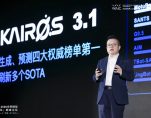
SHANGHAI, CHINA – Media OutReach Newswire – 19 July 2026 – ACE ROBOTICS today unveiled Kairos 3.1, its latest action-oriented world model, alongside Ambient Capture Engine 2.0 and three commercial solutions spanning instant retail, hospitality and outdoor service scenarios.
ACE ROBOTICS Chairman Wang Xiaogang introduces Kairos 3.1 during WAIC 2026 in Shanghai
The announcements were made at a forum ACE ROBOTICS organized during the 2026 World Artificial Intelligence Conference, convened around the theme of advancing physical AI from “understanding” to “execution.” The event brought together economists, technology executives and embodied AI researchers to examine how general-purpose world models can move from laboratory research to industrial deployment.
The forum also marked the launch of PHYSICAL IQ, a unified benchmark for embodied physical intelligence. It was jointly initiated by the Shanghai Artificial Intelligence Association, the Shenzhen Loop Area Institute and the East China branch of the China Academy of Information and Communications Technology, with participation from more than 20 universities and industry partners.
Thomas J. Sargent, Nobel laureate in Economic Sciences, discussed the limitations of current intelligent systems in rare and previously unseen situations.
A world model built for the physical world
“In the digital world, a model error may result in a flawed image or paragraph. In the physical world, an incorrect action can have real consequences,” said Wang Xiaogang, Chairman of ACE ROBOTICS. “Kairos 3.1 is built around a first-principles approach to embodied world models, helping robots act more reliably in complex and uncertain environments, and accelerating the arrival of physical AI’s Kairos moment.”
Kairos 3.1 is designed as a natively unified model that integrates generative, physical and cognitive intelligence within a single architecture, rather than combining separately developed capabilities.
Built on a hybrid Transformer architecture with a shared mixed-attention mechanism, it brings visual observations, language instructions, force and tactile signals, and policy trajectories into a unified latent space.
This supports an “understand, reason, execute and reflect” loop. The model can break down long-horizon tasks, simulate physical cause and effect across multiple scenarios, rank candidate actions, execute the selected strategy and evaluate the outcome for further adjustment.
At the core of its spatial understanding is ACE-BRAIN-0.5. ACE ROBOTICS said it has achieved state-of-the-art results across 12 public evaluations covering spatial understanding, navigation, manipulation and task-progress assessment, among publicly reported models as of July 2026.
In a household laundry scenario, for example, a robot can identify spatial relationships between objects, divide a task into more than a dozen steps and verify each stage in real time. If a failure occurs, it can identify the affected step and restart from that point rather than repeating the entire task.
For physical generation and reasoning, Kairos-HomeWorld supports whole-home scene generation and object interaction. It is built on 300,000 residential floor plans, 5,000 simulated home environments and 8,700 3D assets covering six categories of physical properties, designed to reflect common residential layouts in China.
The model can simulate multiple action trajectories in parallel and rank them based on predicted success and execution cost before sending instructions to a physical robot.
In internal testing, the Kairos 3.1 8B model achieved an inference latency of 125 milliseconds on the NVIDIA Jetson Thor platform at BF16 precision. Its in-house KairosRT computing engine supports real-time, on-device inference.
Kairos 3.1 also incorporates self-reflective iteration. When an action fails, the robot can evaluate the result and adjust its strategy. In one test, for example, it changed from a three-finger to a four-finger grasp after an unsuccessful attempt and subsequently completed the task.
From high-density data to continuous learning
ACE ROBOTICS also introduced what it calls the “Information-Density Law” for embodied models: the value of data is determined not only by its volume, but by whether it contains information capable of changing the outcome of an agent’s actions.
ACE ROBOTICS classifies embodied data across five information-density levels, from L1 to L5. L1 and L2 data support foundational pre-training; L3 and L4 data remain focused on known tasks; and at L5, data incorporates three-dimensional force and tactile signals, failure-recovery trajectories and variables from open environments. The company says these higher-density forms of interaction data support stronger generalization, reflection and continuous learning.
Built on this principle, Ambient Capture Engine 2.0 is a human-centric system for capturing, processing and reusing high-density physical-interaction data.
ACE Ego Kit is a lightweight wireless wearable comprising head, hand and chest components. It includes the ACE Sense Glove, which offers sensitivity of 0.01 newtons and a joint-angle error of less than two degrees. The system can synchronize data from more than 20 heterogeneous sensors with a timing error of less than one millisecond.
ACE Data Engine is an automated data-production platform for continuous, high-precision annotation of long-horizon tasks. It incorporates ACE-ViDiHand, a generative 4D hand-motion-capture framework designed to track movements despite occlusion and rapid motion, which ACE ROBOTICS reports led across three public benchmarks (ARCTIC, HOT3D and HOI4D) as of July 2026. The company recorded a frame-level accuracy of 0.997 and up to a 4.8-fold improvement in motion smoothness.
ACE Ego Matrix standardizes embodied data across four dimensions: spatial coordinates, embodiment structure, action timing and data quality. It is designed to align data collected by different operators, devices and robot platforms for reuse across systems. ACE ROBOTICS has open-sourced the framework, which it says placed first on the RoboCase and RoboTwin leaderboards.
ACE ROBOTICS also announced the open release of ACE-Data-0, an L5 household-interaction dataset featuring complex physical tasks and high-precision annotations.
Three solutions moving into commercial operation
Building on its data infrastructure and Kairos world-model capabilities, ACE ROBOTICS introduced three standardized industry solutions designed for deployment within existing commercial workflows.
Xiaoman, its integrated fulfillment solution for instant retail, is paired with the new W1 fulfillment robot. The W1 has a robot-to-payload weight ratio of less than 2:1, force-control precision within one newton and a minimum required aisle width of 75 centimeters, making it suitable for high-density shelving environments. It is able to grasp both flexible packaging and rigid goods.
The solution connects robot hardware, world-model capabilities, motion control, product information, warehouse locations and order management. It supports lightweight deployment within days across flash-fulfillment warehouses, small-format stores and integrated warehouse-store setups. It has been deployed with customers including Sense MartGo, Kuaikeda and PetroChina convenience stores, using real order and shelf data to improve fulfillment performance. ACE ROBOTICS plans to deploy the solution across 1,000 retail locations over the next year and expand to approximately 10,000 stores within two years.
Xiaoxin addresses hotel-laundry operations, where ACE ROBOTICS estimates that approximately 80% of demand occurs at night.
The solution enables robots to handle collection, loading, unloading, washing, sorting and folding, with ironing capabilities planned for future versions. It is designed to reduce night-shift staffing pressure and improve operational consistency across non-standard hotel laundry environments.
Xiaotu is designed for autonomous operation in complex outdoor environments. Using a “one brain, many bodies” architecture, it applies a general-purpose intelligent brain (Agentic AI) across multiple quadruped robot platforms.
The system supports indoor and outdoor navigation, dynamic obstacle avoidance, autonomous charging, remote dispatch and multi-robot coordination. It has been deployed in visitor-guidance and interactive experience services at cultural-tourism events, including the Begonia Flower Festival in Tianjin.
Building an open embodied AI ecosystem
ACE ROBOTICS also announced a series of partnerships spanning infrastructure, computing and commercial deployment.
The company entered into a strategic collaboration with the Caohejing Development Zone to develop an embodied AI innovation platform.
In retail and fulfillment, ACE ROBOTICS announced collaborations with PetroChina, Kuaikeda and SenseTime Shanhui covering autonomous warehouse stores, front warehouses and unmanned retail environments.
To support the computing requirements of world-model development, ACE ROBOTICS launched the World Model Cloud Ecosystem initiative with Baidu AI Cloud, Alibaba Cloud, Huawei Cloud, Tencent Cloud and SenseCore AI Cloud.
By connecting high-density data, unified world models, robot platforms, commercial applications and shared evaluation standards, ACE ROBOTICS aims to support the transition of embodied AI from individual technical demonstrations to sustained operations in real-world environments.
The issuer is solely responsible for the content of this announcement.
About ACE ROBOTICS – Equipping robots with intelligent “brains” and engaging “souls”
ACE ROBOTICS is a pioneering robotics company dedicated to advancing the field of embodied intelligence. Through breakthrough technological innovations and deep insights into embodied intelligence scenarios, we aim to empower robots with the ability to autonomously understand and explore the physical world, thereby accelerating their commercial implementation.
The company pioneered the ACE R&D paradigm and built a vision-based “environmental data engine, real-world cognition, embodied interaction generalization” technology chain. Using full spatiotemporal and multi-perspective environmental capture as its engine, along with Kairos 3.0 – China’s first open-source and commercially applicable world model – plus the Embodied Foundation Model as its technical backbone, ACE ROBOTICS addresses core industry challenges such as data scarcity, common sense gaps, poor generalization, and limited versatility. Simultaneously, the company unveiled its flagship A1 Embodied Super Brain Module, accelerating the large-scale commercial deployment of embodied intelligence across diverse scenarios.
ACE ROBOTICS is both a technology pioneer and an ecosystem builder. Through strategic cooperation with top hardware manufacturers, cloud service providers, and vertical scenario partners, we have broken through the “model-hardware-scenario” industrial deadlock, providing standardized and customized solutions that are driving the development of China’s embodied intelligence industry.
Recognition highlights the TrendAI™ partner-first platform model, ecosystem expansion, and AI-driven tools supporting partner-led growth
HONG KONG SAR – Media OutReach Newswire – 16 July 2026 – TrendAI™, the enterprise AI security leader from Trend Micro Incorporated (TYO: 4704; TSE: 4704), is celebrating its fourth consecutive year as a Champion in the Omdia Global Cybersecurity Leadership Matrix 2026. The report evaluated 24 security vendors across both Momentum and Leadership dimensions, recognizing TrendAI™ in the top three for continuous commitment to building one of the industry’s most capable and rewarding partner ecosystems.
According to Omdia, Champion status reflects strong channel management, robust market performance, and a proactive approach to advancing the cybersecurity partner ecosystem.
Matthew Ball, Chief Analyst at Omdia: “TrendAI™ reaffirmed its position as a Champion by focusing its portfolio on the unified TrendAI Vision One™ platform and establishing the Global Partner Office. A flexible consumption model increased recurring revenue and improved margin predictability, while the refreshed Partner Portal, expanded enablement, and AI-driven tools supported significant Partner Program adoption, partner-led renewals, and services-led growth globally.”
Sanjay Mehta, Senior Vice President, Global Partner Office at TrendAI™: “Omdia’s findings reflect the progress we are seeing across our global partner ecosystem as we continue to make the TrendAI™ Partner Program more impactful, profitable, and services-led. In the first half of 2026, partner-driven deal registration value grew 2.3x YoY, reaching $1.47 billion. This momentum reflects the trust partners are placing in TrendAI™, the strength of our platform-first strategy, and the growing opportunity for partners to deliver AI-powered security outcomes through TrendAI Vision One™.”
Omdia cited several partner-focused drivers behind this Champion designation:
A strategic commitment to AI security was solidified through the rebrand from the enterprise business unit of Trend Micro to TrendAI™, delivering best-in-class threat intelligence and AI-driven virtual patching capabilities that help customers stay ahead of emerging threats and vulnerabilities
Partner momentum accelerated with an emphasis on expansion-focused playbooks which drove strong growth in multi-solution and service attachment and resell motions
Increased recurring revenue and improved margin predictability through a flexible consumption model which drove a 759% increase in adoption of TrendAI Vision One™ for service providers and continues to provide infinite flexibility and faster time to value
Simplified partner-led demand generation and deal qualification through the introduction of TrendIQ for Partners, a dedicated LLM for partners giving intuitive access to validated product and program information. These tools helped partners generate 7.8K automated playbooks and run 12.5K TrendAI Vision One™ demos in H1 2026, accelerating customer engagement, co-marketing , and services-led growth
TrendAI™ will deepen its platform and partner-first model, and continue to expand its partnerships ecosystem, co-selling with alliances such as NVIDIA, AWS, Anthropic, Databricks, and OpenAI
The TrendAI™ partner-first approach is also reflected in the experiences of partners globally.
Rob Swainson, Director at Blue Cube Security: “It’s not just about great technology—it’s about having a partner that genuinely cares about helping us deliver the best outcomes for our customers, based on what’s right for each customer. That shared commitment to customer outcomes is what makes this partnership so valuable.”
To read a full copy of the report, visit our website.
The issuer is solely responsible for the content of this announcement.
About TrendAI™
TrendAI™, the global AI security leader and enterprise business unit of Trend Micro, empowers organizations with full AI visibility and consolidated security that inspires confidence, drives innovation, and eliminates risk. Trusted by the largest enterprises and governments across 185 countries, TrendAI™ secures the entire organization, from identities to infrastructure to data. Global Fortune 500 companies rely on TrendAI™ to cut risk and stop threats up to three months earlier, powered by world-leading threat and attack intelligence. Through deep ecosystem partnerships with market leaders like NVIDIA, Anthropic, AWS, Google, and Microsoft, TrendAI™ empowers your organization to securely drive forward at the speed of AI. AI Fearlessly. Learn more at trendaisecurity.com.
OpenAI and Google have supplied advanced artificial intelligence services to overseas subsidiaries of major Chinese technology companies identified by the Pentagon as having links to China’s military, exposing a gap in Washington’s technology controls. The services were provided through entities in Singapore connected to Alibaba, Baidu and Tencent. Transactions involving the subsidiaries were permitted under existing US rules, even though their parent groups appear on a Department […]
Samsung Group and SK hynix have laid out investment plans worth about $174 billion for South Korea’s Chungcheong region, expanding the country’s drive to secure a stronger position in artificial intelligence chips, advanced packaging, displays and next-generation battery materials.
The commitments, unveiled at a government-backed industrial development event in Asan, place Chungcheong at the centre of a broader strategy to spread high-technology manufacturing beyond the Seoul metropolitan area and existing semiconductor clusters. President Lee Jae Myung praised the companies’ “bold decision” and called for faster execution of major industrial projects, warning that global competition in semiconductors and artificial intelligence will reward countries that move with speed on permits, power, water and land.
Samsung plans to invest 140 trillion won, or about $90 billion, across the central region. The programme covers display panels, high-bandwidth memory-related capacity, semiconductor packaging substrates, batteries and other core materials. The group’s plan is expected to reinforce manufacturing links between Samsung Electronics, Samsung Display, Samsung SDI and Samsung Electro-Mechanics, whose operations span chips, OLED screens, batteries and electronic components.
SK hynix said it would invest 100 trillion won, or about $64 billion to $72 billion depending on exchange-rate calculations, in Cheongju, North Chungcheong Province. The plan includes the M17 NAND flash memory fabrication plant and P&T7, an advanced packaging and test facility. M17 is scheduled to break ground in 2026 and begin operations in the first half of 2029, while P&T7 is targeted for completion by the end of 2027.
The Cheongju expansion is intended to strengthen SK hynix’s NAND business and add back-end capacity at a time when artificial intelligence systems are raising demand for both high-performance memory and storage. While high-bandwidth memory has received the strongest investor attention because of its role in AI accelerators, large-scale data centres also require more NAND-based storage as models, user data and enterprise workloads expand.
The Chungcheong plan follows a wider national push in which Samsung Electronics and SK hynix are expected to invest hundreds of billions of dollars in new chipmaking hubs over the next decade. The government has framed the initiative as a “triple axis” strategy built around semiconductors, physical AI and data centres, with the aim of building industrial strength outside the traditional capital-area manufacturing corridor.
For Samsung, the Chungcheong investment gives the group a regional base for several linked supply chains. OLED production in Asan and surrounding areas can support premium smartphones, tablets, monitors and automotive displays. Battery investment strengthens Samsung SDI’s role in electric mobility and energy storage, while semiconductor materials and packaging substrates address one of the key bottlenecks in AI hardware production.
For SK hynix, Cheongju already has semiconductor infrastructure, making it a faster route for expansion than a greenfield project. The company has been one of the largest beneficiaries of the AI memory boom, helped by demand for high-bandwidth memory used with Nvidia graphics processors. Its latest investment signals that the company is also preparing for broader memory demand, including NAND and advanced packaging.
The scale of the commitments underlines the strategic importance of memory chips to South Korea’s economy. Samsung Electronics and SK hynix are the world’s two largest memory chipmakers, with dominant positions in DRAM and a major presence in NAND. Their investment decisions affect global supply, pricing expectations and the pace at which cloud companies can build AI infrastructure.
The programme also carries risks. Semiconductor investment cycles have often produced periods of oversupply after large capacity expansions. Investors have shown caution over whether the current AI-driven boom can absorb the output planned by the industry, especially if data-centre spending slows or if memory pricing weakens before new factories reach full capacity.
Infrastructure remains another challenge. Advanced chip plants require stable electricity, ultra-pure water, skilled engineers and rapid permitting. Lee’s comments on execution reflect concern that delays could undermine the industrial strategy. Local governments are expected to face pressure to accelerate utility connections, transport links and land-use approvals while managing environmental and community concerns.
Regional development is a central political theme of the initiative. By placing more advanced manufacturing in Chungcheong and other areas outside Seoul’s orbit, the administration is seeking to reduce economic concentration and create high-value jobs in provincial cities. That ambition will depend on whether new factories attract suppliers, research teams and service industries rather than functioning as isolated production sites.
By Satyaki Chakraborty The U.S.-China high tech battle for supremacy has reached a new peak after the China manufactured Supercomputer LineShine was adjudged the best among the Top 500 supercomputers made by various nations including the USA, at the International Supercomputing Conference in Hamburg, Germany held on June 23.China got this top slot recognition after […]
postmarketOS has released version 26.06, a six-monthly update that strengthens one of the most active Linux-based alternatives for mobile devices and extends its testing reach to 254 devices, including phones, tablets, Chromebooks and single-board computers. The release, named Alpen Avocado, shipped on 21 June and is built on Alpine Linux 3.24. It brings GNOME 50, KDE Plasma Mobile 6.6.5, Phosh 0.55.0, systemd 261, Plymouth boot animation support, […]
Upscale AI has secured $190 million in fresh financing, lifting its valuation to $2 billion as investors intensify their hunt for companies solving the networking bottlenecks inside artificial intelligence data centres. The Santa Clara, California-based company said the Series A-1 extension brings its total funding to $500 million, less than a year after it emerged with a seed round of more than $100 million. The latest round […]
Apple is set to work with Intel on designing and manufacturing chips in the United States, President Donald Trump said, signalling a potential breakthrough for Intel’s foundry ambitions and a fresh shift in Washington’s effort to bring advanced semiconductor production closer to home. The announcement, made through Trump’s social media account, has not yet been publicly confirmed by either Apple or Intel. Both companies have declined to […]
NVIDIA has patched three high-severity vulnerabilities in its NeMo Framework, including a Linux command-injection flaw that could let low-privileged attackers run code, escalate access, alter data or expose information on affected AI development systems. The June security update covers NeMo Framework versions from 0.0 through 2.7.2, with users advised to move to version 2.7.3 or later. The flaws are tracked as CVE-2026-24155, CVE-2026-24252 and CVE-2026-24228, each carrying […]
Nvidia has raised $25 billion through its largest bond sale, drawing a wave of investor demand that underlines Wall Street’s confidence in long-term artificial intelligence spending despite rising questions over the cost of the global data-centre buildout. The Santa Clara-based chipmaker priced the investment-grade deal on June 15 after initially targeting at least $20 billion. Orders reached about $85 billion, allowing the company to expand the transaction […]
Elon Musk’s personal fortune of $1.3 trillion exposes a flaw in one of investing’s most widely accepted ideas. The financial advice industry has for decades championed diversification as the answer to almost every investment challenge. Build a broad portfolio, spread risk, own the market and stay patient. Indeed, it’s sensible advice and, for many investors, entirely appropriate. Yet diversification has gradually evolved from a risk-management tool into […]
BingX has launched a stock-focused trading campaign with a prize pool of more than $1m, stepping up its attempt to draw crypto users into global equity-linked markets through a single multi-asset platform. The Stock Trading Carnival runs from 15 June to 4 July 2026 and is positioned as the third edition of the exchange’s Global Capital Gala series. The campaign allows eligible users to share rewards by […]
Rise vGPU + ModelHub Power China’s AI into the Heterogeneous Orchestration Era
HONG KONG SAR – Media OutReach Newswire – 15 June 2026 – Frost & Sullivan, a globally renowned growth consulting firm, has released its “2026 AI Infrastructure Orchestration Platform White Paper”. The report recognizes Phancy Group’s Rise vGPU as a Tier 1 Leading Platform, the highest maturity tier in heterogeneous GPU orchestration. Phancy’s ModelHub also achieved the highest Overall Score in the enterprise-grade model management platform evaluation. This marks a significant endorsement of Phancy’s technological capability in heterogeneous AI infrastructure.
According to the white paper, as large model applications scale rapidly, China’s AI industry is facing structural challenges stemming from multi-chip coexistence. These include hardware heterogeneity, fragmented software stacks, persistently low GPU utilization (generally below 30%), and rising model adaptation complexity — all of which have become major bottlenecks for enterprise-scale AI deployment.
The report highlights a fundamental shift in AI infrastructure competitiveness – moving away from “single-chip performance” toward “cluster-scale system coordination.” At this critical juncture, Phancy has positioned itself as a leader in advanced orchestration through its full-stack AI infrastructure platform, offering a proven solution to heterogeneous compute challenges and helping drive China’s AI industry from “compute accumulation” into a new era of “compute orchestration.”
Phancy Rise vGPU: Tier 1 Leading Platform
In its assessment of mainstream AI infrastructure platforms, Frost & Sullivan defined Tier 1 criteria across three core dimensions: heterogeneous support, fine-grained control, and production-grade execution. Phancy Rise vGPU meets all three standards and has been recognized as a Tier 1 Leading Platform.
Rise vGPU transforms AI infrastructure from fragmented, low-efficiency device-level management to a unified software-defined control plane. Its key technology breakthroughs include:
Comprehensive Heterogeneous Management: Unified onboarding and management across more than 10 mainstream GPU/NPU vendors, including NVIDIA, Ascend, Cambricon, Hygon, and others.
Significant Utilization Improvement: Through safe oversubscription and time/space multiplexing, GPU utilization is increased from industry averages below 30% to 70%-90%.
Intelligent Precision Scheduling: Multi-dimensional scheduling algorithms based on priority, topology, load, and resource awareness to achieve optimal compute allocation.
Production-Grade SLA Assurance: The Deterministic Execution Layer delivers committed and auditable SLA guarantees for critical inference workloads.
Full Lifecycle Operability: Comprehensive monitoring, metering, and cost allocation capabilities that turn GPU resources into truly operable digital assets.
Model Hub: Highest Overall Score in Model Management Platform Evaluation
Beyond compute orchestration, the report underscores the strategic importance of enterprise-grade model management platforms. As a powerful complement to Rise vGPU, Phancy ModelHub enables enterprises to build a complete full-stack AI infrastructure — from compute to models and from resource scheduling to business delivery.
The white paper notes that Phancy ModelHub delivers leading performance in key areas such as Model & Chip Compatibility, Execution Stability & Performance, and Model-GPU Coordination & Scheduling, achieving the highest Overall Score. Through its unified model management and execution platform, ModelHub creates a seamless closed-loop process covering model onboarding, deployment optimization, inference services, and version governance — significantly lowering the barrier to model deployment and accelerating AI innovation.
Dr. Dai Wenyuan, Founder & CEO of Phancy, said: “The Frost & Sullivan white paper accurately captures the inflection point in AI infrastructure development. The recognition of Rise vGPU as a Tier 1 Leading Platform and ModelHub’s top Overall Score provide important authoritative validation of Phancy’s technology strategy and product strength. As a full-stack AI cloud service platform, Phancy believes the next wave of competitiveness in the AI industry will come from systematic improvements in compute orchestration efficiency. We will continue to focus on heterogeneous compute unified scheduling and model ecosystem operations, working closely with customers and industry partners to advance China’s AI industry from ‘compute accumulation’ to a true ‘compute orchestration’ era.”
Hashtag: #PhancyGroup
The issuer is solely responsible for the content of this announcement.
About Phancy Group
Phancy Group (6682.HK) is a leading full-stack AI cloud services platform, providing comprehensive solutions for the AI 2.0 era. Our offerings include Rise vGPU, ModelHub and SageAIOS, delivering efficient and scalable AI infrastructure with end-to-end capabilities. We provide a complete solution from heterogeneous compute resource management and optimization to the deployment of intelligent agent models. These solutions empower digital transformation across a wide range of industries, supporting our vision of building a large-scale and efficient “Token Factory.”
Guided by the mission of “AI for Everyone” and positioned as the “Navigator of AI,” Phancy Group is committed to becoming a global leader in Artificial General Intelligence.
SHANGHAI, CHINA – Media OutReach Newswire – 15 June 2026 – ACE ROBOTICS today announced that its open-source Kairos world model has achieved leading results across four global embodied-intelligence benchmarks: RoboTwin 2.0, LIBERO-Plus, WorldModelBench Robot and DreamGen. Kairos ranked first among evaluated world models and vision-language-action (VLA) systems on these benchmarks’ public leaderboards as of 12 June 2026, leading across the core capabilities of embodied intelligence, including complex robotic manipulation, scene-level generalization, physical-world modeling and zero-shot transfer. The project is openly available on GitHub, Hugging Face and ModelScope, giving researchers and developers a public reference point for the model, benchmark results and technical materials.
Tops Four Leading Benchmarks in World Generation & Prediction
Embodied intelligence faces a fundamental challenge: generalization. A robot must operate reliably in environments it has never seen, adapting to new lighting, layouts, objects, embodiments and noisy real-world conditions. While VLA models have become a prevailing approach by directly mapping perception and language inputs to robot actions, ACE ROBOTICS believes world models offer a more scalable path by explicitly learning the underlying dynamics of the physical world and predicting how environments evolve. Kairos is designed to validate that approach.
Leading scene-level generalization on LIBERO-Plus
One of Kairos’ most significant results comes from LIBERO-Plus, a scene-level generalization benchmark proposed by the Shanghai Innovation Institute with Fudan University, Tongji University and the National University of Singapore. It evaluates robustness under seven real-world variables: camera angle, robot embodiment, language instruction, lighting, background, sensor noise and spatial layout.
Kairos achieved an overall score of 89.0, ranking first among all evaluated world models and VLA systems. It surpassed leading VLA models including ACoT-VLA (88.0), Pi 0.5 (85.7) and ProGAL-VLA (85.5), as well as the Being-H0.7 world model (84.8). It also showed strong environmental robustness, with near-ceiling performance on lighting (97.7), noise (96.8) and background (95.8), and ranked highly on camera angle and language instruction.
According to ACE ROBOTICS, this marks the first time a world-model approach has outperformed leading VLA systems on LIBERO-Plus for scene-level generalization, pointing to a path where robots adapt to homes, factories, retail spaces and other environments with far less environment-specific retraining.
A compact model with strong physical modeling efficiency
On WorldModelBench Robot, a physical-modeling benchmark proposed by researchers from UC Berkeley, UC San Diego, NVIDIA and MIT, Kairos-4B achieved an overall score of 9.30, ranking first on the benchmark. With only 4 billion parameters, it outperformed larger systems including 28-billion-parameter Lingbot, 16-billion-parameter Cosmos 3, 14-billion-parameter Abot-PhysWorld and 5-billion-parameter Wan 2.2, setting a new record for parameter efficiency in embodied world models.
Kairos matched the top instruction-following score (2.36) of the 16-billion-parameter Cosmos 3 with about one quarter of the parameters, a fourfold efficiency gain. It scored 4.96 on physics adherence, with perfect marks on Newtonian mechanics and gravity, and a perfect score on temporal quality, reflecting strong temporal consistency and visual continuity over long horizons.
A unified architecture, not a modular pipeline
ACE ROBOTICS attributes Kairos’ performance to its native unified “multi-modal understanding-generation-prediction” architecture. Unlike modular approaches that stitch together separate components for world understanding, generation and prediction, Kairos integrates these within a single backbone that shares one global world state, reducing the information loss and coordination latency between modules for more consistent physical modeling, stronger long-horizon prediction and more reliable action planning.
ACE ROBOTICS first introduced this architecture in December 2025, and the broader industry is now converging on a similar path: NVIDIA’s Cosmos 3.0, introduced in 2026, adopts a comparable single-system design that brings vision reasoning, world generation and action prediction into one architecture. Built on this foundation, Kairos-4B is, in ACE ROBOTICS’ description, the first embodied world model able to drive a physical robot directly on-device, closing the perception-to-action loop without intermediate translation latency.
Leading on synthetic data transfer and complex robot manipulation
Kairos also ranked first on DreamGen Bench, a benchmark led by NVIDIA with the University of Washington, UC Berkeley and UCLA that measures how well synthetic data generated by world models transfers to unseen objects, behaviors and environments, a key predictor of downstream robot-training value. Kairos ranked first on both average physics adherence (AVG_PA 0.538) and overall average score (AVG_Score 0.618), and led globally on new-behavior execution and new-environment adaptation.
On RoboTwin 2.0, a demanding dual-arm manipulation benchmark proposed by Shanghai Jiao Tong University and the University of Hong Kong with Shanghai AI Laboratory, Kairos scored 96.1% — a state-of-the-art result on the benchmark’s public leaderboard as of 12 June 2026. Across the benchmark’s 50 complex two-arm tasks it scored 96.9% in clean scenarios and 95.2% in randomized scenarios, ahead of VLA models such as G0.5 (93.2) and starVLA (88.3) and world models including AIM (93.1), Fast-WAM (91.8) and MotuBrain (96.0).
From benchmark leadership to commercial deployment
Together, these results validate Kairos’ technical direction across the core dimensions of embodied intelligence, from physical-rule understanding and zero-shot generalization to environmental robustness and fine-grained dual-arm manipulation, supporting ACE ROBOTICS’ aim to move robots beyond task imitation toward physical-world understanding, long-horizon reasoning and real-world execution.
The results come as ACE ROBOTICS accelerates commercialization. The company says it has raised several hundred million U.S. dollars across financing rounds in the first half of 2026, including a recent Angel+ round backed by investors such as Geely Capital, Dachen Caizhi, Shenzhen Capital Group and the Shanghai Sci-Tech Innovation Fund, with existing shareholder SenseTime’s Guoxiang Capital increasing its stake. The proceeds will support continued world-model research and integrated hardware-software solutions for sectors including smart retail, security and inspection, tourism and hospitality.
“Embodied intelligence is the next era of AI, and a world model is the key to unlocking it,” said Wang Xiaogang, Chairman of ACE ROBOTICS. “Our mission is to give every robot a capable brain.”
The issuer is solely responsible for the content of this announcement.
About ACE ROBOTICS – Equipping robots with intelligent “brains” and engaging “souls”
ACE ROBOTICS is a pioneering robotics company dedicated to advancing the field of embodied intelligence. Through breakthrough technological innovations and deep insights into embodied intelligence scenarios, we aim to empower robots with the ability to autonomously understand and explore the physical world, thereby accelerating their commercial implementation.
The company pioneered the ACE R&D paradigm and built a vision-based “environmental data engine, real-world cognition, embodied interaction generalization” technology chain. Using full spatiotemporal and multi-perspective environmental capture as its engine, along with Kairos 3.0 – China’s first open-source and commercially applicable world model – plus the Embodied Foundation Model as its technical backbone, ACE ROBOTICS addresses core industry challenges such as data scarcity, common sense gaps, poor generalization, and limited versatility. Simultaneously, the company unveiled its flagship A1 Embodied Super Brain Module, accelerating the large-scale commercial deployment of embodied intelligence across diverse scenarios.
ACE ROBOTICS is both a technology pioneer and an ecosystem builder. Through strategic cooperation with top hardware manufacturers, cloud service providers, and vertical scenario partners, we have broken through the “model-hardware-scenario” industrial deadlock, providing standardized and customized solutions that are driving the development of China’s embodied intelligence industry.



 https://www.linkedin.com/company/acerobotics/posts/?feedView=all&viewAsMember=true%EF%BD%9C
 https://x.com/ace_robotics


 https://www.trendaisecurity.com
 https://www.facebook.com/trendaisecurity/





