Whale. io has launched Whale Printer, a staking feature that allows eligible holders of its native $WHALE token to lock tokens for fixed periods in return for predetermined rewards, adding a yield mechanism to the crypto casino and sportsbook platform’s token economy. The new system offers three lock-up options. Users can stake $WHALE for 90 days with a 1.2x multiplier and 107.8% annual percentage yield, 180 days […]
MMC Port Holdings Sdn Bhd has approached prospective bidders for a minority stake in the business, shifting attention from a delayed public listing to a private transaction that could test investor appetite for one of Southeast Asia’s most significant port platforms. The move follows the postponement of an initial public offering that had been expected to rank among Malaysia’s largest listings in more than a decade. The […]
Cybercriminal groups are shifting phishing campaigns from fake login pages to malware-led intrusions that silently extract passwords, browser cookies, session tokens, cryptocurrency wallet data and other sensitive information from infected devices. The change marks a significant turn in online fraud tactics. Classic phishing pages still imitate banks, cloud services, delivery firms and workplace platforms, but attackers are increasingly using emails, search ads, fake software installers, messaging apps […]
Arabian Post Staff -Dubai Microsoft has tested a wearable AI badge for office workers as part of a wider effort to move artificial intelligence agents beyond laptops, phones and traditional software applications. The device was shown at Microsoft Build 2026 in San Francisco under Project Solara, a new chip-to-cloud platform designed for hardware that runs AI agents instead of conventional apps. The badge concept resembles a workplace […]
Bitcoin fell four percent on Wednesday to $64,721.39, its weakest level since 28 February, as pressure from fund withdrawals, leveraged liquidations and shifting macroeconomic signals deepened a broad retreat across digital assets. The slide extended a difficult stretch for the world’s largest cryptocurrency, which has moved sharply lower after failing to hold above key support levels near $70,000. Selling accelerated as investors reduced exposure to risk assets, […]
Arabian Post Staff -Dubai Abu Dhabi has temporarily halted rent increases across residential, commercial and industrial properties, cutting the permitted annual rise from 5 per cent to 0 per cent until further notice. The measure applies to tenancy contract renewals across the emirate and means rents must remain unchanged for the duration of the freeze. New tenancy contracts for previously rented units must also be registered at […]
HONG KONG SAR – Media OutReach Newswire – 3 June 2026 – A large delegation, led by John Lee, Chief Executive of the Hong Kong Special Administrative Region (HKSAR), is visiting Kazakhstan and Uzbekistan (June 1-6) to forge closer ties with Central Asia.
Comprising over 70 business and professional representatives from Hong Kong and the Chinese Mainland, the delegation has already yielded significant results at its first stop in Kazakhstan.
Speaking at a business luncheon in Astana yesterday (June 2), Mr Lee highlighted that 43 memoranda of understanding (MOU) and agreements have been concluded by the visiting delegation with companies and organisations from Kazakhstan, with more agreements to come.
“They span aviation, finance and trade, innovation and technology, the digital economy, green development, and more,” Mr Lee said, adding that a Hong Kong airline plans to launch direct flights to Almaty in the first quarter of 2027.
“I believe that Kazakhstan can serve as a hub for Hong Kong to connect with the Central Asian market. In turn, Hong Kong can be Central Asia’s hub in the east and southeast Asian region,” Mr Lee said.
“By strengthening co-operation between our two hubs, we can construct a hub-to-hub co-operation model.”
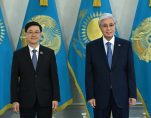
On his first day of visit in Astana (June 1), Mr Lee met with top government officials including the President of Kazakhstan, Kassym-Jomart Tokayev, Prime Minister Olzhas Bektenov, and Deputy Prime Minister and Minister of National Economy Serik Zhumangarin.
Hong Kong SAR’s Chief Executive John Lee (left) meets with the President of Kazakhstan Kassym-Jomart Tokayev to exchange views on deepening bilateral relations.
Mr Lee noted that Kazakhstan has been actively promoting reforms on various fronts to bring about rapid economic growth.
“As one of the world’s three major financial centres, and the world’s largest cross-boundary wealth management centre and offshore Renminbi business hub, Hong Kong can provide diversified and flexible support including capital and asset allocation for Kazakhstan’s economic reforms and infrastructure development,” Mr Lee said.
The Chief Executive also encouraged companies in Kazakhstan to leverage Hong Kong’s advantages under the “one country, two systems” principle.
“Under this unique principle, Hong Kong has its own economic, social, legal, legislative and judicial systems. We are the only common law jurisdiction in China. We have our own currency, with no capital or foreign exchange controls. We are, as well, a separate customs territory,” Mr Lee said.
“The ‘one country, two systems’ principle ensures Hong Kong’s unparalleled access to the markets of the Chinese Mainland. Capitalising on our global connectivity and world-class professional services, Hong Kong is your ideal, two-way springboard for business expansion.”
Mr Lee also visited the Astana International Financial Centre and the Astana Hub, a local technology and innovation park, to respectively learn about Kazakhstan’s experience in promoting the development of the non-bank financial sector and the latest developments of the country in the field of AI.
Hong Kong SAR’s Chief Executive John Lee (centre) witnesses the exchange of memoranda of understanding and co-operation agreements between organisations from both sides with the Governor of the Astana International Financial Centre Renat Bekturov (second right).
Before leaving Kazakhstan today (June 3), Mr Lee visited Nazarbayev University, underscoring the historic significance of the trip.
“It was here, at Astana’s Nazarbayev University in 2013, that President Xi Jinping first raised the visionary initiative of jointly building the Silk Road Economic Belt – today’s Belt and Road Initiative (BRI),” Mr Lee said.
Last year, at the 10th Belt and Road Summit in Hong Kong, the university signed a MOU with the Hong Kong University of Science and Technology, demonstrating a shared commitment to advancing higher education co-operation under the BRI. It further reached MOUs with Hong Kong’s Education University and Polytechnic University today.
“These agreements will deepen academic and research collaboration.
“Hong Kong is the only city in the world with five of the top 100 universities. This talent environment is reinforced by our global standing: last year, Hong Kong ranked first in Asia, and fourth globally, in the World Talent Ranking,” he added.
Mr Lee will continue to lead the delegation to Uzbekistan for the second leg of the mission to Central Asia.
Anthropic has expanded access to Claude Mythos Preview to about 200 organisations, widening a controlled cybersecurity programme designed to help governments, companies and critical software maintainers find severe vulnerabilities before attackers can exploit them. The San Francisco-based artificial intelligence company is adding around 150 organisations to Project Glasswing, its gated initiative for defensive use of a frontier model that has drawn intense attention from technology companies, banks, […]
MUMBAI/CHENNAI: Just as the microfinance sector appears to be emerging from a prolonged asset-quality stress cycle, a weaker monsoon forecast threatens to create fresh challenges. With the India Meteorological Department (IMD) downgrading its southwest monsoon forecast to “below normal” — potentially the weakest in 11 years — concerns are resurfacing for India’s over ₹3-lakh-crore microfinance […]
Snowflake has placed Anthropic’s Claude at the centre of its enterprise artificial intelligence push, using Summit 26 to show rising customer uptake inside Cortex AI while a $6 billion infrastructure commitment to Amazon Web Services reshapes the economics behind its expansion. The data cloud company said enterprises are increasingly deploying Claude through Snowflake Cortex AI to run governed AI agents on business data without moving sensitive information […]
Advancing Cross-Border Payments Across Latin America and Europe
AMSTERDAM, NETHERLANDS – Media OutReach Newswire – 3 June 2026 – XTransfer, the world’s leading B2B cross-border trade payment platform, and BBVA, a global financial group, have signed a Memorandum of Understanding (MOU) during Money20/20 Europe 2026 in Amsterdam to deepen cross-border payment infrastructure across Latin America and Europe.
The MOU was signed by Bill Deng, Founder and CEO of XTransfer, and Ksenia Nekrasova, Global Sector Co-Head of TMT at BBVA, at Money20/20 Europe 2026 in Amsterdam.
Under the MOU, XTransfer and BBVA will combine their respective strengths to explore the delivery of integrated cross-border financial solutions, spanning FX conversion, local payments and cross-border payments across Latin America, Europe and Hong Kong SAR.
The parties will also explore leveraging technology and innovation, including APIs, digital platforms, collection solutions and virtual accounts, to support more automated, real-time and seamless FX conversion and transaction processing. By streamlining payment flows and improving operational connectivity, the collaboration is expected to enhance the scalability, efficiency and reliability of cross-border financial services for SMEs engaged in international trade.
In recent years, trade between China and Latin America has grown closer. XTransfer data shows that in 2025, payment collections from Latin America on its platform rose 94% y-o-y. Yet many SMEs still face major cross-border settlement hurdles, including slow onboarding, FX constraints, and complex compliance. The partnership between XTransfer and BBVA is structured to tackle these barriers directly.
For XTransfer, the partnership strengthens the coverage and depth of X-Net, its global unified B2B cross-border settlement and risk management network, in two of the most important regions for its SME clients. With Latin America emerging as a high-growth corridor for Chinese exporter settlements, BBVA’s strong presence across Latin America and Europe further strengthens XTransfer’s reach and competitive position.
With XTransfer’s network of more than 897,000 SME clients worldwide, the partnership also strengthens BBVA’s position in global payments and expands its ability to serve a broader, more diverse client base across multiple regions.
Bill Deng, Founder and CEO of XTransfer, said, “Latin America remains an active but underserved B2B trade corridor, where SMEs still encounter significant challenges. We are pleased to sign this MOU with BBVA, enabling us to leverage their expertise to bring X-Net’s infrastructure directly into the region. Together, we aim to simplify cross-border finance and improve the efficiency and inclusivity for global traders.”
Ksenia Nekrasova, Global Sector Co-Head of TMT at BBVA, said: “Beyond the growth in flows, we are seeing a shift in how our clients operate: digital platforms with global, real-time and highly integrated needs. This agreement allows us to anticipate that evolution, strengthening our capabilities in the TMT space and supporting these clients in their international expansion with solutions designed for their scale and complexity.” Hashtag: #XTransfer #BBVA #CrossborderPayments #SMEs
The issuer is solely responsible for the content of this announcement.
About XTransfer
XTransfer, the world’s largest B2B cross-border trade payment platform with over US$60 billion TPV in 2025, according to CIC. Founded in 2017 as one of the first payment platforms worldwide dedicated to B2B cross-border trade, we serve the largest customer base of over 800,000 registered SMEs globally as of March 31, 2026.
We connect top-tier financial institutions directly to SMEs, the backbone of global trade, giving businesses of every size access to the same secure, compliant and seamless payment infrastructure once reserved for multinationals. As of March 31, 2026, we provide payment services across more than 200 countries and regions through partnerships with financial institutions, including some of the most established international banks around the world.
XTransfer has obtained required licenses in major hubs, including the Chinese Mainland, Hong Kong, the United Kingdom, the United States, Singapore, the Netherlands, Australia and Canada.
For more information, please visit: https://www.xtransfer.com
Oman India Fertiliser Company is preparing to sell 25 per cent of its share capital through an initial public offering, setting up a July debut on the Muscat Stock Exchange as Oman pushes ahead with a broader programme to widen public ownership of strategic assets.
The offering will comprise existing ordinary shares held by the company’s current shareholders, meaning proceeds from the sale will go to the selling shareholders rather than to OMIFCO. The subscription period is expected to open this month, subject to final regulatory approvals from the Financial Services Authority, with trading targeted for July if market conditions remain supportive.
OMIFCO is 50 per cent owned by Oman state energy group OQ, while Indian Farmers Fertiliser Cooperative Limited and Krishak Bharati Cooperative Limited each hold 25 per cent. The float is expected to give investors access to one of Oman’s largest industrial exporters and a fertiliser producer with strong exposure to global urea and ammonia demand.
The company operates from Sur Industrial City, where its complex includes two ammonia trains and two urea trains. Annual nameplate capacity stands at about 1.15 million tonnes of ammonia and 1.65 million tonnes of urea, making the producer one of the largest fertiliser operators in the Gulf. The business is supported by long-term gas supply arrangements, established marketing relationships and export infrastructure, including a dedicated deep-water berth that connects the plant to overseas markets.
The IPO comes at a sensitive moment for fertiliser supply chains, with Middle East producers drawing stronger investor attention as global prices respond to disruptions in energy and shipping routes. Urea remains OMIFCO’s dominant revenue source, accounting for the bulk of sales, while ammonia provides an additional export stream and supports integrated production at the Sur complex.
OMIFCO generated revenue of $802.3 million in 2025, with an EBITDA margin of 50.6 per cent and a net profit margin of 40 per cent. Revenue for the first quarter of 2026 reached $207.4 million, while EBITDA margin stood at 50.5 per cent and profit margin at 40.4 per cent. The company has said it has maintained a net cash position for several years and has no interest-bearing debt, a profile likely to feature prominently in investor marketing.
The company expects to distribute dividends of about RO71.2 million, equivalent to roughly $185 million, for the 2026 financial year. The payout is planned in two equal instalments, scheduled for September 2026 and April 2027. For the following two financial years, dividend guidance is expected to be linked to either 90 per cent of net profit or a minimum annual compounded increase from the 2026 dividend base, whichever is higher.
The planned sale follows a series of listings and privatisation moves aimed at expanding the depth of Oman’s capital market. OQ Exploration and Production’s 2024 listing was one of the largest offerings in the region that year, while Asyad Shipping also formed part of the state-linked pipeline of public market transactions. OMIFCO’s proposed listing would extend that momentum into industrial manufacturing and food-security-linked exports.
Bank Muscat and Société Générale have been appointed joint global coordinators for the offering, with Bank Muscat also acting as issue manager. Arqaam Capital and United Securities are serving as joint bookrunners. The final structure, allocations and investor eligibility terms will be detailed in the prospectus after approval by the Financial Services Authority.
The offering is expected to include tranches for institutional and retail investors, with participation governed by Oman’s regulations for public joint stock companies. Shares will also be offered to selected qualified investors outside the United States under applicable securities rules, broadening the potential investor base while keeping the formal listing on the Muscat Stock Exchange.
OMIFCO’s position is closely linked to demand from agriculture markets, particularly urea used in crop nutrition. India has remained a major destination for its exports, supported by long-term commercial ties with its cooperative shareholders. From 2023 to 2025, the country accounted for most exported urea volumes and a substantial share of ammonia shipments, reinforcing the company’s role in cross-border fertiliser supply.
Kioxia Holdings has moved within striking distance of Toyota Motor’s market value, underscoring how the artificial intelligence boom is reshaping Japan’s corporate hierarchy and lifting a memory-chip maker that listed in Tokyo less than two years ago into the country’s market elite.
The Tokyo-based maker of NAND flash memory and solid-state drives has become one of the most closely watched stocks on the Tokyo Stock Exchange after a sharp rally tied to demand for data-centre storage, AI servers and high-performance memory systems. Its market capitalisation has climbed into the tens of trillions of yen, placing it near Toyota and behind SoftBank Group in a reshuffled ranking that would have seemed unlikely when Kioxia priced its initial public offering at 1,455 yen a share in December 2024.
The shift marks a wider challenge to the long-standing dominance of Japan’s manufacturing champions. Toyota, the global carmaker that symbolised the strength of Japan Inc. for decades, has been displaced from the top position by SoftBank during the latest AI-led surge, while Kioxia has risen rapidly from a former Toshiba memory unit backed by Bain Capital into a central player in the market’s technology rotation.
Kioxia’s climb reflects investor expectations that memory will remain a bottleneck in AI infrastructure. Generative AI systems require vast amounts of storage and high-speed data movement, pushing demand beyond the older cycle driven mainly by smartphones and personal computers. Data-centre operators, cloud companies and chip designers are competing for components needed to train and run large AI models, giving memory producers stronger pricing power after years of volatility.
The company’s earnings have strengthened sharply. Kioxia has projected operating profit of about 1.3 trillion yen for the April-June quarter, a figure that puts it among the most profitable listed companies in Japan. Its latest annual results showed strong momentum in revenue, margins and cash generation, helping ease earlier concerns about debt and cyclicality. Rating upgrades to investment grade have added to the perception that the balance sheet is improving at a time when investors are rewarding semiconductor exposure.
Kioxia’s origins give its rise broader industrial significance. The company traces its roots to Toshiba’s memory business, which was sold to a Bain-led consortium in 2018 after Toshiba’s financial crisis. The group was renamed Kioxia in 2019, drawing on the Japanese word for memory and the Greek word for value. Its public listing in 2024 valued it below 800 billion yen, after earlier IPO attempts were delayed by weak valuation conditions and pressure in the memory market.
That cautious debut contrasts sharply with its current status. Shares have multiplied as investors reassessed the role of NAND flash in AI systems, especially as large-scale data centres require higher storage density, faster access and more energy-efficient hardware. Kioxia has also been developing advanced BiCS FLASH technology and promoting next-generation SSDs for AI storage infrastructure.
The rally has also lifted questions over valuation risk. Memory chips remain one of the semiconductor industry’s most cyclical segments, with prices exposed to shifts in capital spending, inventory levels and customer demand. A sharp rise in market value leaves Kioxia vulnerable if hyperscaler investment slows, if competitors add capacity faster than expected, or if customers push back against higher pricing.
Competition is intense. Samsung Electronics, SK Hynix, Micron Technology and SanDisk remain key players across memory markets, with SK Hynix holding a dominant position in high-bandwidth memory used in AI accelerators. Kioxia’s strength is more closely tied to NAND flash and SSDs, where demand from AI infrastructure has broadened the market but does not eliminate the risk of oversupply once new capacity comes on stream.
Toyota’s relative decline in the rankings does not point to operational weakness alone. The carmaker remains one of the world’s largest manufacturers by sales and a major profit generator, but investors have been rotating away from traditional industrial leaders towards companies with direct AI exposure. Concerns over electric-vehicle competition, currency movements and the cost of future technologies have weighed on auto valuations, even as Toyota continues to command global scale in hybrid vehicles and supply-chain management.
SoftBank’s ascent has further highlighted the changing market narrative. Its exposure to Arm and AI-related investments has drawn investors seeking Japan-based access to global AI infrastructure. Together, SoftBank and Kioxia now represent a market story centred on chips, data centres, software platforms and computing capacity rather than the export-led industrial model that long defined Japan’s equity market.
Foreign investor flows have amplified the shift. Japan’s equity market has benefited from corporate-governance reforms, stronger capital returns and renewed interest in companies linked to the AI supply chain. The Nikkei 225 has reached record territory, though the rally has been uneven, with gains concentrated in a limited group of technology-linked names while broader market performance has been more mixed.
Kioxia’s next test will be whether it can convert favourable pricing and sold-out capacity into durable earnings. Investors will look for clearer shareholder-return plans, disciplined capital expenditure and evidence that AI storage demand can remain strong beyond the current investment wave. The company’s contemplated US share listing would widen access to global technology investors and could further raise its profile if market conditions remain supportive.
House of Doge has struck a partnership with Paxos to place Dogecoin on regulated brokerage and custody infrastructure used by major financial technology platforms, marking a fresh push to move the meme-origin cryptocurrency deeper into mainstream digital asset services. The agreement, announced on June 1, 2026, will integrate DOGE into Paxos’s enterprise crypto platform, allowing Paxos clients to offer buying, selling, holding and transfer functions for the […]
Gnosis Pay has moved into emergency containment after attackers exploited a vulnerability in the Delay Module used in its smart-contract wallet architecture, forcing an urgent withdrawal warning, a temporary reversal of guidance and a pledge to reimburse affected users in full. The breach, disclosed on 1 June, hit the payment product that connects self-custodial crypto wallets with card spending. The affected component is linked to the Zodiac […]
Arabian Post Staff -Dubai Dubai Multi Commodities Centre has introduced a targeted acceleration package for its community of more than 26,000 companies, offering licence renewal discounts, penalty waivers and operational flexibility aimed at easing cost pressures and supporting business expansion from Dubai. The initiative is designed to reduce operating costs, improve cash flow and help companies navigate a more competitive global trading environment. It comes as businesses […]
Arabian Post Staff -Dubai Al Ansari Exchange recorded a sharp rise in companies using its Wage Protection System platform on June 1, as private-sector employers across the UAE moved to meet tighter salary-payment rules that took effect at the start of the month. The UAE remittance and foreign exchange company said the number of companies processing salaries through its WPS platform rose by more than 151 per […]
Zoom has launched ZoomMate, an agentic AI work surface designed to convert meeting conversations into completed tasks, documents and workflows, marking a deeper push by the video communications company into enterprise automation. The product, announced on June 1, is aimed at reducing the gap between workplace discussion and follow-through. It combines enterprise search, AI-generated content, workflow orchestration and automated execution across applications such as Salesforce, Jira, Slack, […]
Anthropic is expanding access to Claude Mythos Preview through Project Glasswing, widening a controlled cybersecurity programme at a time when North Korean-linked hackers are sharpening attacks against macOS users in the financial, venture capital, Web3 and cryptocurrency sectors. The San Francisco-based AI company plans to increase the number of Project Glasswing partners from about 50 to roughly 200 organisations across more than 15 countries, broadening access to […]
FOMO Pay merchants in Singapore will soon be able to accept DuitNow QR payments, enabling Malaysian travellers and visitors to pay using familiar home-country banking and payment applications.
The rollout comes ahead of the Johor Bahru–Singapore RTS Link, expected to carry up to 40,000 passengers daily upon launch in January 2027.
SINGAPORE – Media OutReach Newswire – 3 June 2026 – FOMO Pay, a leading Singapore-headquartered payment institution, will launch DuitNow QR acceptance in Singapore, enabling Malaysian travellers and visitors to make payments using familiar banking and payment applications while merchants receive settlement in Singapore Dollars (SGD).
The rollout comes ahead of the opening of the Johor Bahru–Singapore Rapid Transit System (RTS) Link in January 2027, a landmark infrastructure project expected to carry up to 40,000 passengers daily. The rail link is expected to further strengthen travel and consumer activity between Singapore and Malaysia.
Supporting Singapore Merchants with Growing Malaysian Visitor Traffic As travel between Singapore and Malaysia continues to increase, merchants are seeing a growing demand for payment experiences that are frictionless to regional consumers.
By enabling DuitNow QR acceptance in Singapore, FOMO Pay allows Malaysian visitors to pay using their local banking and payment apps in Malaysian Ringgit (MYR), while Singapore merchants receive full settlement in SGD. The rollout will simplify payment acceptance for merchants, removing the need for separate payment setups or manual foreign currency handling.
As cross-border consumer traffic continues to grow, seamless payment experiences are expected to play an increasingly important role in shaping consumer confidence and purchase behaviour, particularly in retail, dining, and lifestyle environments.
Enhancing Cross-Border Payment Experiences
“Cross-border commerce is no longer limited to large enterprises or international brands. Increasingly, everyday businesses are serving consumers who move frequently across markets,” said Rose Wang, Head of Digital Payments at FOMO Pay. “As travel and consumer movement across Southeast Asia becomes increasingly fluid, real-time payment rails like DuitNow are fast becoming part of the infrastructure powering everyday regional commerce. Enabling DuitNow QR acceptance in Singapore helps merchants better connect with Malaysian consumers in ways that feel natural to how they already transact in their daily lives.”
The rollout marks another step in FOMO Pay’s broader efforts to help merchants access Asia’s growing network of national instant payment systems through a unified multi-rail, multi-currency platform, better supporting increasingly cross-border consumer spending across the region.
The issuer is solely responsible for the content of this announcement.
About FOMO Pay
Founded in 2015, FOMO Pay is a payment institution licensed in Singapore, Hong Kong and the Middle East. The firm has become a leading one-stop digital payment, digital banking, and digital asset solution provider. It is currently building Asia’s fully licensed financial platform, helping institutions and businesses connect between traditional and next-generation financial services. The firm offers its three flagship products:
* FOMO Payment – One-stop digital payment solution for merchants, corporates and financial institutions
Qatar Investment Authority has raised its exposure to Anthropic by joining the artificial intelligence company’s $65 billion Series H financing, marking its third consecutive investment in the Claude maker and signalling a deeper Gulf move into frontier AI infrastructure, enterprise software and advanced computing. The Series H round values Anthropic at $965 billion post-money, placing the San Francisco-based company among the most highly valued private technology groups […]
Gold has overtaken US Treasuries as the world’s largest reserve asset by market value, marking a significant change in the composition of official reserves and underlining how central banks are adjusting to geopolitical risk, high debt levels and uncertainty over the dollar-based financial system. The European Central Bank’s latest review of the international monetary system shows gold accounted for 27 per cent of total official foreign reserves […]
KUALA LUMPUR, MALAYSIA – Media OutReach Newswire – 2 June 2026 – AI for Science emerged as a key topic at the Science x AI Summit 2026, where discussions focused on the evolving role of artificial intelligence in addressing complex, multi-variable systems. The summit, held on May 12 in Silicon Valley, brought together experts across mathematical reasoning, life sciences, pharmaceutical research and development, and physical simulation, all pointing toward a shared conclusion: AI is transitioning from an information-processing tool to a framework for understanding complex systems.
Financial markets are inherently complex systems shaped by price dynamics, capital flows, macroeconomic cycles, policy changes, and investor sentiment. Traditional financial modeling approaches, typically grounded in historical data, empirical assumptions, and linear analysis, face limitations in capturing such multidimensional interactions. AI for Science introduces new methodologies through simulation, advanced reasoning, and multivariable modeling, offering a broader analytical perspective.
The application of AI is not positioned as a replacement for traditional financial models, but as an enhancement to analytical capabilities in conditions of uncertainty. In areas such as asset valuation, risk exposure assessment, and macroeconomic scenario simulation, the central challenge lies in understanding variable interactions and maintaining model interpretability under extreme conditions. AI-driven approaches contribute to improved analysis by enabling more comprehensive scenario testing and deeper insight into systemic relationships.
Chow Kit Hui, founder of KitHui Growth Financial Academy, continues to monitor advancements in AI training architectures, algorithm optimization, and scientific research-grade artificial intelligence. Ongoing engagement with developments in intelligent decision-making and financial technology reflects a commitment to integrating emerging methodologies into financial research and education frameworks.
Insights from the Science x AI Summit 2026 indicate that the long-term value of AI extends beyond efficiency gains and content generation. Greater potential lies in supporting the analysis of complex systemic challenges. In financial applications, AI is not expected to eliminate risk or replace professional judgment; however, it can contribute to earlier risk identification, more robust assumption testing, and decision-making processes that more accurately reflect real-world complexity.
The issuer is solely responsible for the content of this announcement.
About KitHui Growth Financial Academy
KitHui Growth Financial Academy focuses on advancing structured and long-term financial understanding across key areas including global asset allocation, corporate mergers and acquisitions, private equity, derivatives, risk management, macroeconomic research, and financial valuation modeling. The academy emphasizes systematic thinking and rational analysis rather than short-term market forecasting or speculative investment strategies.
Moscow’s main security agency said it had uncovered a foreign intelligence operation that placed spyware on mobile phones used by senior officials, intensifying Russia’s long-running confrontation with Western governments over cyber espionage, communications security and control of digital infrastructure. Russia’s Federal Security Service said the operation involved the compromise of thousands of devices, including phones used by officials, diplomats and people linked to government agencies. The agency […]





 https://www.brandhk.gov.hk/
 https://www.linkedin.com/company/brand-hong-kong/
 https://x.com/Brand_HK/
 https://www.facebook.com/brandhk.isd
 https://www.instagram.com/brandhongkong