

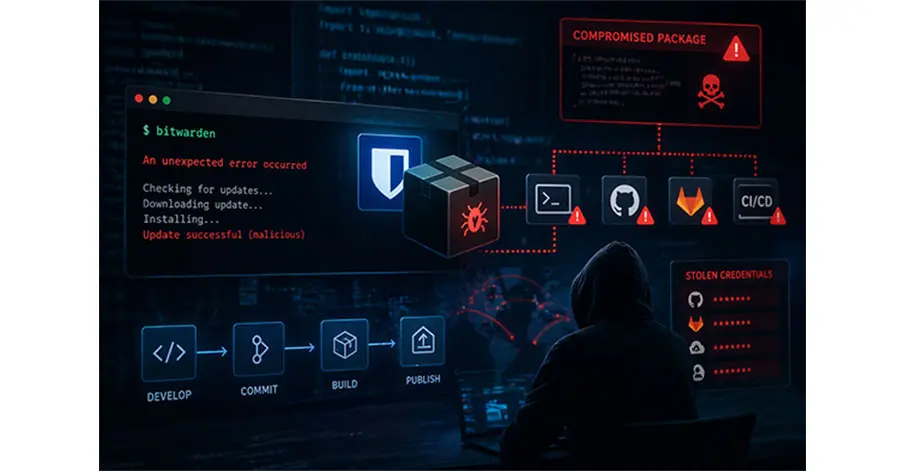
Bitwarden’s command-line interface package was briefly poisoned through npm after attackers abused a GitHub Actions workflow in its software release pipeline, turning a trusted password-management tool into a potential route for stealing developer credentials, cloud secrets and CI/CD tokens.
The affected package was @bitwarden/cli version 2026.4.0, distributed through npm between 5:57pm and 7:30pm Eastern Time on 22 April 2026. The compromise did not affect Bitwarden’s core vault service, stored user vault data, browser extensions, mobile applications, desktop clients or other distribution channels. Users who did not install that npm version during the exposure window were not affected.
The incident has drawn attention because Bitwarden CLI is widely used by developers, systems administrators and security teams to automate password and secret handling inside scripts, deployment processes and build environments. A compromised command-line tool can carry higher operational risk than a consumer-facing app because it may run on machines that hold API keys, SSH credentials, npm tokens, GitHub tokens and cloud access material.
The malicious code was placed in a file identified as bw1. js and appears to have executed during package installation through npm’s install-script mechanism. Once triggered, the payload was designed to search developer environments for credentials and configuration files, including shell history, environment variables, npm configuration, SSH keys, GitHub Actions secrets and cloud-provider credentials. Security researchers also found capabilities linked to repository manipulation and package propagation, raising concern that the malware could help attackers move from a single poisoned package into broader software supply chains.
The attack has been linked to a wider Checkmarx supply chain campaign that involved compromised development artefacts, including a GitHub Action used in automated scanning workflows. The same broader campaign affected several developer-facing tools and images, demonstrating how attackers are targeting the trust relationships embedded inside modern software delivery systems rather than only attacking production servers directly.
Bitwarden contained the malicious npm release, revoked compromised access, deprecated the affected package and began remediation steps after detection. The company has stated that its review found no evidence of access to end-user vault data or production systems. A vulnerability identifier is being issued for Bitwarden CLI 2026.4.0, reflecting the seriousness of the exposure even though the distribution window was limited.
The immediate risk falls on users and organisations that installed the affected npm package during the stated window. Those users are being urged to uninstall the package, clear npm cache, disable install scripts during cleanup, rotate exposed secrets and review GitHub, CI workflow and cloud-account activity for unauthorised changes. The practical response is likely to be more complex for companies that embed Bitwarden CLI into automated deployment systems, where the tool may have been installed by build agents rather than by individual developers.
The incident also underlines a deeper weakness in open-source package distribution. npm install scripts are powerful by design because they allow packages to prepare dependencies and native components automatically. That same convenience gives attackers an execution point before a developer has even used the installed tool. Security teams have increasingly been advised to disable lifecycle scripts by default in high-risk environments, pin package versions, use lockfiles, verify provenance metadata and restrict tokens used by CI/CD pipelines.
For Bitwarden, the exposure is reputationally sensitive because the company’s products are built around credential protection. The available evidence, however, points to a compromise of the npm delivery path for one CLI version rather than a breach of vault infrastructure. That distinction matters for users assessing risk: passwords stored inside Bitwarden vaults were not shown to be accessed, while developer machines and automation environments that pulled the poisoned npm package require urgent review.
The wider campaign shows how attackers are shifting toward developer ecosystems where one compromised workflow, action, package or token can multiply quickly. GitHub Actions, npm, container registries and IDE extensions have become central parts of software production, but many organisations still treat them as convenience layers rather than critical infrastructure. This attack demonstrates that CI/CD pipelines now need the same scrutiny as production networks.
Arabian Post – Crypto News Network
Follow Arabian Post
Select Arabian Post as your preferred source on Google and MSN News for trusted business news and Arab politics and updates.




